


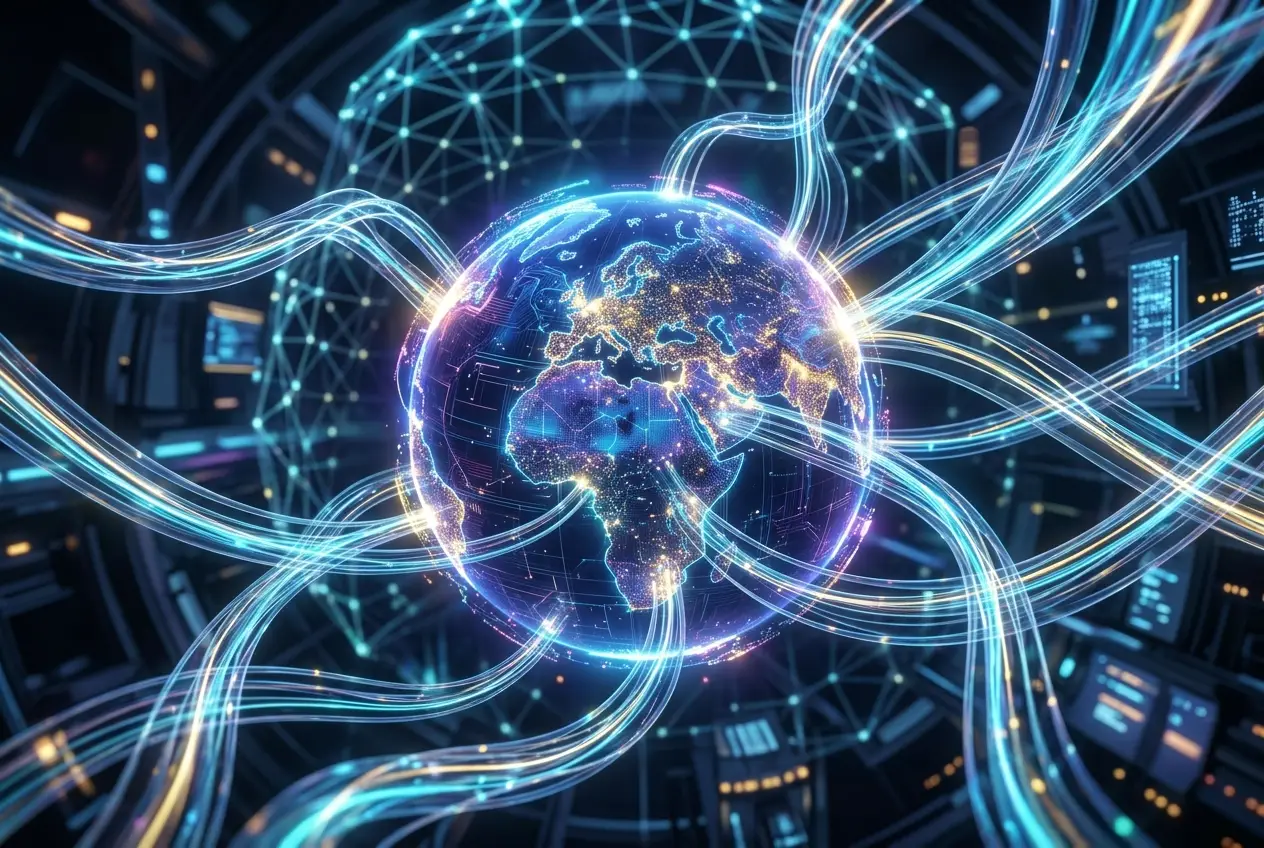
Imagine sending a message across the world, not as an electrical pulse, but as a beam of pure light, traveling at nearly the speed of light itself. It sounds like something out of science fiction, doesn’t it? Yet, this is precisely what happens every single time you stream a movie, make a video call, or even just browse a webpage. The magic behind this seemingly instantaneous global communication is fiber optics. I often find myself marveling at how something so fundamental to our daily lives operates with such incredible sophistication, yet remains largely invisible to us.
For years, I've seen these glass threads touted as the backbone of the internet, but I wondered, how exactly does light manage to carry all our complex digital data across continents without spilling out or getting lost? It's a question that delves into the fascinating world where physics meets engineering. Let's peel back the layers and understand the ingenious principles that allow your data to travel at light speed.
The Unsung Hero: What Exactly is Fiber Optics?
At its core, a fiber optic cable is an incredibly thin strand of glass or plastic, roughly the diameter of a human hair. Unlike traditional copper cables that transmit data as electrical signals, fiber optic cables transmit data as pulses of light. This fundamental difference is what unlocks their extraordinary speed and capacity. Instead of electrons struggling through resistance, we have photons, light particles, dancing their way through super-transparent pathways. This isn’t just a faster way; it’s a completely different paradigm for how information moves. For a broader look at how our data already crosses continents, I encourage you to check out our previous discussion on the topic: How Does Your Data Instantly Cross Continents? (opens in a new tab).
Components of a Fiber Optic Cable
A typical fiber optic cable isn't just one strand; it's a carefully engineered structure designed to protect the delicate glass fiber and ensure optimal light transmission. I find it amazing how much thought goes into something so simple in concept.
- Core: This is the central, super-thin glass or plastic strand where the light actually travels. It’s essentially a tiny, perfectly clear highway for photons.
- Cladding: Encasing the core is another layer of glass or plastic with a slightly different refractive index. This critical difference is what traps the light within the core, preventing it from escaping.
- Buffer Coating: An outer plastic layer that protects the delicate core and cladding from damage and moisture. Think of it as the cable's protective armor.
The Magic Trick: Total Internal Reflection
The real secret sauce behind fiber optics lies in a phenomenon called Total Internal Reflection (TIR). I remember learning about this in physics class and being absolutely captivated. Imagine shining a flashlight into a swimming pool from underwater. If you point it straight up, the light goes out. But if you start angling the flashlight, there's a point where the light doesn't exit the water anymore; it reflects back into the water as if the surface were a mirror. That's TIR in action.
In a fiber optic cable, the core and cladding are designed so that any light entering the core at a certain angle hits the boundary between the core and cladding and is totally reflected back into the core, rather than refracting out. This means the light bounces along the entire length of the fiber, no matter how long it is, without escaping. It's like a never-ending series of mirrors guiding the light forward. You can read more about this fascinating optical principle on Wikipedia's Total Internal Reflection page (opens in a new tab).
Single-Mode vs. Multi-Mode: Not All Fibers Are Equal
While the basic principle is the same, not all fiber optic cables are created equal. I often get asked why some connections are faster than others, and the type of fiber is a huge part of the answer.
| Feature | Single-Mode Fiber (SMF) | Multi-Mode Fiber (MMF) |
|---|---|---|
| Core Diameter | Very small (8-10 micrometers) | Larger (50 or 62.5 micrometers) |
| Light Source | Laser | LED or Vertical-Cavity Surface-Emitting Laser (VCSEL) |
| Wavelength | Longer (1310 nm, 1550 nm) | Shorter (850 nm, 1300 nm) |
| Distance | Very long distances (up to hundreds of kilometers) | Shorter distances (up to a few kilometers) |
| Bandwidth | Extremely high (Terabits per second) | Lower than SMF (Gigabits per second), but still very high |
| Applications | Long-haul networks, internet backbone, transoceanic cables | Local area networks (LANs), data centers, shorter enterprise links |
Single-mode fiber, with its tiny core, allows only one path for light, minimizing signal distortion and enabling incredible distances and speeds. This is why your international internet traffic moves so swiftly. For similar explorations into the speed of light in computing, you might find our blog on Is Light Our Universe's Fastest Computer? (opens in a new tab) quite illuminating.
From Electrons to Photons: How Data Travels
So, how does your digital data – a stream of ones and zeros – get converted into light?
- The Transmitter: When you send data (e.g., uploading a photo), an electrical signal representing those ones and zeros is fed into a transmitter. This transmitter contains a tiny laser diode or a Light-Emitting Diode (LED). Lasers are preferred for their precision and speed, especially for single-mode fiber. For more on laser diodes, see Wikipedia's Laser Diode page (opens in a new tab).
- Electrical to Optical Conversion: The electrical pulses cause the laser or LED to rapidly turn on and off, emitting corresponding pulses of light. A "one" might be a flash of light, and a "zero" the absence of light.
- The Journey: These light pulses are then injected into the fiber optic cable's core. Thanks to total internal reflection, they zip along the fiber, bouncing off the cladding boundaries, traveling at nearly the speed of light. Modern systems often use a technique called Wavelength-Division Multiplexing (WDM), which allows multiple streams of light, each at a different color (wavelength), to travel simultaneously down a single fiber. This is like turning a one-lane highway into a multi-lane superhighway, dramatically increasing the data capacity. Learn more on Wikipedia's Wavelength-Division Multiplexing page (opens in a new tab).
- The Receiver: At the other end, a photodetector, typically a photodiode, senses the incoming light pulses. When light hits the photodiode, it converts it back into an electrical signal. This signal reproduces the original stream of ones and zeros. See Wikipedia's Photodiode page (opens in a new tab).
- Optical to Electrical Conversion: Finally, this electrical signal is passed on to your device, allowing you to see the photo, hear the call, or load the webpage.
Why Fiber Optics Reigns Supreme
Fiber optics isn't just a niche technology; it’s the king of modern data transmission. Here’s why, and why it directly impacts your daily experience:
- Blazing Speed: Light travels faster than electricity in a wire. This is why you can download large files or stream high-definition content with minimal buffering. This is why your 4K Netflix streams flawlessly and your online gaming has lower latency.
- Massive Bandwidth: Fiber can carry far more data than copper cables. The ability to send multiple light signals (colors) down a single fiber multiplies its capacity. This means an entire neighborhood can have fast internet from a single fiber without congestion.
- Longer Distances: Light signals in fiber can travel much further without needing regeneration or amplification compared to electrical signals in copper. This is crucial for connecting cities and continents.
- Immunity to Interference: Electrical signals in copper are susceptible to electromagnetic interference (EMI) from other devices or power lines. Fiber optics, using light, is completely immune to EMI, leading to clearer, more reliable signals. This is why your internet connection doesn't drop when your microwave is on.
- Enhanced Security: It's much harder to "tap" into a fiber optic cable without disrupting the light signal, making it inherently more secure for sensitive data transmission.
- Durability and Longevity: While the glass strands are delicate, the overall cables are robust and resistant to temperature fluctuations and corrosion, often outlasting copper infrastructure.
Fiber vs. Copper: A Visual Comparison
The Road Ahead: The Future is Luminous
While fiber optics has already revolutionized our world, its journey isn't over. Researchers are constantly pushing the boundaries, exploring new ways to harness light for even greater speeds and capabilities. We're looking at things like hollow-core fibers that reduce latency even further, and integrating optical components directly into computer chips for faster processing. The concept of using light for computation itself is a fascinating field; imagine an internet built on quantum principles. Our blog, Can Light Trapped in Crystals Build Quantum Internet? (opens in a new tab), explores some of these exciting possibilities.
Fiber optics isn't just a technology; it's the nervous system of our global digital age, silently facilitating nearly every digital interaction we have. I believe understanding how this intricate system works truly deepens our appreciation for the modern world. So, the next time you effortlessly stream a video or connect with someone thousands of miles away, remember the invisible beams of light working tirelessly beneath the surface, making it all possible.




Conversation0
No comments yet. Be the first to share a thought — the best questions often become new stories.