


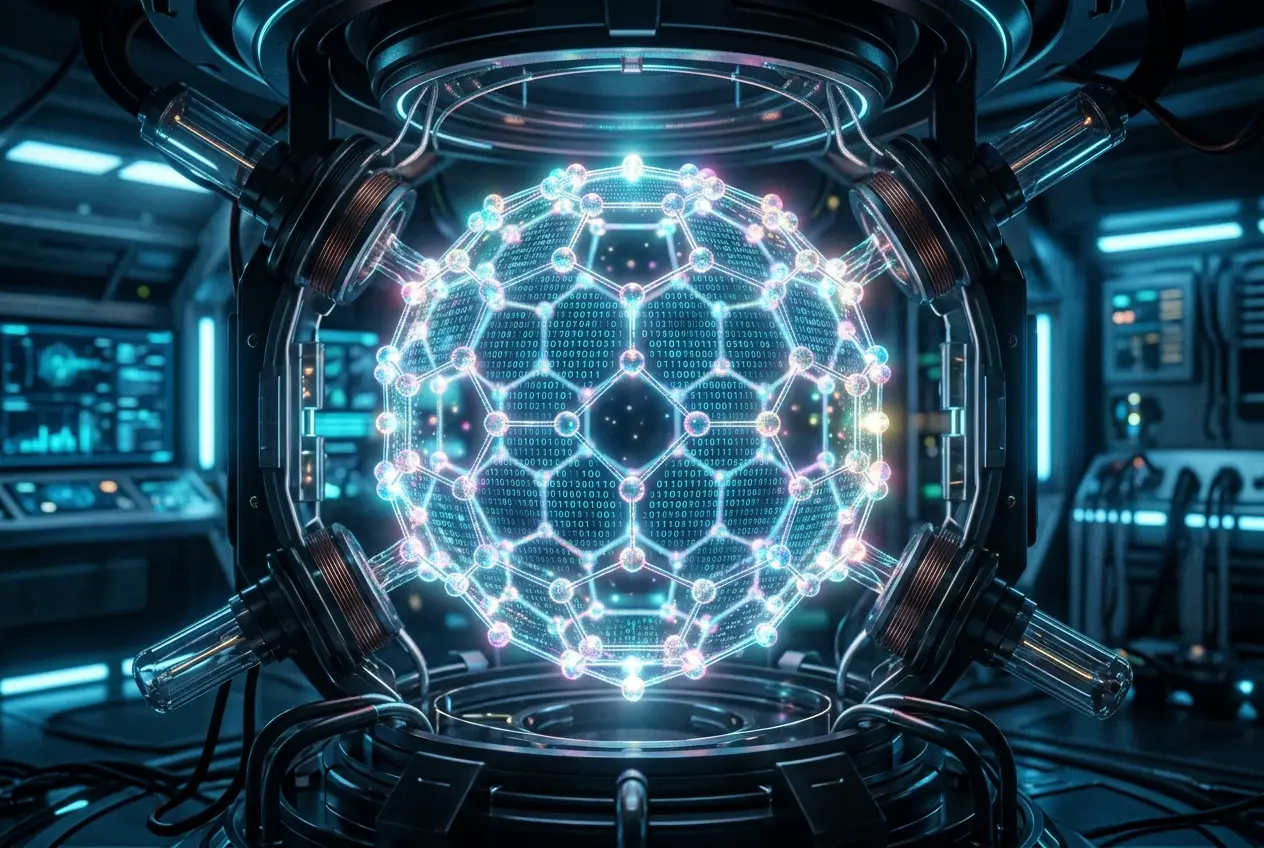
The sheer volume of digital data generated globally is staggering. Every minute, we upload hundreds of hours of video, send millions of emails, and process countless transactions. This ever-growing mountain of information, from personal memories to scientific breakthroughs and the operating systems of entire civilizations, demands increasingly efficient and durable storage solutions. Our current technologies, primarily based on silicon and magnetic media, are rapidly approaching their fundamental physical limits. I often find myself pondering: what happens when terabytes turn into zettabytes, and zettabytes into something unimaginable? Where will we store it all?
For years, engineers have chased Moore's Law, shrinking transistors and packing more data onto smaller chips. But the laws of physics are immutable, and we're bumping against atomic scales. This challenge isn't just about capacity; it's about energy consumption, speed, and the sheer physical space required for server farms that consume entire landscapes. This is where the realm of "extreme matter" enters the conversation – a frontier where the properties of materials, often under conditions far removed from our everyday experience, could revolutionize how we perceive and manage information.
Scientists and engineers are now looking beyond conventional materials, exploring the bizarre and wonderful properties of matter pushed to its limits. Think materials at absolute zero, under immense pressure, or with quantum states so fragile they defy common sense. These are not mere academic curiosities; I believe they hold the key to unlocking the next generation of data storage, potentially allowing us to store the entirety of human knowledge in something the size of a sugar cube.
The Impending Data Deluge: Why We Need a Solution
Let's put the data crisis into perspective. Every day, an estimated 2.5 quintillion bytes of data are created. By 2025, the global datasphere is projected to reach 175 zettabytes (that's 175 with 21 zeros after it!). Much of this is "cold data" – information that needs to be archived for long periods but isn't accessed frequently. Current magnetic tapes and hard drives have limitations in terms of lifespan, access speed, and physical footprint. Optical storage like Blu-rays offers better longevity but limited capacity and speed.
The implications of this data tsunami are profound. From preserving cultural heritage to enabling advanced AI and facilitating deep space exploration, our ability to store, access, and process information underpins almost every aspect of modern society. If we can't keep pace, the very foundations of our digital world could crumble, leading to information loss, slower technological progress, and economic bottlenecks. We need a paradigm shift, and many researchers are finding it in the most unlikely places: materials that behave in truly extreme ways.
Metallic Hydrogen: The Universe's Ultimate Storage Medium?
One of the most tantalizing prospects for ultra-dense data storage is metallic hydrogen. For decades, it existed purely as a theoretical state, believed to form under pressures found deep within gas giants like Jupiter. Imagine hydrogen, the simplest and most abundant element in the universe, transformed from a gas into a solid metal that conducts electricity with zero resistance, potentially even at room temperature. The quest to synthesize it in the lab has been one of the holy grails of high-pressure physics.
In 2017, Harvard scientists claimed to have created metallic hydrogen in a laboratory setting, applying pressures greater than those at the center of the Earth to a tiny sample of hydrogen gas, cooled to near absolute zero. While the claims are still debated due to the difficulty of replication, the implications are staggering. If stable, metallic hydrogen could be a room-temperature superconductor, revolutionizing energy transmission. But for data storage, its potential density is what truly captivates me.
Because it's made of the smallest atom, metallic hydrogen would be incredibly dense. Each atom could potentially store a bit of information. This isn't just about packing more atoms together; it's about the unique quantum properties of a metallic hydrogen lattice. Some theorize that its crystalline structure could be engineered to hold information in incredibly stable, high-density configurations, far exceeding anything we currently possess. Imagine the data density if we could harness even a fraction of that potential! For more on extreme materials and energy, you might be interested in our blog post on Metallic Hydrogen: Can it Unlock Unlimited Power?.
Beyond Silicon: Quantum Dots and Topological Materials
While metallic hydrogen remains largely theoretical in its stable form, other forms of extreme matter are closer to practical application.
-
Quantum Dots: These are semiconductor nanocrystals so tiny that their quantum mechanical properties become dominant. When excited, they emit light of specific wavelengths, tunable by their size. Their ability to exist in multiple quantum states (superposition) means a single quantum dot could potentially encode far more information than a classical bit. Beyond just storage, they are critical components in quantum computing. We've explored the amazing potential of single-atom storage in a previous article, Can a Single Atom Store All Our Data?, which touches on similar principles.
-
Topological Insulators: These are exotic materials that act as insulators in their bulk but conduct electricity perfectly on their surface or edges. What makes them "topological" is that these conducting surface states are protected by fundamental symmetries, meaning they are incredibly robust against defects and impurities. This robustness is a game-changer for data storage. Information encoded in these protected states would be far less susceptible to environmental interference, offering unprecedented data integrity and longevity. Imagine data that lasts for millennia without degradation! Learn more about these fascinating states of matter on their Wikipedia page (opens in a new tab).
These materials aren't just about cramming more bits into a smaller space; they're about redefining what a "bit" even is. In the quantum realm, information isn't just 0 or 1; it can be both simultaneously, or somewhere in between.
The Promise of Phase-Change Materials and Beyond
Another exciting area is the development of phase-change materials. These substances can rapidly switch between different states (e.g., amorphous and crystalline) when heated or cooled. Each state has distinct electrical or optical properties, allowing them to store data. While already used in some optical discs, researchers are pushing their limits, making them faster, more durable, and capable of storing multiple bits per cell. The material vanadium dioxide, for example, can switch between insulating and metallic states at room temperature, offering a platform for non-volatile, high-speed memory.
Beyond these, I'm fascinated by the theoretical possibilities of manipulating fundamental forces for data storage. Imagine micro-scale black holes, where the information density approaches the theoretical maximum, as discussed in the concept of the Holographic principle (opens in a new tab) in physics. While purely speculative and currently impossible to achieve, it highlights the extreme end of what physics permits for information packing. More practically, the manipulation of individual atoms, as demonstrated by IBM's "The World's Smallest Movie" where individual atoms were moved to create frames, shows a direct path towards atomic-scale data storage.
| Technology | Material Basis | Density (Relative) | Speed (Relative) | Longevity | Energy Efficiency |
|---|---|---|---|---|---|
| HDD (Current) | Magnetic layers | Low | Low | 5-10 years | Moderate |
| SSD (Current) | Silicon NAND flash | Medium | High | 10-20 years | Good |
| DNA Storage (Emerging) | Synthetic DNA strands | Extremely High | Very Low | Thousands of years | Excellent (passive) |
| Quantum Dots (Future) | Semiconductor nanocrystals | Very High | Extremely High | Long | Excellent |
| Topological Insulators (Future) | Exotic quantum materials | High | High | Extremely Long (robust) | Excellent |
| Metallic Hydrogen (Future/Theoretical) | Solid metallic H₂ | Ultimate | Ultra-High | Potentially infinite | Ultra-Efficient |
Challenges and the Path Forward
The journey from laboratory curiosity to mass-produced storage solution is fraught with challenges. The extreme conditions required to create many of these materials – ultra-high pressures, cryogenic temperatures – are incredibly difficult to maintain and scale. Stability is another major concern; metallic hydrogen, if created, needs to remain stable at ambient conditions for practical use. Cost, manufacturability, and integration into existing infrastructure also present significant hurdles.
However, the incentives are enormous. The potential for truly limitless, durable, and energy-efficient data storage drives relentless research. Partnerships between academic institutions, government labs, and private industry are crucial. Funding for high-pressure research, materials science, and quantum physics is more critical than ever. The breakthroughs we make today in understanding extreme matter could define the digital landscape of tomorrow. You can read more about the cutting edge of materials science on Wikipedia's Materials Science page (opens in a new tab).
Conclusion: A Future Forged in the Extreme
The question, "Can extreme matter store humanity's data?" isn't a matter of "if," but "when." As our digital footprint expands exponentially, the need for revolutionary storage solutions becomes ever more urgent. The fascinating properties of materials under extreme conditions—from the hypothetical density of metallic hydrogen to the quantum robustness of topological insulators—offer glimpses into a future where information is stored with unprecedented efficiency and longevity.
I believe this exploration of extreme matter is more than just an engineering challenge; it's a testament to human curiosity and our unwavering drive to push the boundaries of what's possible. As we delve deeper into the quantum realm and harness the universe's most exotic substances, we might just discover that the answers to our biggest technological dilemmas lie hidden in the smallest, strangest corners of the cosmos. The future of data, it seems, will be anything but ordinary.



Conversation0
No comments yet. Be the first to share a thought — the best questions often become new stories.