


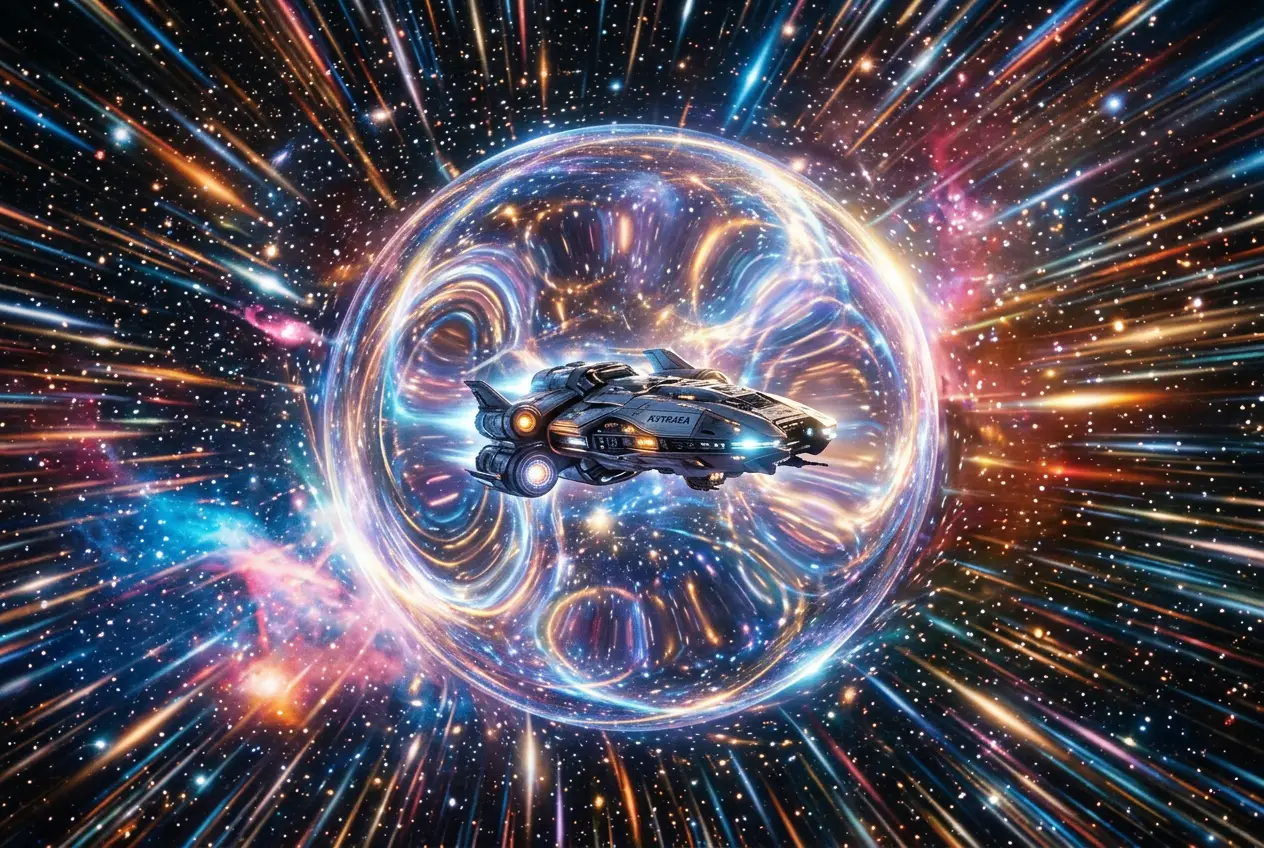
I’ve always been captivated by the idea of venturing beyond our solar system, exploring distant galaxies, and witnessing cosmic wonders that are currently light-years away. But then reality sets in: the vastness of space and the seemingly insurmountable speed limit imposed by the universe itself – the speed of light. Traversing even our nearest star, Proxima Centauri, would take tens of thousands of years with current technology. It’s a cosmic barrier that makes interstellar travel feel like an impossible dream.
But what if that barrier isn't as impenetrable as we think? What if there's a loophole, a scientific key hidden within the fabric of reality that could bend spacetime itself, allowing us to effectively travel faster than light without actually breaking Einstein's cosmic speed limit? This isn't just the stuff of science fiction anymore; it’s a concept being actively explored by theoretical physicists, and at its heart lies something truly mind-bending: exotic matter.
The Universal Speed Limit: Einstein's Legacy
Before we dive into the extraordinary, let’s briefly acknowledge the ordinary – or rather, the fundamental. Albert Einstein's theory of Special Relativity famously dictates that nothing with mass can accelerate to or exceed the speed of light (approximately 299,792,458 meters per second in a vacuum). As an object approaches this speed, its mass increases infinitely, requiring an infinite amount of energy to push it further. This isn't just a theoretical speed bump; it's a cosmic law that underpins our understanding of the universe.
So, if we can't go faster than light, how do we get to Alpha Centauri for a coffee? The answer might not be about going faster, but about making the journey shorter.
Entering the Warp Zone: The Alcubierre Drive
In 1994, Mexican theoretical physicist Miguel Alcubierre proposed a concept that sounded straight out of Star Trek: the warp drive. Alcubierre's idea doesn't involve moving a spaceship faster than light through space, but rather manipulating space itself. Imagine folding a piece of paper: the distance between two points on the paper effectively shrinks. The Alcubierre drive aims to do something similar.
Here's the simplified breakdown:
- Contract Space in Front: The drive would compress the spacetime fabric in front of the spacecraft.
- Expand Space Behind: Simultaneously, it would expand the spacetime fabric behind the spacecraft.
- The Warp Bubble: The spacecraft itself would sit in a "warp bubble" of flat, normal spacetime, undisturbed. It wouldn't feel any acceleration and would essentially be surfing a wave of compressed and expanded space.
From the perspective of an observer outside the bubble, the craft would appear to move at superluminal (faster-than-light) speeds. Crucially, within the bubble, the spacecraft isn't violating any relativistic laws; it remains stationary relative to its local spacetime, which is itself moving. This is similar to how the universe's expansion can cause distant galaxies to recede from us faster than light, without the galaxies themselves moving through space at FTL speeds. You can learn more about the universe's expansion here on Wikipedia: Cosmological expansion (opens in a new tab).
The Unthinkable Ingredient: Exotic Matter
This all sounds fantastic, right? A neat trick to circumvent Einstein. However, there's a colossal catch, a requirement that pushes us into the realm of the truly mysterious: the Alcubierre drive fundamentally requires exotic matter.
What is exotic matter? It's not just "dark matter" (which interacts gravitationally but not electromagnetically) or antimatter (which has positive mass but opposite charge). Exotic matter, in the context of warp drives, refers to hypothetical matter with negative energy density or, equivalently, negative mass.
Normal vs. Exotic Matter: A Quick Comparison
| Property | Normal Matter | Exotic Matter (Hypothetical) |
|---|---|---|
| Mass | Positive | Negative |
| Energy Density | Positive | Negative |
| Gravitational Effect | Attracts (Pulls things in) | Repels (Pushes things away) |
| Interaction | Obeys known laws of physics | Violates some classical energy conditions |
This "negative energy density" is the critical component needed to compress spacetime ahead of the ship and expand it behind. Standard matter and energy only have positive energy density and always generate attractive gravity. To warp space in the way Alcubierre described, you need something that generates repulsive gravity, pushing space apart.
"The concept of negative energy density is not entirely unprecedented in physics," explains Dr. Richard Obousy, president of Icarus Interstellar, a non-profit organization focused on interstellar travel. "The Casimir effect provides a real-world, albeit small-scale, example of regions of negative energy."
A Glimmer of Hope: The Casimir Effect
While true exotic matter remains hypothetical, physics isn't entirely devoid of phenomena exhibiting aspects of negative energy density. The Casimir effect is a fascinating quantum phenomenon where two uncharged, parallel conductive plates placed very close together experience a small attractive force. This force arises from the quantum fluctuations of the vacuum. The energy density between the plates is theoretically lower (more negative) than the energy density outside the plates.
While the Casimir effect demonstrates localized negative energy density, it's incredibly tiny and doesn't involve negative mass. Scaling this up to the astronomical levels needed for an Alcubierre drive is an entirely different beast. However, it shows that the concept of negative energy isn't just pure fantasy; it has a quantum mechanical precedent. You can explore the Casimir effect further on its Wikipedia page: Casimir effect (opens in a new tab).
The Monumental Hurdles Beyond Exotic Matter
Even if we could somehow create or harness exotic matter, the journey to a functional warp drive is fraught with other, equally daunting challenges:
- Causality Violations (Time Travel Paradoxes): Many theoretical FTL mechanisms, including some configurations of the Alcubierre drive, can lead to the possibility of traveling back in time. This creates causality paradoxes (e.g., killing your own grandfather), which generally indicate a fundamental flaw in the theoretical framework or our understanding. Physicists like Stephen Hawking have proposed a "chronology protection conjecture" to prevent such paradoxes.
- Immense Energy Requirements: While exotic matter itself might be the "fuel," the amount required to warp space for a macroscopic spacecraft is staggering. Initial calculations suggested that a warp drive would need an amount of exotic matter equivalent to the mass of Jupiter, or even an entire galaxy! Later refinements by Harold "Sonny" White at NASA Johnson Space Center suggested that optimizing the warp bubble's geometry might reduce the requirement to something closer to the mass of a small car, but still an unimaginable feat to produce or control.
- The "Bow Shock" Radiation: As the warp bubble moves at superluminal speeds, it would accumulate particles and radiation in front of it. When the ship decelerates and exits the warp, this accumulated energy would be released in a devastating burst, potentially sterilizing any star system it arrived in, or incinerating the destination. Not exactly a friendly arrival!
- How to Steer and Stop: Creating a warp bubble is one thing; precisely controlling its shape, direction, and speed, and then safely dissolving it upon arrival, presents engineering and physics challenges that are currently beyond our comprehension.
- Lack of a "Motive": The Alcubierre metric doesn't describe how to generate the warp bubble, only that if you had exotic matter, this is how spacetime would behave. It's like having a blueprint for a car that needs anti-gravity fuel, but no way to make the fuel.
Other Paths to the Stars: Wormholes and Beyond
While exotic matter is a central theme for warp drives, it's also a key ingredient for other theoretical shortcuts through space, such as wormholes. These hypothetical tunnels through spacetime could connect two distant points, dramatically reducing travel time. However, stable, traversable wormholes also require vast amounts of exotic matter to prop them open. If you're curious about wormholes, we've explored them in another blog post: Do Wormholes Link Universes? The Science Unveiled.
Another fascinating area, albeit not FTL in the same sense, involves exploring quantum phenomena. While "beyond light speed" for particles (tachyons) remains highly speculative, the realm of quantum entanglement offers instantaneous correlations between particles no matter the distance. While this can't transmit information faster than light, it highlights how quantum mechanics challenges our classical intuitions about space and time. We delved into this connection in our blog: Does Quantum Entanglement Connect Parallel Universes?.
The Road Ahead: From Theory to Reality?
Despite the immense challenges, research into warp drives and exotic matter continues. Organizations like Icarus Interstellar and individuals within NASA have explored the theoretical possibilities, even conducting small-scale experiments to look for subtle spacetime distortions that might be precursors to a warp field.
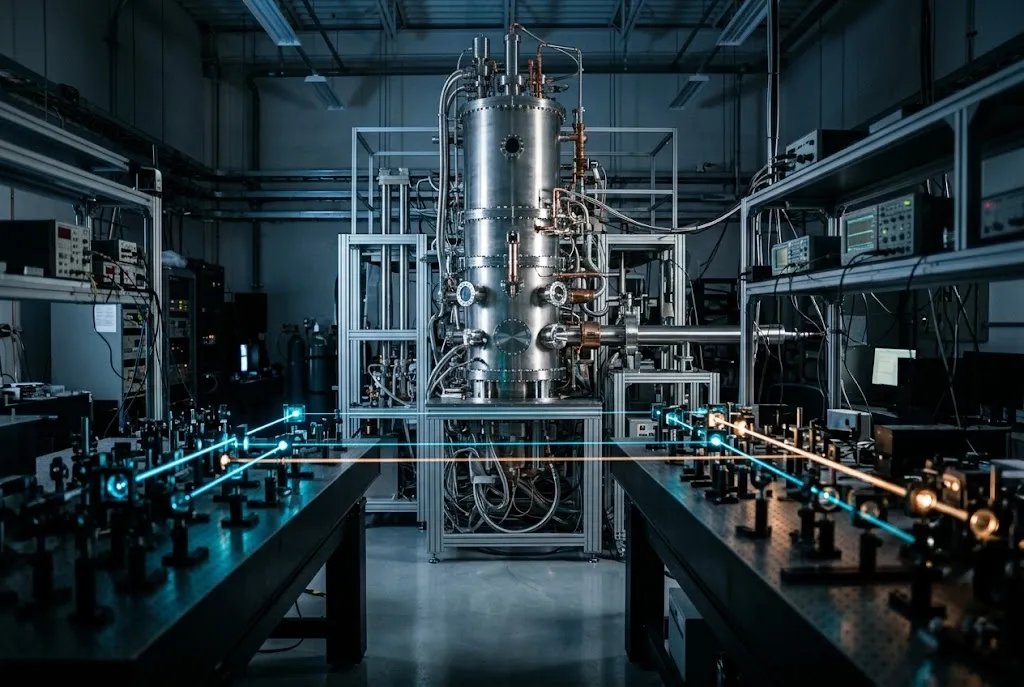
In 2012, Harold "Sonny" White's team at NASA's Eagleworks Laboratories claimed to have made progress in detecting microscopic spacetime perturbations using a "White-Juday Warp Field Interferometer," a device designed to detect minute changes in the path length of a laser beam in a simulated warp field. While these results were highly preliminary and did not confirm a warp drive, they demonstrated a willingness to push the boundaries of theoretical physics into experimental exploration. You can read more about early NASA warp drive research here: NASA's warp drive efforts (opens in a new tab).
I find it inspiring that we continue to ask these "impossible" questions. The journey to understand exotic matter and its potential role in interstellar travel is a testament to human curiosity and our relentless pursuit of the unknown. It might be centuries or millennia away, or perhaps we'll discover a fundamental reason why it’s truly impossible. But for now, the dream of warping spacetime and venturing to the stars remains a vibrant, if theoretical, possibility, fueled by the elusive promise of exotic matter. The cosmos awaits, and perhaps, one day, we'll find a way to meet it on its own terms.



Conversation0
No comments yet. Be the first to share a thought — the best questions often become new stories.