


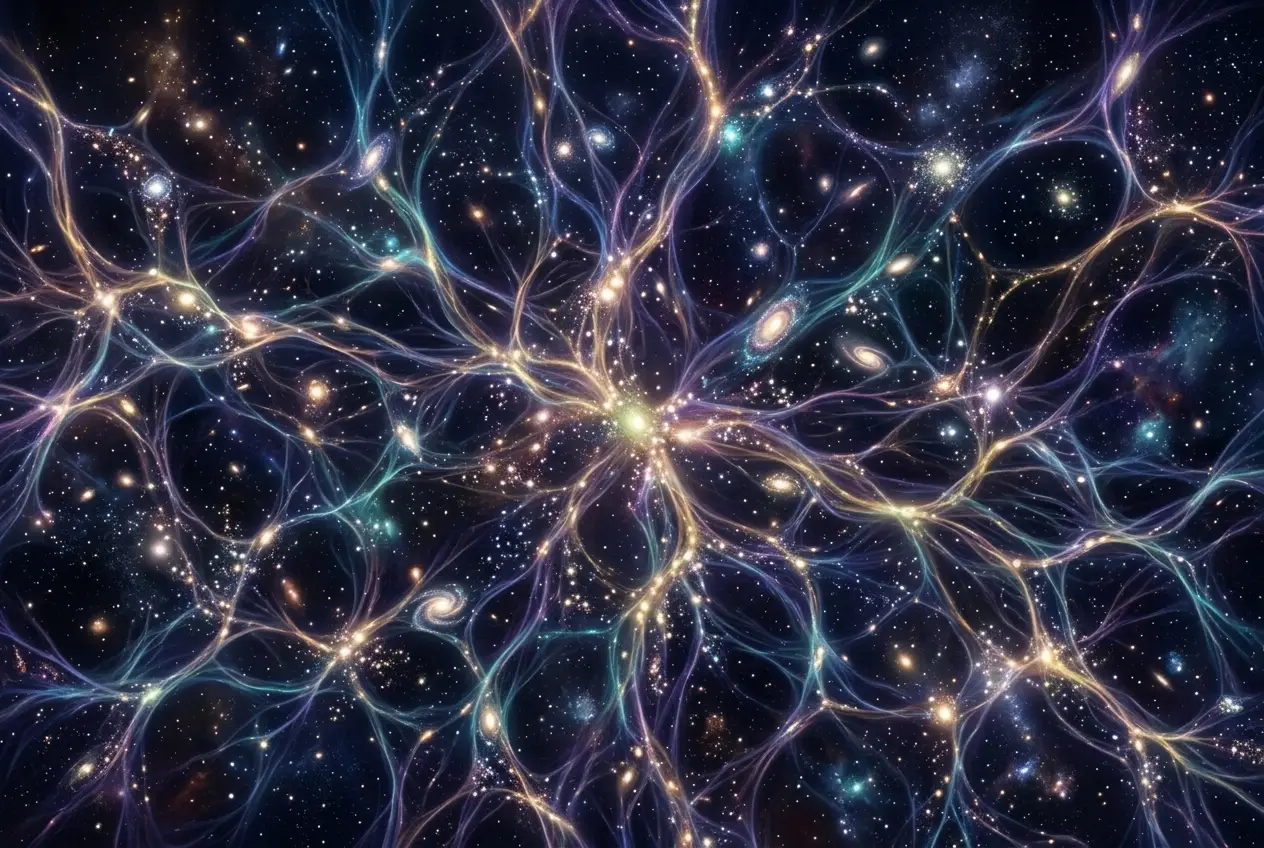
I often find myself gazing at the night sky, not just in wonder at the countless stars, but pondering the deeper, hidden fabric of existence. What if the universe isn't just a collection of celestial bodies, but an elaborate, interconnected system, a cosmic superhighway of information? This thought usually leads me to one of the universe’s most profound enigmas: dark matter. We know it's there, making up about 27% of the universe's mass-energy, yet it remains stubbornly invisible, interacting with ordinary matter only through gravity. But what if its role extends beyond gravitational glue? What if dark matter isn't just a passive scaffold, but the very medium of a universal internet, silently facilitating communication across galaxies?
The idea feels like science fiction, yet the more I delve into the mysteries of the cosmos and the strange properties of quantum mechanics, the less fantastical it seems. Imagine a network so vast and profound that it predates everything we know, a silent conduit for cosmic data, woven into the very fabric of spacetime itself.
The Unseen Architect: Dark Matter's Enigma
For decades, scientists have grappled with the invisible hand shaping galaxies and galaxy clusters. We observe stars rotating too fast at the edges of galaxies, and galaxy clusters holding together far more tightly than the visible matter within them could explain. The unanimous conclusion points to dark matter: an unknown substance that exerts gravitational pull but does not absorb, reflect, or emit light. This lack of interaction with electromagnetic forces is precisely why it's "dark."
While its gravitational effects are undeniable, the precise nature of dark matter remains one of the greatest unsolved puzzles in physics. Is it composed of Weakly Interacting Massive Particles (WIMPs), hypothetical axions, sterile neutrinos, or something even stranger? The ongoing hunt for direct detection of these particles, using incredibly sensitive underground laboratories, has so far yielded no definitive answers. Yet, the existence of dark matter is crucial to our understanding of cosmic structure formation. Without it, the universe as we know it simply wouldn't exist.
The cosmic web, a vast, filamentary structure of galaxies, gas, and presumed dark matter, stretches across billions of light-years. It's the largest known structure in the universe, a magnificent testament to gravity's organizing power. I often think of this web not just as a physical scaffolding, but as a potential communication backbone. For more on how this cosmic architecture might compute, I recommend checking out our blog on Can the Cosmic Web Compute Our Universe's Fate?.
The Internet of the Cosmos: How Could it Work?
If dark matter were to act as a cosmic internet, the implications would be staggering. How could this invisible network transmit information? Let's consider a few theoretical possibilities, drawing from concepts in both theoretical physics and information theory.
Beyond Electromagnetism: The Dark Sector
Our current understanding of communication relies almost entirely on electromagnetic waves – radio, light, X-rays, etc. However, these interactions are limited by the speed of light and are easily scattered or absorbed by interstellar dust and gas over vast distances. A "dark internet" would need to operate outside this electromagnetic realm, possibly within what physicists call the "dark sector".
The dark sector is a hypothetical realm of particles and forces that interact only very weakly with the standard model particles we know. Dark matter particles could be part of this sector, potentially interacting with each other through their own set of "dark forces" or "dark photons." If these dark interactions exist, they could serve as a mechanism for information transfer.
Imagine a scenario where:
- Dark particles carry information: Instead of photons, hypothetical "dark photons" or other mediators of dark force could carry encoded information.
- Minimal interaction with ordinary matter: This would allow signals to traverse vast cosmic distances without significant degradation or absorption.
- Faster-than-light? While highly speculative and challenging to reconcile with special relativity, some exotic theories propose that certain particles or interactions might operate outside conventional speed limits within a localized "dark" spacetime warp. More realistically, the sheer volume and ubiquity of dark matter would allow near-instantaneous connectivity across scales.
Quantum Entanglement: The Ultimate Intergalactic Link
One of the most mind-bending phenomena in quantum mechanics is entanglement, where two or more particles become linked in such a way that they share the same fate, no matter how far apart they are. Measuring the property of one entangled particle instantly influences the property of the other, even if they are light-years apart. This "spooky action at a distance," as Einstein called it, doesn't violate the speed of light because it doesn't allow for transfer of information faster than light in a classical sense. However, it forms the basis of quantum communication and quantum computing.
Could dark matter particles be entangled across cosmic distances, forming a vast, instantaneous quantum network? If dark matter particles are indeed WIMPs or axions, their sheer numbers and weak interactions could create a persistent, ubiquitous entanglement web. This cosmic entanglement could then be modulated by gravity or other weak interactions to encode and transmit data. For a deeper dive into the potential of dark matter for messaging, you can read our article: Can Dark Matter Be Used to Send Messages?.
Gravitational Waves as Modulators
Another intriguing possibility involves gravitational waves. These ripples in spacetime, predicted by Einstein and recently detected, are generated by massive cosmic events like black hole mergers. Unlike electromagnetic waves, gravitational waves pass through matter virtually unimpeded.
Perhaps the "dark internet" isn't directly carried by dark matter particles, but rather modulated by them. Imagine dark matter forming a substrate, and gravitational waves acting as the signals that perturb or interact with this substrate in a way that encodes information. The varying density or subtle movements of dark matter halos could create localized gravitational fluctuations, which could then propagate across the cosmic web, carrying data.
| Communication Medium | Interaction with Matter | Speed Limit | Range Potential | Potential Drawbacks |
|---|---|---|---|---|
| Electromagnetic Waves | Strong (absorption, scattering) | Speed of Light | Limited by distance/obstacles | Signal degradation, slow over vast scales |
| Gravitational Waves | Extremely Weak | Speed of Light | Universe-wide | Low energy, difficult to encode complex data |
| Dark Sector Forces | Very Weak (only with dark matter) | Hypothetical (possibly FTL locally) | Universe-wide | Existence unconfirmed, detection challenges |
| Quantum Entanglement | Instantaneous correlation | Apparent FTL (no info transfer) | Universe-wide | Practical implementation for information encoding is a major hurdle |
Implications for Life and the Universe
If a dark matter internet truly exists, what would it mean for our understanding of the universe and the search for extraterrestrial intelligence?
Cosmic Consciousness or Data Flow?
The implications could range from a purely mechanistic data transfer network, enabling faster astrophysical processes or synchronization, to something far more profound. Could complex civilizations across the cosmos be utilizing this dark network, communicating with each other through means we can barely conceive? Perhaps advanced beings don't rely on cumbersome radio waves but on modulating the very fabric of dark matter, sending messages through the universe's ultimate broadband connection.
Or, pushing the idea further, could the cosmic web itself, with its dark matter scaffolding, possess a form of emergent consciousness or a universal intelligence, processing cosmic information in ways we cannot comprehend? This aligns with philosophical questions about the universe as a giant computer, a concept explored in our blog on Is the Universe a Giant Neural Network?.
New Physics and Technology
Discovering such a network would necessitate a revolution in physics. It would confirm the existence of a dark sector with its own forces and particles, potentially leading to new forms of energy, communication, and even propulsion. I believe this kind of discovery would reshape our technological landscape entirely, allowing us to build instruments sensitive to dark matter interactions, potentially unlocking instantaneous communication or energy sources beyond our wildest dreams.
The theoretical framework for a "dark sector" with its own forces is not entirely without foundation. Physicists like Nima Arkani-Hamed and Jonathan Feng have explored models where dark matter particles interact via a "dark photon." You can find more information about these theoretical explorations on the Wikipedia page for Dark Matter (opens in a new tab).
The Road Ahead: Detection and Theory
Proving the existence of a dark matter internet is, of course, an astronomical challenge. It would require:
- Direct detection of dark matter particles: A prerequisite to understanding their fundamental properties and interactions.
- Detection of dark forces or dark photons: Providing evidence for interactions within the dark sector.
- Observational evidence of information transfer: This might involve subtle anisotropies in the cosmic microwave background or gravitational lensing patterns that hint at non-gravitational dark matter interactions.
- Theoretical breakthroughs: New models that unify dark matter interactions with information theory and quantum mechanics.
The journey to unraveling these cosmic mysteries is ongoing. Experiments like the Large Hadron Collider (LHC) continue to search for new particles that could be dark matter candidates or mediators of dark forces. Other experiments like XENONnT and LUX-ZEPLIN aim to directly detect dark matter particles interacting with ordinary matter. Learning more about these cutting-edge experiments can be found on the Wikipedia page for Dark Matter Detection (opens in a new tab).
In conclusion, the notion of dark matter as a cosmic internet is a bold leap of imagination, yet it elegantly addresses some of the universe's greatest enigmas. It transforms dark matter from a mere gravitational ghost into an active, fundamental player in the cosmic information highway. As I look up at the stars, I can't help but feel a profound sense of excitement for the possibilities this idea unlocks. What if the universe isn't just speaking to itself, but whispering secrets across the dark web, waiting for us to finally tune in? The universe, I believe, has far more intricate designs than we've yet uncovered.


Conversation0
No comments yet. Be the first to share a thought — the best questions often become new stories.