


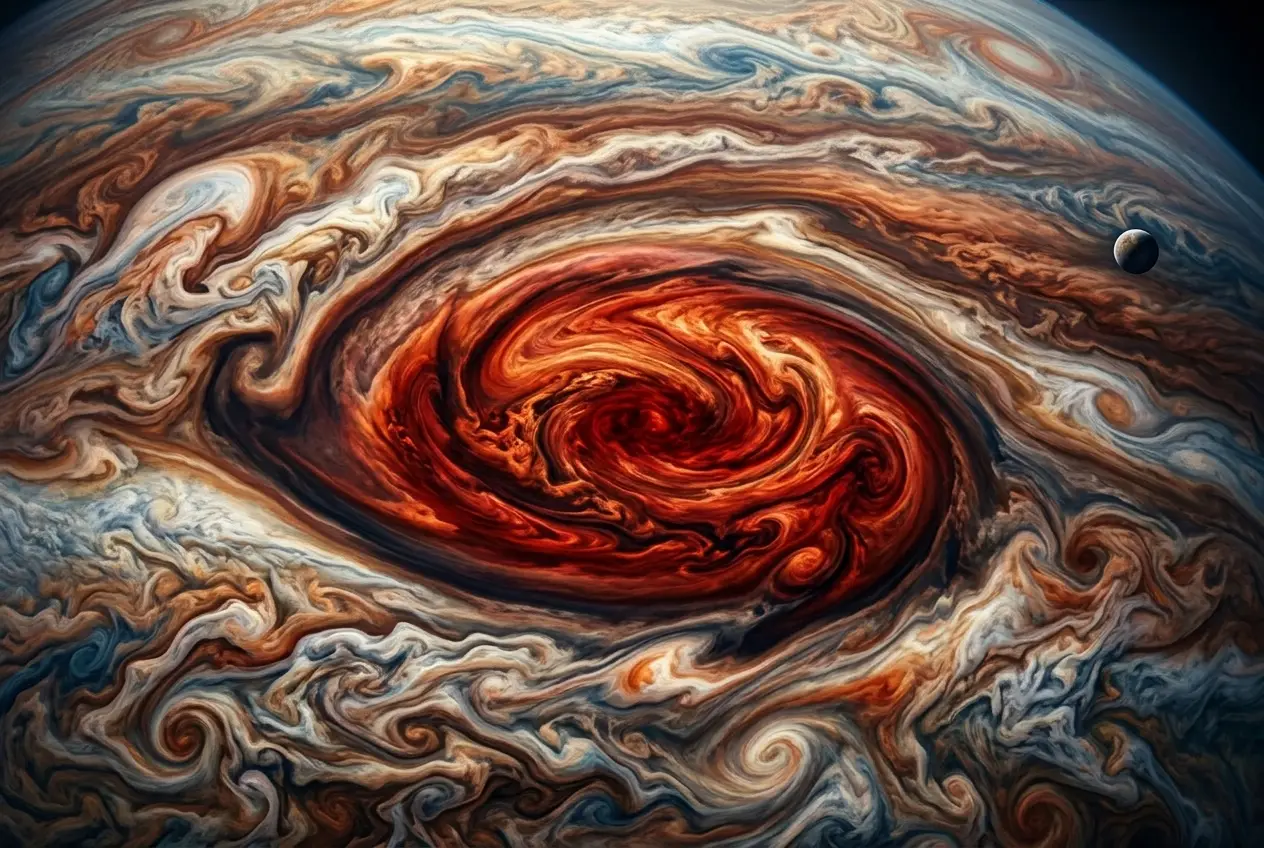
The cosmos is full of wonders, but few are as iconic and enduring as Jupiter’s Great Red Spot. For centuries, this colossal storm has raged on the solar system’s largest planet, a truly mesmerizing anomaly visible even through amateur telescopes. I remember the first time I saw it, a tiny reddish smudge in the eyepiece, yet knowing its true scale filled me with an unparalleled sense of awe. This isn’t just a storm; it’s a vortex larger than Earth itself, a planetary scar that has persisted for at least 350 years, maybe even longer. But recently, a new narrative has begun to emerge, one that suggests this cosmic titan might finally be losing its grip. Could Jupiter's famous "Red Eye" be slowly fading away?
For generations, scientists and stargazers alike have been captivated by the sheer tenacity of the Great Red Spot (GRS). It's a testament to the dynamic, often violent nature of gas giants, planets where oceans of liquid metallic hydrogen churn beneath a thick, swirling atmosphere. But recent observations from powerful telescopes and the incredible data streamed back by NASA's Juno spacecraft have revealed something intriguing: the GRS is shrinking and becoming less vibrant in color. This isn't just a minor fluctuation; the change is significant enough to spark a lively debate among planetary scientists about the storm’s ultimate fate.
The Anatomy of a Cosmic Behemoth
To understand if the GRS is truly dying, we first need to appreciate what it is. The Great Red Spot is an anticyclonic storm (opens in a new tab)—a high-pressure system—located in Jupiter's southern hemisphere. Unlike hurricanes on Earth, which are cyclones (low-pressure systems), the GRS spins counter-clockwise in the southern hemisphere, a characteristic of high-pressure systems on gas giants. Its immense size means it doesn't dissipate easily; it's a stable, self-sustaining vortex that dwarfs any storm we’ve ever seen on our home planet.
Imagine a storm so vast that it could swallow three Earths side-by-side, stretching approximately 40,000 kilometers across in its heyday in the late 19th century. Its winds can reach speeds of over 600 kilometers per hour, creating a maelstrom far beyond anything we experience. The distinct reddish hue is thought to come from chemicals in Jupiter's atmosphere—possibly sulfur and phosphorus compounds—that are brought up from deeper layers and then reacted with ultraviolet light from the sun.
Decades of Diminution: The Shrinking Story
The idea that the GRS is shrinking isn't new. Astronomers have been tracking its dimensions for over a century, noting a consistent trend. In the late 1800s, it was observed to be around 40,000 km wide. By the time Voyager 1 and 2 flew past Jupiter in 1979, it had already shrunk to about 23,000 km. Fast forward to 2017, when the Juno spacecraft made its close flybys, and the measurements showed it had further reduced to roughly 16,000 km. That’s a reduction of more than 50% in width since observations began!
What’s driving this contraction? Scientists believe that the GRS is slowly being "nibbled" away by smaller storms and vortices that constantly circulate in Jupiter's turbulent atmosphere. As the GRS spins, these smaller storms often merge with it or are absorbed, but some appear to shear off pieces of the larger storm, contributing to its overall decrease in size. It's like a cosmic battle where the giant is slowly being eroded by relentless, smaller attackers.
Fading Colors and Rising Questions
Beyond its shrinking dimensions, observers have also noted a subtle, yet noticeable, fading of its characteristic red color. While the exact mechanism for its coloration is still debated, a dimmer, less intense hue could indicate a change in the atmospheric dynamics within the storm. Perhaps the updrafts that bring the chromophores (color-bearing chemicals) to the surface are weakening, or the chemicals themselves are being processed differently.
"The Great Red Spot is an iconic, centuries-old storm, but it's not immortal," says Dr. Glenn Orton, a planetary scientist at NASA's Jet Propulsion Laboratory. "While it has shown considerable resilience, the changes we're observing are prompting new questions about its longevity and the underlying forces at play in Jupiter's atmosphere."
I find it fascinating that something so immense and seemingly eternal could show signs of decay. This change forces us to reconsider our understanding of long-lived atmospheric phenomena on gas giants. For instance, are similar processes occurring on other gas giants, like Neptune’s Great Dark Spot, which was observed by Voyager 2 in 1989 but had vanished by 1994? It seems even cosmic giants have their lifespans. Speaking of other planets and their mysteries, I've often pondered if do rogue planets hide oceans of alien life? or if is Europa's ocean hiding alien life? Decoding icy moons – these questions highlight the dynamic and often surprising nature of planetary bodies beyond Earth.
Juno's Revelations: Peering into the Depths
The Juno spacecraft (opens in a new tab), orbiting Jupiter since 2016, has revolutionized our understanding of the GRS. Its Microwave Radiometer instrument has allowed scientists to peer deep beneath the visible cloud tops, revealing that the GRS is far deeper than previously imagined. It extends at least 350 to 500 kilometers into Jupiter's atmosphere, significantly deeper than Earth's oceans and thousands of times more massive than terrestrial storms.
Juno's data has also shown that the GRS's roots are warmer at the top and cooler at the bottom, indicating complex convective processes. The shrinking and fading could be related to changes in these deeper dynamics, perhaps a weakening of the jet streams that feed and maintain the storm, or an alteration in the chemical composition that contributes to its color.
The Future of the Great Red Spot: Fade or Vanish?
So, is the Great Red Spot truly dying, or is it merely entering a new, less dramatic phase? The scientific community is divided. Some researchers predict that the GRS could completely disappear within the next few decades or centuries, eventually dissolving into smaller, less significant vortices. Others argue that it might simply reach a new equilibrium, shrinking to a stable, albeit smaller, size, perhaps becoming a "Great Red Circle" or "Great Red Oval."
I think it's crucial to remember that natural phenomena often undergo cycles. While the current trend is one of contraction, Jupiter's atmosphere is an incredibly complex system, and predicting the GRS's ultimate fate with certainty is challenging. It’s possible that new atmospheric conditions could arise that re-energize the storm, causing it to grow and regain its intensity.
This ongoing mystery reminds me of the broader cosmic questions we face. The universe holds countless enigmas, from the nature of dark matter to the Fermi Paradox: why is the universe so quiet?. Each observation, each piece of data, whether from Jupiter or distant galaxies, adds another layer to our understanding, pushing the boundaries of what we thought was possible.
Conclusion: A Cosmic Enigma Continues
Whether the Great Red Spot fully disappears, shrinks to a stable miniature, or stages a dramatic comeback, its current transformation offers an invaluable opportunity for scientists to study the dynamics of super-storms on other planets. It’s a natural laboratory unfolding before our very eyes, helping us understand planetary meteorology and the long-term evolution of gas giant atmospheres.
I believe that the shrinking of the GRS, rather than being a sad farewell, is an exciting new chapter in our cosmic exploration. It reinforces the idea that nothing in the universe is truly static, and even the most ancient and powerful phenomena are subject to change. Jupiter’s Red Eye may be dimming, but its mystery continues to shine brightly, inspiring awe and pushing the boundaries of our scientific curiosity.


Conversation0
No comments yet. Be the first to share a thought — the best questions often become new stories.