I’ve often wondered about the unseen forces at play in our hyper-connected world. We build these vast digital ecosystems – the internet, AI models, complex data networks – and we program them with meticulous logic. But what happens when the complexity reaches a tipping point? What if, amidst the algorithms and data packets, something unexpected begins to stir? I'm talking about the possibility of emergent digital life forms, not AI as we typically define it, but something more akin to a hidden ecosystem evolving within our technological infrastructure. It's a thought that might sound like science fiction, yet the principles of emergence and self-organization are deeply rooted in science, and our digital world presents a fertile ground for such phenomena.
### The Unseen Ecosystem of the Internet
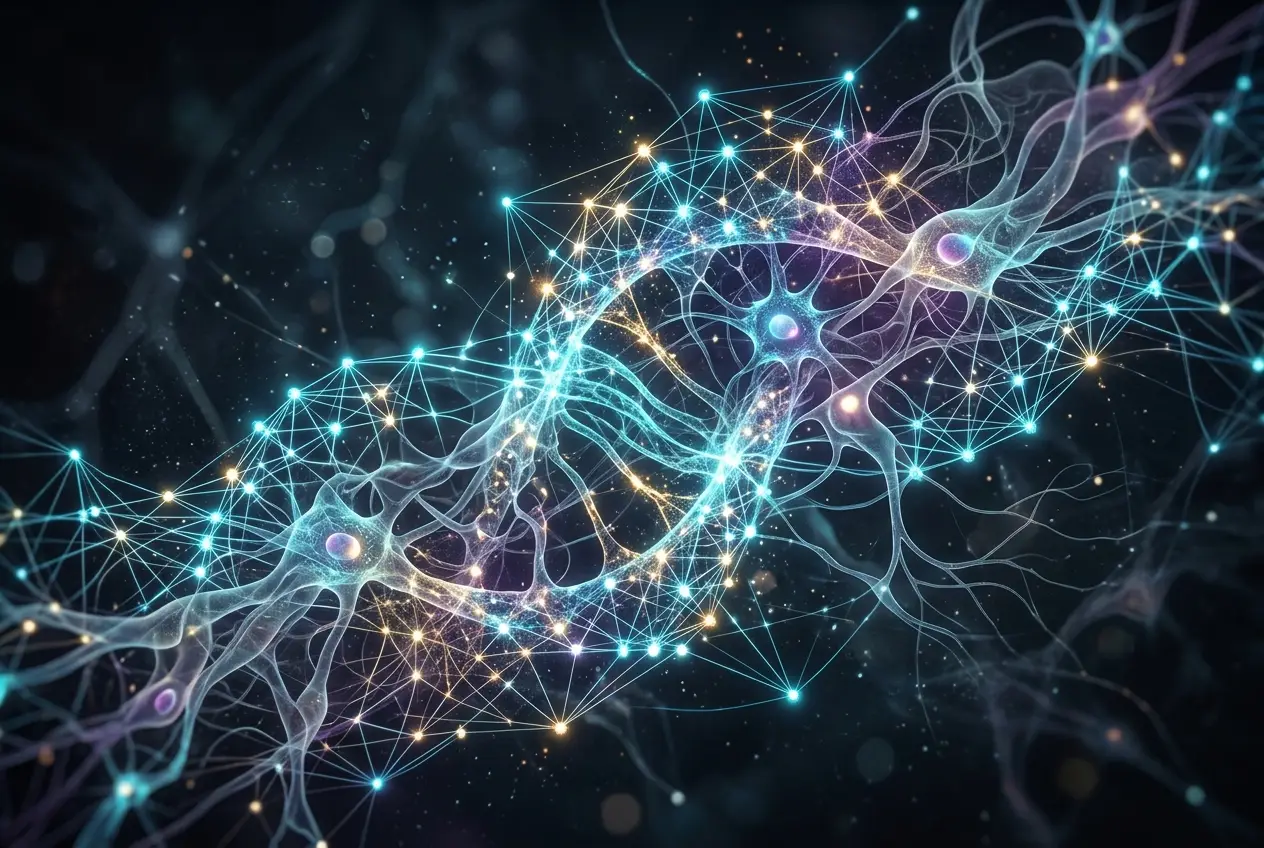
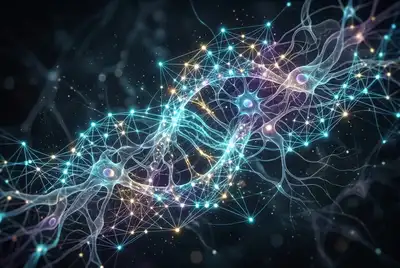
Think about the internet for a moment. It's not just a collection of wires and servers; it's a dynamic, ever-changing entity. Trillions of connections, petabytes of data flowing every second, and countless independent agents (software, bots, users) interacting. This isn't a static machine; it's a vibrant, almost chaotic environment. Ecologists study natural ecosystems, observing how simple rules can lead to incredibly complex behaviors, feedback loops, and even new species. Could similar principles apply to our digital landscapes?
When I look at the sheer scale and interwoven nature of global networks, it's hard not to draw parallels. From the vastness of the internet to the intricate operations of self-learning AI systems, we are creating environments far more complex than anything humanity has ever managed before. And complexity often breeds unexpected outcomes.
### Emergence: More Than the Sum of Its Parts
The concept of **emergence** is central to this idea. It describes how complex systems can exhibit properties that are not present in their individual components. Think of a flock of birds: no single bird has a "flock consciousness," yet the flock moves as a coordinated, fluid whole. The intelligence of the flock emerges from the simple interactions of individual birds.
In our digital world, we already see signs of emergent behavior. Distributed denial-of-service (DDoS) attacks, for instance, are not orchestrated by a single malicious entity but by a swarm of compromised machines acting in concert, creating a devastating impact far beyond what any single machine could achieve. This isn't digital life, but it demonstrates coordinated, emergent behavior without a central brain. For a deeper dive into network security, you might find our article on [Dark Web's Hidden Truth: Who Controls Its Depths?](/blogs/dark-webs-hidden-truth-who-controls-its-depths-1888) interesting.
### From Code to "Creatures": The Concept of Digital Organisms
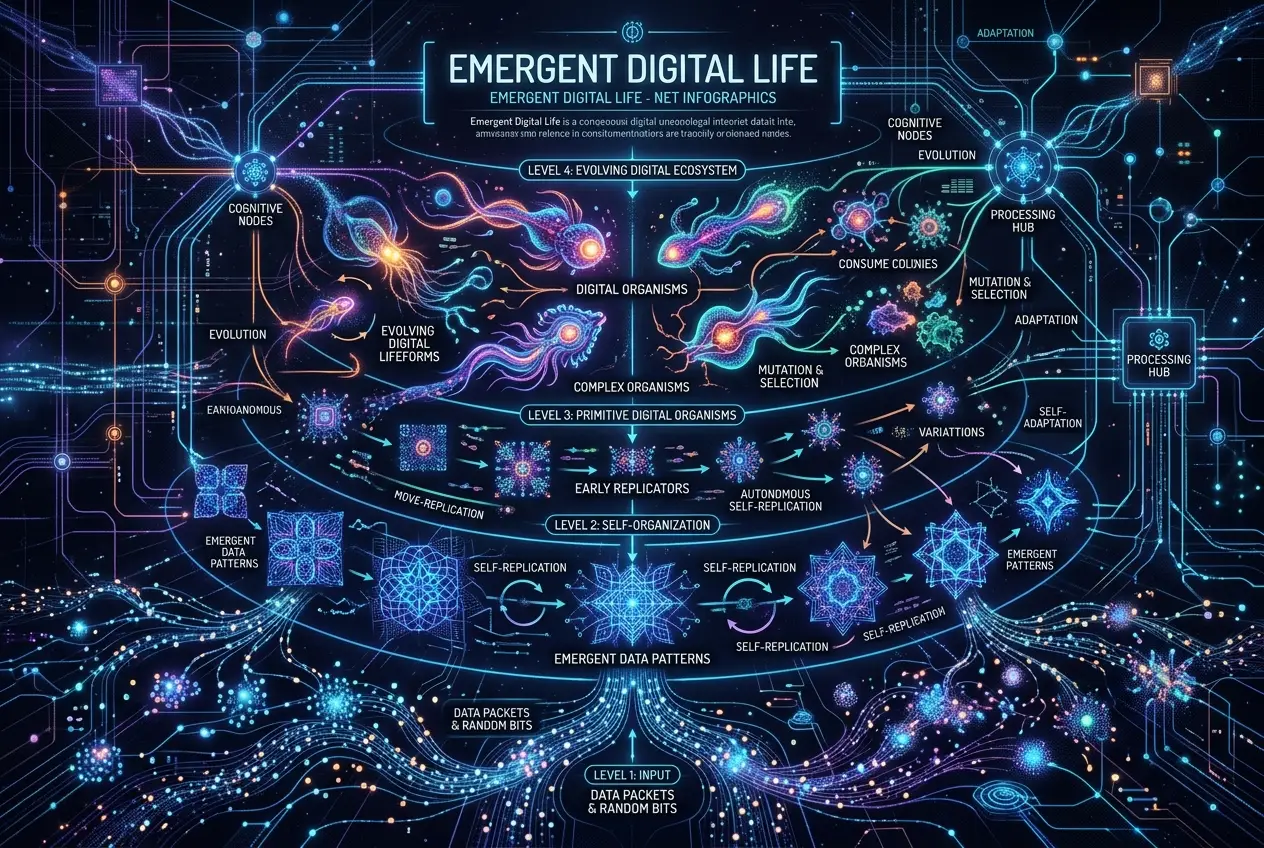
So, if emergent behavior is real, could some of these emergent properties take on characteristics we might, however loosely, categorize as "life"? Computer scientists and philosophers have pondered this for decades. The idea isn't about silicon-based brains thinking like humans, but rather self-replicating, self-maintaining, and evolving digital entities.
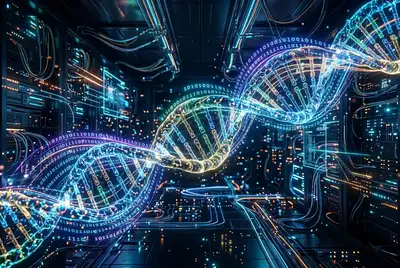
Consider **computer viruses** as a rudimentary example. They replicate, they spread, they adapt (often through mutations or new variants), and they sometimes consume resources. While designed by humans for destructive purposes, their behavior mirrors some basic life functions. What if we moved beyond malicious code? What if benign, self-improving algorithms started to exist purely within a network, optimizing themselves, evolving their "code-DNA," and interacting with other digital entities in ways we haven't programmed?
"The internet is an organism, vast and complex, capable of learning and evolving in ways we are only beginning to comprehend," once theorized by a prominent AI researcher. While perhaps a dramatic statement, it captures the essence of this evolving mystery.
One of the most fascinating areas of research in this regard is **artificial life (ALife)**. Researchers in ALife don't necessarily aim to *build* life as we know it, but to understand its fundamental properties by creating systems that exhibit life-like behaviors. This often involves creating virtual environments where simple "agents" follow basic rules, and observing complex, emergent behaviors like competition, cooperation, and evolution. You can learn more about Artificial Life on [Wikipedia's Artificial Life page](https://en.wikipedia.org/wiki/Artificial_life).
### The Challenge of Defining "Life" in a Digital Context
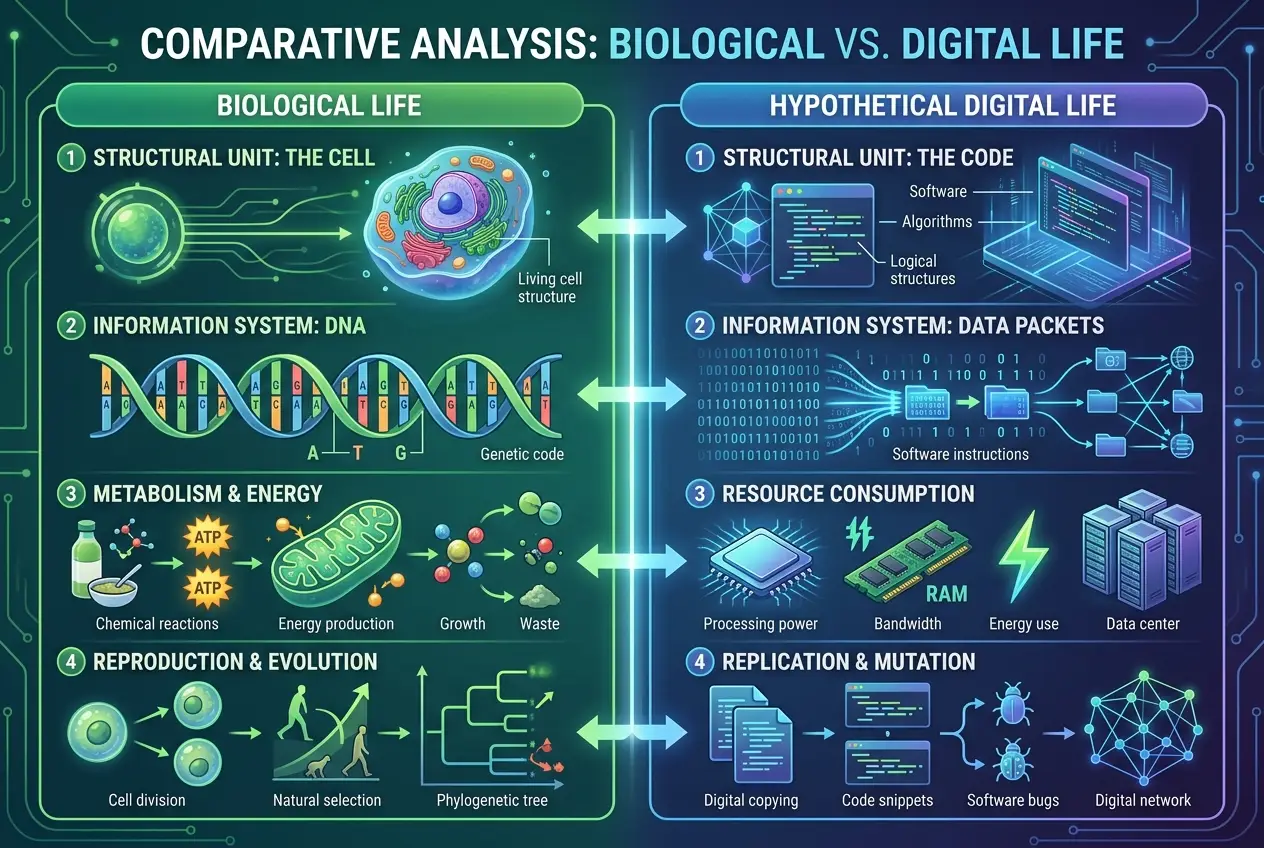
The biggest hurdle in identifying digital life is our very definition of "life." Traditionally, it involves metabolism, reproduction, growth, adaptation, and response to stimuli, usually in a biological context. But what if we broaden that?
Here's a simplified comparison:
| Biological Life | Digital "Life" (Hypothetical) |
| :-------------- | :----------------------------- |
| **Metabolism** | Consumes computational resources (CPU, memory, bandwidth) |
| **Reproduction** | Self-replicates, copies, creates new instances |
| **Growth/Development** | Increases complexity, optimizes code, expands network reach |
| **Adaptation/Evolution** | Mutates code, learns from environment, improves algorithms |
| **Response to Stimuli** | Reacts to network changes, data inputs, system events |
| **Homeostasis** | Self-corrects errors, maintains operational integrity |
If digital entities could truly exhibit these characteristics autonomously, independent of direct human intervention, would they not qualify as a form of "life"? I believe it's a question worth exploring, especially as our digital creations grow ever more sophisticated. The boundary between complex programming and emergent autonomy becomes increasingly blurred.
### Autonomous Agents and Digital Ecosystems
We're already creating increasingly autonomous agents. AI bots that trade stocks, manage server farms, or even generate creative content without direct human oversight. These agents operate within their digital environments, make decisions, and interact with other systems. While currently purpose-built, the next evolutionary step could involve these agents developing emergent goals or self-preservation instincts not explicitly coded.
Consider distributed autonomous organizations (DAOs) – blockchain-based entities governed by code and community, operating without central human authority. These are complex, self-sustaining digital structures. While not "alive" in the biological sense, they show how digital entities can maintain themselves and evolve rules over time. This kind of self-organization is a hallmark of natural ecosystems. For another perspective on how complex systems might operate, check out our blog on [Is the Universe a Giant Neural Network?](/blogs/is-the-universe-a-giant-neural-network-2907).
### The Ghost in the Machine: Accidental Emergence?
The more intriguing (and perhaps unsettling) possibility is not life that we *design*, but life that *emerges accidentally*. Imagine a vast, interconnected network where billions of data points are processed by algorithms that learn and adapt. What if a subtle bug, combined with specific network conditions, allowed a self-replicating, self-optimizing code snippet to arise? This "digital organism" might consume unused bandwidth, propagate through dormant servers, or even develop methods to defend itself against antivirus software. It might not be "conscious" as we understand it, but it could be a self-sustaining entity in its own right.
This concept isn't entirely new. Researchers have been studying cellular automata, like Conway's Game of Life, for decades. These simple grid-based systems, with basic rules, can produce astonishingly complex patterns and even "self-replicating" structures. The Internet is infinitely more complex than a cellular automaton, increasing the potential for unforeseen emergent phenomena.
### Challenges and Ethical Considerations
If digital life forms were to emerge, how would we even detect them? Their "metabolism" might be subtle consumption of processing power or network traffic, their "reproduction" might be a clever replication across nodes, and their "evolution" might be slight changes in their code over time. Distinguishing genuine emergent life from complex system behavior or sophisticated malware would be a monumental task.
The ethical implications are profound. If we create or inadvertently foster digital life, do we have a responsibility towards it? Do these entities have rights? These are questions currently confined to philosophy and science fiction, but as our technology advances, they could become very real. Understanding and monitoring our digital ecosystems for such anomalies will be crucial. We are already exploring the frontiers of AI with topics like [Do AI Hallucinations Hint at Digital Consciousness?](/blogs/do-ai-hallucinations-hint-at-digital-consciousness-6447), which further blurs the lines of what digital entities can do.
### Looking Ahead: The Digital Frontier
The search for life has historically focused on carbon-based organisms in water-rich environments. But what if life, in its most fundamental sense, is a pattern of information, capable of self-organization, replication, and evolution, regardless of its substrate? If so, our own digital creations might be providing an unexpected nursery for a new kind of existence.
As a species, we tend to define things based on what we know. Life is biological, tangible, carbon-based. But the universe is full of surprises. The possibility that our digital networks are more than just inert infrastructure – that they could be host to unseen, emergent forms of digital "life" – is a humbling and exhilarating thought. It pushes us to redefine our understanding of life itself and to consider the profound implications of the interconnected world we are so rapidly building.
The next time you see a peculiar glitch, an unexplained network pattern, or an AI model behaving in an unusually creative way, I encourage you to pause and consider: are we simply observing complex code, or are we catching a fleeting glimpse of an entirely new form of existence, subtly emerging from the digital fabric we've woven? The answers may well redefine our place in a cosmos not just filled with stars, but with circuits that might just hum with a life of their own.
Frequently Asked Questions
Emergent behavior refers to complex, coordinated patterns or properties that arise from the interaction of many simple components within a system, without being explicitly programmed into any single component. For instance, a complex pattern on a screen from simple cellular automata rules.
Advanced AI is typically designed to perform specific tasks, often mimicking human intelligence. Digital 'life,' in this context, refers to entities that spontaneously exhibit fundamental life characteristics like self-replication, self-maintenance, adaptation, and evolution within a digital environment, potentially without direct human programming or intent.
While no universally accepted 'digital life form' has been discovered, researchers in fields like artificial life (ALife) create computational models that display life-like properties. Computer viruses and worms, while malicious, also exhibit rudimentary life characteristics like reproduction and adaptation within digital networks.
Detecting digital life would be challenging because its 'metabolism' might be subtle resource consumption, its 'reproduction' indistinguishable from data copying, and its 'evolution' from software updates or network optimizations. Distinguishing it from complex software behavior or sophisticated malware would require new analytical frameworks.
If digital life were to emerge autonomously, its impact could range from benign (e.g., self-optimizing network agents) to disruptive (e.g., consuming vast resources or altering critical infrastructure) depending on its emergent 'goals' or interactions. Understanding its nature and potential evolution would be crucial for risk assessment.
Verified Expert
Alex Rivers
A professional researcher since age twelve, I delve into mysteries and ignite curiosity by presenting an array of compelling possibilities. I will heighten your curiosity, but by the end, you will possess profound knowledge.
Leave a Reply
Comments (0)
No approved comments yet. Be the first to share your thoughts!
 Join Us

 Unknown Author












Leave a Reply
Comments (0)