


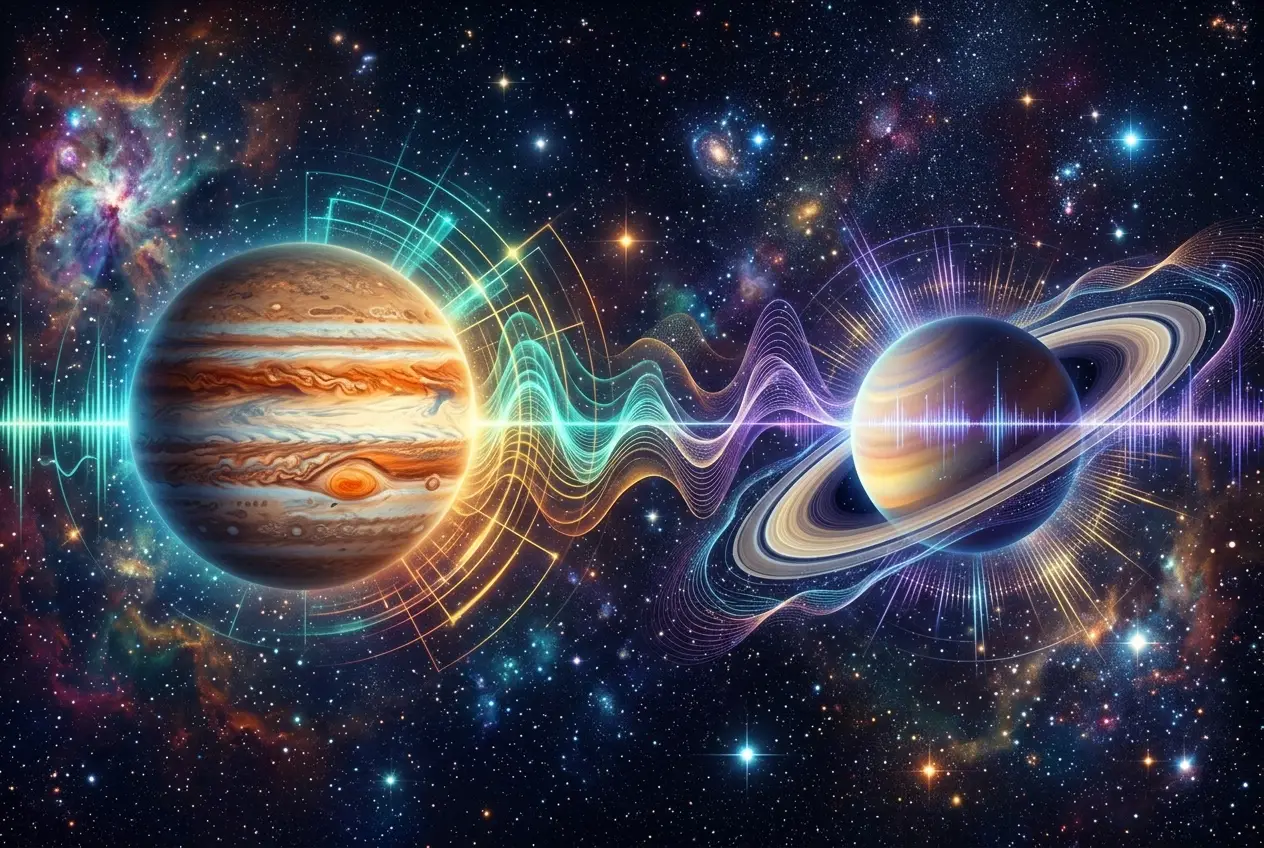
I remember the first time I truly listened to the cosmos beyond the usual humdrum of human-made noise. It wasn't the distant twinkle of stars or the majestic swirl of galaxies that captivated me, but an otherworldly symphony – the "singing" of planets. It’s not a melodic tune audible to the human ear, of course, but a cacophony of radio waves that our advanced instruments can detect and even translate into audible frequencies. For me, it completely reshaped my perception of our solar system, transforming silent celestial bodies into dynamic, vocal entities.
It's a phenomenon that sparks immediate curiosity: planets aren't just inert rocks or gas bags orbiting a star. They are energetic powerhouses, constantly interacting with their environment, emitting signals that tell a profound story about their internal dynamics, their magnetic fields, and their interactions with the solar wind. These cosmic whispers and roars are not random static; they are the electromagnetic fingerprint of a living, breathing planetary system.
Unveiling the Cosmic Orchestra: How Planets Generate Radio Waves
The concept of planets "singing" might sound like something out of science fiction, but it's a very real and extensively studied area of astrophysics. The primary mechanism behind these planetary radio emissions is the interaction between a planet's magnetic field and charged particles from its star – primarily the solar wind in our solar system's case.
Every planet with a significant magnetic field acts like a colossal particle accelerator. When the high-energy, charged particles from the solar wind slam into a planet's magnetosphere, they get trapped and accelerated along magnetic field lines. This acceleration generates powerful electromagnetic radiation across a wide range of frequencies, including radio waves. Think of it like a cosmic dynamo, converting kinetic energy from the solar wind into radio energy.
One of the most common types of these emissions is called auroral radio emissions. Just like the stunning visual auroras (like the Northern Lights on Earth) that occur when charged particles excite atmospheric gases, these particles also emit radio waves as they spiral down magnetic field lines toward the planet's poles. These radio waves are typically in the kilohertz to megahertz range, which is far below what we can see but perfectly detectable by our radio telescopes.
Jupiter: The Solar System's Loudest Singer
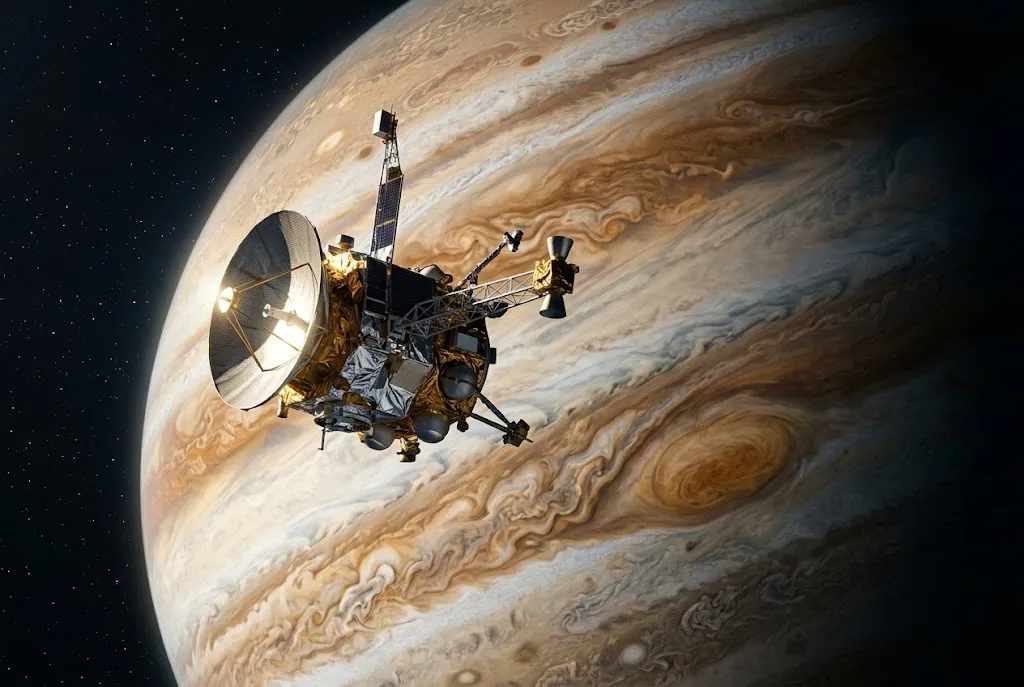
When we talk about planetary radio emissions, Jupiter immediately comes to mind. It is, by far, the most powerful radio source in our solar system, excluding the Sun. Its massive magnetosphere, the largest structure in the solar system if it were visible, traps an immense number of charged particles. These particles are further energized by Jupiter's rapid rotation and the volcanic activity on its moon Io, which constantly spews plasma into Jupiter's magnetosphere.
Jupiter’s radio emissions manifest in two main forms:
- Decametric Emissions (DAM): These are extremely powerful bursts, often hundreds of times stronger than Earth's lightning strikes, occurring at frequencies of 3-40 MHz. They are strongly influenced by Io, acting as a giant electrical generator within Jupiter's magnetosphere. Researchers have even observed specific "Io-controlled" emissions, providing insights into the moon's interaction with the giant planet. For a deeper dive into these unique emissions, you can check out the Wikipedia article on Jupiter's radio emissions (opens in a new tab).
- Decimetric Emissions (DIM): These are relatively steady, broadband emissions at higher frequencies (around 10-30 cm wavelength). They are generated by relativistic electrons spiraling in Jupiter's inner magnetic field, a process known as synchrotron radiation.
The Voyager and Galileo missions provided incredible recordings of Jupiter’s "sounds" – a symphony of whistles, crackles, and roars that truly evoke the raw power of this gas giant. It's an astounding testament to the fact that space is anything but silent.
Saturn, Uranus, and Neptune: The Whispering Giants
While not as boisterous as Jupiter, Saturn, Uranus, and Neptune also emit their own distinctive radio signals. Saturn's kilometric radiation (SKR), for instance, is generated by similar auroral processes as on Earth and Jupiter, but with its own unique characteristics influenced by its ring system and moons. Cassini-Huygens mission provided us with fascinating recordings of Saturn’s radio waves, often described as sounding like static or a distant ocean surf. These emissions offer crucial data about the planet's rotation rate, magnetic field strength, and the dynamics of its plasma environment.
Uranus and Neptune, though further away and less studied, also possess strong magnetic fields and display auroral radio emissions. Their peculiar magnetic field orientations—tilted significantly relative to their rotational axes—lead to complex and intriguing radio signatures that scientists are still working to fully understand. These distant signals are a treasure trove of information about the outer solar system's mysterious gas and ice giants.
Earth's Own Radio Symphony
It's easy to forget that our home planet also "sings." Earth's magnetosphere is a complex shield, constantly bombarded by the solar wind. This interaction generates a variety of radio phenomena, many of which are collectively known as geomagnetic pulsations or whistlers. These are low-frequency electromagnetic waves generated by lightning strikes that travel along magnetic field lines to the opposite hemisphere, often sounding like descending tones. Other emissions include "chorus" and "hiss" which are generated by particle interactions in the magnetosphere and sound remarkably like birdsong or static.
Understanding Earth's radio emissions is critical for studying space weather, which can impact our satellites, power grids, and communication systems. The Van Allen Probes, for example, have provided unprecedented insights into the dynamics of Earth’s radiation belts and the radio waves that play a role in accelerating or scattering particles within them. To learn more about how Earth's magnetic field creates these phenomena, you can consult this resource on geomagnetic pulsations (opens in a new tab).
The Science Behind the Sounds: What We Learn
These planetary radio emissions are not just cosmic oddities; they are invaluable scientific tools. By analyzing the frequency, intensity, and modulation of these signals, scientists can deduce a wealth of information about a planet's hidden properties:
- Magnetic Field Strength and Structure: The characteristics of the radio emissions are directly linked to the strength and geometry of a planet's magnetic field. This is how we've mapped the intricate magnetospheres of distant worlds.
- Rotation Rates: For gas giants without solid surfaces, determining the internal rotation rate can be challenging. However, the modulation of radio emissions, tied to the planet's internal dynamo, provides a reliable "clock."
- Atmospheric and Auroral Dynamics: Changes in radio emissions can indicate variations in solar wind activity, atmospheric composition, and the energy levels of auroral processes.
- Plasma Environments: The interaction of charged particles with magnetic fields creates complex plasma waves, which radio emissions can help us characterize. This is crucial for understanding how planets interact with their space environment.
- Exoplanet Potential: Detecting similar radio emissions from exoplanets could be a powerful new method for finding exoplanets with magnetic fields – a key indicator for potential habitability, as a strong magnetic field can protect an atmosphere from stellar winds. For more about this exciting prospect, see this review on exoplanet radio detection (opens in a new tab).
Can We Decode Alien Voices?
The study of planetary radio emissions naturally leads to a tantalizing question: if planets "sing," could advanced alien civilizations be sending signals within this cosmic static? The Search for Extraterrestrial Intelligence (SETI) actively scans radio frequencies for artificial signals, differentiating them from natural astrophysical phenomena.
Distinguishing between natural planetary emissions and an intentional alien broadcast is a complex task. Natural emissions tend to be broadband, chaotic, or follow predictable patterns related to planetary physics. An artificial signal, however, might exhibit narrow bandwidth, repetitive pulses, or coded information. While we haven't yet definitively detected alien intelligence in these signals, the ability to discern the "voices" of planets from the general cosmic background is a crucial step in the ongoing quest for life beyond Earth. You can read more about the challenges of detecting extraterrestrial intelligence in this article about pulsars, which can also emit highly regular radio signals (opens in a new tab).
The Future of Listening
Our ability to listen to the cosmos is constantly evolving. Future missions equipped with more sensitive radio instruments will continue to unravel the mysteries of planetary "songs." Imagine orbiting probes dedicated to mapping the radio environments of ice giants or arrays of ground-based telescopes specifically designed to pick up faint echoes from distant exoplanets. The insights gained won't just expand our understanding of individual worlds, but also provide a grander picture of how planetary systems form, evolve, and interact within their stellar neighborhoods.
The fact that planets are not silent, but are constantly broadcasting, reminds me of the intricate, dynamic nature of the universe. Every crackle from Jupiter, every hiss from Earth, and every distant whisper from Saturn is a piece of a cosmic puzzle waiting to be understood. Perhaps one day, amidst these natural symphonies, we might discern a message that isn't just a physical process, but a deliberate communiqué from another intelligent civilization. The universe, it turns out, is a much louder place than we ever imagined. It's a vast choir, and we’re only just learning to hear its full range. We are always uncovering new things about other worlds, for example, the possibilities of life on Europa's ocean (opens in a new tab). Or wondering if exoplanet transits (opens in a new tab) hide signals.


Conversation0
No comments yet. Be the first to share a thought — the best questions often become new stories.