I was recently working on a crucial project, deep in the flow of code, when my computer suddenly froze. Not a graceful freeze, but a full-blown, pixelated seizure followed by an unceremonious crash. I restarted, losing a good hour of unsaved work, and muttered a familiar frustration: "Why now?" It's a scenario many of us have faced—the inexplicable tech glitch, the random data corruption, the phantom error message that defies all logic. We often blame software bugs or aging hardware, but what if there's a more fundamental, almost cosmic culprit at play? What if, at the very fabric of reality, tiny, rogue quantum particles are silently sabotaging our most advanced electronics?
It sounds like something out of a science fiction novel, yet the idea is surprisingly grounded in cutting-edge physics and the increasing miniaturization of our technology. As our devices shrink to atomic scales, they become astonishingly sensitive to the quantum realm, a world governed by probabilities and strange, often counter-intuitive phenomena. I've been fascinated by how these hidden forces might influence our digital lives, pushing the boundaries of what we consider "normal" tech behavior into the truly anomalous.
## The Quantum Realm: A World of Whimsy and Chaos
To understand how quantum particles might glitch our tech, we first need a brief detour into the quantum realm. Unlike the predictable, macroscopic world we inhabit, the subatomic universe operates by different rules. Here, particles like electrons, protons, and photons don't behave like tiny billiard balls. Instead, they exist in a state of **superposition**, meaning they can be in multiple places or states simultaneously until measured. This inherent uncertainty is described by quantum mechanics, a pillar of modern physics.
One of the most mind-bending aspects is **quantum tunneling**, where a particle can pass through a barrier even if it doesn't have enough energy to go over it. Imagine rolling a ball up a hill, but instead of rolling back down or over the top, it simply *appears* on the other side. This phenomenon, while rare in our everyday experience, is vital at the nanoscale and could have profound implications for electronics.
Another key concept is **quantum entanglement**, where two particles become inextricably linked, sharing the same fate regardless of distance. Measuring one instantly affects the other, a "spooky action at a distance" as Einstein famously called it. While entanglement is often discussed in the context of quantum computing, its mere existence points to a universe far stranger than we typically perceive. You can dive deeper into this fascinating concept in our previous blog post, "Can Quantum Entanglement Power FTL Communication?" (/blogs/can-quantum-entanglement-power-ftl-communication-4025).
## The March of Miniaturization: Inviting the Quantum Ghost
For decades, the tech industry has relentlessly pursued miniaturization. Moore's Law, though arguably slowing, dictated that the number of transistors on a microchip would double approximately every two years. This drive has led to components so small that they are now operating at scales where quantum effects are no longer negligible; they are fundamental.
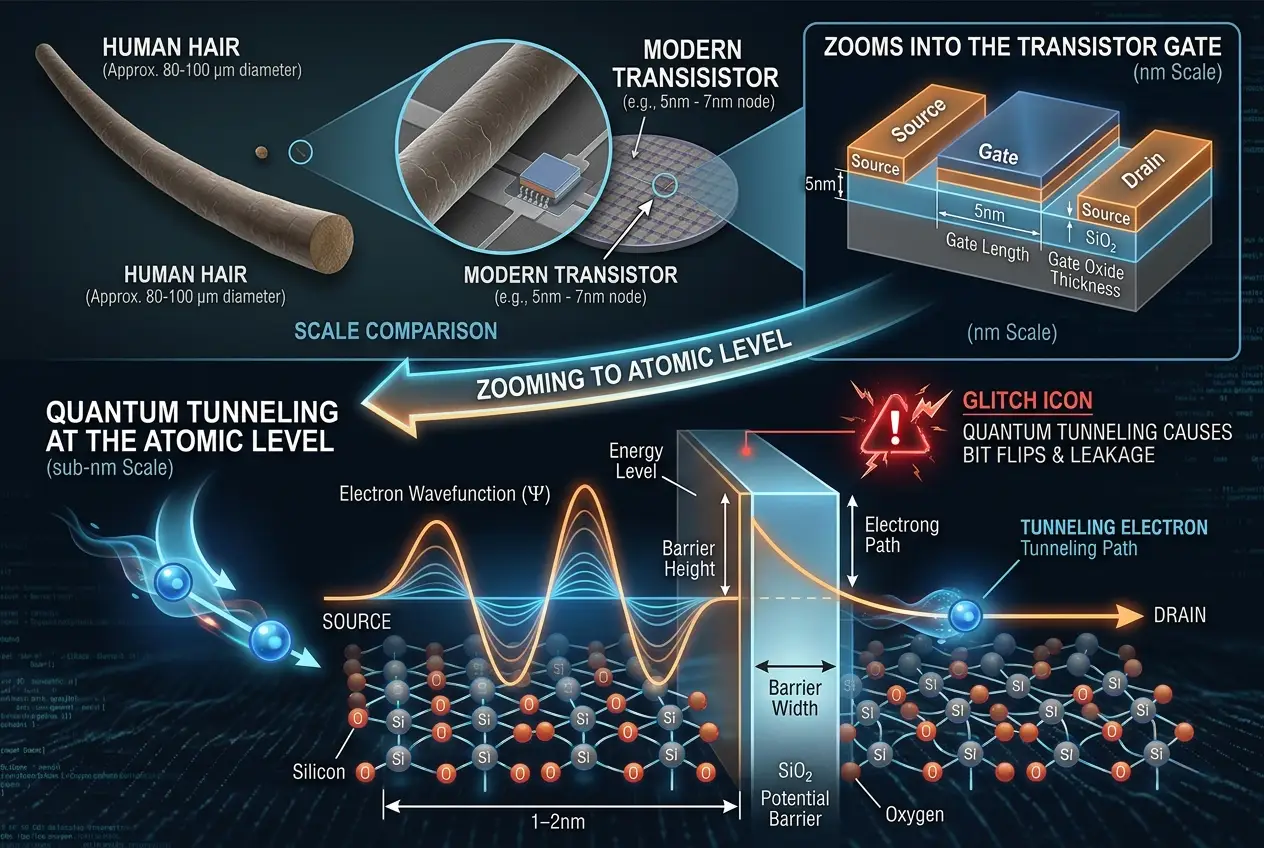
Think about a modern processor. It contains billions of transistors, each acting as a tiny switch. These switches are getting so small—often just a few atoms thick—that the electrons carrying information within them are highly susceptible to quantum phenomena. This is where the concept of "rogue quantum particles" truly enters the picture. These aren't necessarily malicious entities, but rather naturally occurring subatomic events that can unexpectedly interfere with delicate electronic operations.
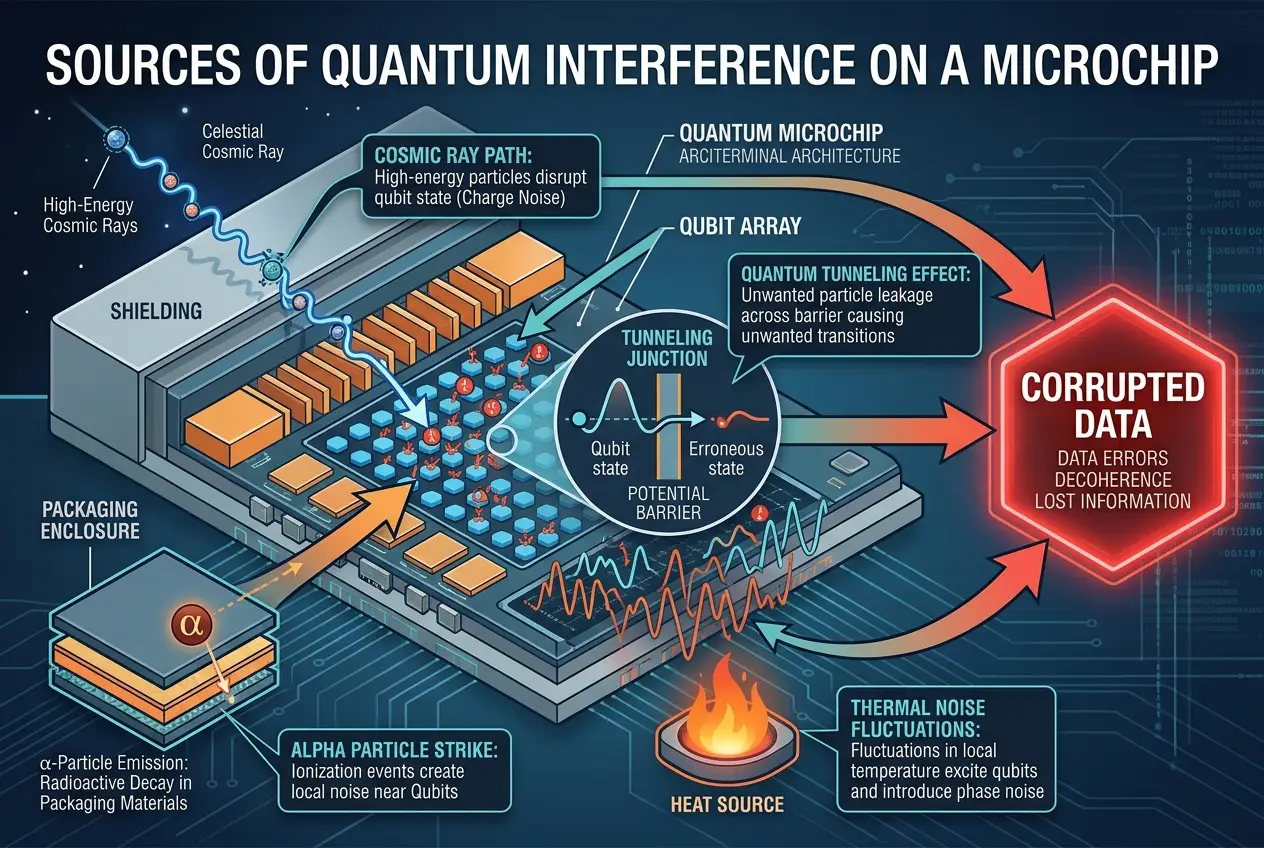
One of the most well-known quantum interferences comes from **cosmic rays**. These are high-energy particles (mostly protons and atomic nuclei) originating from deep space, supernovae, and other violent cosmic events. They constantly bombard Earth's atmosphere. While most are deflected or absorbed, some make it to the surface, and crucially, they can pass through our electronic devices.
When a high-energy cosmic ray strikes a silicon chip, it can ionize atoms, create electron-hole pairs, or even flip the state of a transistor—changing a '0' to a '1' or vice versa. This is known as a **single-event upset (SEU)**, and it can lead to anything from a momentary glitch to data corruption or even a system crash. While redundancy and error-correcting codes are built into critical systems (like those in space satellites or high-performance servers), our everyday devices are less protected. For more on cosmic ray impacts, you might find our blog "Do Cosmic Rays Secretly Glitch Our Tech?" (/blogs/do-cosmic-rays-secretly-glitch-our-tech-3330) insightful.
## Beyond Cosmic Rays: The Subtle Saboteurs
Cosmic rays are just one example. The quantum realm offers other, more subtle ways our tech might be "glitched":
1. **Quantum Tunneling and Leakage:** As transistors become thinner, the insulating barriers separating different parts of the circuit also shrink. Electrons, instead of strictly flowing over these barriers, can "tunnel" through them due to quantum mechanics. This leakage can lead to unexpected current flows, increased power consumption, and erroneous signals, essentially causing bits to flip or calculations to go awry. This is a significant challenge for chip designers trying to push the boundaries of miniaturization. You can read more about quantum tunneling on [Wikipedia](https://en.wikipedia.org/wiki/Quantum_tunnelling).
2. **Thermal Noise and Quantum Fluctuations:** Even at room temperature, atoms and electrons are in constant motion. This thermal energy can manifest as noise, interfering with the precise electrical signals that represent data. At quantum scales, this noise can be amplified by **zero-point energy** fluctuations—tiny, inherent energy variations in the vacuum itself, predicted by quantum field theory. These fluctuations could, theoretically, cause random changes in the energy states of electrons, inducing errors.
3. **Alpha Particle Emission from Packaging:** Believe it or not, some materials used in the packaging of microchips, or even trace contaminants within them, can contain minute amounts of radioactive isotopes. These isotopes can emit alpha particles, which are essentially helium nuclei. When an alpha particle strikes a sensitive part of a chip, it can also cause an SEU, similar to cosmic rays but from a more localized source. This has been a known issue in microelectronics for decades, leading to the development of "low-alpha" materials.
4. **Neutrino Interactions (Rare but Possible):** Neutrinos are elusive subatomic particles, often called "ghost particles" because they rarely interact with matter. Trillions pass through our bodies every second unnoticed. However, in extremely rare instances, a high-energy neutrino could interact with an atom in a silicon chip, potentially causing a cascade of particles that result in a bit flip. While exceptionally improbable for a single device, given the sheer number of computing devices globally, such events are not entirely outside the realm of possibility. Learn more about neutrinos and their mysterious nature on [Wikipedia](https://en.wikipedia.org/wiki/Neutrino).
## The Implications: From Data Centers to Daily Drivers
The ramifications of these quantum glitches extend far beyond your occasional computer crash. For critical applications, the consequences can be severe:
* **Financial Systems:** Imagine a rogue quantum particle flipping a bit in a financial transaction, leading to incorrect sums or transfers.
* **Medical Devices:** Errors in pacemakers, diagnostic equipment, or life support systems due to quantum interference could have fatal outcomes.
* **Autonomous Vehicles:** A single bit flip in the decision-making unit of a self-driving car could lead to catastrophic malfunctions.
* **Scientific Research:** Data corruption in experiments designed to detect subtle phenomena could invalidate years of work.
It's a testament to modern engineering that our devices are as reliable as they are, with sophisticated error-correction codes (ECC) and redundant systems designed to catch and fix many of these random errors. However, as chips continue to shrink, the probability of these quantum phenomena causing noticeable effects increases.
## The Future of Glitch-Proofing: Embracing Quantum Engineering
Acknowledging the influence of the quantum world on our tech isn't about fostering fear, but about driving innovation. Engineers are already developing new strategies to mitigate these issues:
* **Radiation-Hardened Designs:** For mission-critical systems, chips are designed with special layouts and materials that are more resilient to radiation-induced errors.
* **Advanced Error-Correction Codes:** These algorithms are becoming increasingly sophisticated, able to detect and correct multiple errors within a data block, much like a good librarian who can piece together a damaged book.
* **Novel Materials and Architectures:** Research into new semiconductor materials or even entirely new computing paradigms (like quantum computing, which uses quantum effects deliberately) could inherently be more robust or, conversely, present entirely new challenges. Our discussion on "Can Graphene Chips Unleash AI Superpowers?" (/blogs/can-graphene-chips-unleash-ai-superpowers-8640) delves into such advanced materials.
* **Quantum-Resistant Computing:** Moving forward, especially with the advent of quantum computers, understanding and controlling quantum noise will be paramount. Future classical computers might even adopt some quantum principles for enhanced stability.
> "The only limit to our realization of tomorrow will be our doubts of today." - *Franklin D. Roosevelt (Though not a scientist, his quote encapsulates the spirit of overcoming technological challenges)*
The next time your phone unexpectedly reboots or your computer freezes at the worst possible moment, take a moment to ponder the unseen forces at play. It might not just be a bug in the code or a faulty component. It could be a fleeting whisper from the quantum realm, an invisible, rogue particle subtly reminding us that even our most stable digital realities are built upon a foundation of fundamental, probabilistic uncertainty. This intricate dance between the predictable and the profoundly random ensures that the world of technology, much like the universe itself, holds endless mysteries to unravel.
Verified Expert
Alex Rivers
A professional researcher since age twelve, I delve into mysteries and ignite curiosity by presenting an array of compelling possibilities. I will heighten your curiosity, but by the end, you will possess profound knowledge.
Leave a Reply
Comments (0)
No approved comments yet. Be the first to share your thoughts!
 Join Us

 Unknown Author


































Leave a Reply
Comments (0)