


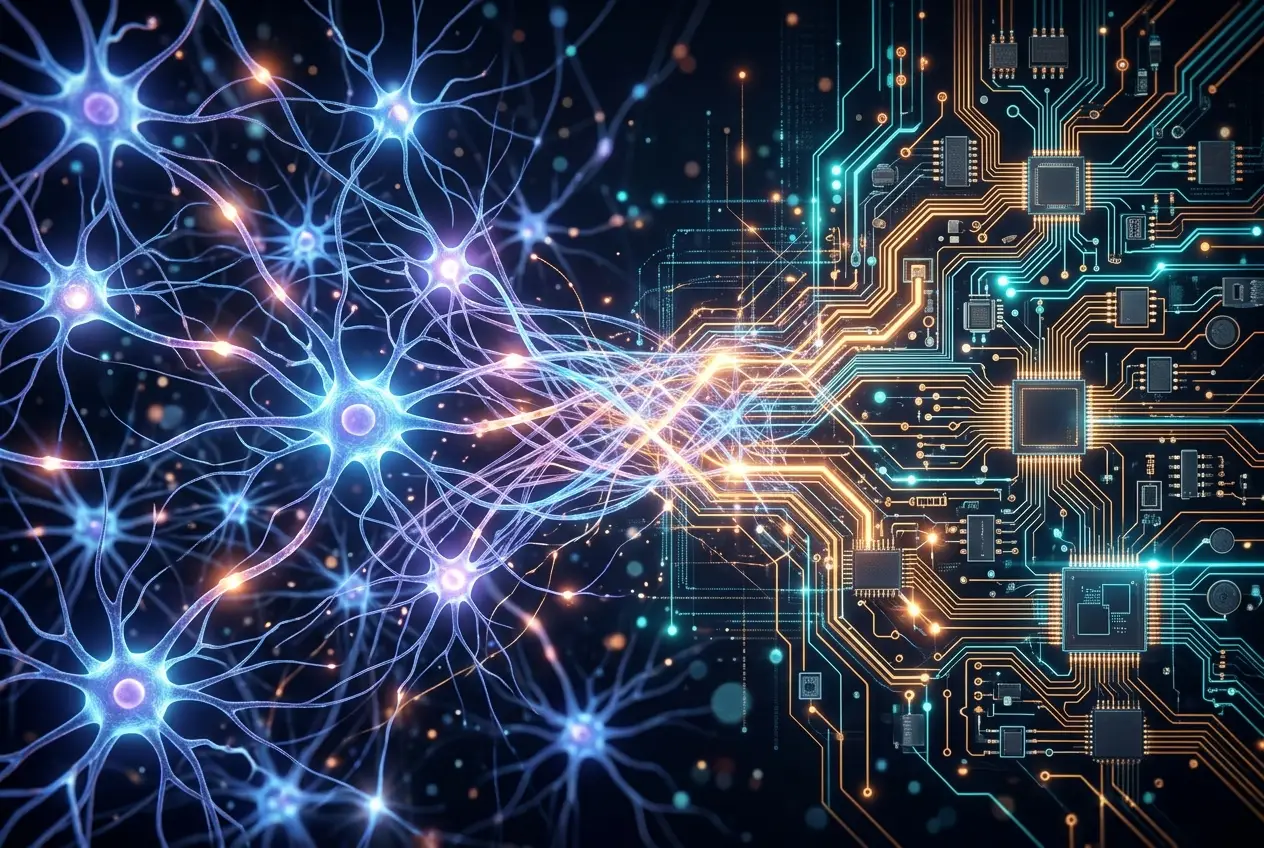
I remember staring at my smartphone the other day, marveling at how seamlessly it anticipated my needs. A quick search for a restaurant led to instant directions, a perfect table reservation, and even a recommendation for a dish I hadn't considered. It felt less like using a tool and more like an extension of my own thoughts. But what if that 'extension' wasn't just in my hand, but directly wired into my brain? What if our very consciousness could seamlessly integrate with artificial intelligence, not just interacting with it, but becoming one with it?
This isn't a plot from a cyberpunk novel anymore; it’s a question echoing through the halls of neuroscience and artificial intelligence labs worldwide. The idea of a human-AI merge — a direct, bidirectional link between our biological brains and digital intelligence — is rapidly transitioning from pure science fiction to a tangible, albeit highly complex, engineering challenge.
The Dawn of Direct Connection: Brain-Computer Interfaces (BCIs)
The journey toward merging human and artificial intelligence begins with Brain-Computer Interfaces (BCIs). These revolutionary technologies establish a communication pathway between a wired brain and an external device. For decades, BCIs have been a beacon of hope for individuals with severe neurological disorders. I’ve seen firsthand the incredible impact these devices can have, allowing paralyzed individuals to control prosthetic limbs with their thoughts or communicate by simply imagining words.
Think about it: a person who cannot move their limbs can now reach out and grasp an object, simply by thinking about it. This isn't just incredible; it's profoundly human. The signals generated by their brain are detected, decoded by algorithms, and translated into commands for robotic devices. While these early BCIs primarily involve extracting information from the brain, the promise has always been greater: a two-way street, where information can flow into the brain as well, directly influencing perception and cognition. This is where the idea of a true brain-AI merge truly starts to take shape.
Beyond Restoration: Augmenting Our Very Selves
Initially, BCIs focused on restoring lost function. But the ambition has quickly expanded. What if we could augment human intelligence beyond its natural limits? Imagine instantly recalling any piece of information, processing complex data at speeds currently unimaginable, or even experiencing senses beyond our biological five. This isn't just about making us "smarter" in the traditional sense; it’s about fundamentally changing the way we interact with and perceive the world.
This vision often intersects with the philosophy of transhumanism, which advocates for the enhancement of the human condition through advanced technology. Proponents believe that by embracing such technologies, humanity can overcome biological limitations, potentially even achieving forms of "digital immortality" or dramatically extending lifespan. It's a bold idea, one that asks us to reconsider the very definition of being human. For more on how AI might affect our perception of self, you might find our previous discussion on whether AI’s neural networks could become self-aware quite illuminating.
Leading the charge in this new frontier are companies like Neuralink, founded by Elon Musk. Their stated goal is to create ultra-high-bandwidth BCIs to connect humans and computers, addressing neurological conditions, and ultimately, achieving symbiotic AI. The idea is to create a seamless interface, almost invisible, that could allow us to upload and download information directly to and from our brains. While still in early stages, Neuralink’s progress with implantable devices, like the "Link," demonstrates a tangible step towards making direct neural integration a reality. You can read more about their ambitious goals on their Wikipedia page (opens in a new tab).
The Architecture of a Brain-AI Bridge: How Would it Even Work?
Creating a direct brain-AI merge is an engineering marvel that requires solving problems on multiple fronts. The human brain is an incredibly complex, analog, electrochemical system. AI, on the other hand, operates on digital logic and vast datasets. Bridging these two distinct architectures is the core challenge.
Here’s a simplified breakdown of the technical hurdles:
- High-Bandwidth Data Transfer: Our brains generate an astonishing amount of data. To truly merge, we need interfaces capable of reading and writing data at unprecedented speeds and volumes. Current BCIs are limited in the number of neurons they can interface with. Future devices would need millions, if not billions, of connections.
- Signal Fidelity and Noise Reduction: Extracting clean, meaningful neural signals from the brain's "noise" is difficult. Similarly, injecting precise digital information back into the brain without causing interference or damage is critical.
- Biocompatibility and Longevity: Implants need to be safe, non-toxic, and durable enough to remain in the brain for decades without degrading or causing adverse immune responses.
- Software and Algorithms: Sophisticated AI algorithms would be needed to translate complex thoughts, intentions, and perceptions into digital data, and vice-versa. This involves machine learning models trained on vast amounts of neural activity.
Imagine a future where you could instantly access the internet, not through a screen, but directly within your mind. Or perhaps, collaborate with an AI that enhances your creative output, offering insights and expanding your cognitive horizons as if it were an extension of your own thought process. This vision of augmented intelligence could redefine productivity and creativity.
Ethical Minefields and Societal Shifts
As we edge closer to the possibility of a direct human-AI merge, profound ethical questions arise. This isn't just about technological feasibility; it's about the very fabric of our society and identity.
- Privacy and Control: If our thoughts can be read and interpreted by AI, what happens to mental privacy? Who owns the data generated by our merged minds? What prevents external entities from influencing or even controlling our thoughts and decisions?
- Identity and Consciousness: What does it mean to be "human" when part of our consciousness is digital? If AI components become integral to our thought processes, could it alter our sense of self? Could a merged individual develop a different kind of consciousness? Our exploration into can neuro-dust upload our minds for digital immortality delves into some of these concerns.
- Access and Equity: Will this technology be accessible to everyone, or will it create a new divide between the "augmented" and the "unaugmented"? The cost and complexity of such procedures could lead to significant social inequalities, widening the gap between those who can afford cognitive enhancement and those who cannot.
- Security Vulnerabilities: A direct brain interface presents an unprecedented attack surface for cyber threats. Could a merged mind be hacked, manipulated, or even "infected" with malware? The implications are truly frightening.
These aren't abstract philosophical debates; they are urgent questions that need to be addressed as the technology advances. We need robust ethical frameworks and international regulations to ensure that the development of human-AI merging technologies benefits humanity as a whole, rather than becoming a source of new dangers or divisions. The discussion on the ethics of artificial intelligence (opens in a new tab) is crucial for navigating this complex landscape.
The Transhumanist Vision vs. Reality
The grand vision of some transhumanists is a future where humanity transcends its biological limitations, moving towards a post-human existence. In this future, the human-AI merge is not merely an enhancement but a necessary evolutionary step. They envision a world where diseases are eradicated, intelligence is limitless, and even death might become optional through advanced forms of mind uploading or digital consciousness.
However, the reality is likely to be far more nuanced and gradual. Initial applications will undoubtedly focus on medical benefits, improving quality of life for those with disabilities. As the technology matures, we might see incremental enhancements, such as improved memory or faster learning capabilities. The "merge" might be more of a sophisticated collaboration, where AI acts as a powerful cognitive co-processor, rather than a complete fusion of identities. The path from current BCIs to a seamless, integrated human-AI mind is fraught with scientific, engineering, and ethical challenges that will take decades, if not centuries, to overcome.
Nevertheless, the pursuit of this integration pushes the boundaries of our understanding of both intelligence and consciousness. It forces us to ask deep questions about what it means to be alive, to think, and to experience. Could AI even design its own evolution, accelerating this process? We explored that fascinating possibility in our blog, can AI design its own evolution.
Conclusion: A Future of Infinite Possibilities, and Profound Responsibilities
The idea of our brains directly merging with AI is a topic that ignites both immense excitement and deep apprehension. The potential benefits—eradicating neurological diseases, vastly expanding human intellect, and unlocking new forms of experience—are truly staggering. However, the ethical and societal risks—questions of privacy, identity, control, and equity—are equally profound.
As researchers continue to push the boundaries of neurotechnology and artificial intelligence, we stand at the precipice of a revolution that could redefine humanity itself. It's a journey that demands careful consideration, open dialogue, and a commitment to ensuring that these powerful tools are developed responsibly and ethically. The future of human-AI integration isn't just about what technology can do, but what we, as a society, decide it should do.

Conversation0
No comments yet. Be the first to share a thought — the best questions often become new stories.