


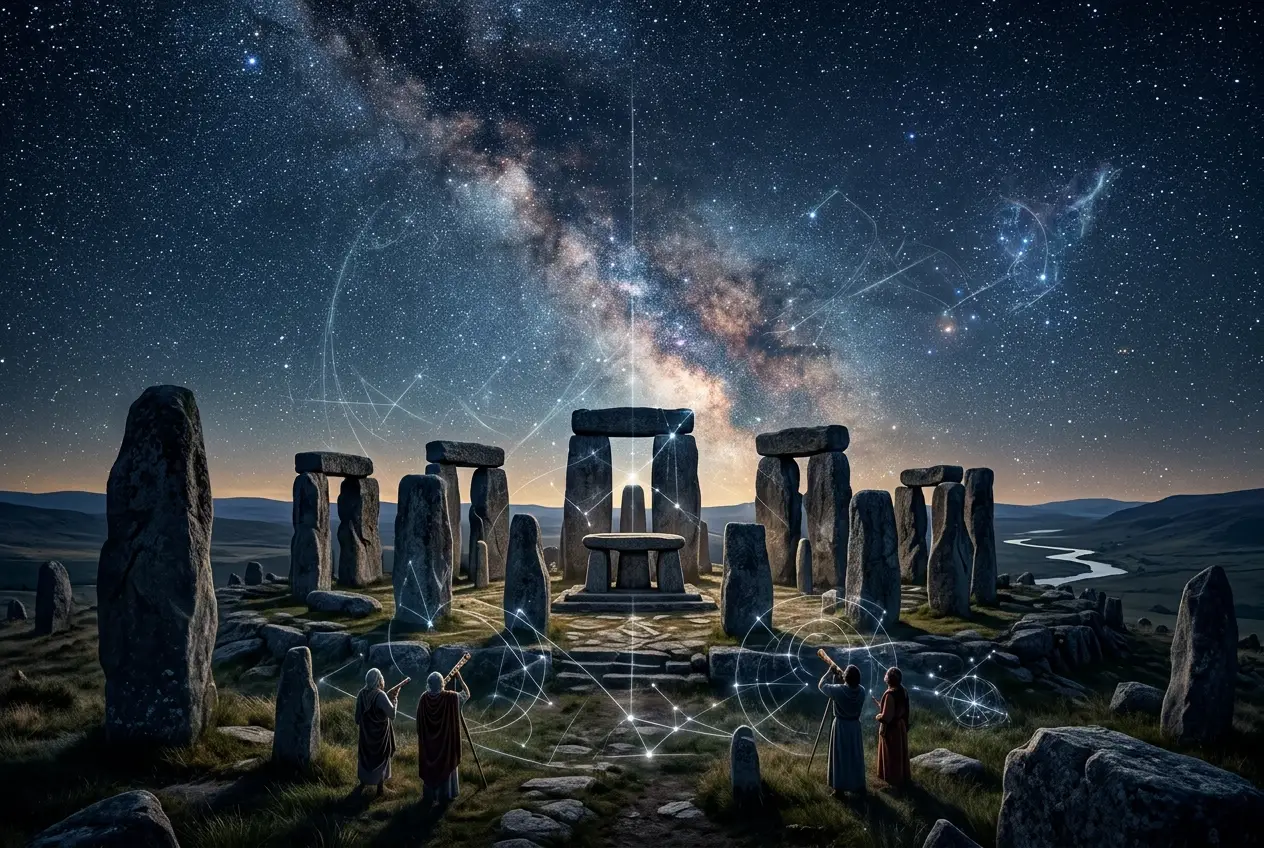
I recently found myself staring at a replica of an ancient star map, not from a textbook, but from a small, dusty antique shop. It wasn't particularly accurate by modern standards, yet it evoked a profound sense of wonder. How did our ancestors, without telescopes, satellites, or supercomputers, manage to chart the heavens with such dedication? What if their understanding of the cosmos went far deeper than mere observation, delving into complex "time algorithms" that modern science is only beginning to fully appreciate?
The common narrative often paints ancient civilizations as simple sky-gazers, noting the solstices and equinoxes for agricultural purposes. While true, I believe this view significantly undersells their intellectual prowess. Digging into archaeoastronomy, I've come across compelling evidence that suggests some ancient cultures possessed an astonishingly sophisticated grasp of cosmic cycles, particularly the precession of the equinoxes — a phenomenon so slow and subtle that it seems almost impossible to detect without centuries of meticulous, uninterrupted record-keeping.
The Grand Cosmic Dance: Precession of the Equinoxes
Imagine a celestial waltz so slow it takes nearly 26,000 years to complete a single turn. That’s the precession of the equinoxes. It’s caused by a slight wobble in Earth’s rotational axis, similar to a spinning top slowing down. This wobble causes the apparent position of the stars at the spring equinox to gradually shift through the constellations of the zodiac. For example, where the spring equinox once occurred with the Sun in Aries, it now occurs with the Sun in Pisces, and in a few hundred years, it will shift into Aquarius. This isn't a quick observation; it requires an almost generational dedication to astronomical data collection.
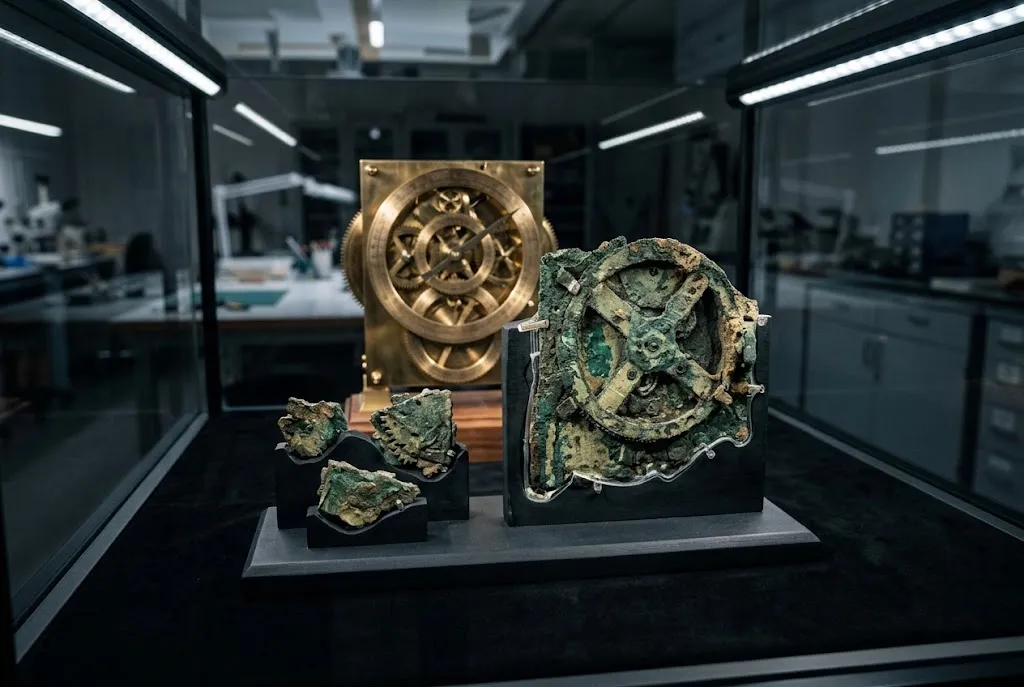
So, how did ancient astronomers, often priest-kings or shamanistic figures, manage to identify, track, and even encode this grand cosmic cycle? It's a question that challenges our assumptions about their scientific capabilities. While direct evidence of a "cosmic computer" in the modern sense is absent (and indeed, Antikythera itself, a marvel of ancient engineering, was more an analog calculator than a cosmic data processor), the sheer depth of their astronomical insights suggests a form of computational thinking, an "algorithmic approach" to understanding cosmic time.
Megalithic Observatories: Ancient Data Processors?
Across the globe, from the towering stone circles of Stonehenge in England to the intricate alignments of Chichen Itza in Mexico and the subtle geometry of Goseck Circle in Germany, ancient cultures constructed monumental structures that served as more than just temples or burial grounds. Many functioned as sophisticated observatories, carefully aligned to track the movements of celestial bodies.
What strikes me as particularly fascinating is that these structures weren't just designed to mark solstices or equinoxes – events that are relatively easy to observe annually. Some alignments suggest an awareness of much longer cycles. For instance, the Caracol observatory at Chichen Itza has windows aligned to the extreme northern and southern settings of Venus, requiring generations of observation to fully map its complex cycles. The precision involved is staggering, implying not just observation, but a methodology for collating, comparing, and interpreting vast amounts of data over extended periods.
For a deeper dive into how some of these sites might have functioned, you might be interested in our earlier post: Did Ancient Structures Track Cosmic Particles?.
These megalithic sites could be seen as ancient data processors. The physical alignments, stone markers, and even the shadows cast by monumental structures acted as analogue "inputs" and "outputs." The "processing" happened within the minds of the astronomers, who, through generations of dedicated study, built complex mental models or practical systems to understand these patterns. This wasn't about building a machine in the silicon sense, but about building a system of knowledge and observation that functioned as a computational network.
Encoding the Unseen: Myths, Mathematics, and Architecture
One of the most intriguing aspects is how this highly specialized knowledge was transmitted and preserved. Ancient societies often didn't have widespread literacy or printed books. Instead, knowledge was embedded in a variety of forms:
- Oral Traditions and Myths: Many ancient myths, often dismissed as mere stories, contain complex astronomical information. The cyclical nature of hero journeys, the appearance and disappearance of deities, or the narratives of cosmic creation could serve as mnemonic devices for remembering long astronomical periods. As explored in our blog: Did Ancient Myths Encode Advanced Cosmic Data?
- Sacred Geometry and Architecture: The dimensions and proportions of ancient temples, pyramids, and other structures often incorporate astronomical constants and mathematical ratios that reflect celestial movements. The Great Pyramid of Giza, for example, has been observed to contain measurements that align with the Earth’s dimensions and astronomical cycles. Could this be a form of "hard-coded" cosmic data?
- Symbolic Art and Calendars: Elaborate carvings, stellae, and intricate calendar systems (like the Mayan Long Count Calendar, which tracks cycles spanning thousands of years) offer another layer of encoded cosmic knowledge. These weren't just about day-to-day timekeeping; they articulated vast, overarching temporal structures. More on ancient celestial observations can be found in our article: Did Ancient Cultures Chart Invisible Stars?.
This encoding suggests a deliberate effort to abstract and generalize astronomical observations into a coherent system. This is the essence of an algorithm: a set of steps or rules followed in calculations or other problem-solving operations. Ancient astronomers likely developed sophisticated "algorithms" based on observed celestial mechanics, using these to predict future events or understand past cycles.
The "Why" Behind Cosmic Time Algorithms
Why was understanding these deep cosmic rhythms so important to ancient civilizations? I believe it goes beyond practicalities like planting seasons, though those were certainly crucial.
- Cosmic Order and Worldview: For many ancient cultures, the cosmos was a living entity, and its movements reflected divine order. Understanding these cycles was a way to comprehend the mind of the divine, to align human society with cosmic harmony, and to maintain stability.
- Predicting Cataclysms: Some theories suggest that awareness of these long cycles might have been linked to prophecies of global change or cataclysms. If long-term celestial shifts were understood, perhaps they were also believed to correlate with periods of upheaval on Earth.
- Spiritual Significance: The journey through the zodiac signs over millennia could have had profound spiritual and esoteric meaning, marking great ages of human development or spiritual evolution.
- Technological Applications (Hypothetical): While speculative, some researchers wonder if a deep understanding of cosmic cycles could have informed other, more practical or even "lost technologies." If they could predict subtle celestial influences, could they have developed ways to harness or mitigate them? For a related discussion on ancient technological insights, consider reading: Ancient Oracles: Did Tech Fuel Divine Prophecy?.
Modern Reappraisal: Unearthing Ancient Brilliance
Today, modern archaeoastronomers and historians are employing cutting-edge technology to re-examine these ancient sites and texts. LiDAR scans reveal previously hidden alignments in landscapes, while advanced computational modeling allows researchers to simulate ancient skies from different vantage points. AI is even being used to detect patterns in ancient iconography that might correlate with astronomical events.
This convergence of ancient wisdom and modern tech is unveiling a picture of our ancestors not as primitive, but as deeply intelligent, systematic thinkers who built complex frameworks to understand their universe. Their "cosmic algorithms" might not have run on circuits, but they were remarkably effective in charting the universe's grandest movements.
Conclusion: A Legacy of Cosmic Curiosity
The idea that ancient astronomers decoded cosmic time algorithms isn't about claiming they had advanced alien technology. It's about recognizing the incredible power of human intellect, dedication, and ingenuity. They looked at the stars, not just as distant lights, but as a vast, unfolding dataset. They developed methods – whether through patient observation, mathematical insight, or collective wisdom passed down through generations – to extract meaning from that data, to identify the slow, majestic rhythms of cosmic time.
As I look at that old star map again, I'm reminded that curiosity is timeless. Our ancestors, standing under the same sky, asked similar questions to ours and, in their own unique ways, built powerful "computers" of knowledge to find the answers. Their legacy urges us to keep looking up, to keep asking questions, and to never underestimate the ingenuity hidden in the annals of history.




Conversation0
No comments yet. Be the first to share a thought — the best questions often become new stories.