


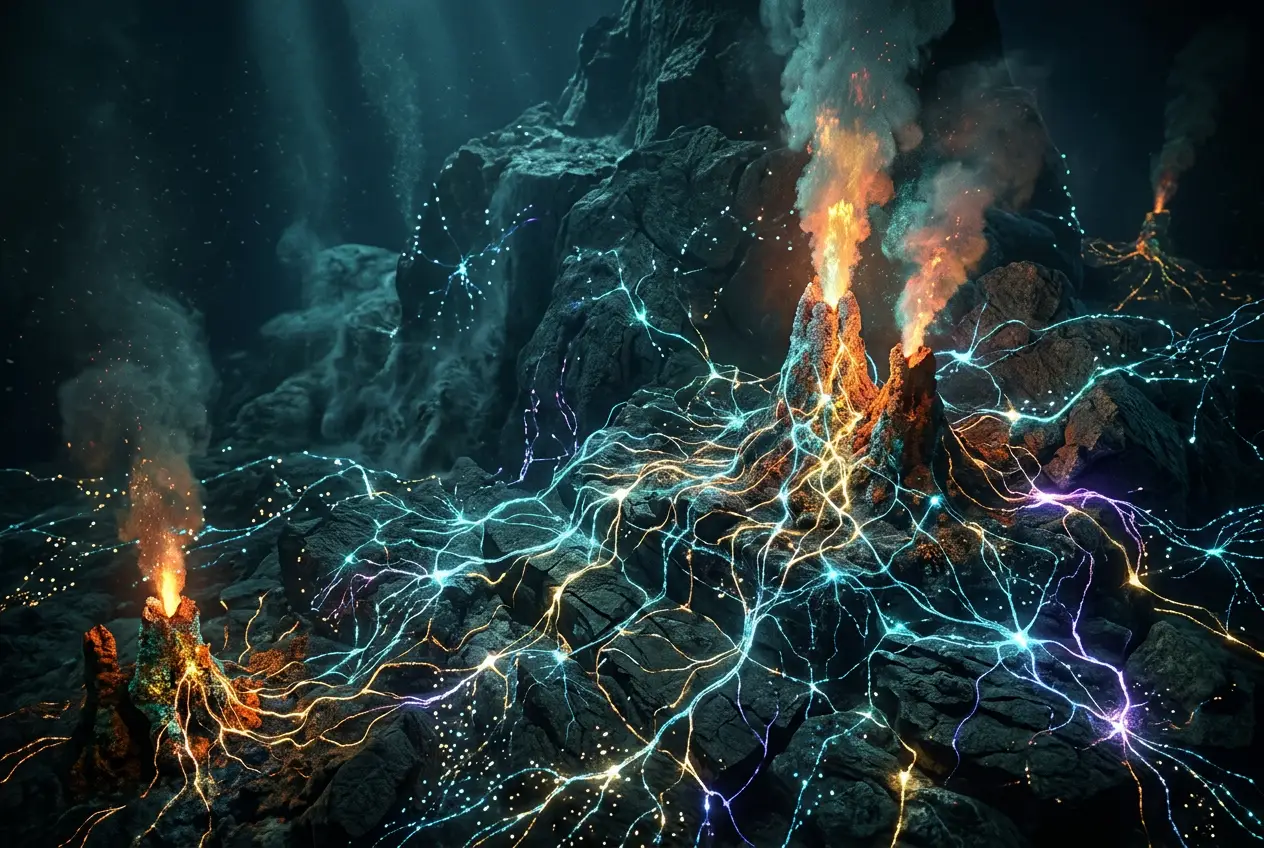
I remember staring at my laptop screen, captivated by the intricate dance of data, and a thought struck me: what truly defines a computer? Is it just silicon chips and electrical currents, or could the very Earth beneath our feet, specifically its vast, enigmatic ocean floor, be processing information in ways we've yet to fully comprehend? This isn't about ancient civilizations or futuristic AI; it’s about rethinking what "computation" means, especially when we look at nature's most complex, least-explored realm.
For decades, we’ve been fixated on human-made machines as the sole arbiters of complex computation. We build supercomputers that fill entire rooms, capable of quadrillions of calculations per second. But what if nature, with its billions of years of trial and error, has been running the ultimate distributed computing network right under our noses – or, more accurately, under miles of crushing ocean water? The idea of the seafloor as a “natural computer” might sound like a stretch, yet when we delve into its intricate processes, a fascinating analogy begins to emerge.
What is a "Computer" Anyway? Beyond Silicon and Code
Before we dive into the abyssal plains, let's briefly challenge our conventional definition of a computer. At its core, a computer is a system that processes information to perform a task. It takes inputs, performs operations based on a set of rules (algorithms), and produces outputs. This can be a digital calculator, a human brain, or even a basic mechanical device.
Modern computing relies on electrons flowing through circuits, but what about other forms of information processing? Chemical reactions, biological interactions, and geological processes all involve inputs, transformations, and outputs. If we broaden our perspective, the line between a "natural process" and a "computational process" starts to blur. Could the deep ocean be performing a kind of planetary-scale computation?
The Seafloor's Unseen Networks: A World of Data
The ocean floor covers over 70% of our planet’s surface, a largely unexplored frontier hiding immense geological, chemical, and biological activity. It’s a realm of extreme pressures, perpetual darkness, and astonishing biodiversity. But it’s also a place where information is constantly being generated, stored, processed, and transmitted.
Imagine the sheer volume of "data" generated daily:
- Sediment Layers: Each layer tells a story of millennia, encoding climatic shifts, volcanic eruptions, and biological evolution. This is Earth's geological hard drive, storing vast amounts of historical data.
- Hydrothermal Vents: These are like natural data centers, spewing superheated, mineral-rich fluids. They create unique chemical environments that drive incredibly complex biological ecosystems, akin to a constant stream of processing.
- Microbial Mats: Billions upon billions of microorganisms form vast, interconnected networks, exchanging chemicals and genetic information. These are biological processors operating at a scale almost beyond comprehension.
This environment isn't static; it's dynamic, reactive, and interconnected. The forces at play—tectonic plate movements, deep-sea currents, chemical gradients—are all forms of information exchange and processing.
Hydrothermal Vents: Nature's High-Performance Computing Clusters
One of the most compelling arguments for the seafloor as a "natural computer" lies in hydrothermal vents. Discovered relatively recently, these underwater geysers are oases of life, thriving in conditions previously thought impossible. Water seeps into the Earth's crust, gets superheated by magma, and then erupts through vents, carrying a unique cocktail of chemicals like hydrogen sulfide, methane, and various metals.
"The discovery of hydrothermal vents revolutionized our understanding of life on Earth, revealing entire ecosystems powered not by sunlight, but by chemosynthesis," notes a relevant article on Wikipedia about Hydrothermal Vents. These vents act as natural chemical reactors, facilitating complex energy transformations. Think of them as high-performance computing clusters:
- Inputs: Seawater, chemicals from Earth's crust, heat energy.
- Processors: The unique chemical environment and specialized extremophile microorganisms.
- Outputs: New mineral formations, altered chemical compositions, and sustained biological communities.
The constant flow and reaction of chemicals, driven by thermal energy, can be seen as a form of analog computation, where physical and chemical states continuously interact and evolve, solving complex problems of energy distribution and biochemical synthesis on a vast scale.
Microbial Life: Living Algorithms and Distributed Networks
The deep-sea microbiome is arguably the most pervasive "computational" layer of the ocean floor. Trillions of bacteria, archaea, and other microorganisms inhabit every conceivable niche, from the water column to the deep sediment and within the Earth's crust itself. These aren't just passive organisms; they are active agents, constantly interacting and reacting.
Consider the biogeochemical cycles they drive: carbon, nitrogen, sulfur – these elements are continuously recycled and transformed by microbial action. This is a massive, distributed network, where each microbe acts as a tiny processor, taking in specific chemical inputs and producing others. Their collective activity maintains the delicate balance of the planet's chemistry, a feat of complex, self-organizing computation.
The analogy to distributed computing is strong. Just as a modern supercomputer distributes tasks across thousands of processors, the deep-sea microbiome distributes biogeochemical tasks across countless individual organisms. They communicate not through Wi-Fi, but through chemical signals, creating a vast, bio-computational network that continuously adapts and evolves. This reminds me of how intricate mycelial networks can process information, a concept explored in our blog on Can Fungi Build Computers? Mycelial Tech Power.
Geological Data Storage & Processing: Earth's Long-Term Memory
Beyond biological processes, the very geology of the seafloor demonstrates computational characteristics. Seismic activity, for instance, isn't just random shaking. It's a complex interaction of forces, pressures, and material properties that results in predictable (though often unpredictable in timing) energy releases. The Earth's crust can be seen as a massive, dynamic data storage medium.
- Tectonic Plates: Their slow, grinding movements are like background processes, constantly reshaping the "hardware" and influencing energy flow. These movements store and release immense energy, influencing everything from volcanic activity to the distribution of elements.
- Sedimentation: Layers of sediment accumulate over millions of years, recording climate history, ancient life, and geological events. This is Earth's archive, its long-term memory, accessible through core samples.
- Magmatic Activity: The flow of magma, its chemical differentiation, and its interaction with the crust are complex chemical computations that determine the composition of new rock and influence vent systems.
These geological processes are not just random events; they are governed by physical laws and chemical reactions, acting as a massive, continuous "solver" for planetary-scale equations, shaping the very structure of our world. The idea that such deep-seated processes could hold secrets is not new, as discussed in the blog Does Earth's Center Hide a Secret Ocean?.
Seismic Activity: A Planetary Input/Output System
Earthquakes are dramatic outputs of this geological "computer." They are the result of immense stress accumulating in the Earth's crust, a form of stored potential energy. When this stress exceeds the rock's strength, it releases as seismic waves. These waves then propagate through the Earth, carrying information about the quake's location, magnitude, and the properties of the materials they travel through.
From a computational perspective:
- Input: Tectonic forces, mantle convection, rock properties.
- Processing: Accumulation and release of stress within the lithosphere.
- Output: Seismic waves, ground deformation.
The study of seismology is, in essence, an attempt to decode the outputs of this natural system to understand the inputs and internal processing. The Earth's continuous hum, or microseisms, also reveals ongoing subtle processing, a topic we touched upon in Earth's Hidden Pulse: Does Our Planet Hum a Secret Song?.
The "Programming" Language of Nature: Gradients and Flows
What would be the "code" or "programming language" of this natural computer? I believe it's the gradients and flows of energy, matter, and information that permeate every corner of the ocean floor.
- Chemical Gradients: Differences in concentration of chemicals drive reactions and microbial activity. These are like instruction sets for biological processors.
- Thermal Gradients: Heat flow from the Earth's interior drives convection currents and influences geochemical processes, acting as energy inputs for computation.
- Pressure Gradients: The immense pressure of the deep sea influences chemical reactions and the behavior of matter, shaping the computational environment.
These gradients aren't static; they are constantly interacting, creating feedback loops and emergent behaviors that maintain ecosystems and reshape geology. It’s a complex, self-organizing system far beyond anything we can design.
Future Implications: What if We Could "Interface"?
If the ocean floor is indeed a natural computer, what are the implications? Firstly, it offers a radical new perspective on planetary intelligence and the intricate ways Earth functions. It suggests that computation isn't limited to human intelligence or even biological brains, but is a fundamental property of complex, interacting systems.
Secondly, understanding these natural computational processes could inspire new paradigms for artificial intelligence and computing. Could we design systems that mimic the distributed, self-organizing, and energy-efficient processing found in deep-sea microbial communities? This concept, often called bio-inspired computing, seeks to learn from nature’s solutions.
Finally, it reinforces the sheer wonder of our planet. The deep ocean remains one of the greatest mysteries, a vast, alien world right here on Earth, potentially running computations crucial for the planet's stability, encoding histories, and orchestrating life itself. Exploring this "natural computer" may reveal secrets far more profound than we can currently imagine, perhaps even informing our understanding of a grander cosmic code, as explored in Is Our Reality a Digital Simulation?.
The idea isn't that the ocean floor is consciously "thinking" or running Python scripts. Instead, it posits that the emergent properties of its vast, interconnected systems of geology, chemistry, and biology collectively perform a form of natural information processing on a scale that dwarfs our most powerful supercomputers. It's a testament to the fact that intelligence and computation manifest in myriad forms, many of which we are only just beginning to decipher.
Conclusion: A New Lens on Earth's Deep Secrets
The concept of the ocean floor as a "natural computer" transforms our perception of Earth's most enigmatic domain. It encourages us to look beyond conventional definitions of technology and computation and appreciate the profound, self-organizing intelligence inherent in natural systems. The deep sea is not merely a dark, desolate void; it is a vibrant, dynamic network, constantly processing, storing, and responding to planetary forces. As our technology advances, perhaps we will develop the tools to truly "read" the data and "understand" the computations happening miles beneath the waves, unlocking secrets that could redefine our place in the universe.
For further reading on related topics, you might find the Wikipedia articles on Geological Computer and Emergent Intelligence insightful.





Conversation0
No comments yet. Be the first to share a thought — the best questions often become new stories.