



I remember a moment in my early studies of history when I stumbled upon something that completely shattered my preconceived notions of ancient civilizations. It wasn't a grand pyramid or a forgotten city, but a humble clay pot, about the size of a modern-day car battery, unearthed near Baghdad. This artifact, now famously known as the Baghdad Battery, sparked a question that still echoes in archaeological circles: Did people living over two millennia ago in Mesopotamia possess knowledge of electricity? Could ancient Iraqis have harnessed a power source we often associate with much later discoveries? The very thought of it sends shivers down my spine, forcing me to rethink the timeline of human innovation.
For centuries, our understanding of technological progress has largely followed a linear path, culminating in the industrial and digital ages. But what if there were brilliant flashes of advanced understanding, quickly lost to time and circumstance? The Baghdad Battery is one such dazzling, perplexing flash, an anomaly that challenges our textbooks and ignites our collective curiosity.
The Unearthing of an Enigma: What is the Baghdad Battery?
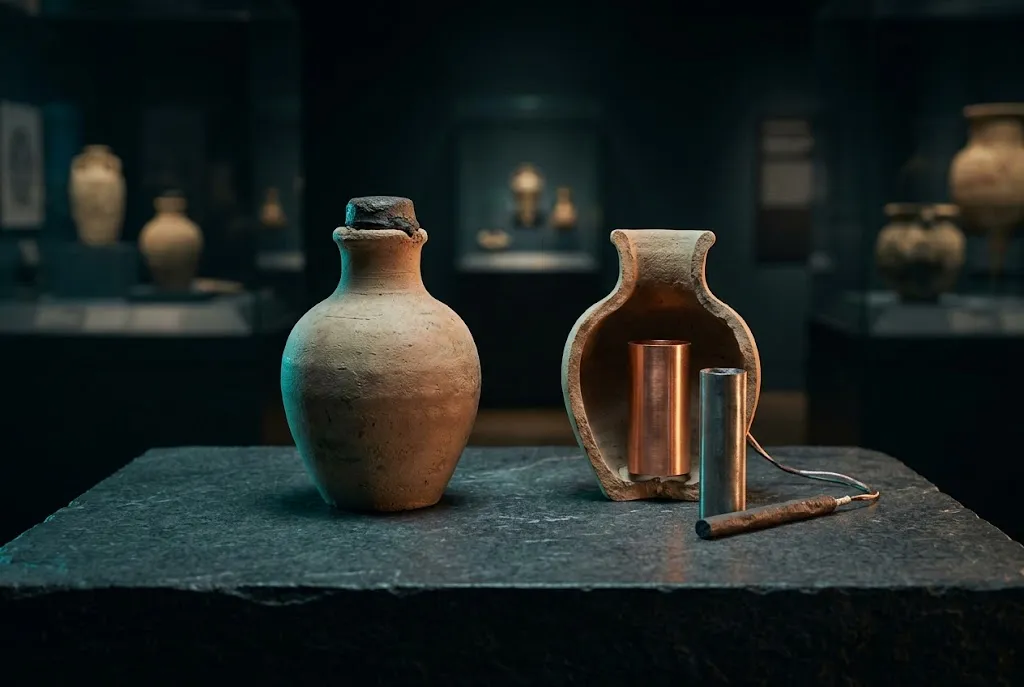
The story of the Baghdad Battery begins in 1938, during archaeological excavations near the village of Khujut Rabou, southeast of Baghdad, Iraq. German archaeologist Wilhelm König was leading the expedition when his team discovered a peculiar artifact. It consisted of a six-inch-tall terracotta jar, within which sat a copper cylinder. Inside this cylinder, an iron rod was suspended, held in place by an asphalt stopper. König, who was then the director of the National Museum of Iraq, immediately recognized its unusual nature.
Upon closer inspection and reconstruction, König proposed a revolutionary idea: this device was an ancient electric battery. He theorized that if an acidic or alkaline liquid, such as vinegar or grape juice, were poured into the jar, it would create an electrochemical reaction between the copper and iron, generating a small electrical current. This was a bold claim, especially considering the conventional view that electricity was not understood until the late 18th century with Alessandro Volta's experiments.
How Could It Have Worked? The Science Behind the Ancient Spark
To understand König's hypothesis, we need a quick dive into basic electrochemistry. A simple battery, like the Baghdad Battery, relies on two different metals (electrodes) submerged in an electrolyte solution. In this case:
- Copper: The more noble metal, acting as one electrode.
- Iron: The less noble metal, acting as the other electrode.
- Electrolyte: An acidic liquid (like vinegar, lemon juice, or even fermented grape juice) that facilitates the flow of ions between the metals.
When these components are assembled, a chemical reaction occurs. Electrons flow from the iron (anode) to the copper (cathode) through an external circuit (if one were connected), creating an electrical current. The voltage generated by a single Baghdad Battery replica is typically around 0.8 to 2 volts, depending on the electrolyte used. While this isn't enough to power a laptop, it’s certainly enough to make certain things happen. For a deeper understanding of this electrochemical process, you can refer to the Wikipedia page on the Baghdad Battery itself, which details the scientific principles at play: Baghdad Battery - Wikipedia (opens in a new tab).
Applications: What Were They For?
This is where the mystery truly deepens and various theories emerge, painting vivid pictures of ancient technological prowess.
1. Ancient Electroplating
One of the most compelling theories, and the one most widely supported by experimental archaeologists, is that the batteries were used for electroplating. Electroplating is the process of coating a metallic object with a thin layer of another metal, often gold or silver, using an electric current. This technique could have been used to create decorative items, jewelry, or even to give cheaper metals the appearance of precious ones.
For instance, some archaeological findings from the region, such as small silver objects with incredibly thin gold coatings, hint at the possibility of electroplating. If the Baghdad Battery could produce even a small, sustained current, it could facilitate such a process, albeit a slow one. Imagine ancient artisans, meticulously transforming bronze ornaments into gleaming "gold" treasures, long before modern chemistry formally discovered the technique. This could be one of the early instances of applied electrochemistry in human history.
2. Medicinal Purposes
Another intriguing theory suggests a medical application. In ancient times, electricity was often associated with healing. The ancient Greeks and Romans, for example, used electric fish (like torpedo rays) to treat pain, especially gout and headaches. While the Baghdad Battery couldn't deliver the powerful shock of an electric eel, it could produce a mild tingling sensation. This sensation might have been perceived as having therapeutic or pain-relieving properties, similar to modern TENS (Transcutaneous Electrical Nerve Stimulation) units. Patients might have held small objects connected to the battery, believing in its mystical or scientific power to alleviate ailments.
3. Ritualistic or Religious Use
Given the era, it's also plausible that the Baghdad Batteries served a ritualistic or religious purpose. A mild electric shock could have been interpreted as a divine touch, a mystical force, or a way to enhance spiritual experiences. Priests might have used them in ceremonies to create awe or to signify a connection to the gods. The "magic" of a silent, invisible force could have greatly impressed the uninitiated.
4. Novelty or Education
Perhaps the simplest explanation is that they were merely curiosities, novelties, or even teaching aids. The human drive to experiment and understand the natural world is timeless. A bright mind in ancient Mesopotamia might have discovered this effect purely by accident and then replicated it for demonstration or personal amusement. Not every invention needs a grand, practical purpose; sometimes, the wonder of discovery is enough.
Replicating the Past: Experimental Archaeology
Countless modern experiments have replicated the Baghdad Battery, using various electrolytes and attempting different applications. Scientists from institutions like the New York State Department of Parks and Recreation's Archeological Laboratory have successfully demonstrated that these devices could produce electricity. In 1999, the "MythBusters" television show built ten replica batteries, filled them with grape juice, and connected them in series to generate enough voltage to electroplate a small medal with gold.
These experiments lend considerable weight to König's original hypothesis. They show that the technology was indeed feasible with the materials and knowledge available to the Parthian (c. 250 BC – AD 224) or Sasanian (AD 224–651) empires, the periods to which the battery is generally dated. The craftsmanship involved in creating the sealed copper cylinder and asphalt stopper suggests a deliberate construction rather than accidental assembly.
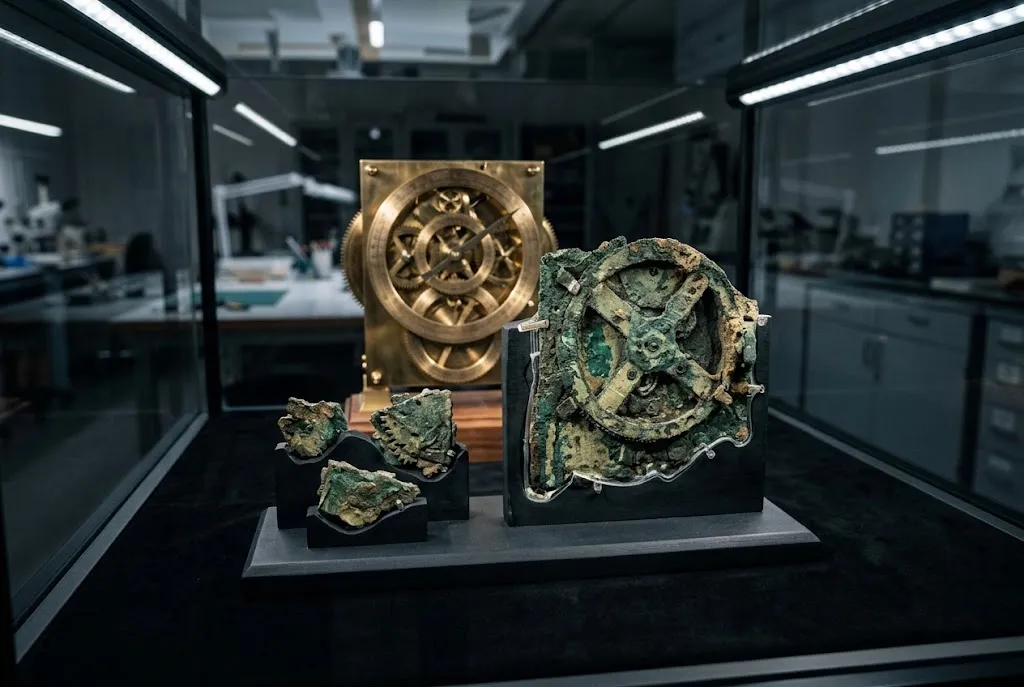
The ability of ancient civilizations to achieve surprising feats of engineering and scientific understanding is not unheard of. Consider the Antikythera Mechanism, a complex astronomical calculator from ancient Greece, which we discussed in a previous post: Did Ancient Greeks Build a Cosmic Computer?. These discoveries force us to challenge our assumptions about the "primitive" nature of early societies.
The Skeptics and Counterarguments
Despite the compelling evidence and successful replications, the Baghdad Battery theory isn't without its detractors. Skeptics raise valid points that prevent the theory from being universally accepted:
- No Wires or Electrical Appliances: A major argument against the electrical theory is the complete absence of any accompanying wires, electrodes, or other devices that would logically be powered by such batteries. If they were used for electroplating, where are the workshops, the discarded electrodes, or the finished goods that unequivocally show signs of this process?
- Alternative Interpretations: Another leading counter-theory, proposed by German Egyptologist Arne Eggebrecht, suggests the jars were used to store sacred scrolls, possibly made of papyrus. The copper cylinder would have been rolled up with the scroll, and the asphalt sealant protected it from moisture. However, no traces of papyrus or scrolls have ever been found inside the artifacts.
- Limited Power: While replications show a small voltage, the current produced by a single battery is quite low. To achieve significant electroplating or therapeutic effects, multiple batteries would need to be connected in series, forming a "battery pack." While feasible, no such collections of connected batteries have been discovered.
- Lack of Documentation: There are no ancient texts, blueprints, or descriptions that explicitly mention the use of electricity or devices akin to the Baghdad Battery. While many ancient records are lost, the complete silence on such a potentially revolutionary technology is puzzling.
This debate highlights the constant struggle in archaeology: interpreting silent artifacts without a direct historical narrative. It's similar to the enduring mysteries surrounding unexplained technologies or anomalies in other areas, such as those we explore in Mysteries on the Moon: Are Anomalies Unexplained Tech?.
Historical Context: The Parthians and Sasanians
The dating of the Baghdad Battery places it firmly within the Parthian or Sasanian empires. These were powerful, sophisticated civilizations that controlled vast territories in the Middle East, boasting impressive advancements in architecture, art, mathematics, and metallurgy. The Parthians, in particular, were known for their innovative military tactics and resilient empire. The Sasanians, who followed them, were a highly centralized empire with a rich cultural output. It wouldn't be entirely out of character for such inventive societies to stumble upon or even deliberately develop a rudimentary form of electrical technology.
The regions controlled by these empires were hotbeds of intellectual exchange, sitting at the crossroads of major trade routes and cultural influences from Greece, Rome, India, and China. This rich intellectual environment makes the idea of a significant scientific discovery more plausible, even if its purpose and widespread adoption remain debated. For context on the Parthian Empire's historical significance, you can visit their Wikipedia page: Parthian Empire - Wikipedia (opens in a new tab). Similarly, the Sasanian Empire also has a detailed history available: Sasanian Empire - Wikipedia (opens in a new tab).
The Enduring Mystery and Our Perception of the Past
The Baghdad Battery remains an captivating enigma. It forces us to confront the possibility that ancient peoples, far from being technologically primitive, might have possessed flashes of genius that we are only now beginning to uncover or understand. Whether it was a rudimentary battery for electroplating, a medical device, a ritualistic tool, or just a fascinating novelty, it speaks volumes about the continuous human quest for knowledge and innovation.
As researchers continue to analyze and debate the evidence, the Baghdad Battery serves as a potent reminder that history is not a static timeline but a dynamic, often surprising narrative. It encourages us to look beyond conventional wisdom and ask "what if?" – challenging us to redefine the boundaries of ancient capabilities and perhaps even inspiring us to consider how easily advanced knowledge can be lost and rediscovered over millennia, much like the debate around Did Tesla Really Hide Free Energy From the World?. The legacy of this unassuming clay pot is not just about ancient electricity; it's about the boundless potential of human ingenuity across all ages.




Conversation0
No comments yet. Be the first to share a thought — the best questions often become new stories.