


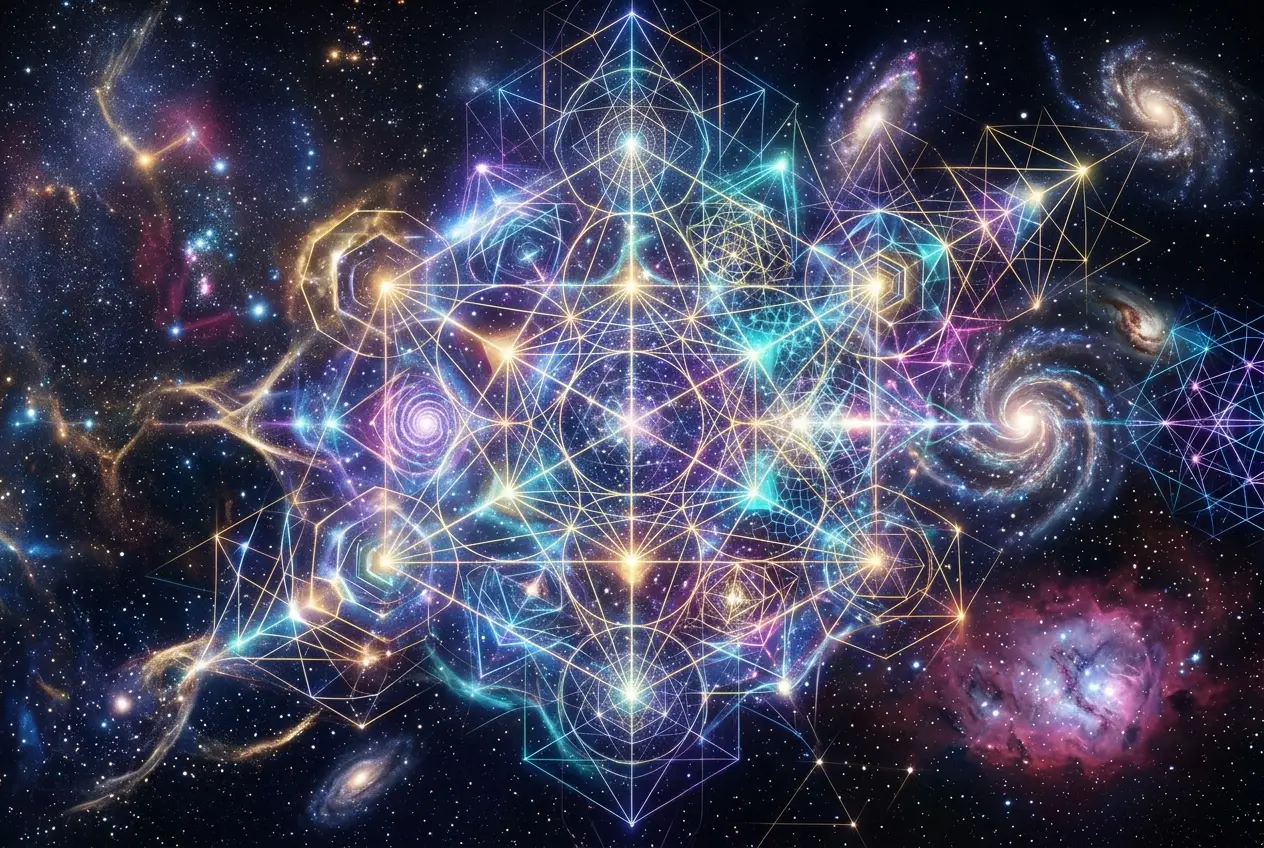
I often find myself gazing at the night sky, mesmerized by the sheer scale of the cosmos. Every star, every galaxy, seems to exist in a reality we can perceive: three spatial dimensions (up/down, left/right, forward/backward) and one of time. But what if this visible universe, vast as it is, is merely a thin slice of a much grander, more complex reality? What if, beyond our immediate comprehension, there exists a "dark web" of hidden dimensions, subtly influencing everything we know, yet remaining stubbornly out of sight?
This isn't the plot of a sci-fi blockbuster, but a profound question that lies at the heart of modern theoretical physics. The idea of extra dimensions isn't new; it’s a concept that has intrigued thinkers for over a century, offering elegant solutions to some of the universe's most perplexing mysteries. Imagine our universe as a vast, intricate tapestry. We, with our current instruments and understanding, can only see the vibrant patterns woven on the front. But what if there are threads and structures on the back, invisible to us, that hold the entire fabric together, dictating its very nature? This hidden side, this "dark web" of dimensions, could be where the true secrets of the universe reside.
The Problem with Our Universe's "Simplicity"
For all its complexity, our universe appears strikingly simple in its fundamental forces. We have gravity, electromagnetism, and the strong and weak nuclear forces. Each plays a distinct role, but one force, gravity, stands out as an odd one out. It’s incredibly pervasive, shaping galaxies and dictating the orbits of planets, yet it’s also astonishingly weak when compared to the others. A tiny magnet can lift a paperclip against the gravitational pull of the entire Earth! This disparity, known as the hierarchy problem, has puzzled physicists for decades. Why is gravity such a cosmic wallflower?
Another deep puzzle is the existence of dark matter and dark energy. These mysterious entities make up about 95% of the universe’s mass and energy, yet we can’t directly observe them. They interact with our visible universe primarily through gravity, further hinting at a gravitational connection that might span beyond our observable dimensions. Could these unseen forces and particles be residues or manifestations of extra dimensions interacting with our own? The possibilities ignite a scientific curiosity that few other concepts can match.
Kaluza-Klein Theory: The First Glimmer of a Hidden World
The first serious scientific foray into extra dimensions came in 1919 from Theodor Kaluza. He proposed adding a fifth dimension to Albert Einstein's theory of general relativity. Kaluza’s incredible insight was that if this fifth dimension was "compactified" – curled up into an incredibly tiny circle, too small to be observed directly – then electromagnetism could emerge naturally from the equations of gravity in this higher-dimensional space. It was a stunning unification!
Oskar Klein later refined this idea, suggesting the fifth dimension was so small, perhaps at the Planck length (10^-35 meters), that it would be invisible to us. Think of a garden hose. From far away, it looks like a 1D line. But up close, you see it has a 2D surface – the circumference of the hose. Kaluza and Klein theorized that our universe might be similar, with our familiar four dimensions being just one aspect of a larger, multi-dimensional hose. This pioneering work, though not fully supported by subsequent experiments, laid the groundwork for future, more complex theories. You can learn more about this groundbreaking theory on Wikipedia's Kaluza-Klein theory page (opens in a new tab).
String Theory: A Symphony of Vibrating Dimensions
The most prominent theory advocating for extra dimensions today is String Theory. It posits that the fundamental constituents of the universe aren't point-like particles, but rather tiny, one-dimensional vibrating strings. The different ways these strings vibrate determine the properties of the particles they represent – much like different notes on a violin string. For string theory to work, mathematically, it requires the existence of not just four, but ten or eleven dimensions.
Where are these extra dimensions? String theory suggests they are "compactified" – curled up into incredibly tiny, intricate shapes called Calabi-Yau manifolds. These shapes are so small that they are effectively invisible to our current experimental methods, existing at scales far smaller than even subatomic particles. They might be nestled at every point in our familiar spacetime, dictating the very laws of physics we observe. The implications are mind-boggling: our entire perceived reality could be a mere shadow of a grander, multi-dimensional symphony. This concept significantly builds upon early ideas about how fundamental forces might be unified, exploring profound questions about the nature of reality, much like we discussed in the blog about decoding the universe's code.
Brane Worlds: Our Universe as a Membrane in the Bulk
While Kaluza-Klein and early string theory envisioned all extra dimensions as tiny and curled up, another intriguing concept emerged: the Brane World models. In these theories, our entire universe, including all the matter and forces we know (except possibly gravity), is confined to a 3-dimensional membrane (a "brane") floating within a much larger, higher-dimensional space called the "bulk."
Imagine a piece of paper (our 2D universe) floating in a 3D room (the bulk). Anything drawn on the paper can only move within the paper's surface. But sound waves or light (analogous to gravity) could travel through the entire room, interacting with other pieces of paper (other branes or universes) if they existed.
This "leakage" of gravity into the bulk could explain its peculiar weakness. If gravity can spread out into these extra dimensions, it would appear diluted and weaker from our perspective on the brane. This offers a compelling solution to the hierarchy problem, suggesting gravity isn't inherently weak, but simply spread thin across a larger cosmic canvas. Such ideas push the boundaries of our understanding of cosmic phenomena, much like the discussion around alien megastructures challenges our perception of cosmic engineering.
Searching for the Unseen: Experimental Probes
Detecting these hidden dimensions is one of the greatest challenges in modern physics. If they are truly compactified to Planck scale, they remain far beyond the reach of any current or foreseeable particle accelerator. However, if some extra dimensions are slightly larger – perhaps even millimeter-sized, as proposed by certain models – we might have a chance.
Physicists are looking for subtle deviations from Newton's inverse square law of gravity at very small distances. If gravity "leaks" into extra dimensions, its strength might increase more rapidly at extremely close range than predicted by standard physics. Experiments using exquisitely sensitive torsion balances are designed to probe gravity at these sub-millimeter scales. So far, no definitive evidence has been found, but the hunt continues.
Another avenue is through high-energy particle colliders like the Large Hadron Collider (LHC). If extra dimensions exist, some particles might be able to escape into them, effectively "disappearing" from our universe and taking energy with them. This could manifest as missing energy in collision experiments, an anomaly that physicists are constantly on the lookout for. Discovering such a phenomenon would be a game-changer, fundamentally altering our understanding of space and reality itself. For more details on experimental searches, the Wikipedia article on Extra Dimensions (opens in a new tab) provides a comprehensive overview.
The Cosmic Implications: A Multiverse of Possibilities?
The existence of hidden dimensions would profoundly reshape our cosmic worldview. It could imply:
- A Multiverse: Our brane universe might be just one among many, existing in the vast bulk of higher dimensions, potentially leading to new interactions or even the birth of new universes.
- New Physics: Unseen forces or particles that exist primarily in these other dimensions could interact with our own in ways we don't yet comprehend, offering solutions to dark matter and dark energy.
- The Nature of Reality: It challenges our fundamental understanding of spacetime, suggesting that what we perceive as reality is only a fraction of what truly exists. This echoes similar mind-bending concepts explored when considering if our brain is a quantum machine.
The "Dark Web" of Reality: More Than Just Theory?
The term "dark web" usually conjures images of hidden online spaces, illicit activities, and concealed information. In the context of the universe, I use it metaphorically. If hidden dimensions exist, they represent a 'dark web' of reality: a vast, interconnected network of unseen spatial components that govern fundamental aspects of our existence. These are not places for digital secrets, but for cosmic ones – the true source of gravity's weakness, the home of dark matter, and perhaps even the genesis of our universe.
The quest to uncover these hidden dimensions is a testament to humanity's insatiable curiosity. It’s a journey into the unknown, pushing the boundaries of physics, mathematics, and philosophy. Whether they are tiny, curled-up spaces or vast, inaccessible bulks, the idea of extra dimensions invites us to reconsider our place in a universe that might be far more expansive and intricate than we ever dared to imagine. As we continue to probe the cosmos with ever-increasing precision, we might one day find evidence of these concealed realms, forever changing our definition of reality.
The universe, it seems, always has more layers to peel back. And perhaps, the most profound secrets are not those hidden in plain sight, but those folded into dimensions we're only just beginning to conceptualize.





Conversation0
No comments yet. Be the first to share a thought — the best questions often become new stories.