The year was 1948. A Dutch physicist named Hendrik Casimir was pondering a seemingly empty vacuum, a space devoid of matter, radiation, or even a single photon. Yet, he theorized, this emptiness wasn't truly empty. It was teeming with virtual particles, flickering in and out of existence, creating a subtle but measurable force. He proposed that two uncharged, parallel metal plates, placed incredibly close together in a vacuum, would experience an attractive force. This wasn’t due to gravity or electromagnetism in the traditional sense, but from the pressure of these virtual particles. Decades later, experiments confirmed what is now known as the **Casimir Effect**, a tangible manifestation of what physicists call zero-point energy.
I find this concept absolutely mind-boggling. Imagine, the very fabric of nothingness, the vacuum of space, isn't silent or inert. It's a bubbling cauldron of activity, a cosmic ocean of potential energy waiting to be understood, and perhaps, harnessed. The idea of drawing energy from "empty" space sounds like science fiction, a perpetual motion machine reborn. But what if the science points to something more profound, something that could redefine our energy future?
### The Whispers of the Vacuum: What is Zero-Point Energy?
At its core, **zero-point energy (ZPE)** is the lowest possible energy state that a quantum mechanical system can possess. In classical physics, a system at absolute zero temperature (0 Kelvin) would have no kinetic energy, meaning its particles would be perfectly still. However, quantum mechanics paints a different picture. According to the Heisenberg Uncertainty Principle, you can't simultaneously know a particle's exact position and momentum. If a particle were perfectly still (zero momentum), its position would be perfectly known, violating this principle. Therefore, even at absolute zero, particles must retain some minimum, irreducible vibration or "jiggle." This residual energy is the zero-point energy.
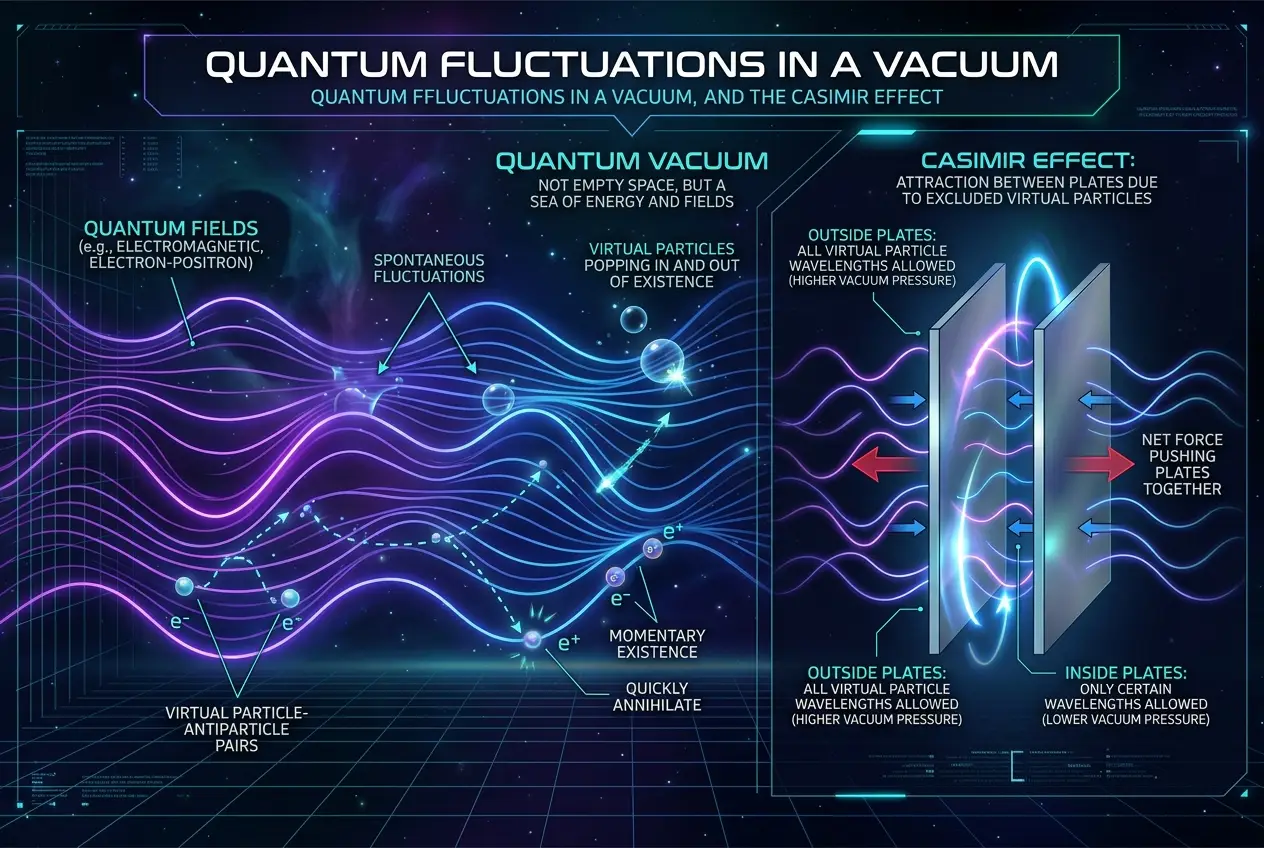
This isn't just a theoretical quirk for individual particles. When we scale this up to the vacuum of space, quantum field theory suggests that every point in space is filled with these fluctuating quantum fields. These fields are constantly generating and annihilating virtual particles – electrons, positrons, photons, and countless others – that exist for an infinitesimally short time before vanishing. The sum total of the energy from all these virtual particles, across all fields, constitutes the **vacuum energy**. Zero-point energy is often used synonymously with vacuum energy in this cosmological context, referring to the inherent, irreducible energy of space itself.
### From Theory to Tangibility: The Casimir Effect
The Casimir Effect is our most direct experimental evidence for ZPE. As mentioned, two uncharged, parallel conductive plates placed very close together (on the order of nanometers) will experience a small attractive force. How does this happen? Inside the plates, only virtual photons with wavelengths that fit perfectly between the plates can exist. Outside, however, virtual photons of all wavelengths can exist. This imbalance creates a pressure differential: more virtual photons push the plates from the outside than from the inside, resulting in a net attractive force.
"The Casimir effect is a fascinating demonstration of quantum field theory in action," explains physicist Dr. Steve Lamoreaux, whose experiments have verified the effect. "It shows that the vacuum is not truly empty, but a dynamic medium with measurable energy." You can learn more about the profound implications of this effect on its [Wikipedia page on the Casimir effect](https://en.wikipedia.org/wiki/Casimir_effect). This isn't just theoretical musing; it's a measurable physical phenomenon, tiny but real, influencing things at the nanoscale.
### The Grand Challenge: Harnessing the Vacuum's Secret
The sheer magnitude of vacuum energy, if it could be tapped, is staggering. Theoretical calculations suggest that the energy density of the quantum vacuum is enormous, potentially enough to boil all the oceans on Earth in a fraction of a second from a single cubic centimeter of space. However, this is where the mystery deepens. If the vacuum energy is so vast, why doesn't it rip the universe apart? This discrepancy between theoretical calculations and cosmological observations (which suggest a much smaller, but still positive, vacuum energy, known as dark energy) is one of the biggest unsolved problems in modern physics – the **cosmological constant problem**.
Regardless of this cosmological puzzle, the question remains: can we harness this energy? Current technology, which relies on temperature differences or mass-energy conversions, cannot easily extract energy from ZPE. Why? Because ZPE is the *lowest* energy state. To get useful work out of any system, you typically need a higher energy state transitioning to a lower one. It's like trying to draw water from an ocean that's already at sea level – there's no potential difference to drive a turbine.
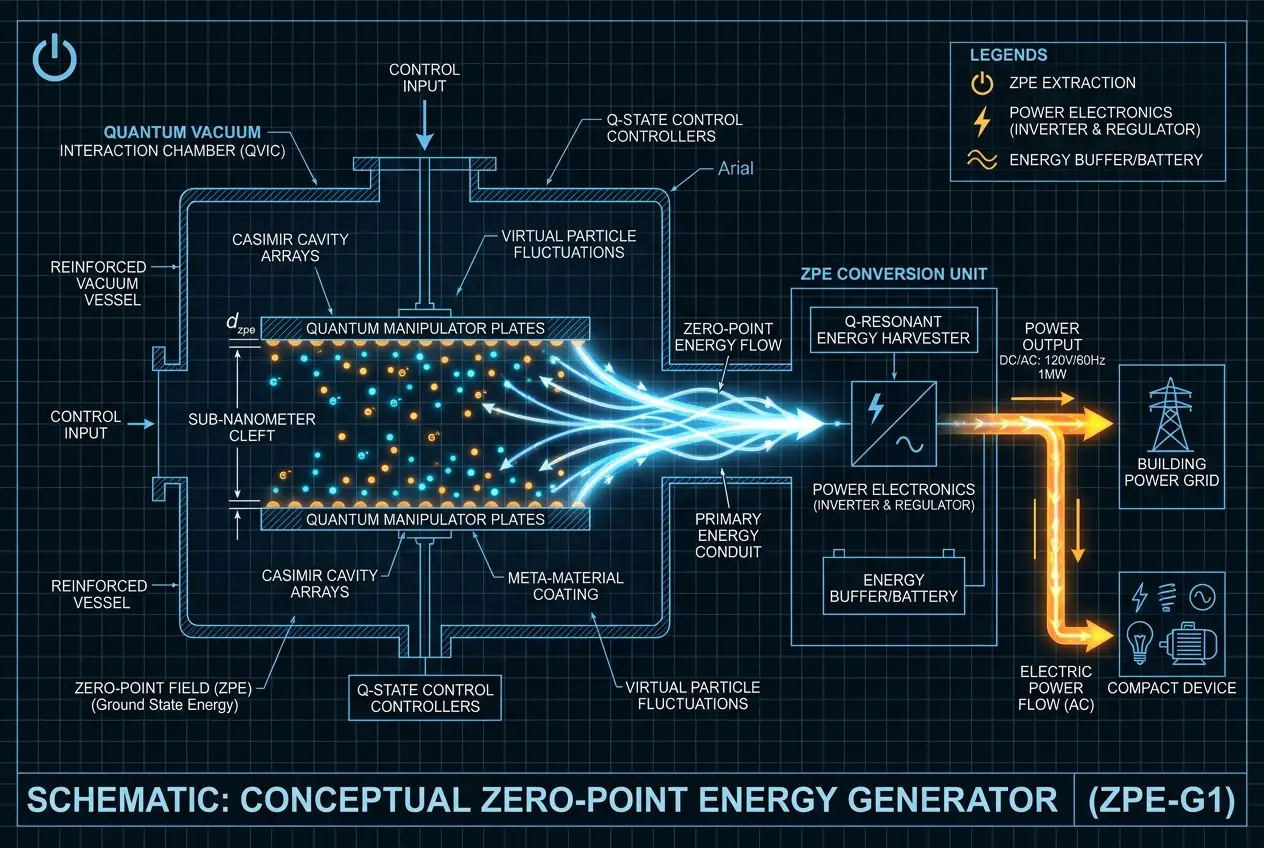
However, the Casimir effect hints at a pathway. If we can manipulate the quantum vacuum, perhaps by altering boundary conditions like those parallel plates, we might be able to create localized energy differentials. Imagine a device that continuously creates these "energy imbalances," converting the pressure from virtual particles into usable power. This is the dream of zero-point energy technology.
### The Roadblocks and the Dreamers
While the scientific basis for ZPE is solid, the engineering challenges are immense.
* **Scale:** The forces involved in the Casimir effect are incredibly small, detectable only at nanometer distances. Scaling this up to power a city would require unprecedented levels of material manipulation and control.
* **Energy Extraction:** Even if we create a local energy differential, how do we efficiently convert it into a macroscopic, usable form of energy without simply expending more energy in the process?
* **Fundamental Physics:** There are still deep unanswered questions about the nature of vacuum energy and its interaction with matter and gravity. A deeper understanding might reveal fundamental limits to its extraction. For more on the theoretical underpinnings, the [Wikipedia page on Quantum field theory](https://en.wikipedia.org/wiki/Quantum_field_theory) provides a comprehensive overview.
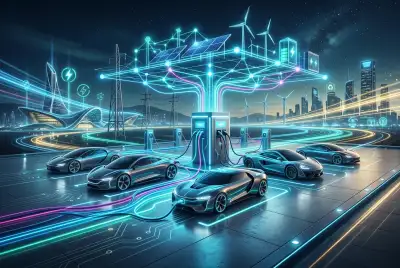
Despite these hurdles, the pursuit of ZPE remains a captivating field of research, often blurring the lines between mainstream physics and fringe science. Researchers are exploring various avenues, from optimizing Casimir devices to understanding exotic materials that might interact more strongly with vacuum fluctuations. The implications could be revolutionary, offering a clean, inexhaustible energy source that doesn't rely on fossil fuels, nuclear fission, or even solar input. Imagine powering our homes, vehicles, and even interstellar spacecraft not by burning finite resources, but by tapping into the very essence of space itself.
### Beyond Terrestrial Power: ZPE and the Cosmos
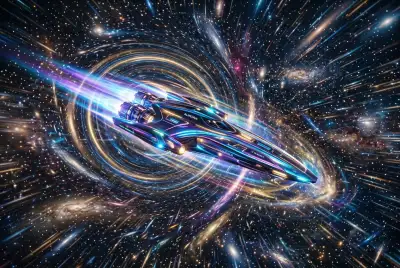
The potential for zero-point energy extends far beyond Earth. If we could ever control it, ZPE propulsion systems might make interstellar travel a reality. Instead of carrying massive amounts of fuel, a spacecraft could draw its energy directly from the vacuum as it travels, theoretically enabling speeds and ranges currently unimaginable.
This connects to other cosmic mysteries. The vast, empty expanses of the cosmos, often considered inert, might be teeming with this latent energy. Could advanced civilizations be harnessing this power already? It’s a thought that echoes discussions around [dark energy as a fuel for future space travel](/blogs/dark-energy-can-it-fuel-future-space-travel-3737) or even the idea of [empty space itself acting as a quantum computer](/blogs/is-empty-space-a-quantum-computer-9021). The universe, it seems, has more secrets than we can fathom.
Just as the early quantum physicists grappled with seemingly absurd ideas like quantum entanglement, which now forms the basis of quantum computing (a topic explored in blogs like [Black Holes: Are They Nature's Ultimate Quantum Computers?](/blogs/black-holes-are-they-natures-ultimate-quantum-computers-5819)), perhaps our understanding of zero-point energy is just scratching the surface. The journey to unlock the vacuum's secret is a testament to humanity's relentless curiosity and our quest to understand and leverage the fundamental laws of the universe. The prospect of an energy source that literally comes from nothing, yet underpins everything, is a profound and thrilling challenge for future generations of scientists and engineers.
We are, in essence, exploring the true meaning of "empty space," discovering it might be the ultimate reservoir of power. The vacuum, as we now understand, is not an absence, but a presence—a vibrant, quantum ocean waiting for us to learn how to sail its currents. The future, powered by the vacuum, could be far more exciting than any science fiction story. For a deeper dive into the concept, the [Wikipedia page on Zero-point energy](https://en.wikipedia.org/wiki/Zero-point_energy) is an excellent resource.
 Join Us

 Unknown Author











Leave a Reply
Comments (0)