I remember staring up at the night sky as a child, lost in the vastness, wondering if there was something out there trying to talk to us. That childish wonder has never truly left me, especially when I consider the universe's most profound enigma: **dark matter**. We know it's there – its gravitational tug shapes galaxies, holding them together against the outward push of cosmic expansion. It makes up approximately 27% of our universe's total mass-energy content, yet remains stubbornly invisible, silent, and undetectable by our current instruments. But what if "silent" isn't entirely accurate? What if, in its enigmatic existence, dark matter isn't just a passive gravitational scaffold, but is actively sending us signals, a cryptic message encoded in the very fabric of reality?
For decades, the search for dark matter has focused on detecting its elusive particles, often referred to as WIMPs (Weakly Interacting Massive Particles) or axions. Scientists have built colossal underground detectors, shielded from cosmic noise, hoping to catch a stray interaction. They’ve looked for dark matter annihilation signatures in space with telescopes like Fermi Gamma-ray Space Telescope. Yet, despite immense effort and ingenious experiments, dark matter continues to elude direct detection. This persistent mystery has led some pioneering minds to ponder a truly mind-bending possibility: what if we're looking for the wrong kind of interaction? What if dark matter isn't just interacting gravitationally, but also through subtler, yet perhaps more profound, means of communication?
### The Whispers of a Hidden Universe: Beyond Gravity
Imagine a vast, parallel universe interwoven with our own, governed by different rules, yet subtly influencing our cosmic landscape. This is essentially the theoretical picture we have of dark matter. It doesn't interact with light, electromagnetism, or the strong nuclear force. Only gravity, as far as we know. But what if dark matter interacts with itself, or even with our visible matter, in ways that produce signals we haven't learned to decode?
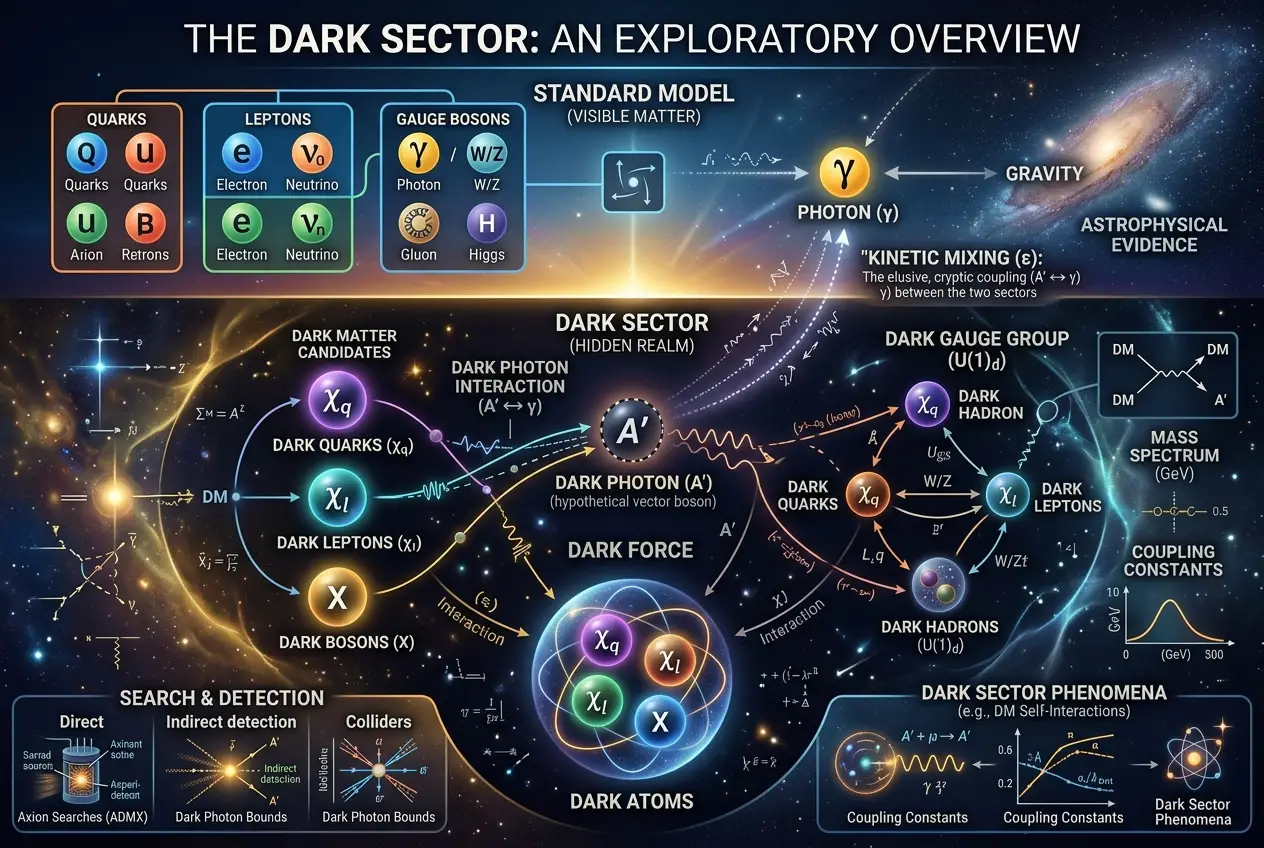
Some theories propose that dark matter isn't a single type of particle, but a complex "dark sector" with its own forces and particles, much like our standard model. If this dark sector exists, it could have its own equivalent of photons – "dark photons" – or other force carriers that mediate interactions within the dark matter realm, and perhaps, occasionally, even with our familiar baryonic matter. These interactions could produce faint, unusual signals that we might be misinterpreting as cosmic noise, or simply overlooking.
One exciting area of research explores **dark matter stars** or even **dark matter planets**. If such structures exist, they would be incredibly difficult to detect, as they wouldn't emit or reflect light. However, their sheer gravitational presence might perturb the orbits of visible stars, or they could produce unique gravitational wave signatures. Imagine a civilization within such a dark matter structure, potentially communicating across its own realm, with incidental "spillover" signals reaching our universe as gravitational anomalies or subtle energetic pulses.
### Decoding the Cosmic Static: A New Paradigm for Detection
The conventional approach to dark matter detection is akin to listening for a faint knock on a wall. But what if dark matter isn't knocking, but sending a complex radio signal, or even encoding information in subtle quantum fluctuations? This requires a complete re-evaluation of our detection strategies.
**1. Dark Photons and Hidden Portals:**
The concept of dark photons is particularly intriguing. These hypothetical particles would be analogous to our photons but would interact exclusively with dark matter. However, some models suggest a "kinetic mixing" between dark photons and regular photons, allowing for a tiny, almost imperceptible interaction. This could mean that dark matter, through its dark photon interactions, might be subtly altering the electromagnetic spectrum we observe. Detecting these tiny anomalies could be like catching a fleeting radio signal from an entirely different dimension. You can learn more about dark photons and their potential interactions on [Wikipedia's Dark Photon page](https://en.wikipedia.org/wiki/Dark_photon).
**2. Neutrinos as Messengers:**
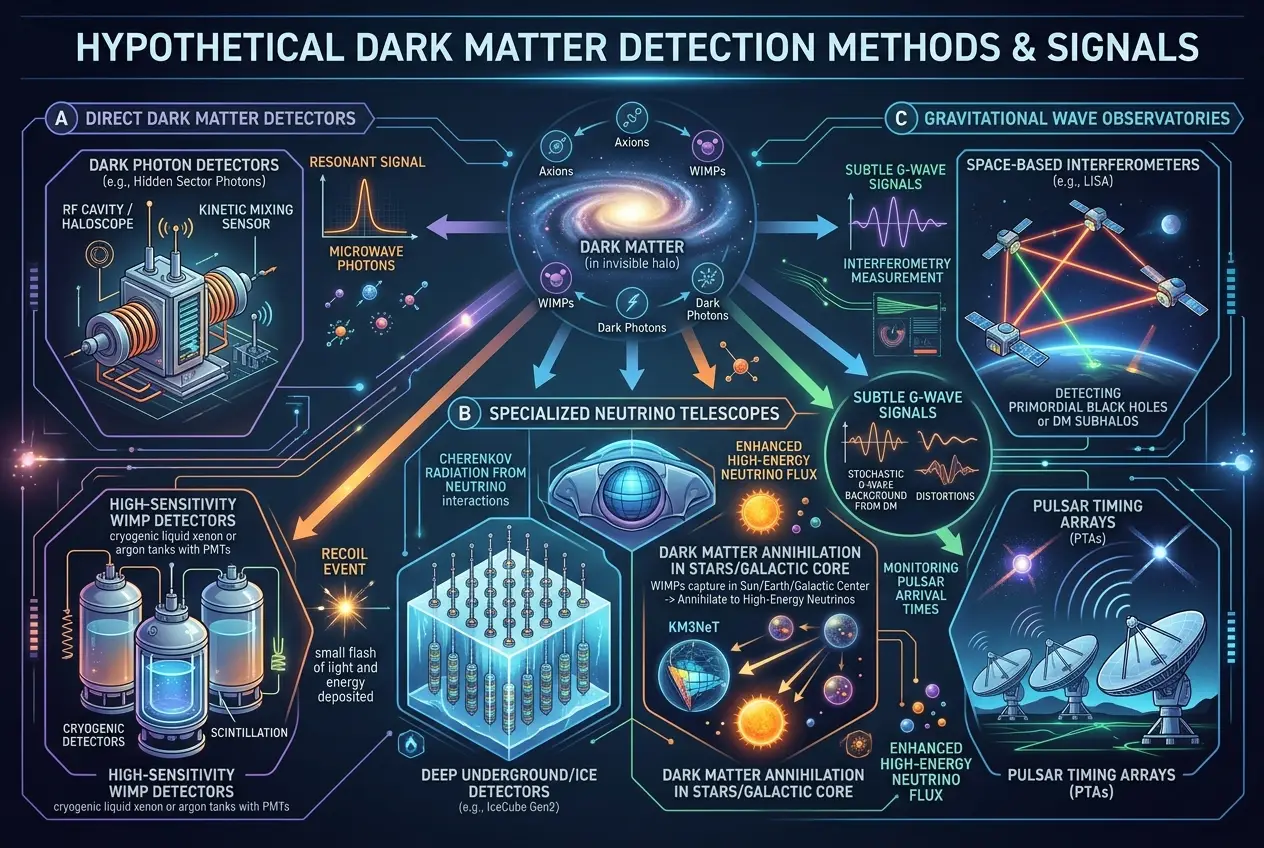
Neutrinos are notoriously elusive, interacting only via the weak nuclear force and gravity. They are also abundantly produced in certain dark matter annihilation scenarios. While most neutrino detectors search for neutrinos produced by standard astrophysical processes, some experiments are beginning to look for anomalous neutrino fluxes or energy spectra that could hint at dark matter interactions. If dark matter forms structures or has complex internal dynamics, it could be producing specific neutrino "bursts" or patterns that act as a form of communication, though one we'd need sophisticated algorithms to decipher.
**3. Gravitational Waves: The Ultimate Interstellar Telegram?**
Gravitational waves, ripples in spacetime, travel unimpeded across the universe. They are created by accelerating massive objects, like merging black holes or neutron stars. But what if dark matter, especially if it coalesces into dense objects, also produces specific gravitational wave signatures? Theories about primordial black holes (which could be a form of dark matter) or exotic dark matter structures suggest they might emit characteristic gravitational waves. These "ripples" could carry information about the dark sector's dynamics, acting as a universal, if indirect, form of communication. Imagine trying to decipher a message from the very fabric of spacetime itself! I find myself wondering if our efforts to detect cosmic rays and other high-energy phenomena, as discussed in [Do Ultra-High Energy Cosmic Rays Reveal New Physics?](https://curiositydiaries.com/blogs/do-ultra-high-energy-cosmic-rays-reveal-new-physics-5038), might inadvertently be picking up faint echoes of dark matter interactions.
**4. Quantum Entanglement and Spacetime Distortions:**
This is where it gets truly speculative, yet immensely fascinating. Some physicists explore the possibility that dark matter might interact with our observable universe through incredibly subtle quantum effects or localized spacetime distortions. Could information be "entangled" across the dark and visible sectors? Could the very notion of information, as explored in articles like [Does Information Have Mass?](https://curiositydiaries.com/blogs/does-information-have-mass-unpacking-digital-gravity-5714), be more universally intertwined with dark matter than we currently understand? While highly theoretical, such ideas open up possibilities for a form of communication that transcends traditional electromagnetic or gravitational signals.
### The Challenge of Interpretation: From Signal to Meaning
Even if we were to detect a peculiar signal unequivocally linked to dark matter, the next, even greater challenge would be interpretation. What would a "message" from dark matter even look like? Would it be a simple pulse, a complex sequence of energy fluctuations, or something entirely beyond our current understanding of information encoding?
Consider the cosmic microwave background (CMB) radiation, the afterglow of the Big Bang. It's a "message" from the early universe, but one that required decades of sophisticated scientific inquiry to decode, revealing secrets about the universe's age, composition, and evolution. A dark matter message could be exponentially more complex, possibly encoded in patterns of interaction, subtle shifts in fundamental constants, or even the very distribution of dark matter across the cosmic web.
### The Cosmic Internet Hypothesis Revisited
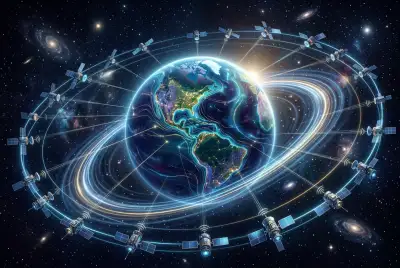
The idea of a cosmic network isn't new; we've explored the intriguing concept of [Is Dark Matter a Cosmic Internet?](https://curiositydiaries.com/blogs/is-dark-matter-a-cosmic-internet-unpacking-universal-communication-1374) before. While that blog focused on dark matter *being* the network, the current question shifts the perspective: could entities *within* or *of* dark matter be *using* it to communicate? If dark matter has a rich internal structure and dynamics, with its own "cities" and "societies" of dark particles, then the possibility of it being a medium for, or even the source of, cryptic messages becomes incredibly compelling.
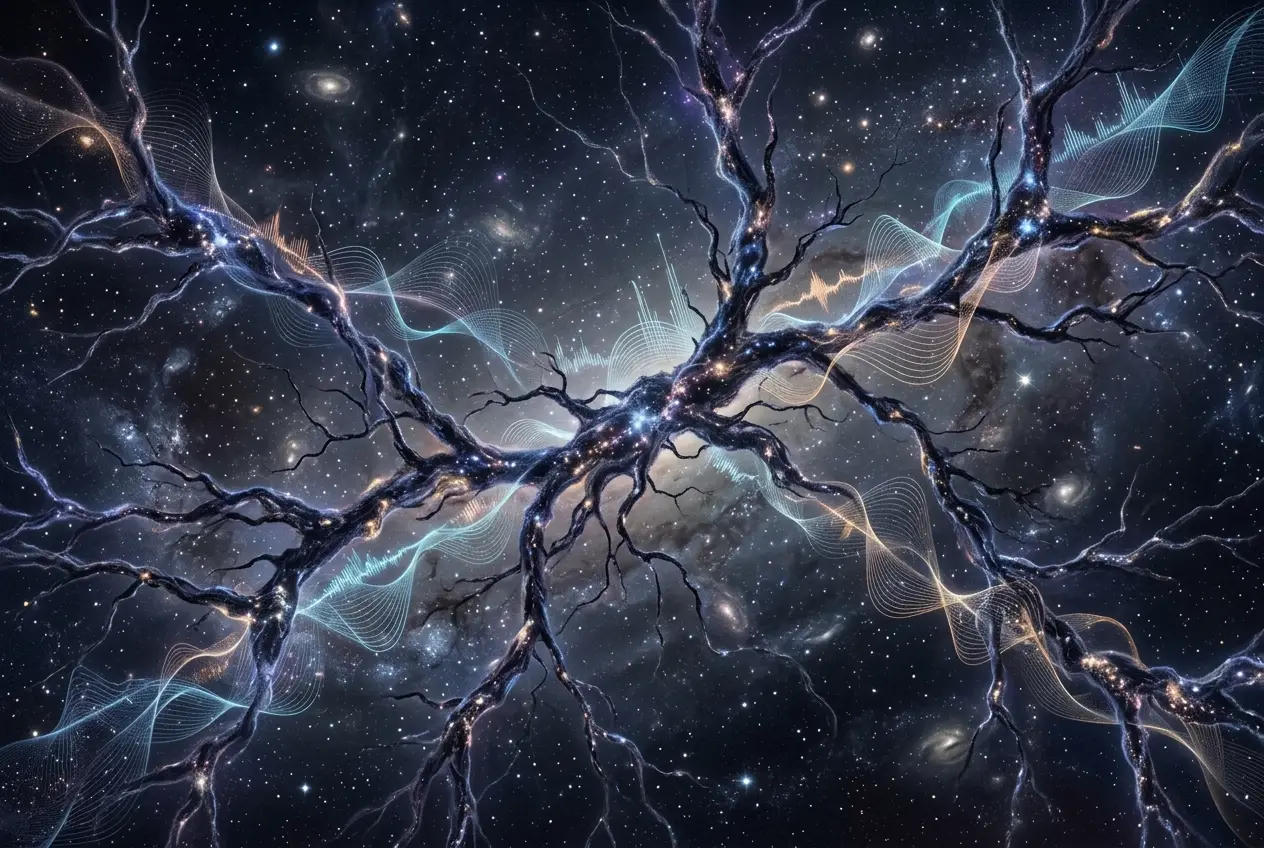
One could imagine a scenario where dark matter, being impervious to many of the destructive forces that plague baryonic matter, forms stable, long-lived structures that could potentially harbor highly advanced forms of "dark life" or information processing systems. These entities, existing outside our conventional perception, might develop ways to send out signals, perhaps as a beacon, a warning, or simply an exploration of their own cosmic neighborhood.
### Looking Ahead: The Future of Dark Matter Communication Research
The search for dark matter is one of the grandest quests in modern physics. Shifting our perspective from merely detecting its presence to actively listening for its potential signals represents a profound paradigm shift. This new frontier will require:
* **Novel Detector Technologies:** Moving beyond simple particle collisions to look for subtle field interactions, quantum signatures, or highly specific gravitational wave patterns.
* **Advanced Data Analysis:** Developing AI and machine learning algorithms capable of sifting through vast amounts of cosmic data for anomalous patterns that might escape human detection.
* **Interdisciplinary Collaboration:** Bringing together particle physicists, astrophysicists, cosmologists, and even information theorists to consider entirely new ways dark matter could interact and communicate.
* **Theoretical Innovation:** Proposing new models of dark matter that allow for more complex interactions and potential communication mechanisms.
Ultimately, whether dark matter is actively sending us messages or not, the very act of asking this question pushes the boundaries of our scientific imagination. It compels us to consider the universe not just as a collection of observable phenomena, but as a vast, interconnected, and potentially communicating entity. The cosmos, in its grand silence, may actually be whispering secrets, and it's up to us to learn how to listen.
Could humanity one day decipher a message from the invisible scaffolding of the universe itself? The possibility is breathtaking, a challenge that promises to redefine our place in the cosmos.
Frequently Asked Questions
A 'dark sector' is a theoretical concept suggesting that dark matter isn't just one particle but a complex system with its own forces and particles, similar to our visible matter. If a dark sector exists, it could have its own form of communication (e.g., via 'dark photons') that might subtly interact with our universe, potentially sending cryptic messages.
Unlike radio astronomy, which looks for electromagnetic waves, detecting dark matter messages might involve searching for subtle gravitational wave patterns, anomalous neutrino fluxes, or unusual quantum effects. These interactions would be far more indirect and require highly specialized detectors and analytical techniques compared to traditional radio telescopes.
While highly speculative, if dark matter forms stable, dense structures (like hypothetical dark matter stars or planets), it's conceivable these environments could harbor forms of 'dark life' or advanced information-processing systems that exist outside our current understanding of biology and technology. Any communication from them would be entirely alien to our current detection methods.
Even if we detect a signal, interpreting it would be immensely challenging. A dark matter message might not resemble any known form of information encoding. It could be embedded in complex patterns of interaction, shifts in fundamental physical constants, or the cosmic distribution of dark matter, requiring entirely new scientific frameworks to decipher.
While no experiments are explicitly titled 'dark matter communication detectors,' many cutting-edge dark matter experiments are broadening their search parameters. This includes next-generation neutrino observatories, gravitational wave detectors (like LIGO/Virgo), and experiments searching for exotic particles like dark photons, all of which could potentially stumble upon anomalous signals that might be interpreted as a form of dark matter communication.
Verified Expert
Alex Rivers
A professional researcher since age twelve, I delve into mysteries and ignite curiosity by presenting an array of compelling possibilities. I will heighten your curiosity, but by the end, you will possess profound knowledge.
Leave a Reply
Comments (0)
No approved comments yet. Be the first to share your thoughts!
 Join Us



 Unknown Author


























Leave a Reply
Comments (0)