


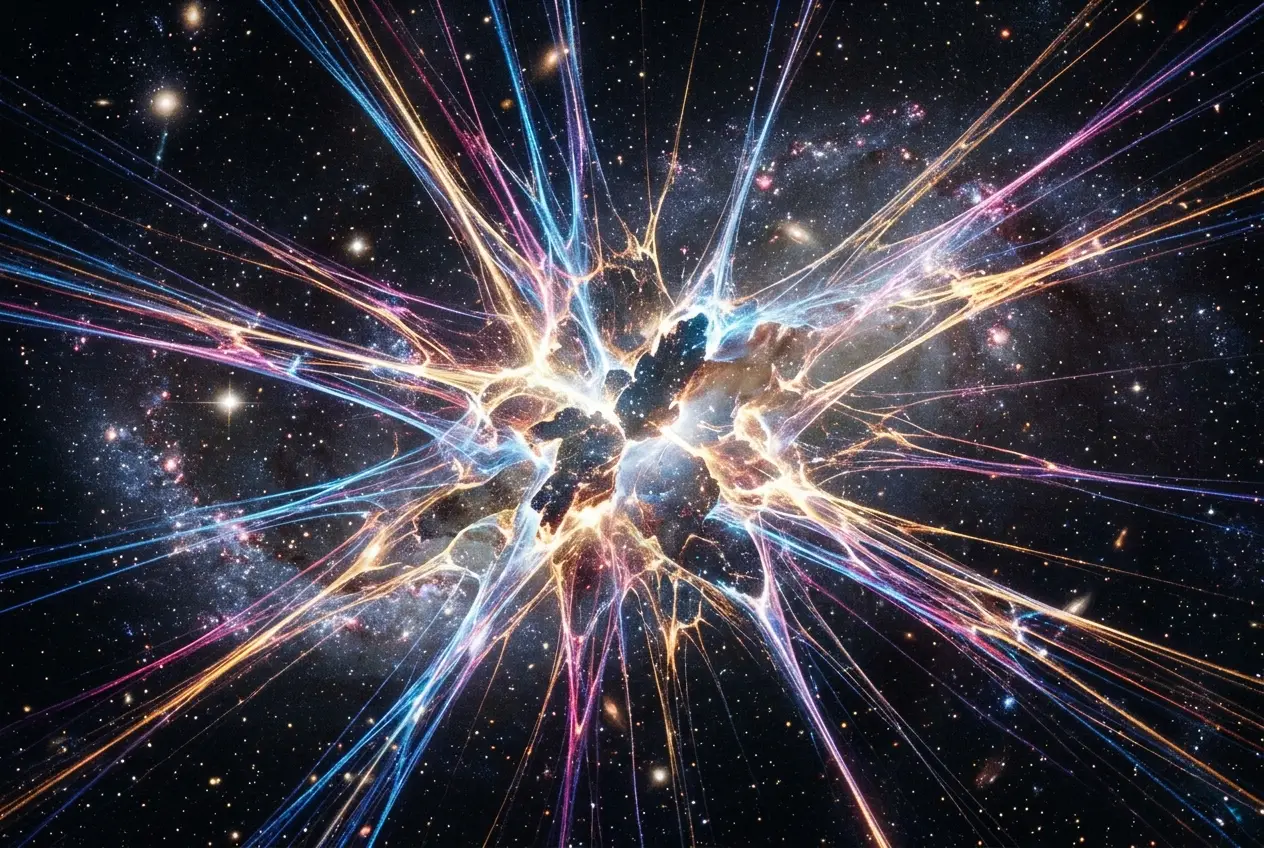
I often find myself staring up at the night sky, lost in the sheer immensity of the cosmos. It's a humbling experience, thinking about the unfathomable distances, the countless stars, and the grand narrative of creation that began with the Big Bang. For decades, scientists believed our universe was either slowing down or would eventually reverse course, collapsing back into a "Big Crunch." But then, a startling discovery in the late 1990s completely overturned our understanding: the universe isn't just expanding; it's accelerating. This cosmic acceleration, driven by a mysterious force we call dark energy, introduced a new, chilling possibility for the universe's ultimate fate, one that some theoretical models suggest could lead to an end far more dramatic than a gentle fade into nothingness – a scenario known as the Big Rip, fueled by something even more extreme: phantom energy.
The Universe's Accelerating Mystery
The journey to understanding cosmic acceleration is one of humanity's greatest scientific detective stories. For much of the 20th century, the prevailing cosmological models predicted that the gravity of all the matter in the universe would inevitably slow down its expansion. The only question was whether it would slow enough to eventually halt and reverse (the Big Crunch) or expand forever at a decreasing rate (the Big Freeze).
Then, in 1998, two independent teams of astronomers, studying distant Type Ia supernovae – cosmic lighthouses with a known intrinsic brightness – made an astonishing observation. These supernovae were fainter than they should have been if the universe's expansion was merely slowing down. The only way to explain their dimness was if the universe's expansion was actually speeding up, pushing these distant markers further away faster than expected. This groundbreaking discovery earned a Nobel Prize and fundamentally reshaped modern cosmology.
The force responsible for this accelerated expansion was dubbed dark energy. Unlike gravity, which pulls things together, dark energy acts as a repulsive force, pushing spacetime apart. It’s theorized to make up about 68% of the total energy density of the universe, yet its nature remains one of the greatest unsolved puzzles in physics. Is it a constant energy intrinsic to space itself, like Einstein's cosmological constant? Or is it a dynamic, evolving field, often called quintessence? The answer profoundly influences our cosmic destiny. You can delve deeper into the enigma of dark energy on its Wikipedia page.
Enter Phantom Energy: A Radical Idea
While standard dark energy models already paint a picture of an endlessly expanding, cooling universe, some theoretical constructs take the implications of dark energy a terrifying step further. This is where phantom energy comes into play.
Phantom energy is a hypothetical form of dark energy characterized by an unusual property: its equation of state parameter, denoted as w, is less than -1. For standard dark energy (like the cosmological constant), w equals -1. For quintessence, w is greater than -1 but less than 0. The value of w dictates how dark energy behaves. If w < -1, phantom energy has a negative kinetic energy, meaning its density increases as the universe expands. This is a crucial, counterintuitive distinction. Instead of becoming diluted like other forms of energy or remaining constant, phantom energy grows more potent with cosmic expansion, creating a runaway effect.
Imagine a cosmic tug-of-war. Gravity pulls everything inward, while dark energy pushes everything outward. If dark energy is the cosmological constant, the outward push remains steady. If it's quintessence, the push might weaken over time. But with phantom energy, the outward push gets stronger as space stretches. It’s like an unstoppable, accelerating centrifugal force tearing the very fabric of reality apart. The concept of phantom energy, while extreme, is an active area of theoretical physics, explored further on its Wikipedia page.
The Big Rip: A Universe Unbound
If phantom energy truly dominates the cosmos, the ultimate fate of the universe would be a cataclysmic event known as the Big Rip. Unlike the Big Freeze, where everything slowly drifts apart and cools to absolute zero, the Big Rip is a violent, accelerating disintegration of all structures, from the grandest cosmic webs down to the smallest subatomic particles.
The sequence of destruction in a Big Rip scenario is terrifyingly precise:
- Galaxies and Galaxy Clusters: Initially, billions of years from now, the increasing strength of phantom energy would overcome the gravitational pull holding galaxy clusters together. Our Local Group, including the Andromeda galaxy and the Milky Way, would first cease to be gravitationally bound, and then individual galaxies within it would begin to separate from each other, drifting into accelerating isolation.
- Individual Galaxies: Eventually, the repulsive force would become strong enough to overcome the internal gravity of galaxies themselves. Stars would be torn from their orbits around galactic centers. Our own Milky Way would disintegrate, its spiral arms scattering into the ever-expanding void.
- Solar Systems: As the expansion continues to accelerate, the gravitational bonds holding individual solar systems together would fail. Planets would break free from their stars, hurtling alone through the rapidly expanding space. Our Earth would be ripped from the Sun's embrace.
- Planets and Stars: The very objects themselves – planets, moons, and even stars – would begin to unbind. A star might be torn apart from its own gravity, its constituent gas and plasma flung outwards. For a chilling read on other cosmic threats, check out our blog on do-rogue-black-holes-threaten-our-galaxy-6767.
- Atoms and Molecules: In the final minutes of the universe, the phantom energy would become so overwhelmingly powerful that it would overcome the strong nuclear force holding atomic nuclei together and the electromagnetic force binding electrons to nuclei. Atoms would be ripped apart into their constituent protons, neutrons, and electrons.
- Elementary Particles: In the absolute final moments, even the elementary particles themselves – quarks and leptons – would be torn asunder, ceasing to exist as coherent entities. Spacetime itself would be shredded, leading to a singularity where all distances become infinite in a finite amount of time. The Big Rip is a true end to all structure and order. For further reading, Wikipedia has a comprehensive article on the Big Rip.
Hunting the Phantom: Observational Evidence and Limits
So, is the Big Rip merely a theoretical curiosity, or is there a genuine possibility it could happen? Scientists are actively trying to measure the precise properties of dark energy, especially its equation of state parameter (w).
Observational data from supernovae, the cosmic microwave background (CMB), and large-scale structure of the universe currently constrain w to be very close to -1. While the current data doesn't definitively rule out w < -1, the range of possible values for w that would lead to a Big Rip is very narrow and increasingly disfavored. Most observations suggest w is very slightly greater than or equal to -1, which would lead to a Big Freeze scenario, where the universe expands forever but doesn't tear itself apart.
Astronomers use incredibly sophisticated methods to gather this data. By studying the precise light curves of Type Ia supernovae at various distances, for example, they can infer the universe's expansion rate at different points in cosmic history. The precision of these measurements is constantly improving, helping us to narrow down the true nature of dark energy. Understanding the equation of state is critical for predicting cosmic fate, as detailed in the Wikipedia article on the equation of state (cosmology).
Beyond the Rip: Other Cosmic Fates
It’s important to remember that the Big Rip is just one of several theoretical endings for our universe. The ultimate fate truly hinges on the exact nature of dark energy, which we are still trying to understand.
- Big Freeze (or Heat Death): This is currently the most favored scenario. If dark energy is a cosmological constant (w = -1) or quintessence (w > -1), the universe will continue to expand indefinitely, with galaxies moving further and further apart. Stars will eventually burn out, black holes will evaporate through Hawking radiation, and the universe will become a cold, dark, empty expanse, reaching a state of maximum entropy.
- Big Crunch: If dark energy weakens or reverses, and gravity eventually triumphs, the expansion could halt and reverse, causing the universe to contract back into an incredibly hot, dense state, mirroring the Big Bang.
- Big Bounce: Some theories propose a cyclical universe, where a Big Crunch is followed by a new Big Bang, implying an eternal cycle of creation and destruction.
Each of these scenarios presents a profound set of implications for existence itself, underscoring the deep connection between fundamental physics and our understanding of reality. For a broader perspective on these cosmic endings, refer to the Wikipedia page on the Future of an expanding universe.
The Implications for Future Civilizations & Tech
The discussion of cosmic fates, particularly scenarios like the Big Rip, might seem purely academic, distant, and perhaps even morbid. Yet, understanding these possibilities has profound implications for how we, as a species, might envision our long-term future, technological development, and aspirations for cosmic exploration.
If the Big Rip were a certainty, it would impose an ultimate deadline on any civilization, no matter how advanced. Knowing that even atoms would eventually be torn apart could drive a desperate urgency to understand and potentially counteract this cosmic force, or to find a way to escape its grasp. Could future technologies somehow harness exotic matter to create localized stable bubbles of spacetime, or develop ways to traverse dimensions to escape the impending doom? Our ability to explore and colonize other parts of the cosmos might simply delay the inevitable. Questions like these force us to consider what truly constitutes a "legacy" in a universe facing such a dramatic end. For thoughts on broader cosmic mysteries, explore decoding-reality-does-the-universe-hide-extra-dimensions-5269.
Conclusion
The idea of phantom energy and the Big Rip is a powerful reminder of how much we still have to learn about the universe. It's a testament to humanity's relentless curiosity that we can even conceive of such dramatic cosmic endings and use the faint whispers of distant supernovae to test these grand theories. While current evidence leans away from the Big Rip, the possibility continues to drive research, pushing the boundaries of our understanding of dark energy and the very fabric of spacetime. As we continue to gaze at the accelerating expansion of the cosmos, we’re not just observing; we’re also pondering our ultimate destiny, hoping that the universe has a more gentle conclusion in store than being torn apart from the inside out.
Conversation0
No comments yet. Be the first to share a thought — the best questions often become new stories.