


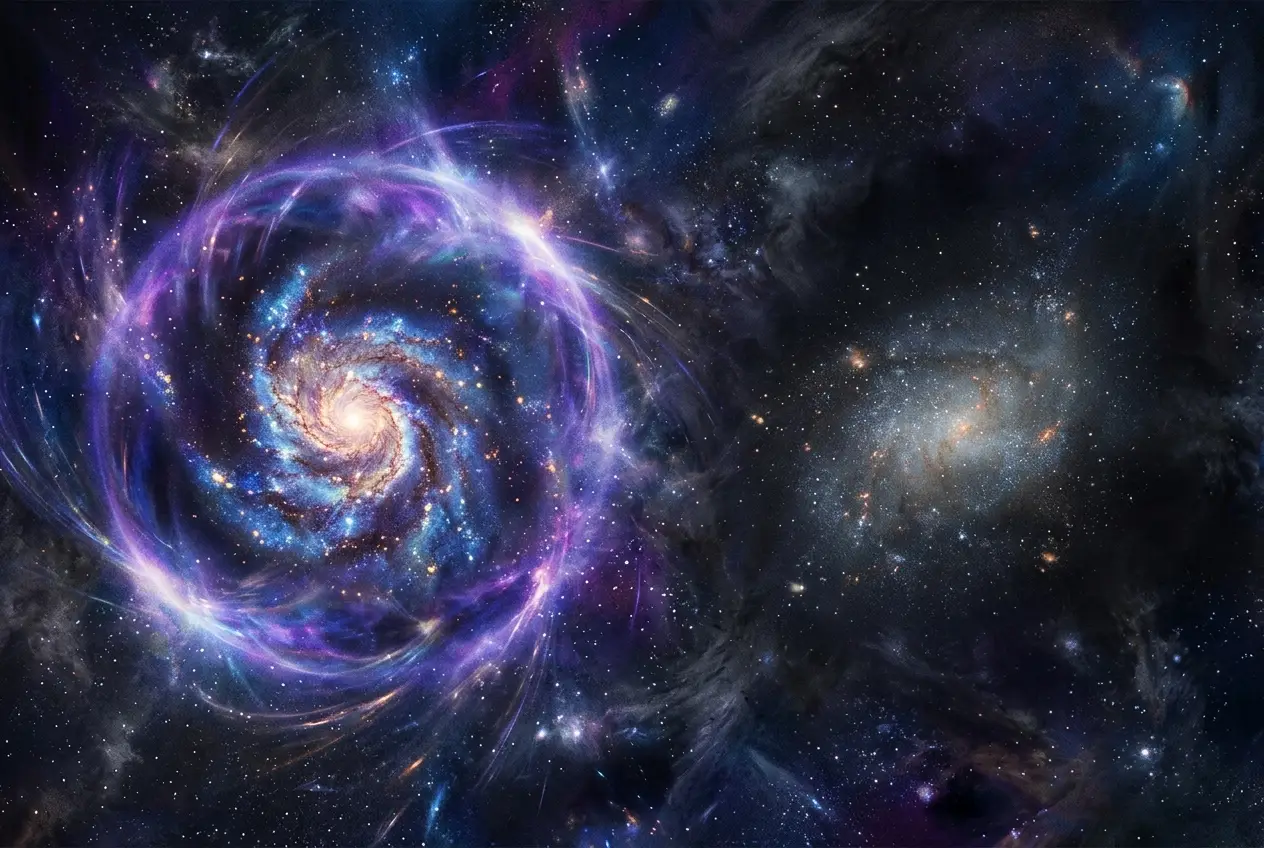
I was recently captivated by a discovery that challenges one of the most fundamental tenets of modern cosmology: dark matter. We’ve long been told that dark matter is the invisible scaffold holding galaxies together, providing the extra gravitational pull needed to explain how stars orbit so quickly without flying apart. But what if I told you that some galaxies seem to be… missing it? Imagine finding a massive structure, like a skyscraper, that somehow stands tall without its core support beams. That’s the kind of cosmic paradox we’re talking about, and it has scientists scratching their heads.
The universe, as we understand it, is a grand cosmic tapestry woven with threads of visible matter and an overwhelming, invisible presence we call dark matter. This enigmatic substance makes up about 27% of the universe's mass-energy content, far outweighing the paltry 5% contributed by the stars, planets, and gas we can actually observe. Dark matter's gravitational influence is crucial for the formation and evolution of galaxies, dictating their rotation curves and providing the underlying structure for the cosmic web. Without it, the standard model of cosmology, often referred to as Lambda-CDM, would simply collapse.
The Unseen Architect: Dark Matter's Role
For decades, the existence of dark matter has been inferred through its gravitational effects. We can't see it, touch it, or directly detect it, but its presence is evident in how galaxies spin, how light bends around massive galaxy clusters (a phenomenon known as gravitational lensing), and in the large-scale structure of the universe. It acts as an invisible glue, preventing galaxies from tearing themselves apart as they rotate at speeds far exceeding what visible matter alone could account for.
The conceptual model of a galaxy typically involves a central bulge, a galactic disk, and an extended halo of dark matter. This halo is thought to be the dominant mass component, spanning far beyond the visible starlight. Its gravitational pull shapes the galaxy, providing stability and influencing star formation. Without this unseen architect, the dynamics of most galaxies simply don't make sense.
The Anomaly: Galaxies Without Dark Matter
Then came the revelations that stunned the astronomical community. In 2018, a team of astronomers led by Pieter van Dokkum at Yale University announced the discovery of NGC1052-DF2 (often shortened to DF2), a galaxy that appeared to have very little, if any, dark matter. This ultra-diffuse galaxy, located about 65 million light-years away, rotated far too slowly for its size and stellar content if it contained the expected amount of dark matter. Its stars moved at speeds consistent with only the visible matter present, a direct contradiction to the prevailing dark matter paradigm.
"The stars in this galaxy can account for almost all of the mass, and that's not something we've ever seen before," said van Dokkum. "For decades, we thought that galaxies were dark matter-dominated objects that existed inside dark matter halos. This object shows that there may be galaxies that don't have dark matter at all." (Source: Wikipedia - NGC 1052-DF2 (opens in a new tab))
This wasn't an isolated case. Soon after, another galaxy, NGC1052-DF4 (DF4), was found with similar characteristics, further cementing the idea that these dark matter-poor galaxies weren't just statistical flukes. These discoveries sent ripples through the astrophysical community, prompting intense scrutiny and a flurry of new theories. Could our understanding of dark matter be fundamentally flawed, or were these just extremely rare cosmic oddities?
How Do We "Measure" Missing Dark Matter?
You might be wondering, how do scientists conclude that a galaxy lacks dark matter if it's invisible? The method relies on measuring the velocities of stars and gas within a galaxy. If a galaxy has a certain amount of visible mass, we can predict how fast its stars should be orbiting its center. If the observed orbital velocities are significantly higher than predicted, then an additional, invisible mass (dark matter) must be present.
In the case of DF2 and DF4, the orbital velocities of their globular clusters and stars were remarkably low, almost perfectly matching the gravitational pull expected from their visible stellar mass alone. This direct observational evidence suggested an unprecedented deficit of dark matter. It was like weighing a car and finding its mass matches only the passengers, not the car itself.
Unpacking the Anomalies: Competing Theories
The existence of dark matter-deficient galaxies presents a fascinating puzzle, leading to several hypotheses:
Tidal Stripping: The Galactic Thief
One leading explanation suggests that these galaxies might have been tidally stripped of their dark matter. Imagine a smaller galaxy venturing too close to a much larger, more massive galaxy (like NGC 1052, a giant elliptical galaxy near DF2 and DF4). The immense gravitational forces of the larger galaxy could literally pull away, or "strip," the lighter, more diffuse dark matter halo from the smaller galaxy, leaving behind only the more tightly bound stars.
This scenario is plausible, as tidal forces are known to dramatically reshape galaxies. However, for tidal stripping to completely remove almost all dark matter while leaving the stellar component largely intact requires very specific conditions and a highly efficient stripping mechanism, which some models struggle to reproduce perfectly. You can read more about tidal stripping on Wikipedia - Tidal dwarf galaxy (opens in a new tab).
Modified Gravity: A Challenge to Dark Matter?
Another, more radical, explanation involves Modified Newtonian Dynamics (MOND). MOND proposes that Newton's laws of gravity (and by extension, Einstein's General Relativity) break down at very low accelerations, which are characteristic of the outer regions of galaxies. Instead of invoking dark matter, MOND suggests that gravity itself behaves differently on galactic scales, leading to the observed rotation curves without any need for unseen mass.
While MOND has had some success explaining galaxy rotation curves, it struggles to account for other cosmological observations, such as gravitational lensing in galaxy clusters and the cosmic microwave background. However, the discovery of dark matter-poor galaxies might provide a unique testing ground for MOND. If MOND is correct, these galaxies should still behave according to its modified gravitational laws, even without dark matter. The jury is still out, but it’s a compelling alternative to consider.
Star Formation Feedback: Pushing Away the Invisible?
A more recent hypothesis suggests that intense star formation early in a galaxy's life could have expelled its dark matter. Powerful stellar winds and supernova explosions can create galactic outflows that push gas and dust out of a galaxy. If this "feedback" mechanism is strong enough, it might also heat and push out the more diffuse dark matter particles, especially in smaller, less massive galaxies. This idea proposes a dynamic interplay between visible matter processes and the invisible dark matter halo.
Rare Formation Conditions: A Cosmic Accident?
Perhaps these galaxies simply formed under extremely rare conditions, where the initial distribution of gas and dark matter was unusually segregated. It’s possible that in certain pockets of the early universe, galaxies could have formed predominantly from baryonic matter without accruing a significant dark matter halo. While statistically improbable for most galaxies, the vastness of the universe makes such cosmic accidents a possibility.
Implications for Our Understanding of the Universe
The existence of galaxies like DF2 and DF4 is a profound challenge to the standard Lambda-CDM model. If dark matter is truly ubiquitous and essential for galaxy formation, then these anomalies demand a robust explanation.
Could dark matter be more complex than we think? Perhaps dark matter isn't a single, monolithic entity but comes in different forms, or interacts in subtle ways we haven't yet discovered. This could lead to a deeper understanding of its properties. For more on the types and mysteries of dark matter, you might find our previous article, "Is Dark Matter a Cosmic Internet? Unpacking Universal Communication" quite illuminating.
Are these truly "ghost galaxies"? While DF2 and DF4 are ultra-diffuse, they are not entirely devoid of stars, unlike some theorized "ghost galaxies" that haunt our cosmic voids. Their unique properties push the boundaries of what we thought possible for galactic structures.
The Future of Dark Matter Research
The discovery of dark matter-poor galaxies highlights the dynamic and ever-evolving nature of astrophysics. Future observations with advanced telescopes, such as the James Webb Space Telescope, will provide even more detailed insights into these peculiar galaxies, helping astronomers to map their stellar populations and internal dynamics with unprecedented precision.
Furthermore, these findings could spur new theoretical work, either to refine the Lambda-CDM model to accommodate these anomalies or to explore alternative gravitational theories like MOND more rigorously. The ongoing quest to directly detect dark matter particles on Earth, through experiments like LUX-ZEPLIN (LZ), also continues, and any new insights into dark matter's behavior in galaxies could inform these ground-based searches.
Ultimately, these dark matter-poor galaxies are not just anomalies; they are invaluable cosmic laboratories. They force us to re-examine our foundational assumptions about the universe and provide crucial clues that could lead us to a more complete and accurate understanding of gravity, galaxy formation, and the mysterious nature of dark matter itself. It's a reminder that even in the seemingly well-understood cosmos, there are still profound surprises waiting to be uncovered, continually pushing the boundaries of our knowledge and sparking our endless curiosity.



Conversation0
No comments yet. Be the first to share a thought — the best questions often become new stories.