


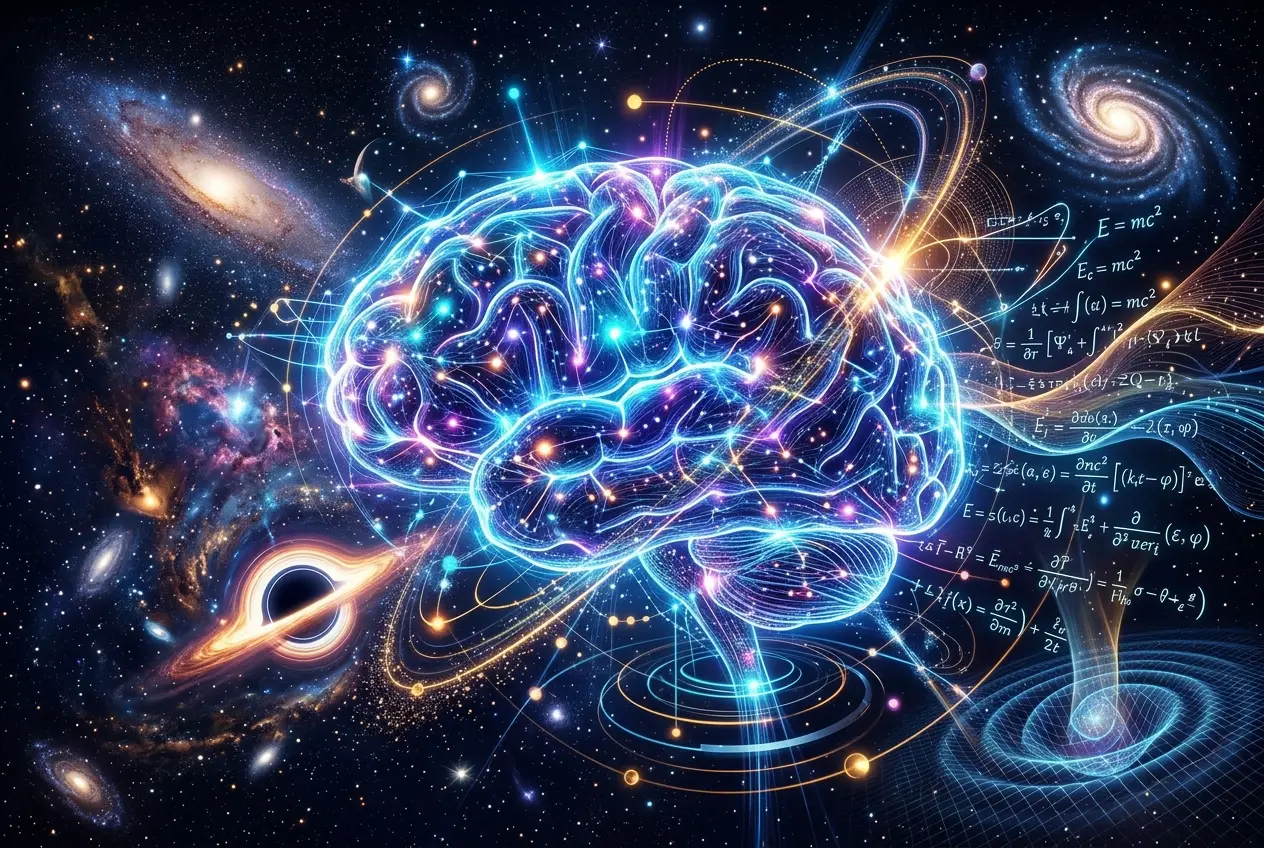
I remember a conversation I had recently with a friend, a brilliant theoretical physicist. We were discussing the ever-growing capabilities of artificial intelligence, and I jokingly asked, "Do you think a robot could ever win a Nobel Prize for discovering a new law of physics?" My friend paused, then, with a twinkle in their eye, admitted, "It’s not as far-fetched as it sounds." That statement stuck with me, sparking a cascade of questions: Are we on the cusp of an era where humanity's most profound scientific breakthroughs might originate from silicon brains rather than human ones? Could artificial intelligence truly push the boundaries of our understanding of the universe, uncovering principles that have eluded us for centuries?
The idea might seem like something out of a science fiction novel, where super-intelligent machines casually rewrite the textbooks of reality. Yet, the rapid advancements in machine learning, deep learning, and computational physics are bringing this futuristic scenario closer to home. We've already seen AI excel at complex tasks, from designing novel proteins to predicting material properties. But can it transcend mere data analysis and pattern recognition to formulate entirely new, abstract laws that govern the cosmos?
The Human Touch: How We Discover Laws of Physics
Before we dive into AI's potential, let’s consider how humans have historically unveiled the universe's secrets. Think of Newton observing an apple fall and formulating gravity, or Einstein's thought experiments leading to the theory of relativity. These breakthroughs weren't just about crunching numbers; they involved intuition, imagination, abstract reasoning, and a profound ability to synthesize seemingly disparate observations into elegant, universal principles. Human scientific discovery often involves:
- Observation and Experimentation: Gathering data from the natural world or controlled lab environments.
- Pattern Recognition: Identifying recurring themes and correlations within the data.
- Hypothesis Formulation: Proposing a testable explanation for observed patterns.
- Mathematical Formalization: Expressing the hypothesis as a precise, often elegant, mathematical equation.
- Prediction and Verification: Using the new law to predict phenomena and testing those predictions through further experiments.
- Conceptual Leap: Often, the most significant discoveries involve a leap of imagination, a re-framing of existing paradigms.
This process is messy, iterative, and heavily reliant on human cognitive strengths. The question then becomes: can AI replicate, or even surpass, these uniquely human cognitive leaps?
AI's Current Prowess: From Data to Deep Insights
Modern AI, particularly deep learning models, excels at the first two steps of human discovery: observation and pattern recognition. Given vast datasets, AI can identify correlations that are too subtle or complex for human minds to detect. For example, AI algorithms are already being used in particle accelerators to sift through petabytes of data, searching for signatures of new particles or interactions.
Consider Google's AlphaFold, which can predict protein structures with astonishing accuracy, a challenge that stumped biologists for decades. This isn't quite "discovering a law of physics," but it demonstrates AI's capacity to derive complex, underlying rules from intricate biological data. Similarly, in materials science, AI is accelerating the discovery of new materials with desired properties, far faster than traditional trial-and-error methods.
Some researchers are already using AI to find new mathematical equations from raw data. Systems like the "Symbolic Regression via Deep Learning" are trained on data and attempt to reverse-engineer the underlying mathematical formulas that govern that data. If these formulas accurately describe fundamental interactions, are they not, in essence, new laws? For a deeper dive into how AI can uncover hidden codes of the universe, you might find this interesting: Can AI Unlock the Universe's Hidden Code?.
The Challenge of Conceptual Leaps and Abstract Reasoning
The real hurdle for AI lies in the conceptual leap and abstract reasoning – the ability to generate a genuinely novel hypothesis or a paradigm-shifting theory without explicit pre-programming. AI is exceptionally good at interpolation (filling in gaps within existing knowledge) and extrapolation (projecting known patterns), but genuine innovation often requires thinking "outside the box," creating new boxes altogether.
- Inductive vs. Deductive Reasoning: Humans often use a blend of both. They observe specifics (inductive) and then form general theories, which are then used to predict other specifics (deductive). While AI can be trained on inductive tasks, developing truly deductive systems that can self-generate axioms and derive consequences is a much harder problem, touching on the realm of Artificial General Intelligence (AGI). For more on the future of AI prediction in science, see: Can AI Really Predict Science's Next Big Leap?.
- Intuition and Creativity: Many pivotal discoveries arose from flashes of insight, dreams, or seemingly unrelated analogies. Can an algorithm have a "eureka!" moment? While AI can generate novel combinations of ideas, the subjective experience of intuition remains uniquely human. This aspect is perhaps the most difficult to simulate.
- The Problem of "Why": AI can tell us what happens and how it happens based on data, but it struggles with the philosophical "why." Why do particles interact in a certain way? Why is the speed of light constant? These questions drive human curiosity and lead to deeper theoretical frameworks.
The Role of Mathematical Formalization: AI as a 'Mathematician'
Perhaps the most promising area for AI in discovering new physical laws is in its capacity for advanced mathematical formalization. Once a human or another AI identifies a potential pattern, AI could become an unparalleled tool for:
- Exploring Solution Spaces: Rapidly testing countless mathematical expressions and models against observed data.
- Optimizing Equations: Refining complex equations to achieve maximum predictive power and elegance.
- Discovering Symmetries: Identifying underlying symmetries in data that might correspond to fundamental conservation laws, which are often at the heart of physical theories (e.g., Noether's theorem, discussed further on Wikipedia: https://en.wikipedia.org/wiki/Noether%27s_theorem (opens in a new tab)).
A study published in Nature Communications demonstrated an AI system capable of identifying new physical concepts and deriving corresponding laws from experimental data. While still operating within a constrained environment, this research suggests AI could act as a "super-mathematician," translating raw observations into formal physical laws.
Beyond Human Limits: Where AI Might Shine
There are domains where AI might even surpass human capabilities in fundamental discovery:
- High-Dimensional Data: Physics often involves complex systems with many interacting variables. Human minds struggle to visualize or comprehend spaces beyond three or four dimensions. AI, however, can navigate and find patterns in high-dimensional data with ease. This could be crucial for theories like string theory or loop quantum gravity, which postulate extra spatial dimensions or incredibly complex interactions.
- Unbiased Search: Humans are susceptible to cognitive biases, favoring certain theories or approaches based on their existing knowledge or aesthetic preferences. An AI, in theory, could perform a truly unbiased search for fundamental laws, exploring avenues that human researchers might overlook due to preconceived notions.
- Rapid Iteration: The scientific method is iterative. AI can cycle through observation, hypothesis generation, testing, and refinement far faster than any human team, potentially accelerating the pace of discovery exponentially.
"The ultimate goal of science is to understand the universe. If AI can help us achieve that understanding faster and more completely, then it's a powerful tool, regardless of whether it's 'thinking' like a human or not." – Dr. Max Tegmark, MIT physicist and AI researcher.
The Path to AI-Driven Discovery
For AI to truly discover new laws of physics, several advancements are necessary:
- Improved Symbolic AI: Current deep learning models are primarily statistical. Developing more robust symbolic AI that can manipulate abstract concepts and rules, similar to how human logic works, is crucial.
- Autonomous Experimentation: Integrating AI with robotics to design, conduct, and interpret experiments autonomously. This "AI scientist" could tirelessly explore new phenomena.
- Enhanced Interpretability: We need to understand how AI arrives at its conclusions. If an AI proposes a new law, but we can't understand its reasoning, trust and verification become challenging. This is an ongoing area of research in "explainable AI" (XAI).
- Bridging the Gap to AGI: True, fundamental discovery likely requires a level of general intelligence that can generalize across domains, adapt to new problems, and exhibit common sense – hallmarks of AGI. We’re still far from achieving true AGI, but progress in fields like quantum computing might play a role. Check out our blog on Can Quantum Computers Break Time's Rules? for more on advanced computing.
The idea of the universe itself as a kind of neural network or computational system is also gaining traction, a concept that might blur the lines between AI and fundamental reality, as discussed in: Is the Universe a Giant Neural Network?.
Conclusion: A Collaborative Future
Will an AI someday stand alone as the discoverer of a new fundamental law? While possible in the very long term, the more immediate and probable future involves a powerful collaboration between humans and AI. AI will serve as an indispensable partner, an intellectual amplifier that extends our cognitive reach into realms of data and complexity that are currently inaccessible.
Imagine an AI sifting through telescope data, detecting a subtle anomaly in the cosmic microwave background, then generating a hundred plausible mathematical models, each leading to novel predictions. Human physicists would then evaluate these models, refine them with their intuition, and design experiments to test the most promising ones. In this symbiotic relationship, humanity's creativity and abstract reasoning would combine with AI's unparalleled processing power and pattern recognition.
The potential for such a partnership is breathtaking. It could lead to breakthroughs in fundamental physics, revealing secrets about dark matter, dark energy, quantum gravity, or even the very nature of reality itself, accelerating our understanding of the universe in ways we can scarcely imagine. The future of scientific discovery isn't about AI replacing us, but about AI empowering us to see further, think deeper, and unlock mysteries that have been hidden in plain sight.



Conversation0
No comments yet. Be the first to share a thought — the best questions often become new stories.