I've always been captivated by the ocean's profound mystery. It's a realm far more alien than space in many ways, an enormous, largely unexplored territory beneath the waves that holds secrets we've only just begun to glimpse. Recently, while diving into research about undiscovered phenomena, I found myself drawn to the perplexing world of deep-sea sounds—signals that defy easy explanation and stir a primal curiosity: *what* is making those noises?
The ocean is far from silent. It’s a symphony of natural sounds, from the rhythmic sloshing of waves against distant shores to the thunderous crack of icebergs calvin. Add to that the chorus of marine life—the clicks of dolphins, the haunting songs of whales, the croaks and growls of various fish species. And then there are the human contributions: the hum of cargo ships, the sonar pings of submarines, the seismic surveys searching for oil and gas. We have sophisticated tools to listen to this underwater world, instruments known as **hydrophones** that capture every tremor and whisper. If you're curious about how these devices work, you can learn more about them on [Wikipedia's Hydrophone page](https://en.wikipedia.org/wiki/Hydrophone).
But amidst this cacophony, a handful of sounds have emerged over the decades that scientists simply cannot identify. These aren't just faint anomalies; some are incredibly powerful, spanning vast distances, and their origins remain stubbornly unknown. Could these unexplained deep-sea signals hint at something truly extraordinary, perhaps even non-human intelligence dwelling in the abyssal plains?
### The Echoes of the Unknown: Famous Unidentified Signals
The most iconic of these enigmatic sounds is undoubtedly **"The Bloop."** Discovered in 1997 by the U.S. National Oceanic and Atmospheric Administration (NOAA) during their routine monitoring of the equatorial Pacific Ocean, The Bloop was an ultra-low-frequency, high-amplitude underwater sound. It lasted for about a minute, sweeping through the hydrophone array that spanned over 5,000 kilometers. What made it so remarkable was its sheer power; it was far louder than any known animal, including the mighty blue whale, and its frequency characteristics didn't quite match any known geological event either.
Imagine a sound so loud, so vast, that it dwarfed the vocalizations of the largest creature on Earth, yet seemed to come from nowhere. NOAA scientists initially hypothesized it might be an unrecorded type of gigantic marine animal, something truly colossal, pushing the boundaries of what we thought possible in marine biology. The speculation ran wild, fueled by the mysterious nature of the deep ocean, and even prompted comparisons to H.P. Lovecraft’s mythical Cthulhu. Though later, in 2012, NOAA clarified that the Bloop's spectrographic characteristics were consistent with icequakes caused by large icebergs cracking and fracturing in Antarctica, the initial mystery, and the possibility it held, captured the public imagination. You can delve deeper into the fascinating story of The Bloop on its [Wikipedia page](https://en.wikipedia.org/wiki/Bloop).
The Bloop wasn’t an isolated incident. Before and after it, other unidentified sounds have been recorded:
* **"Upsweep":** Detected in 1991, this long-duration sound consisted of a series of narrow-band upsweeping events, each lasting several seconds. It was strong enough to be detected across the entire Pacific Ocean and continued for several years, though its intensity gradually diminished. Its source was eventually linked to volcanism in the Pacific.
* **"Whistle":** This was a unique, complex signal, also recorded by NOAA, that did not fit any known biological or geophysical profile. Its origin remains largely unknown.
* **"Slow Down":** Recorded in 1997, this was a sound whose frequency gradually decreased over about seven minutes. It was picked up by hydrophones over a 2,000 km range. Similar to The Bloop, it was eventually attributed to large ice movements, but the initial mystery was compelling.
These phenomena highlight a fundamental truth: our understanding of the deep ocean's soundscape is far from complete.
### How Do We Listen to the Abyssal Depths?
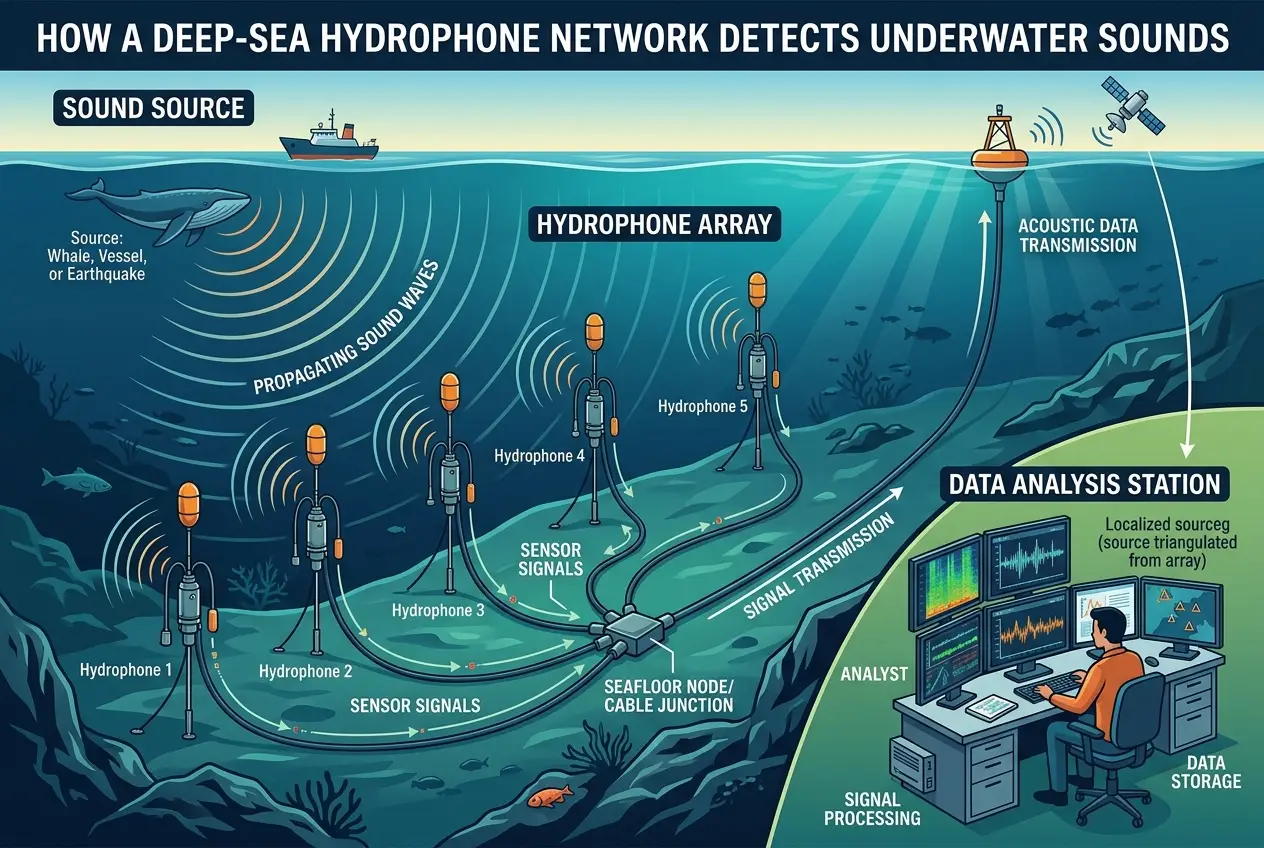
The ability to detect these deep-sea signals stems from advanced acoustic monitoring systems, many of which were initially developed for military purposes. The most famous is likely the **SOSUS (Sound Surveillance System)**, a network of underwater hydrophone arrays deployed by the U.S. Navy during the Cold War to track Soviet submarines. This system, originally shrouded in secrecy, proved invaluable for oceanographic research once declassified, providing an unprecedented window into the deep-sea sound environment. For more on this fascinating piece of technological history, check out the [Wikipedia page for SOSUS](https://en.wikipedia.org/wiki/SOSUS).
Today, scientific organizations like NOAA deploy similar, though often more specialized, arrays of hydrophones. These instruments are capable of detecting subtle pressure changes in the water, converting them into electrical signals that can then be analyzed for frequency, amplitude, and duration. By triangulating signals picked up by multiple hydrophones, scientists can often pinpoint the approximate location of a sound's origin, even hundreds or thousands of kilometers away. This is how we distinguish a distant earthquake from a nearby whale song.
### The Quest for Explanations: Natural Candidates
When faced with an anomalous signal, scientists first look for natural explanations, both known and undiscovered.
1. **Geological Activity:** The Earth's crust is dynamic, even beneath the ocean. Submarine volcanoes, seismic shifts, and hydrothermal vents all produce distinct sounds. While some mysterious signals, like "Upsweep," have been linked to volcanic activity, others don't quite fit the profile.
2. **Ice Activity:** As discussed with The Bloop and Slow Down, the movement and fracturing of massive icebergs and glaciers can generate extremely powerful low-frequency sounds. These can travel vast distances and mimic characteristics previously thought to be biological.
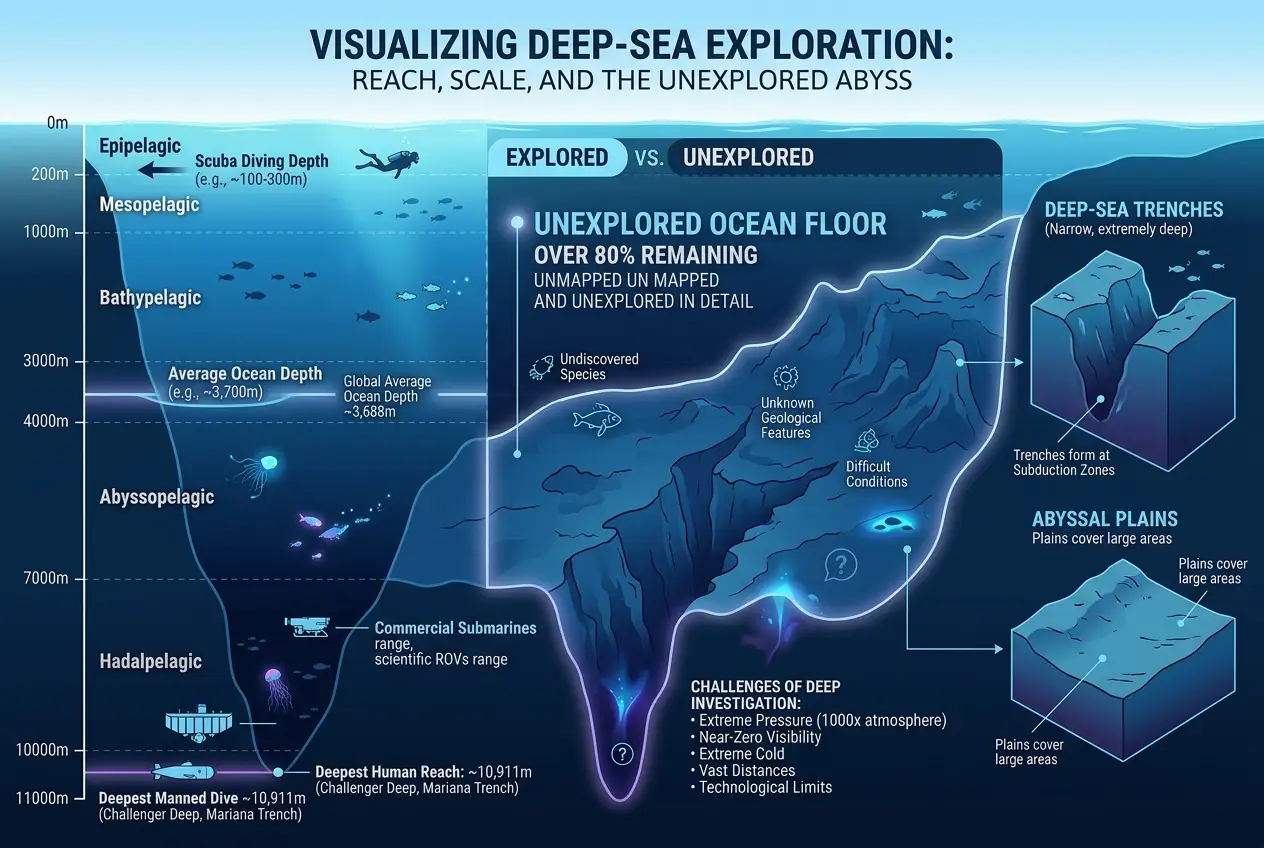
3. **Undiscovered Marine Life:** This is where the true wonder often lies. The deep ocean is the largest habitat on Earth, and we have explored less than 5% of it. It's plausible, even probable, that immense, undescribed creatures inhabit these depths. Could there be a species of baleen whale or an even larger, more elusive organism capable of producing sounds far beyond our current understanding? The field of [Bioacoustics](https://en.wikipedia.org/wiki/Bioacoustics) studies precisely this—the production, dispersion, and reception of sound in animals, and its continued evolution could reveal incredible insights. While we have internal blogs on topics like the possibility of extraterrestrial life in Europa's oceans, the idea of undiscovered megafauna on Earth is equally tantalizing, hinting at the vast, unexplored biological richness of our own planet, as we explored in our post on whether [Europa's ocean hides alien life](/blogs/is-europas-ocean-hiding-alien-life-decoding-icy-moons-2055).
### Beyond the Natural: The Non-Human Intelligence Hypothesis
While mainstream science rightly prioritizes natural explanations, the sheer anomaly of some signals, coupled with the profound mystery of the deep, has led some to consider more speculative, yet intriguing, hypotheses. What if some of these sounds are not natural phenomena, nor conventional marine life, but rather indicators of an unknown, intelligent presence?
This line of thought often branches into two main categories:
* **Undiscovered Earth-based Intelligence:** Could an advanced, highly intelligent species have evolved entirely within the deep ocean, far removed from human interaction? Such a civilization would likely have developed technologies and communication methods radically different from our own. Perhaps their "signals" are a form of communication or environmental sensing we simply don't recognize. The vast pressures, darkness, and unique chemistry of the deep ocean could foster life that is utterly alien to our surface-dwelling perspective. It's a fascinating concept that makes one wonder if, like the "hum" that baffles scientists globally, some deep-sea sounds are signals we simply aren't equipped to interpret. Read more about unexplained global sounds in our blog, [Why Does The Hum Baffle Scientists Globally?](/blogs/why-does-the-hum-baffle-scientists-globally-2236).
* **Cryptoterrestrials or Extraterrestrial Connections:** This hypothesis ventures further, suggesting that an advanced intelligence, terrestrial or otherwise, might be operating from deep beneath our planet's surface. This is more in the realm of speculative fiction, but the "unidentified aquatic phenomena" (UAP) observed by military and civilian personnel over decades add a layer of intrigue. Some researchers propose that UAPs could be trans-medium vehicles, capable of operating seamlessly in air and water, and if so, their underwater movements or communications might generate sounds we detect as anomalous. While there's no concrete evidence to support this, the enduring mystery encourages us to consider all possibilities, however remote.
### The Challenges of Deep Ocean Exploration
Investigating these deep-sea signals is incredibly difficult. The ocean floor is miles beneath the surface, bathed in perpetual darkness, and subject to crushing pressures. It's a hostile environment for human exploration and technological deployment alike.
* **Cost and Technology:** Sending remotely operated vehicles (ROVs) or autonomous underwater vehicles (AUVs) to these depths is extraordinarily expensive and technically challenging. Batteries degrade, signals struggle, and equipment must withstand immense pressure.
* **Vastness:** Even with advanced hydrophone arrays, triangulating a sound source only narrows down an area. Searching that area—which can be hundreds or thousands of square kilometers—is like finding a needle in an oceanic haystack.
* **Temporal Nature:** Many anomalous sounds are fleeting. By the time researchers can mobilize and reach a potential source region, the sound may have ceased, leaving behind only an echo and lingering questions.
### The Future of Deep-Sea Acoustics
As technology advances, so does our ability to listen and explore. Future breakthroughs could involve:
* **AI-driven Acoustic Analysis:** Artificial intelligence could be trained to identify subtle patterns in vast datasets of ocean sounds that human ears or conventional algorithms might miss. This could help differentiate natural phenomena from truly unknown sources more effectively.
* **Next-Generation Autonomous Vehicles:** More resilient, energy-efficient AUVs equipped with advanced sensors could be deployed in swarms to patrol vast regions, responding rapidly to detected anomalies and providing real-time data.
* **Neutrino Detectors:** While highly speculative, some physicists propose that future neutrino detectors might offer a way to "see" through vast swathes of the Earth, potentially revealing large structures or energy sources deep within the crust or ocean.
The deep ocean remains our planet's final frontier, a place where genuine discovery is still possible on a grand scale. The mysterious signals we've detected are more than just scientific puzzles; they are invitations to imagine, to question, and to push the boundaries of our understanding. Whether these sounds are eventually attributed to undiscovered geological processes, colossal unknown marine animals, or something truly beyond our current comprehension, the ongoing quest to decode them continues to fuel our innate curiosity about the wonders hidden beneath the waves. The seafloor itself holds immense geological and biological complexity, acting almost like a "natural computer" with its intricate systems, a concept we explored in our blog about the [ocean's hidden brain](/blogs/oceans-hidden-brain-is-the-seafloor-a-natural-computer-5039). Our journey into the unknown depths has just begun.
Frequently Asked Questions
The most famous unidentified deep-sea sound is 'The Bloop,' recorded in 1997 by NOAA. It was an ultra-low-frequency, high-amplitude sound that puzzled scientists due to its power and unique characteristics, though it was later attributed to icequakes.
Scientists use specialized underwater microphones called hydrophones, often deployed in vast arrays like the former military SOSUS system, to listen to and record sounds. By analyzing signals picked up by multiple hydrophones, they can triangulate the source of a sound.
Natural explanations typically include geological activity such as submarine volcanoes or seismic events, and the movement and fracturing of large icebergs (icequakes). Scientists also consider the possibility of undiscovered, large marine animals.
Investigating deep-sea signals is challenging due to the extreme conditions of the deep ocean (immense pressure, darkness), the high cost and technological demands of deep-sea exploration, the vastness of the ocean, and the often fleeting or transient nature of the anomalous sounds.
While highly speculative and lacking direct evidence, some hypotheses suggest the possibility of an advanced, intelligent species having evolved entirely within the deep ocean, utilizing communication methods we don't yet understand. This remains a topic of scientific curiosity and wonder.
Verified Expert
Alex Rivers
A professional researcher since age twelve, I delve into mysteries and ignite curiosity by presenting an array of compelling possibilities. I will heighten your curiosity, but by the end, you will possess profound knowledge.
Leave a Reply
Comments (0)
No approved comments yet. Be the first to share your thoughts!
 Join Us

 Unknown Author






















Leave a Reply
Comments (0)