


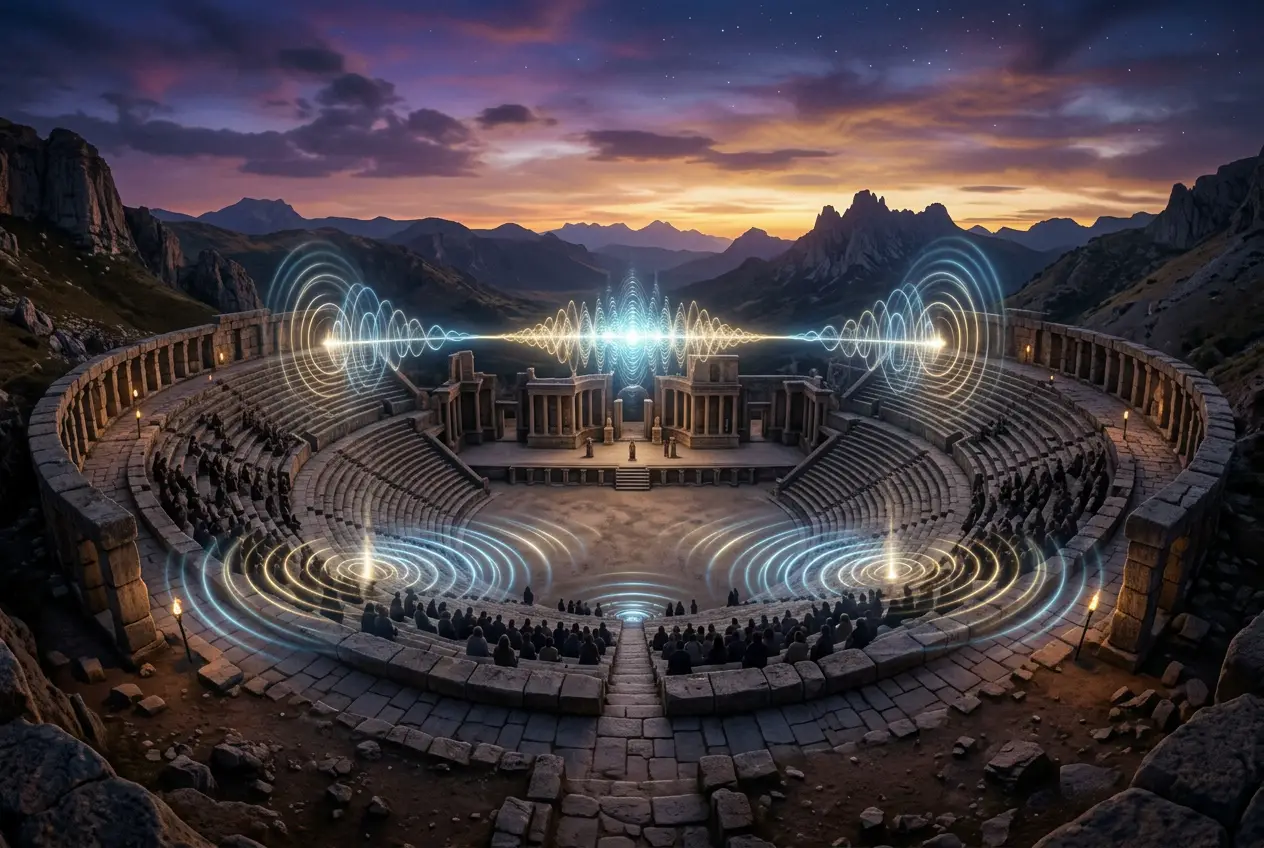
Stepping into certain ancient sites, you don't just see history; you feel it. But what if you could hear it in ways modern architects struggle to replicate? I’m talking about an uncanny acoustic phenomenon where whispers carry across vast distances, or a single voice resonates with unbelievable clarity, almost as if the very stones were designed to amplify or direct sound. This isn’t just about good acoustics; it's about a potential mastery of sound engineering by civilizations millennia ago, raising a fascinating question: Can ancient structures truly focus sound, and are we hearing echoes of lost technology?
The idea might sound like something out of a science fiction novel, yet empirical observations from sites worldwide suggest there’s more to it than simple echoes. From the perfectly projected voices in ancient Greek amphitheaters to the perplexing resonant chambers of megalithic tombs, an understanding of sound manipulation seems almost inherent in their design. It makes me wonder if our ancestors possessed an intuitive, perhaps even scientific, grasp of acoustics that has since faded from our collective memory.
The Phenomenon of Acoustic Anomalies
We’ve all experienced moments where sound behaves strangely in certain environments. A cathedral’s long reverberation, the crisp echo in a canyon, or the deadened silence of a specially designed studio. But what we find in some ancient structures goes beyond the expected. These aren't just echo chambers; they are often places where sound is channeled, amplified, or even distorted in ways that seem deliberate.
Consider the classic example of ancient Greek amphitheaters, like the one at Epidaurus. It's legendary for its acoustic perfection. A whisper from the stage can be heard distinctly by every one of the 14,000 to 15,000 spectators, even in the very last row. Modern acousticians have studied Epidaurus extensively, initially attributing its success to the stone benches filtering out low-frequency background noise, thus allowing high-frequency sounds to propagate further. However, recent research suggests the unique design of the tiered seating might also act as an acoustic lens, subtly reflecting and directing sound waves in a highly sophisticated manner.
But it's not just theaters. Many ancient temples, pyramids, and underground chambers exhibit unusual acoustic properties. Some researchers suggest these properties might have been central to their ceremonial or spiritual functions, perhaps inducing altered states of consciousness through specific frequencies or resonant vibrations. This is a field of study that combines archaeology, physics, and even a touch of speculative history, trying to decode what our ancestors knew about the invisible world of sound.
The Science Behind Acoustic Focusing
To understand how ancient structures might focus sound, we need to delve a little into the physics of sound waves. Sound travels as vibrations through a medium, and when these waves encounter a surface, they can be reflected, absorbed, or transmitted. The shape, material, and orientation of these surfaces profoundly affect how sound behaves.
- Reflection and Refraction: Just like light, sound waves can be reflected off hard surfaces. If these surfaces are shaped parabolically or elliptically, they can gather sound waves from one point and focus them onto another, creating a "whispering gallery" effect.
- Resonance: Every object has a natural frequency at which it prefers to vibrate. If sound waves matching this frequency strike the object, it will resonate, amplifying the sound. Ancient builders might have intuitively chosen materials and dimensions that resonated at significant frequencies.
- Diffraction and Diffusion: Sound waves can also bend around obstacles (diffraction) or scatter off irregular surfaces (diffusion). A sophisticated understanding of these principles could allow architects to eliminate unwanted echoes while preserving desired sounds.
Imagine a parabolic reflector – the kind used in satellite dishes. These shapes are designed to collect incoming signals from a vast area and focus them onto a single point. If ancient architects understood this principle, even intuitively, they could have applied it to their structures using curves, domes, and even stepped surfaces to control sound propagation. The exact scientific knowledge they possessed remains a mystery, but the empirical results speak volumes. For further reading on the physics of sound, Wikipedia offers an excellent overview on sound (opens in a new tab) and its properties.
Case Studies in Ancient Acoustic Engineering
Beyond Epidaurus, numerous other sites present intriguing acoustic anomalies:
- Chichen Itza, Mexico: The famous El Castillo pyramid. If you clap your hands at the base, the echo that returns is said to resemble the chirp of a quetzal bird. This acoustic illusion is thought to be a result of the pyramid's stepped geometry and specific dimensions, diffracting the sound in a peculiar way. The complex interplay of reflection and resonance here is truly captivating.
- Newgrange, Ireland: This ancient passage tomb, older than the pyramids of Egypt, exhibits a remarkable resonance when certain low-frequency sounds are produced within its central chamber. Some researchers suggest these frequencies might have been used in ritualistic chanting, potentially inducing trance-like states. This aligns with theories about the use of sound in ancient spiritual practices, a topic also explored in our blog on Lost Acoustic Tech.
- Hagar Qim and Mnajdra, Malta: These megalithic temples feature "oracle holes" and acoustic properties where voices appear amplified or distorted, particularly by the unique curvature of their stone chambers. The very layout of the chambers could have been designed to create specific auditory experiences.
- The Oracle of Delphi, Greece: While much of its original structure is gone, historical accounts suggest the oracle's prophecies were often delivered with powerful, echoing voices, perhaps enhanced by the temple's architecture and geological features. The interplay of natural acoustics and structural design would have been formidable.
- Stonehenge, England: Beyond its astronomical alignments, some studies have hinted at unique acoustic properties, particularly concerning how sounds might have traveled or resonated within the original circle of standing stones. While less dramatic than a whispering gallery, the arrangement could have influenced how ceremonies were heard by participants. This calls to mind other ancient structures with enigmatic purposes, such as Gobekli Tepe.
These examples compel us to reconsider the sophistication of ancient builders. Did they possess advanced knowledge, or was it a gradual accumulation of practical wisdom passed down through generations?
The Lost Knowledge Hypothesis
The idea that ancient civilizations might have possessed knowledge we’ve since forgotten is a recurring theme in archaeological and scientific discourse. When it comes to acoustics, it's possible that their understanding was empirical, born from trial and error over centuries, rather than derived from complex mathematical formulas as ours is today. They might have simply observed what worked and replicated it.
However, the precision seen in some of these structures suggests more than just serendipity. The integration of acoustic design into overall architectural and ritualistic purpose hints at a holistic approach. Did they have specialist "sound architects" or "acoustic priests" who understood these principles deeply? The absence of written treatises on acoustic engineering from these periods leaves us to piece together the puzzle from the physical evidence alone. This often feels like interpreting an impossible artifact without a manual.
One theory posits that acoustic phenomena were not merely incidental but fundamental to the power and mystery of these sites. Imagine a priest whose voice, through architectural design, sounded like that of a deity, booming and omnipresent. Such effects would undoubtedly enhance the spiritual and political authority of those in power.
Bridging the Past and Future
Today, modern acousticians use advanced computer modeling and materials science to design concert halls and recording studios with impeccable sound quality. Yet, the enduring mystery of sites like Epidaurus continues to challenge our assumptions about what’s possible without our current technology. Perhaps these ancient engineers understood something fundamental about the interaction of sound, material, and space that we are only now beginning to rediscover. Wikipedia's article on Architectural Acoustics (opens in a new tab) highlights how contemporary design draws on similar principles.
The implications of this lost knowledge could extend beyond mere historical curiosity. Understanding how ancient builders achieved such remarkable acoustic feats could inspire new approaches in sustainable architecture, urban planning, or even therapeutic environments. Imagine buildings that naturally enhance human communication or create calming soundscapes without relying on artificial amplification or soundproofing.
The echoes from these ancient stones continue to whisper a fascinating narrative: that perhaps, in the deep past, humanity had a profound and practical understanding of the unseen forces around us, including the very air we vibrate with our voices. What else might be hidden in plain sight, waiting for our ears—and our minds—to truly listen?
What do you think? Were these acoustic wonders intentional designs or happy accidents? Share your thoughts in the comments below!





Conversation0
No comments yet. Be the first to share a thought — the best questions often become new stories.