


I’ve always been captivated by the sheer scale of the cosmos. When I look up at the night sky, my imagination inevitably drifts to distant galaxies, alien civilizations, and the seemingly insurmountable challenge of traversing the immense voids between them. We dream of interstellar travel, of reaching Proxima Centauri in a human lifetime, but the speed of light—our universe's ultimate speed limit—stands as a cosmic barrier. It’s a paradox: the faster we go, the further away everything else appears to recede, limited by the very laws of physics. But what if there was a loophole? What if the universe itself offers a subtle, mind-bending mechanism that could bypass this limitation, at least for communication? This is where I start thinking about quantum entanglement.
Recently, I was diving deep into the bizarre world of quantum mechanics, and the concept of "spooky action at a distance" once again sparked my curiosity. Could this truly instantaneous connection between particles be the key to unlocking communication that transcends light speed, effectively accelerating our journey to becoming an interstellar species? It’s a question that tantalizes physicists and science fiction writers alike, hinting at a future where our messages could reach distant probes or colonies in an instant, rather than centuries.
The Enigma of Quantum Entanglement
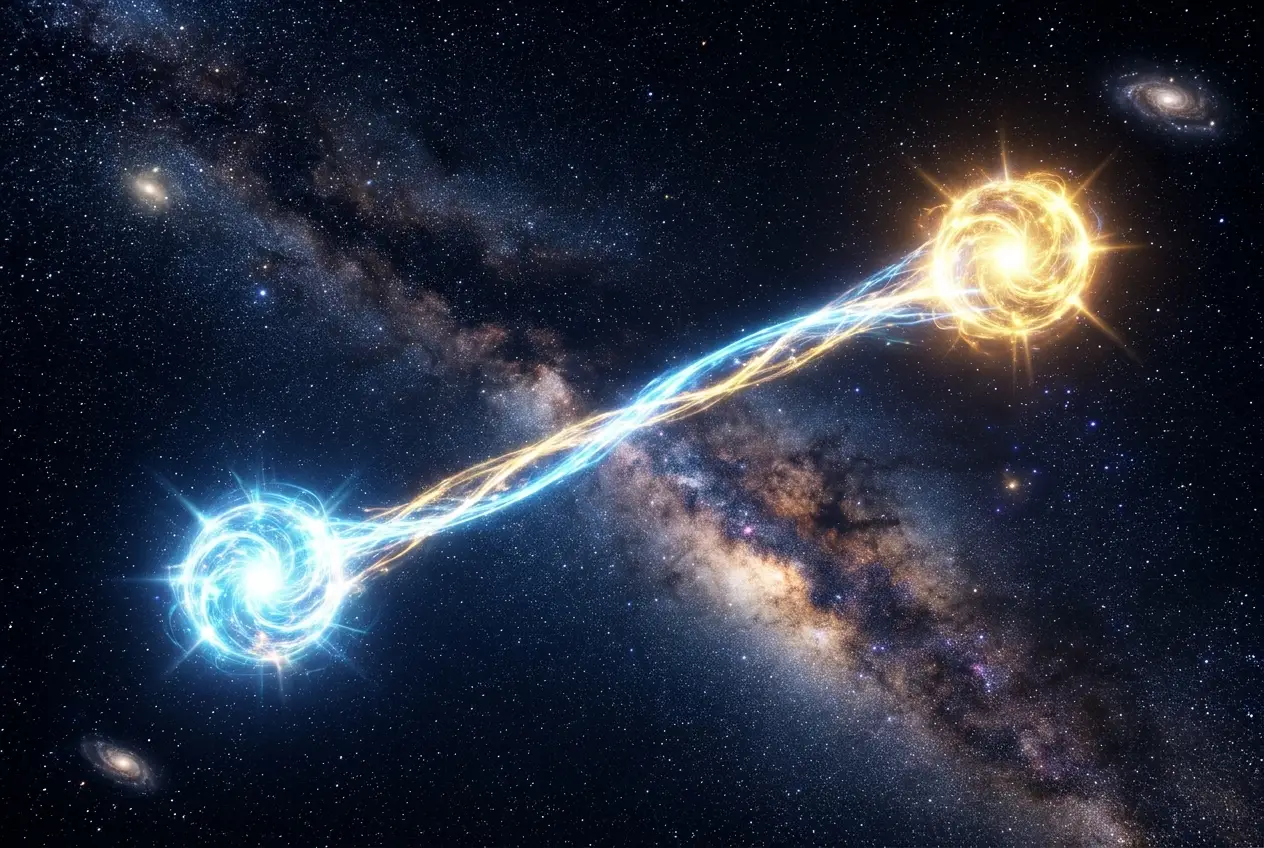
To understand this audacious idea, we first need to grasp the phenomenon itself. Quantum entanglement is one of the most perplexing and fascinating aspects of quantum mechanics. Imagine two tiny particles, say electrons or photons, becoming linked in such a way that they share the same fate, no matter how far apart they are. If you measure a property of one particle, like its spin or polarization, the other instantaneously assumes a correlated state. This happens faster than the speed of light, defying our classical understanding of reality. Albert Einstein famously called it "spooky action at a distance," a term that perfectly captures its unsettling nature.
Think of it like this: you have two coins, one in London and one in New York. You flip the London coin, and it lands heads. Instantly, the New York coin, without any physical communication, also lands heads. If the London coin landed tails, the New York coin would also be tails. The outcome for one instantaneously determines the outcome for the other, regardless of the distance separating them. In the quantum realm, this isn't a trick; it's a fundamental property of how these particles interact.
The implications of this instantaneous correlation are profound. If information could be transmitted this way, it would revolutionize everything from secure communication to, potentially, our ability to explore the universe. For a deeper dive into the fundamental principles, Wikipedia offers an excellent overview of Quantum Entanglement (opens in a new tab).
The "No-Communication Theorem": Why FTL Comm Is (Currently) Impossible
This sounds like the perfect solution for interstellar communication, doesn't it? If we could entangle a pair of particles, send one to a distant spaceship, and keep the other on Earth, we could seemingly send messages instantly. A measurement on Earth would instantly affect the particle on the spaceship, and vice-versa. Problem solved, right?
Unfortunately, here’s where the universe politely reminds us of its rules. The "no-communication theorem" is a cornerstone of quantum mechanics that states you cannot use quantum entanglement alone to transmit classical information faster than light. Why? Because while the state of the distant entangled particle changes instantaneously, you cannot control what that state will be.
Let's revisit our coin analogy. You flip your London coin. It's either heads or tails, randomly. You know instantly what the New York coin is, but you can't force the London coin to be heads to send a "yes" message, or tails to send a "no." The randomness is inherent to the quantum measurement. To transmit a message, you need to encode information, which requires pre-determined states. Since the outcome of any single quantum measurement is probabilistic and truly random, you can't deliberately manipulate the distant particle's state to convey a specific message.
To actually communicate the result of your measurement (e.g., "my coin landed heads"), you still need a classical channel – like radio waves or light – to send that information. And those classical signals are bound by the speed of light. So, while entanglement is instantaneous, it doesn't allow for instantaneous information transfer in a controllable, message-sending way. This elegant theorem protects Einstein's cosmic speed limit, preventing causal paradoxes and ensuring the stability of our physical laws.
Pushing the Boundaries: Quantum Tech for Secure, Not FTL, Comm
While direct FTL communication via entanglement remains firmly in the realm of science fiction, the practical applications of quantum entanglement are already here and incredibly impactful. The most prominent example is Quantum Key Distribution (QKD). This technology uses entangled particles to create unhackable encryption keys. If an eavesdropper tries to intercept the entangled particles, their presence instantly disturbs the quantum state, alerting the communicating parties. This allows for truly secure communication channels, crucial for sensitive data. My colleagues have explored similar concepts in "Can Quantum Biometrics Unlock Unhackable Security?" which delves into the potential of quantum principles for unbreachable digital protection.
Think of QKD as setting up a shared, secret cryptographic key between two distant points using quantum principles. Once the key is established, classical communication (which is still limited by light speed) can then use this quantum-secured key to encrypt messages. It's a game-changer for cybersecurity, but it doesn't break the light-speed barrier for information transmission itself.
Furthermore, the ongoing development of quantum computing relies heavily on understanding and manipulating entangled states. Future quantum networks, sometimes dubbed the "quantum internet," aim to distribute entangled particles over vast distances to enable revolutionary applications like distributed quantum computing and ultra-precise sensing. While these advancements won't facilitate FTL messaging, they represent a profound leap in our ability to harness quantum phenomena. For more on the power of quantum computing, you might find our article on "Black Holes: Are They Nature's Ultimate Quantum Computers?" a fascinating read, exploring the theoretical limits of natural quantum processing.
The Speculative Frontier: Entanglement Beyond Communication
While directly using entanglement for FTL communication seems off-limits, the thought of its indirect impact on space travel continues to spark imagination. Could understanding entanglement lead us to breakthroughs in propulsion or spacetime manipulation? Some highly speculative theories ponder whether a deeper understanding of quantum gravity, potentially involving entanglement, could one day reveal pathways to concepts like warp drives or stable wormholes. These are theoretical shortcuts through spacetime that could drastically reduce interstellar travel times.
If we could somehow manipulate the very fabric of spacetime, entanglement might play a role in sensing or stabilizing these exotic phenomena. However, this is far, far beyond our current scientific understanding and technological capability. It ventures into the realm of theoretical physics that would require entirely new laws or interpretations of physics. For instance, some theories propose exotic matter might be needed to create stable wormholes, a concept explored in our blog "Is Dark Energy Creating Cosmic Wormholes?", which touches upon the immense forces and unknown variables at play.
Currently, entanglement doesn't offer a direct "teleporter" or FTL drive. It's more of a shared, probabilistic connection. Yet, the persistent curiosity it ignites drives researchers to explore every angle.
The Quantum Leap: Are We Ready for the Future?
The immense scientific and engineering hurdles in truly harnessing quantum phenomena for large-scale applications are staggering. Maintaining entanglement over vast distances is incredibly difficult due to decoherence, where particles lose their quantum properties through interaction with their environment. The cold, empty vacuum of space might seem ideal, but cosmic radiation and subtle gravitational influences could still pose significant challenges.
Moreover, the sheer energy requirements and the technological precision needed to build and deploy interstellar quantum communication infrastructure are currently unimaginable. We are still in the early stages of building functional quantum computers and establishing rudimentary quantum networks on Earth. Scaling this to cosmic distances represents a monumental leap.
However, the history of science is filled with "impossibilities" that became realities. The dream of harnessing quantum entanglement to somehow accelerate our reach into the cosmos remains a powerful motivator. It encourages us to continue pushing the boundaries of physics and engineering, to seek new understandings that might one day reshape our interaction with the universe.
In conclusion, while quantum entanglement doesn't, by itself, allow us to send messages faster than light, its profound implications for secure communication and its potential role in a future "quantum internet" are already revolutionizing technology. As for its role in enabling true faster-than-light travel or communication for humanity's interstellar ambitions, that remains one of the universe's most tantalizing "tech mysteries" – a long, exciting road of discovery that I, for one, can't wait to see unfold.





Conversation0
No comments yet. Be the first to share a thought — the best questions often become new stories.