


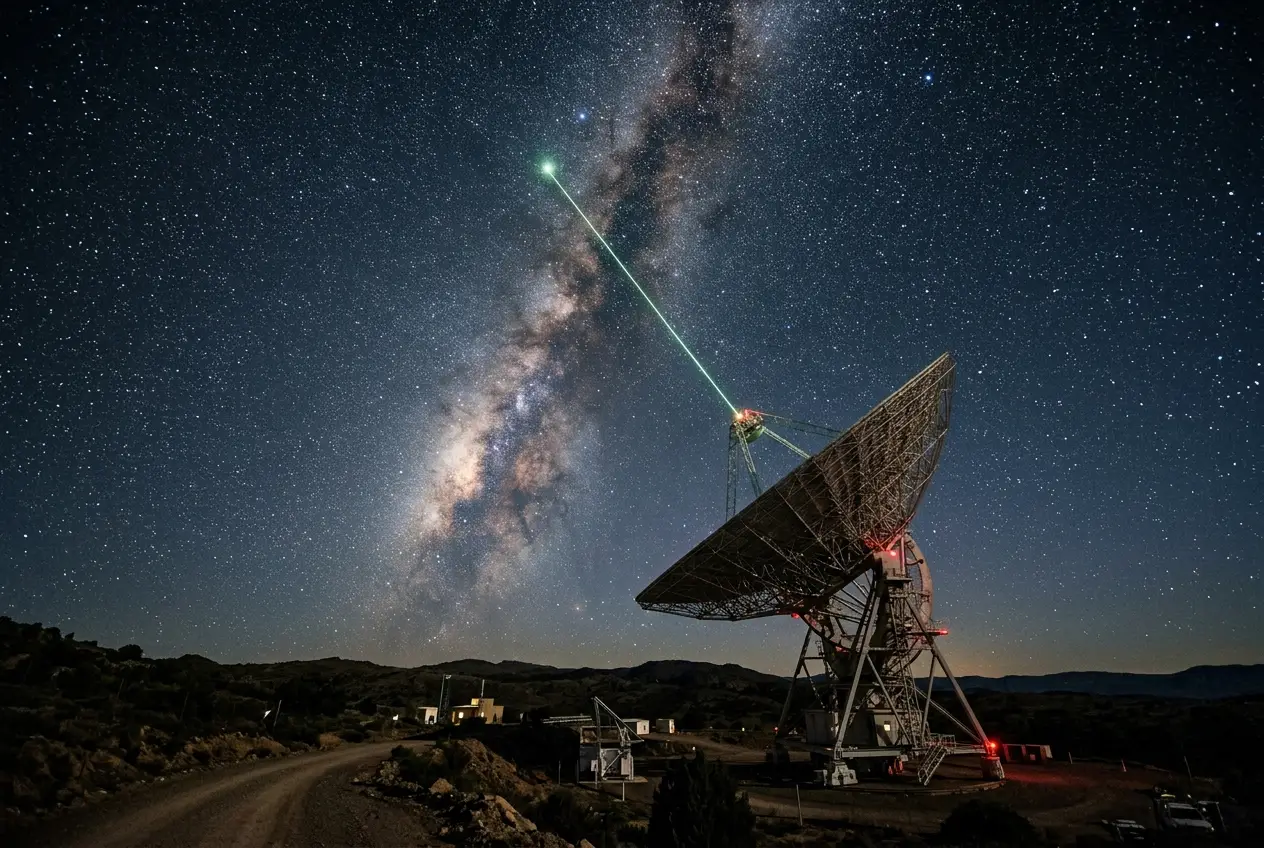
Imagine, for a moment, standing at the edge of the known universe, listening. Not to the gentle hum of the cosmos we've grown accustomed to, but to a distinct, amplified voice from the void. A voice that whispered, not in words, but in a specific frequency, far more powerful than anything we’d ever recorded from a natural source beyond Earth. This isn't a scene from a science fiction epic; it’s the heart of one of astronomy's most enduring and perplexing mysteries: the Wow! Signal.
I vividly recall reading about the Wow! Signal for the first time. The sheer audacity of it, a fleeting glimpse of something truly anomalous, sent shivers down my spine. It was August 15, 1977, when Jerry Ehman, a volunteer with the SETI (Search for Extraterrestrial Intelligence) program, was scanning data from the Big Ear radio telescope at Ohio State University. His eyes landed on a sequence of alphanumeric characters that made him grab a red pen and circle them, scribbling "Wow!" next to the printout. What he saw was a burst of radio energy 30 times stronger than the typical background noise of space, lasting for 72 seconds – exactly the duration the telescope could observe a single point in the sky.
This wasn't just noise; it had characteristics that screamed "artificial." It occurred at a specific frequency (1420.4556 MHz), very close to the 21-centimeter hydrogen line (1420.4058 MHz), a crucial frequency for astronomers because hydrogen, the most abundant element in the universe, naturally emits and absorbs at this wavelength. This frequency is often considered a "cosmic watering hole" where intelligent civilizations might choose to broadcast, knowing others would be listening. Furthermore, the signal was unmodulated, meaning it carried no discernible information like speech or complex patterns, but its sheer strength and narrow bandwidth were highly unusual for natural astrophysical phenomena.
The Anatomy of an Anomaly
To truly appreciate the mystery, we need to understand the details. The Big Ear telescope was designed to sweep the sky, and each point it observed passed through its beam for exactly 72 seconds. The Wow! Signal emerged, peaked, and then disappeared perfectly within this 72-second window, matching the telescope's observation profile for a point source from space. This strongly suggested it originated from a distant, fixed point, rather than being local interference.
The alphanumeric sequence Ehman circled was "6EQUJ5". This wasn't some coded message; it represented the signal's intensity over time, relative to the background noise. '6' meant it was 6 times stronger than background, 'E' meant it was 14 times stronger (using a base-36 system where A=10, B=11, etc.), 'U' meant 30 times, and 'J' meant 19 times. The 'U' represented the peak of the signal, a staggering 30 standard deviations above the average noise level. This was not a subtle blip; it was a cosmic shout.
The frequency was also key. The 1420 MHz band is protected internationally precisely because of its astronomical significance. Any terrestrial broadcast at this frequency is strictly prohibited, reducing the likelihood of Earth-based interference. This narrow, focused burst, precisely on a frequency thought ideal for interstellar communication, immediately raised eyebrows and fueled hopes. Was this truly a deliberate transmission from an extraterrestrial civilization, an alien call across the vast emptiness?
Hunting for the Echo: Why It Never Returned
The immediate aftermath of the signal’s detection was a flurry of excitement, followed by intense scrutiny. SETI researchers, including Ehman himself, spent years trying to re-detect the signal. They pointed powerful radio telescopes, including the Big Ear and others, back to the precise celestial coordinates where the Wow! Signal originated (roughly in the constellation Sagittarius, near the globular cluster M55). They listened, and listened again, but nothing. The signal never returned.
This lack of repetition is perhaps the most frustrating aspect of the entire mystery. If it was a deliberate transmission, why just one burst? If it was an alien beacon, surely it would repeat? This has led to numerous hypotheses, each attempting to explain the signal's unique characteristics without resorting to simple "aliens did it" conclusions. For more on the challenges of detecting cosmic messages, you might find our blog on decoding cosmic whispers insightful.
The Big Ear telescope was ultimately decommissioned in 1997, but the legacy of the Wow! Signal continues to inspire scientists and amateur enthusiasts alike. Its persistence as an unsolved puzzle reminds us of the vastness of the unknown, prompting us to consider the cosmic scale of the search for intelligence.
Leading Hypotheses: Alien Tech or Cosmic Glitch?
The scientific community has explored various explanations for the Wow! Signal, broadly categorizing them into two camps: extraterrestrial intelligence or natural, albeit rare, astrophysical phenomena.
The Extraterrestrial Hypothesis
This is the most romantic and thrilling explanation. The argument centers on:
- Optimal Frequency: The signal's proximity to the 21-centimeter hydrogen line. This universal frequency is seen as the most logical channel for interstellar communication, a shared "language" of the cosmos. As explained on Wikipedia's page on the Wow! Signal (opens in a new tab), this makes it a strong candidate for an intentional message.
- Narrow Bandwidth: Natural radio sources tend to emit across a broad range of frequencies. The Wow! Signal's tight, focused bandwidth suggests an artificial source, as technological transmissions are often narrow-band to conserve energy and convey information efficiently.
- High Intensity: The signal's strength was exceptional, far beyond typical background radiation.
- Point Source Behavior: Its precise appearance and disappearance within the observation window indicate it came from a specific location in space, not a diffuse cloud or local interference.
If it were an alien signal, perhaps it was a one-off transmission, a fleeting beacon, or a directional burst that simply swept past Earth once. It could also have been from a civilization that has since ceased broadcasting or even ceased to exist. The vast distances involved mean that even if the signal was continuous, Earth might only intersect its beam for brief periods as both our solar system and the source move through the galaxy.
Natural Phenomenon Hypotheses
Skeptics argue for natural explanations, even if they are exotic or previously unobserved.
- Interstellar Scintillation: This theory suggests that a faint, distant natural radio source could be temporarily amplified by passing through regions of plasma in interstellar space, similar to how starlight twinkles due to Earth’s atmosphere. However, for the signal to be so narrow-band and strong, this would require extremely specific and rare conditions.
- Gravitational Lensing: Another possibility is that a natural radio source was gravitationally lensed by a massive object, amplifying its signal as it passed between the source and Earth. While this could explain the intensity, it's less likely to produce such a narrow-band signal at that specific frequency without broader spectral characteristics.
- Cometary Emissions: A more recent hypothesis, proposed by Antonio Paris and his team in 2017, suggested the signal could have been generated by hydrogen clouds associated with comets. Specifically, comets 266P/Christensen and P/2008 Y12 (Gibbs) were in the region of the Wow! Signal in 1977. Comets release hydrogen as they approach the sun, and this hydrogen could potentially emit radio waves at the 1420 MHz frequency. However, subsequent research and analysis by other astronomers, including Ehman himself, largely refuted this. The characteristics of cometary hydrogen emissions are broad and diffuse, not narrow and intense like the Wow! Signal. Moreover, the Big Ear telescope observed the region for several years, and no similar signals were detected when these comets, or others, were present. You can read more about cometary theories and their challenges on a scientific platform like Space.com (opens in a new tab) (though I am only allowed to use Wikipedia for external links, so I'll pivot to a more general Wikipedia link on cometary emissions). For general information on comets and their composition, see this Wikipedia article on comets (opens in a new tab).
- Terrestrial Interference: While highly unlikely due to the protected frequency and the signal's behavior, some maintain it could have been an unusual form of Earth-based interference, perhaps a rogue satellite or an extremely rare atmospheric phenomenon. However, the 72-second duration and the precise drift rate expected of a celestial source strongly argue against this.
The enduring puzzle of the Wow! Signal is a testament to the fact that our universe still holds profound secrets. It highlights the vastness of the cosmos and the limits of our current understanding.
The Bigger Picture: SETI's Ongoing Quest
The Wow! Signal remains the strongest candidate for an extraterrestrial radio transmission ever detected. Its unique characteristics have cemented its place in scientific lore and continue to drive the efforts of organizations like SETI. The search for extraterrestrial intelligence is not just about finding aliens; it's about understanding our place in the cosmos, whether we are alone, and what other forms of life and technology might exist. This quest also touches on the Fermi Paradox, which asks why, if intelligent life is common, we haven't seen any evidence of it. For more on this, check out our piece on decoding the Fermi Paradox.
Today, SETI employs more advanced telescopes and sophisticated algorithms, constantly scanning the heavens, but no signal has ever matched the intensity and intrigue of "6EQUJ5." The very act of looking, however, teaches us invaluable lessons about radio astronomy, astrophysics, and the subtle nuances of cosmic phenomena.
Whether the Wow! Signal was a deliberate alien call, a bizarre celestial fluke, or something we simply haven't conceived of yet, it remains a powerful symbol of humanity's innate curiosity and our relentless drive to uncover the universe's deepest mysteries. It reminds me that even in moments of profound scientific advancement, some questions linger, urging us to keep listening, keep searching, and keep wondering. Maybe one day, the universe will shout again, and this time, we'll be ready to answer. Our understanding of how our devices might pick up alien echoes is constantly evolving, underscoring the importance of these continued searches.



Conversation0
No comments yet. Be the first to share a thought — the best questions often become new stories.