


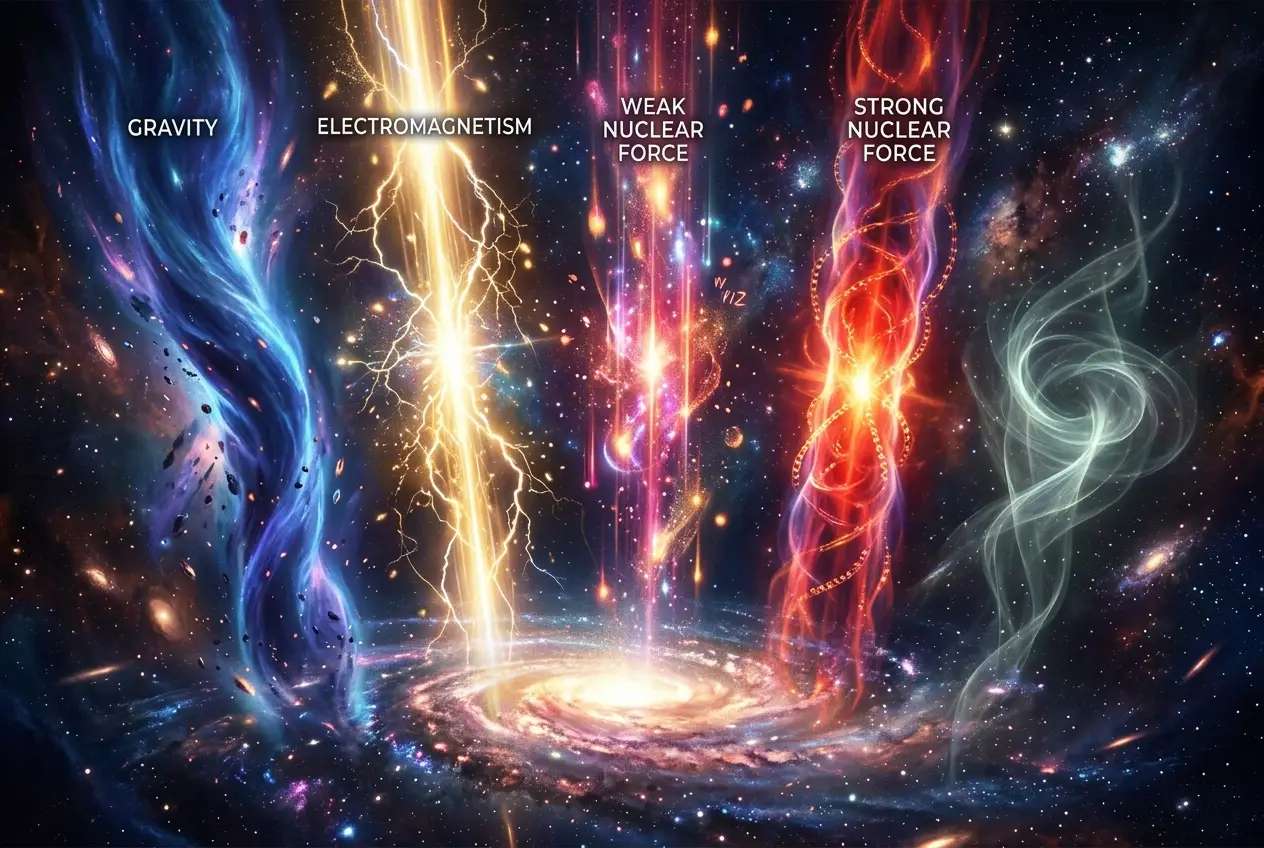
I’ve always been fascinated by the universe’s fundamental rules, the invisible puppet strings that dictate everything from the smallest subatomic dance to the grand ballet of galaxies. For decades, physics has operated on the understanding that four fundamental forces govern all interactions: gravity, electromagnetism, and the strong and weak nuclear forces. They’re the pillars upon which our understanding of reality rests. But what if, for all our advanced telescopes and particle accelerators, we've overlooked something monumental? What if there's a fifth universal force at play, quietly shaping the cosmos right under our scientific noses?
It's a question that might sound like science fiction, but it's one that a growing number of physicists are seriously considering. The universe, it seems, has a knack for surprising us, revealing hidden layers of complexity just when we think we’ve got it all figured out. I find myself constantly drawn to these edges of discovery, where current models fray and new possibilities emerge.
The Unseen Hand: Understanding the Four Known Forces
Before we delve into the realm of the hypothetical, let's quickly recap the four forces we do know. They form the bedrock of the Standard Model of particle physics and Einstein’s theory of General Relativity, painting a remarkably successful picture of how the universe works.
- Gravity: This is the most familiar, the force that pulls apples to the ground and keeps planets orbiting stars. It governs large-scale cosmic structures and is described by Einstein's theory of General Relativity. It's unique because it only attracts and affects everything with mass or energy.
- Electromagnetism: Responsible for light, electricity, magnetism, and all chemical interactions. It binds atoms into molecules, allows our computers to function, and powers our modern world. It can both attract and repel.
- Strong Nuclear Force: The strongest of the four, it binds quarks together to form protons and neutrons, and holds atomic nuclei together, overcoming the electromagnetic repulsion between protons. Without it, atoms as we know them wouldn't exist.
- Weak Nuclear Force: Responsible for certain types of radioactive decay, it plays a crucial role in nuclear fusion processes within stars, transforming one type of subatomic particle into another. It’s essential for the lifecycle of stars and the creation of heavier elements.
These four forces have been rigorously tested and confirmed through countless experiments and observations. They explain everything from the flickering of a candle to the birth of a galaxy. So, why would anyone suggest there's something missing?
Cracks in the Cosmic Foundation: Hints of the Unknown
The idea of a fifth force isn't born out of pure speculation. It arises from persistent anomalies and unresolved mysteries that the Standard Model, for all its glory, cannot fully explain. It's like finding a strange ripple in a perfectly calm pond – it suggests an unseen disturbance.
One of the most compelling arguments for new physics comes from the perplexing phenomena of dark matter and dark energy. These invisible components are believed to make up about 95% of the universe's total mass and energy, yet we can't directly detect them, nor do they fit neatly into our existing framework of fundamental forces. While dark matter is usually thought of as a particle, some theories propose it interacts via a new, weak force. Similarly, the accelerating expansion of the universe, attributed to dark energy, could potentially be explained by a new fundamental interaction, as explored in articles discussing concepts like Dark Energy's potential as future fuel.
Another intriguing anomaly comes from the subatomic world, specifically from experiments involving muons. Muons are essentially heavier cousins of electrons. In 2021, the Muon g-2 experiment at Fermilab announced results that significantly deviated from the predictions of the Standard Model. The "g-factor" of a muon, a measure of its magnetic moment, was found to be slightly different from what theory dictates. This tiny discrepancy, if confirmed, could be a strong hint that the muon is interacting with an undiscovered particle or a previously unknown force. As physicists at Fermilab put it, "This result provides strong evidence that the muon is feeling a force or interaction not accounted for by science’s current best theory, the Standard Model of particle physics." Source: Wikipedia - Muon g-2 (opens in a new tab)
Beyond these headline-grabbing puzzles, other subtle inconsistencies have emerged:
- Proton Radius Puzzle: Measurements of the proton's radius using different methods (electron vs. muon scattering) have yielded slightly different results, leading some to wonder if new forces are at play at very small scales.
- Anomalies in galactic rotation curves: While largely explained by dark matter, some alternative theories propose modifications to gravity or a new force to explain these observations without invoking dark matter directly.
These aren't outright rejections of our current understanding but rather tantalizing clues that the picture might be incomplete. I see them as breadcrumbs leading to a deeper understanding of reality.
The Search for New Messengers: What Could a Fifth Force Look Like?
If a fifth force exists, what would be its characteristics? Physicists hypothesize it would likely be a very weak force, possibly with a very short range, which is why it has eluded detection for so long. Unlike gravity, which has an infinite range, or electromagnetism, which is long-range, this new force might only manifest under specific conditions or at specific scales.
The search for a fifth force often involves looking for new mediator particles. Just as photons mediate the electromagnetic force, and gluons mediate the strong force, a fifth force would need its own messenger particle. Potential candidates include:
- Dark Photons: These hypothetical particles are theorized to mediate a "dark electromagnetic force" that interacts with dark matter. They wouldn't interact with regular matter via electromagnetism, making them incredibly elusive.
- Axions: Originally proposed to solve a different problem in particle physics (the strong CP problem), axions are also candidates for dark matter and could mediate a very weak, short-range force.
- "X17" Particle: In 2016, Hungarian physicists observed an anomaly in radioactive decay that could be explained by a new, light boson particle with a mass of about 17 megaelectronvolts, which they dubbed "X17." This particle could be the mediator of a new force. Source: Wikipedia - X17 boson (opens in a new tab)
These particles are typically predicted to be very light, making them difficult to detect directly. Their interactions with known matter would be incredibly feeble, leaving only tiny, subtle imprints on experiments.
How Do We Look for It? The Modern Alchemists
The hunt for a fifth force is a testament to human ingenuity. Scientists employ a diverse array of experimental techniques, often pushing the boundaries of precision and sensitivity.
- Precision Measurements: Experiments like the Muon g-2 are designed to measure known properties of particles with extreme precision. Any deviation from the Standard Model's predictions could signal the presence of a new force. Similarly, tests of the inverse-square law of gravity at very small distances are trying to find subtle modifications that a new force might cause.
- Particle Colliders: High-energy colliders like the Large Hadron Collider (LHC) at CERN smash particles together at incredible speeds, creating conditions similar to the early universe. By analyzing the debris from these collisions, physicists look for signs of new, exotic particles that could be mediators of a fifth force. If new particles are created, they would leave an energy deficit or unique decay signatures.
- Astrophysical Observations: We might also detect a fifth force through its influence on cosmic phenomena. For instance, subtle deviations in the behavior of dark matter halos around galaxies or the expansion rate of the universe could be explained by a new force. Researchers studying the cosmic microwave background, the afterglow of the Big Bang, also look for signatures of new physics. The universe itself can act as the largest laboratory for fundamental physics.
- Quantum Sensors: The development of advanced quantum sensors, as discussed in posts like Do Quantum Sensors Reshape Our Reality Perception?, offers new avenues for detecting incredibly weak forces. These sensors can measure minute changes in atomic or subatomic systems, potentially revealing the elusive tug of a fifth force.
| Force Type | Mediator Particle | Relative Strength (at nuclear scale) | Range | Governs |
|---|---|---|---|---|
| Strong Nuclear | Gluon | 1 | Short (10^-15 m) | Binds quarks, atomic nuclei |
| Electromagnetic | Photon | 1/137 | Infinite | Atoms, molecules, light, electricity |
| Weak Nuclear | W/Z bosons | 10^-6 | Very Short (10^-18 m) | Radioactive decay, stellar fusion |
| Gravity | Graviton (hypothetical) | 10^-39 | Infinite | Planets, stars, galaxies, spacetime curvature |
| Fifth Force (Hypothetical) | New Boson (e.g., Dark Photon, Axion) | ??? (Very Weak) | ??? (Short to Infinite) | Dark matter interactions, Muon g-2 anomaly, etc. |
Table: Comparison of Fundamental Forces and a Hypothetical Fifth Force
The Implications: A New Era of Physics?
The discovery of a fifth fundamental force would be nothing short of revolutionary. It would necessitate a complete rewrite of physics textbooks, fundamentally altering our understanding of how the universe operates.
- Unlocking Dark Matter and Dark Energy: A fifth force could provide a direct mechanism for dark matter particles to interact with each other, or even with regular matter in ways we haven't yet conceived. It might even offer a new perspective on the nature of dark energy, perhaps by connecting it to new fields or particles, rather than merely being a constant of space.
- Beyond the Standard Model: Such a discovery would confirm that the Standard Model of particle physics is incomplete, opening up entirely new avenues for theoretical research. It could lead to a more comprehensive "Theory of Everything" that unifies all forces, potentially linking to grand cosmic questions about the nature of reality itself, as some theorists ponder if the universe is a giant neural network.
- Technological Advances: Historically, every major scientific breakthrough in fundamental physics has eventually led to unforeseen technological advancements. Understanding a new force could, in the long term, unlock entirely new forms of energy, communication, or even propulsion.
- Reshaping Our Cosmic Perspective: Imagine if this force connected us to other dimensions or aspects of reality we can't currently perceive. It would be a profound shift in our cosmic self-awareness. Source: Wikipedia - Fundamental interaction (opens in a new tab)
Conclusion
The universe is a vast, intricate tapestry, and even with our impressive scientific instruments and theories, we might only be seeing a fraction of its threads. The hunt for a fifth universal force embodies the spirit of scientific inquiry – driven by curiosity, challenged by anomalies, and propelled by the relentless pursuit of truth. Whether it manifests as a subtle deviation in a particle's behavior or a cosmic ripple across galaxies, the possibility of a hidden force reminds me that the universe still holds countless secrets, waiting for us to uncover them. As we continue to probe the depths of reality, I can't help but wonder what other astonishing discoveries await us at the frontiers of physics.
&blog_title;





Conversation0
No comments yet. Be the first to share a thought — the best questions often become new stories.