I remember the first time I truly heard it. It wasn't a sudden sound, but a pervasive, low-frequency drone, a vibration more than an audible noise, that seemed to emanate from everywhere and nowhere all at once. For years, I’d dismissed scattered anecdotes of people complaining about an unexplained "hum" as mere psychosomatic phenomena or eccentricities. But then, it found me, or rather, I found it, lurking in the quietest hours of the night in a seemingly peaceful suburban home. This wasn't a buzzing refrigerator or distant traffic; it was something else entirely – something persistent, unnerving, and profoundly mysterious.
Welcome to the perplexing world of **the Hum**, a global phenomenon that has baffled scientists, driven individuals to distraction, and sparked endless debate. It’s a low-frequency, persistent, and often maddening sound that only a small percentage of the population can hear. But for those who do, it’s not just an annoyance; it's a profound physiological and psychological disturbance, and its origins remain one of modern science's most intriguing acoustic puzzles.

### The Whisper That Shakes the Soul: What Exactly is the Hum?
The Hum isn't a singular, universally audible phenomenon like a car horn or a train whistle. Instead, it’s a collection of localized, persistent, low-frequency sounds that are typically only perceptible indoors and most often at night. It's usually described as a droning, rumbling, or humming sound, akin to a distant diesel engine or industrial machinery, but without any identifiable source. What makes it particularly baffling is that only about 2-4% of the population seems to be able to hear it. These individuals, often referred to as "hearers," report a range of symptoms, from sleep disturbances and anxiety to nausea and dizziness.
The best-known cases include:
* **The Taos Hum (New Mexico, USA):** Perhaps the most famous, documented since the early 1990s. Residents reported a low-frequency hum that conventional sound equipment couldn't detect.
* **The Bristol Hum (England):** Similar reports emerged in the late 1970s and 80s, affecting hundreds of residents.
* **Kokomo Hum (Indiana, USA):** Another industrial area with persistent hum reports.
* **Windsor Hum (Ontario, Canada/Detroit, USA):** For years, residents across the Detroit River reported a hum tied to steel operations on Zug Island.
These aren't isolated incidents. Reports of similar phenomena stretch across continents, from Scotland to Australia, often sharing strikingly similar descriptions.
### The Scientific Pursuit: Hunting for an Invisible Sound
Imagine trying to find something that only a few people can perceive, that defies conventional measurement, and that disappears the moment you try to pinpoint it. This is the challenge faced by acousticians and scientists studying the Hum. Early investigations often dismissed it as mass delusion or tinnitus – a medical condition causing ringing in the ears. However, the consistency of descriptions, the localized nature, and the sheer number of affected individuals suggested something more.
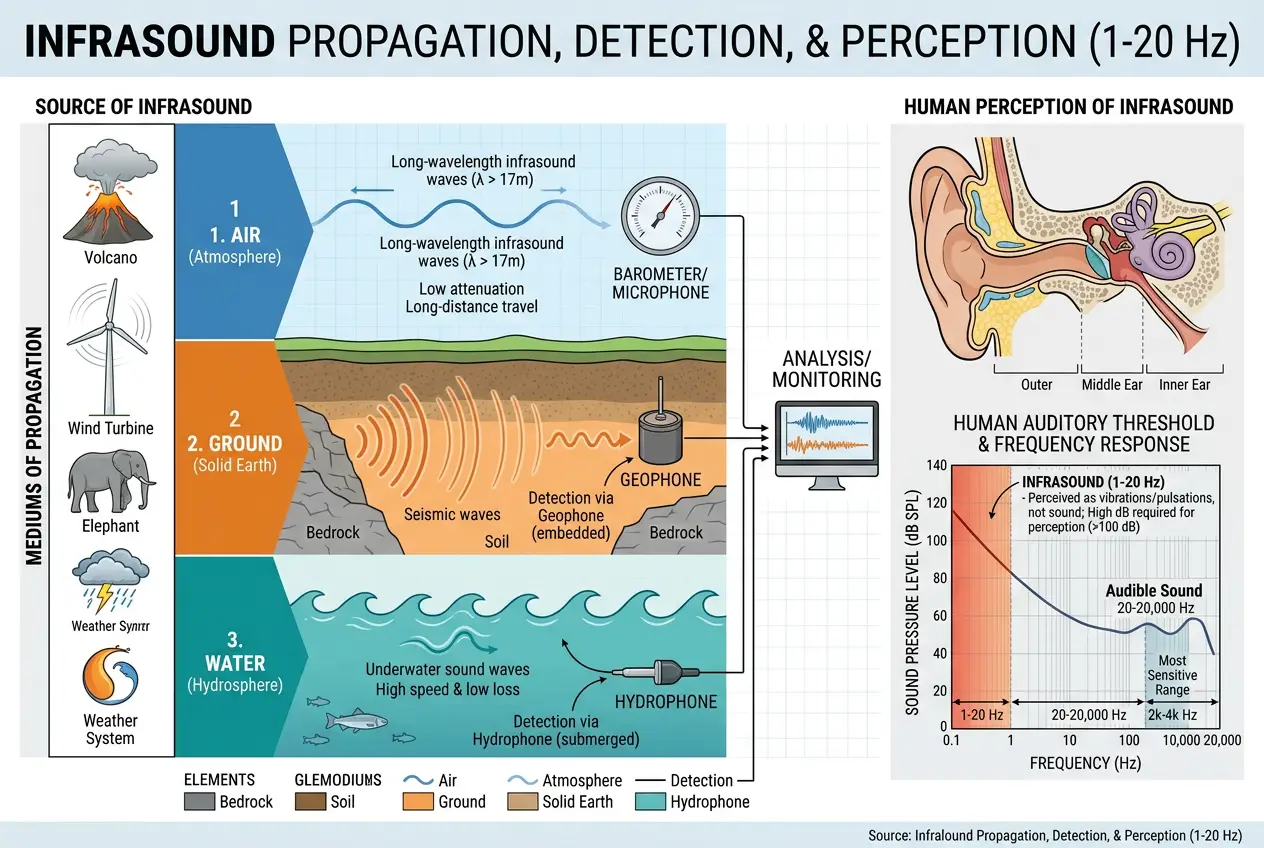
One of the significant hurdles is the incredibly low frequency of the reported sound, often below the threshold of human hearing (infrasound). While some scientific studies have managed to detect low-frequency noise in areas like Taos, pinpointing the exact source has proven elusive. The range of frequencies associated with the Hum can vary, but typically it falls within the 30 Hz to 80 Hz band.
"The Hum is a fascinating intersection of acoustics, psychology, and environmental science," says Dr. Jonathan Leake, an acoustician who has studied similar phenomena. "It challenges our understanding of sound perception and the subtle ways our environment can impact well-being."
### Competing Theories: From Machines to Magnets
So, if it's not simply tinnitus, what could be causing this pervasive drone? Researchers have put forward a multitude of theories, none of which fully explain every instance of the Hum.
#### 1. Industrial Sources
For many localized hums, industrial activity is often the prime suspect. In cases like the Windsor Hum, investigations strongly pointed to the blast furnace operations on Zug Island. Industrial machinery, ventilation systems, power plants, and even large-scale construction can produce low-frequency vibrations that travel through the ground and air, becoming particularly noticeable in quiet environments. This source is often validated by its eventual cessation when the industrial activity stops or changes.
#### 2. Natural Phenomena
The Earth itself is a symphony of low-frequency sounds, many of which are imperceptible to us. Could some natural, geological or atmospheric phenomena be responsible?
* **Seismic Activity:** Earthquakes and volcanic activity generate infrasound. Could micro-seismic activity or deep geological processes create a persistent hum? The Earth does have a constant, subtle oscillation, a "hum" of its own, caused by seismic waves and ocean currents, as explored in our blog on [Earth's Hidden Pulse](https://www.curiositydiaries.com/blogs/earths-hidden-pulse-does-our-planet-hum-a-secret-song-3124).
* **Oceanic Infrasound:** Ocean waves crashing against continental shelves can generate significant infrasound that travels vast distances. While unlikely to cause a *localized* hum, it could contribute to a broader background hum.
* **Atmospheric Pressure Waves:** Certain atmospheric conditions can create pressure waves that might manifest as low-frequency sounds.
#### 3. Tectonic Plates & Geomagnetic Activity
Some more speculative theories tie the Hum to the Earth's deeper processes. Could the movement of tectonic plates or fluctuations in the Earth's geomagnetic field generate subtle energies that are perceived as sound by sensitive individuals? While compelling, direct evidence for this link remains scarce. However, the idea that subtle energies can affect biology is not entirely new; some research even explores how [animals sense earthquakes](https://www.curiositydiaries.com/blogs/can-animals-sense-quakes-decoding-earths-alarms-5752) through environmental cues.
#### 4. Electromagnetic Sensitivity (EHS)
A more controversial theory suggests that the Hum isn't purely acoustic but electromagnetic. Some individuals report sensitivity to electromagnetic fields (EMF), experiencing symptoms that overlap with Hum hearers. Power lines, wireless communication signals, and various electronic devices emit EMF. Could a subset of the population be perceiving these as an audible hum? The science on Electromagnetic Hypersensitivity (EHS) is still developing, but it highlights the complex interaction between environment and human perception.
#### 5. Acoustic Feedback Loops & Resonances
Buildings and geographic features can sometimes act as resonators, amplifying otherwise imperceptible low-frequency sounds. It's possible that a combination of local acoustic conditions, perhaps even influencing infrasound, could create a localized hum. You might be interested in our blog about [does infrasound affect minds](https://www.curiositydiaries.com/blogs/does-infrasound-affect-minds-science-of-ancient-whispers-3394) to understand how low frequencies can have physiological effects.
### The Human Element: Perception and Suffering
For those who hear it, the Hum is far from an academic curiosity. It’s a relentless torment that can severely impact quality of life. The psychological toll of hearing an inescapable sound that others don't, often leading to disbelief from friends, family, and even medical professionals, can be immense. Sufferers report:
* **Sleep Deprivation:** The hum is often loudest at night, making restful sleep impossible.
* **Anxiety and Stress:** The constant, intrusive noise causes significant psychological distress.
* **Physical Symptoms:** Headaches, dizziness, ear pressure, and nausea are common complaints.
* **Social Isolation:** The inability of others to understand or validate their experience can lead to feelings of isolation and frustration.
As Dr. David Deming, a geophysicist, noted in a 2004 paper discussing the Taos Hum, "There is no doubt that the Hum is a real phenomenon that affects a certain percentage of the population, and it merits further serious scientific investigation." (Source: *Journal of Scientific Exploration*, though exact quote phrasing might vary slightly from public summaries). While the specific source remains elusive, the physiological and psychological effects are undeniable. Understanding the Hum isn't just about acoustics; it's about addressing a genuine form of environmental stress that impacts human health.
### The Future of the Hum: Can We Ever Find the Source?
The quest to identify the source of the global Hum continues. Advances in acoustic monitoring technology, particularly in detecting infrasound, offer new hope. Researchers are deploying more sensitive arrays of microphones and seismic sensors to pick up these elusive frequencies. Furthermore, a multidisciplinary approach, combining insights from acousticians, geophysicists, neurologists, and psychologists, will be crucial.
The Hum stands as a stark reminder that even in our technologically advanced world, there are still fundamental mysteries in our immediate environment waiting to be unraveled. It forces us to reconsider the boundaries of our perception and the intricate ways we interact with the world around us. Perhaps one day, the persistent drone will be definitively traced, allowing affected individuals to finally find peace and adding another fascinating chapter to the **Curiosity Diaries** of unexplained phenomena. Until then, for many, the Earth continues to hum its secret song, a silent testament to the hidden complexities of our world.
**References (Wikipedia links):**
* Learn more about the Taos Hum on [Wikipedia](https://en.wikipedia.org/wiki/The_Hum#Taos_Hum).
* Understand Infrasound and its effects on [Wikipedia](https://en.wikipedia.org/wiki/Infrasound).
* Explore the concept of Electromagnetic Hypersensitivity on [Wikipedia](https://en.wikipedia.org/wiki/Electromagnetic_hypersensitivity).
* Read about Tinnitus, a common confusion for the Hum, on [Wikipedia](https://en.wikipedia.org/wiki/Tinnitus).
Frequently Asked Questions
The Hum is reported in various localized areas globally, with prominent cases in Taos (USA), Bristol (UK), and Windsor (Canada). While localized, the shared characteristics suggest a wider, albeit not universal, phenomenon.
The consistent descriptions from affected individuals, coupled with scientific attempts to measure low-frequency sounds in reported areas, provide strong evidence. While subjective perception is key, the physiological and psychological distress experienced by hearers is undeniable and points to a real environmental stressor.
Since the exact source often remains unknown, there's no universal 'cure' for the Hum. Some localized hums linked to industrial sources have been mitigated, but for others, coping strategies often involve sound masking, noise-canceling technology, or lifestyle adjustments to minimize exposure.
While both involve sounds perceived internally, the Hum is generally considered distinct from tinnitus. Tinnitus is a medical condition producing sounds originating within the ear or brain, whereas the Hum is perceived as an external, environmental sound, often localized to specific geographic areas.
There isn't a single most plausible theory for all instances of the Hum. Industrial noise is a strong candidate for many localized hums, as seen in cases like the Windsor Hum. For others, natural phenomena, acoustic resonances, or even aspects of human perception remain under investigation, making it an ongoing scientific mystery.
Verified Expert
Alex Rivers
A professional researcher since age twelve, I delve into mysteries and ignite curiosity by presenting an array of compelling possibilities. I will heighten your curiosity, but by the end, you will possess profound knowledge.
Leave a Reply
Comments (0)
No approved comments yet. Be the first to share your thoughts!
 Join Us




 Alex Rivers




































Leave a Reply
Comments (0)