


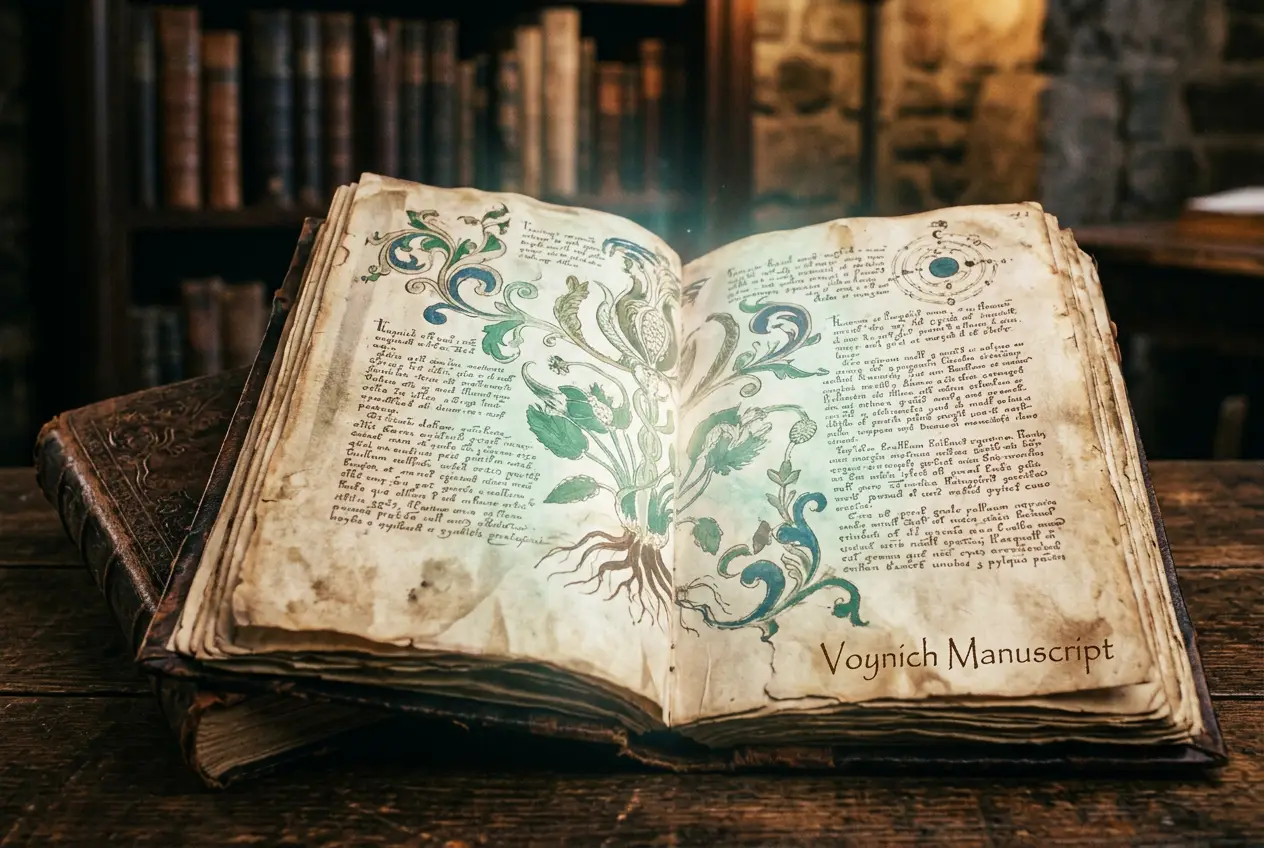
I recently found myself staring at a digital reproduction of one of history's most baffling artifacts: the Voynich Manuscript. It’s not just a book; it’s a portal to a world we can’t quite grasp, a puzzle box left ajar but never fully opened. Imagine holding a book, centuries old, filled with vivid illustrations of plants that don’t exist, astronomical diagrams that defy known constellations, and human figures bathing in strange green pools. The most striking feature? It’s written in a script no one has ever been able to read. Not cryptographers, not linguists, not even the most advanced AI.
This isn’t some fictional prop from a blockbuster movie; it’s a real, tangible enigma housed in Yale University’s Beinecke Rare Book and Manuscript Library. For over a century, it has tantalized, frustrated, and captivated scholars, code-breakers, and conspiracy theorists alike. The question isn't just "What does it say?" but rather, "What is it?" Is it a sophisticated code, a lost language, a medieval hoax, or something far more profound—perhaps an early, unrecognized form of complex data storage or even an "ancient AI" of sorts, presenting information in a way our minds are yet to decode?
The Whispers of History: A Manuscript Unveiled
The Voynich Manuscript's recorded history begins in 1665 when Georg Baresch, an alchemist in Prague, found himself in possession of the curious tome. Unable to make sense of it, he sent it to Athanasius Kircher, a renowned Jesuit scholar, hoping for an explanation. Kircher, known for his vast knowledge and interest in hieroglyphics, also failed. The book then vanished from public record for over two centuries until it resurfaced in 1912. Wilfrid Voynich, a Polish book dealer, acquired it from a Jesuit college near Rome and, understanding its profound mystery, brought it to the attention of the world. Since then, it has borne his name and continued its silent defiance.
I often wonder about the hands that crafted this manuscript. Who was the author? What was their intention? The parchment itself has been radiocarbon dated to between 1404 and 1438, placing it firmly in the early 15th century. This timing is crucial. It precedes many significant scientific and technological advancements, yet some of its diagrams seem to hint at concepts far beyond what was commonly understood at the time.
The Unreadable Text: A Cryptographer's Nightmare
The core of the Voynich mystery lies in its script. It comprises approximately 240 vellum pages, filled with text written from left to right, much like European languages. However, its alphabet consists of an estimated 20-30 unique characters that bear no resemblance to any known language system, whether ancient or modern. The script exhibits linguistic patterns—word lengths, frequency distributions, and repetitions—that are characteristic of natural languages, suggesting it’s not just random gibberish. Yet, every attempt to decipher it has failed.
Many brilliant minds have thrown themselves at this puzzle. From the cryptographers who broke Japanese and German codes during World War II to modern computational linguists, all have been defeated. The famed U.S. Army cryptanalyst William Friedman, who spearheaded efforts to break the Japanese PURPLE code, dedicated years to the Voynich but ultimately concluded it was a hoax or an artificial language. More recently, computational approaches using AI and machine learning have tried to find patterns, but without a Rosetta Stone, they remain stumped. Could this suggest the "language" isn't a conventional one at all, but rather something else entirely? Perhaps it's not meant to be read in the traditional sense.
One theory I find particularly compelling is that the Voynich Manuscript employs a polyalphabetic cipher so complex it has eluded all attempts at decryption. Think about the Caesar cipher, where each letter is shifted a certain number of places. That's simple. A polyalphabetic cipher uses multiple substitution alphabets, making it much harder. If the Voynich uses a very long key or a sophisticated, perhaps even visual, method for selecting which alphabet to use at any given point, it could explain its resilience.
As one researcher, Mary D'Imperio, eloquently put it in her detailed analysis: "The Voynich Manuscript is a challenge, a cryptographic problem perhaps, that has never been solved."
Curious Content: Beyond the Unreadable Words
Beyond the baffling script, the Voynich Manuscript's illustrations are equally enigmatic. They depict:
- Botanical Section: Numerous plants, many of which don't correspond to any known species. Are they extinct, mythical, or simply creations of an artist's imagination?
- Astronomical Section: Elaborate diagrams featuring celestial bodies, zodiac signs, and what appear to be cosmological charts, some depicting what could be galaxies or star clusters viewed in a way impossible with 15th-century technology. You can see similarities in the fascination with celestial bodies with historical records like the Roman Dodecahedra, which possibly charted stars.
- Balneological Section: Nude women bathing in interconnected pools, often with intricate plumbing systems, suggesting some form of ritual bathing or alchemical process.
- Pharmaceutical Section: Drawings of various herbs and roots, alongside containers and apparatus that look like tools for preparing medicinal concoctions.
- Cosmological Section: Intricate, folding pages featuring large, circular diagrams, often called "rosettes," which some interpret as maps of unknown lands or perhaps even cellular structures.
What if these illustrations are not mere decorations but integral parts of the "code" itself? Perhaps the pictures provide clues to deciphering the text, or even function as a data visualization layer for highly complex information. It's a bit like imagining an instruction manual where the diagrams are just as important, if not more, than the written language.
Is it an "Ancient AI"? Reinterpreting the Unfamiliar
The idea of "Ancient AI" might sound like science fiction, but let's reframe it. What if the Voynich Manuscript isn't a book in the conventional sense, but a highly sophisticated information system? Imagine if an intelligence—human or otherwise—wanted to record and transmit vast amounts of data in a way that would be robust against accidental discovery or unauthorized access for centuries.
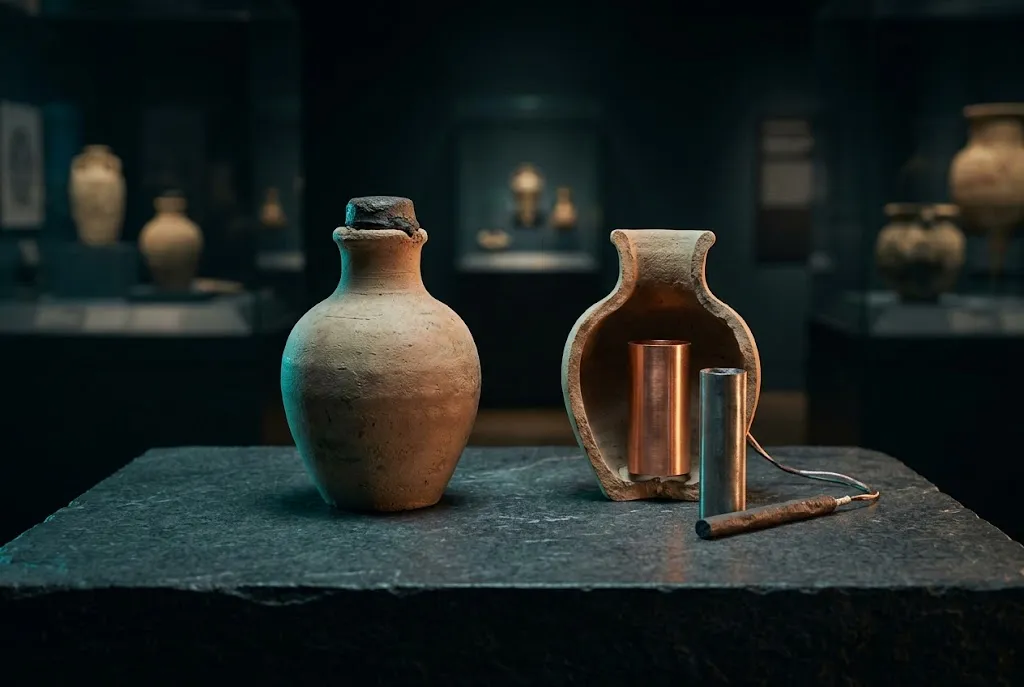
- Complex Data Encoding: The manuscript's script exhibits patterns, suggesting rules, but rules that are not easily discernible. Modern AI excels at pattern recognition, yet it fails here. Could the encoding mechanism be so alien to our linguistic structures that our algorithms miss the fundamental logic? Perhaps the "meaning" isn't just in the words but in the arrangement, the sequence, the visual elements, and even the "grammar" of its peculiar illustrations. This is a far cry from a simple battery, like the Baghdad Battery, which hinted at ancient electrical knowledge, but it shares the same spirit of a lost, advanced concept.
- Self-Organizing Information: Some linguistic analyses have suggested the text displays fractal-like properties, where similar patterns repeat at different scales. This is a characteristic sometimes found in complex systems or even biological data. Could the manuscript be a form of self-organizing information, designed to reveal layers of meaning only when approached with a specific computational key or paradigm?
- Lost Knowledge Preservation: What if the manuscript was created to preserve critical knowledge during a period of upheaval, but designed to be accessible only to a select few with the key? This isn't just about encrypting a message; it's about encrypting an entire knowledge base. The diversity of its illustrated content—botany, astronomy, cosmology—suggests a comprehensive scope, perhaps encompassing fields we don't even recognize as unified disciplines today.
Considering the rapid advancements in AI, especially in natural language processing and pattern recognition, it makes me wonder if we are on the cusp of developing the tools to finally crack it. Just as AI is being explored for tasks like unlocking animal languages, perhaps a future AI will be able to deconstruct the underlying logic of the Voynich. However, the biggest hurdle remains: without any known examples of the "language" to train on, AI is effectively blind.
Hoax or Masterpiece? The Enduring Debate
Of course, the most straightforward explanation for its undecipherability is that it’s an elaborate hoax. Perhaps a medieval prankster spent years meticulously crafting a book of nonsense, designed to fool scholars and alchemists. Yet, the sheer volume of text, its internal consistency, and the seemingly organized structure of its illustrations make a simple hoax difficult to accept. Crafting such a consistent, yet meaningless, work over hundreds of pages would have required immense effort and an almost artistic dedication to deception.
Another theory suggests it's an artificial language, perhaps an early attempt at a philosophical language or a linguistic experiment designed by a specific group for a specific purpose. Such languages were conceived to be perfectly logical and unambiguous, free from the quirks of natural languages. While intriguing, this still doesn't explain its persistent secrecy.
Ultimately, whether it’s a sophisticated code, a lost language, or an alien information system, the Voynich Manuscript remains one of humanity's most persistent and fascinating intellectual challenges. It forces us to confront the limits of our understanding, reminding us that history holds secrets far more intricate than we often imagine. I believe that one day, with new computational techniques or an unexpected historical discovery, the Voynich Manuscript will finally yield its secrets, potentially revealing a hidden chapter of human ingenuity—or something entirely beyond it.
Until then, it stands as a testament to the power of mystery, a tangible prompt for our unending curiosity.
External Sources:



Conversation0
No comments yet. Be the first to share a thought — the best questions often become new stories.