I often find myself marveling at the sheer processing power we hold in our pockets today, yet a nagging question persists: are we truly ready for the AI revolution we’re hurtling towards? The intricate neural networks that power everything from self-driving cars to sophisticated language models demand exponentially more computational muscle. It feels like every year, our silicon-based chips, while remarkable, are hitting a wall, struggling to keep pace with the insatiable hunger of advanced artificial intelligence.
We’re at a crossroads where the dreams of truly intelligent machines are being constrained by the physical limits of our current computing architecture. This is where a material hailed as a "wonder material" could step in: **graphene**. Imagine a world where AI doesn't just process information faster, but does so with unparalleled efficiency, unlocking new levels of intelligence that were once confined to science fiction. I believe graphene isn't just an incremental upgrade; it could be the fundamental shift that unleashes genuine AI superpowers.
## The Silicon Squeeze: Why Current Chips Fall Short
For decades, we’ve relied on silicon, the workhorse of the digital age. Moore’s Law, famously observed by Gordon Moore, predicted that the number of transistors on a microchip would double approximately every two years. This incredible exponential growth fueled the digital revolution, giving us faster, smaller, and more powerful devices. However, as transistors shrink to near-atomic scales, silicon is encountering fundamental physical limitations. Heat dissipation becomes a massive challenge, quantum tunneling effects interfere with reliable operation, and manufacturing at such minute scales becomes astronomically expensive.
Modern AI, especially deep learning and large language models, thrives on massive parallelism and rapid data transfer. Training these models can take weeks, even months, on vast clusters of energy-guzzling GPUs. The sheer energy consumption is a growing concern, not to mention the environmental impact. For AI to truly ascend to more complex, real-time, and ubiquitous applications, we need a breakthrough in materials science that can push past these silicon barriers. You can read more about the foundations of AI on [Wikipedia](https://en.wikipedia.org/wiki/Artificial_intelligence).
## Enter Graphene: The 2D Marvel
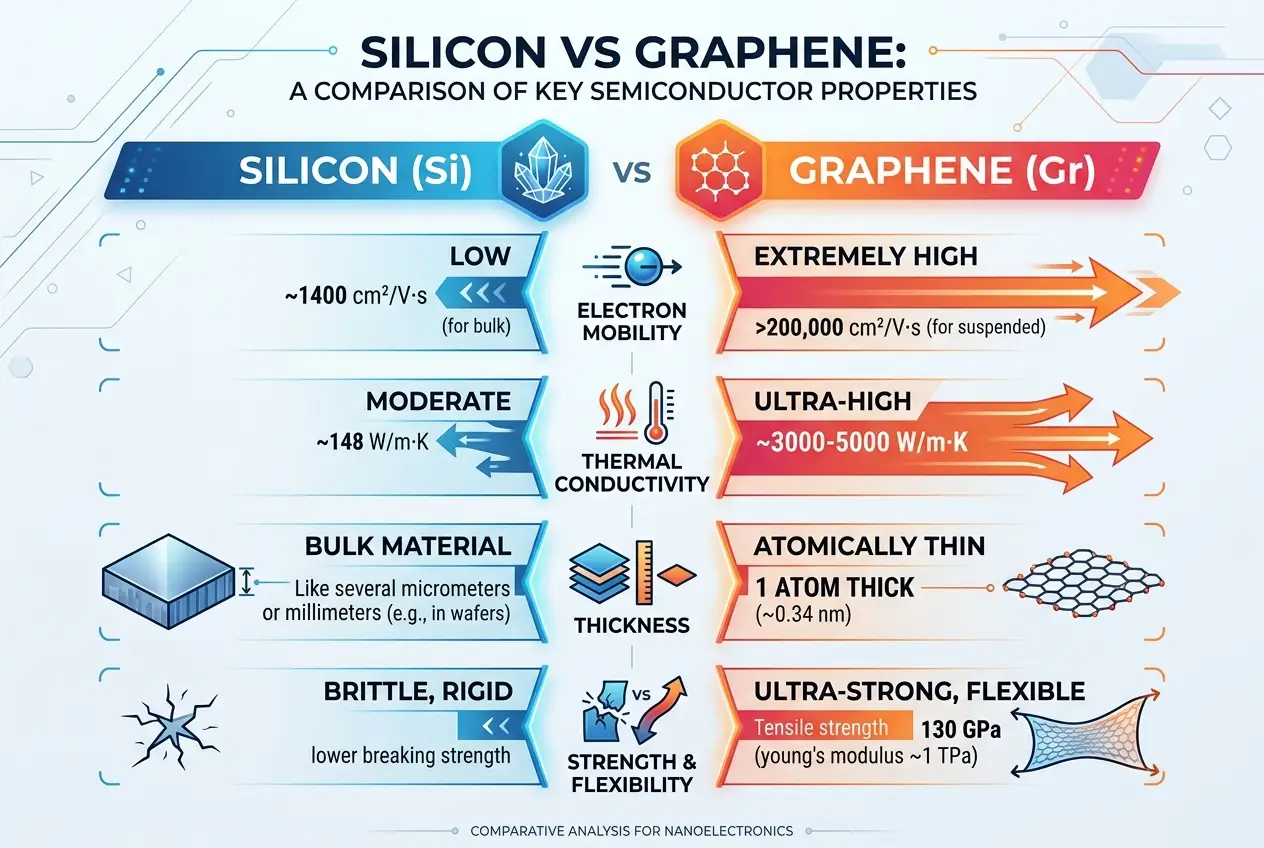
So, what exactly is graphene? In essence, it's a single layer of carbon atoms arranged in a hexagonal lattice, resembling a microscopic chicken wire fence. Discovered relatively recently in 2004 by Andre Geim and Konstantin Novoselov (earning them a Nobel Prize in Physics in 2010), graphene quickly captivated the scientific community due to its extraordinary properties. It is the thinnest material known to man, yet also one of the strongest—200 times stronger than steel. But its true magic for computing lies in its electronic properties.
Graphene boasts **superlative electrical conductivity**. Electrons can zip through a graphene lattice at incredibly high speeds, almost as if they were massless particles. This phenomenon, known as "ballistic transport," means less resistance and significantly less heat generation compared to silicon. Imagine data flowing through your AI chips at near the speed of light, with minimal energy loss. That's the promise of graphene. For a deeper dive into this incredible material, check out its [Wikipedia page](https://en.wikipedia.org/wiki/Graphene).
### The Graphene Advantage for AI
Let's break down how graphene's unique attributes could revolutionize AI hardware:
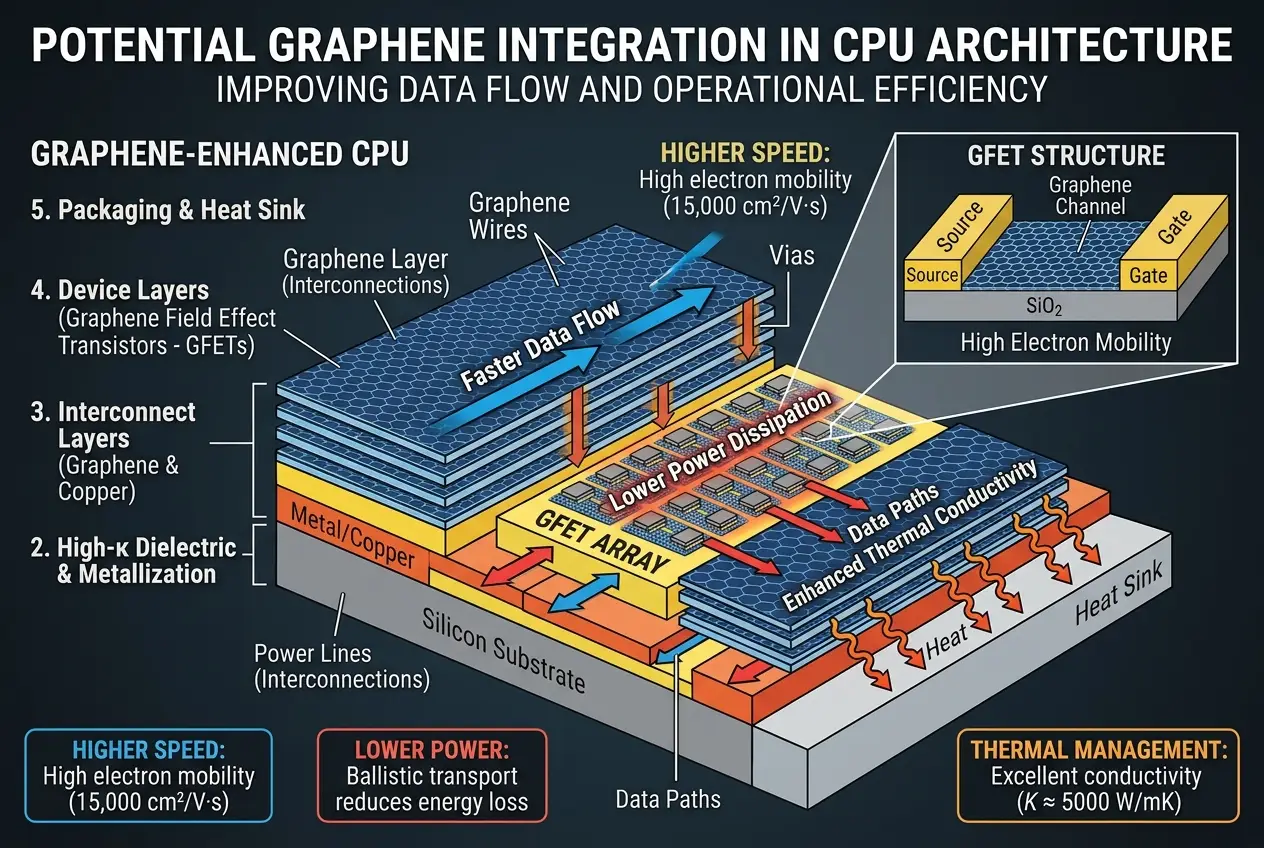
1. **Blazing Speed:** The high electron mobility in graphene translates directly into faster transistors. This means AI computations could be executed at speeds previously unimaginable, accelerating everything from real-time analytics to complex simulations. Imagine AI models training in hours instead of weeks, allowing for faster iterations and more rapid advancements.
2. **Unmatched Energy Efficiency:** Less resistance means less heat, and less heat means less power consumption. This is a critical factor for the future of AI. Data centers currently consume vast amounts of electricity, and scaling AI further exacerbates this issue. Graphene-based chips could drastically reduce the energy footprint of AI systems, making them more sustainable and economically viable for widespread deployment.
3. **Miniaturization Beyond Silicon:** Being a one-atom-thick material, graphene offers unprecedented opportunities for miniaturization. We could pack even more computational power into smaller spaces, leading to more compact and powerful AI devices. This is crucial for edge AI applications, where processing happens locally on devices like drones, smart sensors, and robots, rather than relying solely on cloud computing.
4. **Beyond Binary: Analog and Neuromorphic Computing:** Graphene’s unique electronic properties also make it an exciting candidate for new computing paradigms. Its ability to change resistance based on external stimuli could be leveraged for analog computing, which processes information continuously rather than discretely (like digital computers). Furthermore, its unique electron behavior could be ideal for neuromorphic computing, which mimics the structure and function of the human brain. This could be a game-changer for AI, allowing for more brain-like, energy-efficient processing.
## Current Hurdles and Future Prospects
Despite its incredible potential, graphene isn't yet in our everyday devices. The primary challenge lies in its mass production and integration into existing semiconductor manufacturing processes. While synthesizing high-quality, large-area graphene has seen significant progress, reliably creating graphene transistors with consistent performance remains a hurdle.
One major issue is the lack of a "band gap" in pristine graphene. A band gap is essential for semiconductors to switch electricity on and off effectively (the 0s and 1s of digital computing). Researchers are exploring various methods to introduce a band gap, such as doping graphene with other elements, creating nanoribbons, or combining it with other 2D materials like boron nitride.
However, the research community is relentless. Companies and research institutions worldwide are investing heavily in graphene technology. We're seeing exciting breakthroughs in everything from flexible electronics to advanced sensors, and the applications for computing are rapidly evolving. The journey from lab to market for a revolutionary material like graphene is long, but the potential rewards are immense.
### Graphene's Role in a Multiverse of Computing
Graphene won't necessarily replace every aspect of silicon overnight, nor is it the only contender for future computing. We're also seeing incredible advancements in areas like [living cells building supercomputers]( /blogs/can-living-cells-build-our-next-supercomputers-6472) and exploring if [light itself can think]( /blogs/is-light-our-universes-fastest-computer-3214). The future of computing is likely to be a diverse ecosystem, with different materials and architectures optimized for specific tasks. Graphene could carve out a crucial niche, particularly for high-performance AI accelerators, neuromorphic chips, and perhaps even play a role in advanced quantum computing components.
The integration of graphene could lead to AI that is not only faster and more energy-efficient but also capable of learning and adapting in ways we are only beginning to envision. It could empower AI to tackle some of humanity's most complex challenges, from accelerating scientific discovery to creating truly personalized medicine. Just as we ponder if [AI can design its own evolution]( /blogs/can-ai-design-its-own-evolution-decoding-future-machines-4579), the material substrate on which it runs will undoubtedly play a pivotal role.
## Conclusion: A New Dawn for AI?
The limitations of silicon are becoming increasingly apparent as AI pushes the boundaries of computation. Graphene, with its astounding electrical, thermal, and mechanical properties, offers a compelling solution to these challenges. While significant engineering hurdles remain, the promise of graphene-powered AI chips is too profound to ignore.
As researchers continue to unlock the secrets of this 2D wonder, I believe we are on the cusp of a new era in computing—an era where AI can truly break free from its current constraints, evolving into an even more powerful and pervasive force in our world. The journey of graphene from a lab curiosity to the backbone of future AI is a testament to human ingenuity, and I, for one, am incredibly excited to see the superpowers it unleashes.
Frequently Asked Questions
Graphene boasts significantly higher electron mobility, meaning electrons travel much faster with less resistance and heat generation. This translates to faster processing speeds and dramatically improved energy efficiency for AI computations compared to traditional silicon chips.
Key challenges include mass-producing high-quality, large-area graphene reliably, integrating it into existing semiconductor manufacturing processes, and overcoming the intrinsic lack of a band gap in pristine graphene, which is essential for creating effective on/off switches in digital circuits.
Yes, graphene's unique electronic properties make it a strong candidate for advanced computing paradigms like analog computing, which processes information continuously, and neuromorphic computing, which mimics the structure and function of the human brain. These could lead to more energy-efficient and brain-like AI.
Graphene chips could drastically reduce AI's energy footprint. Less electrical resistance means less heat generated, directly translating to lower power consumption for training and running complex AI models, making AI development more sustainable.
It's unlikely graphene will entirely replace silicon in all applications. The future of computing will likely involve a diverse ecosystem where different materials and architectures, including silicon, graphene, and potentially even biological or optical components, are optimized for specific tasks and AI applications.
Verified Expert
Alex Rivers
A professional researcher since age twelve, I delve into mysteries and ignite curiosity by presenting an array of compelling possibilities. I will heighten your curiosity, but by the end, you will possess profound knowledge.
Leave a Reply
Comments (0)
No approved comments yet. Be the first to share your thoughts!
 Join Us




 Unknown Author

































Leave a Reply
Comments (0)