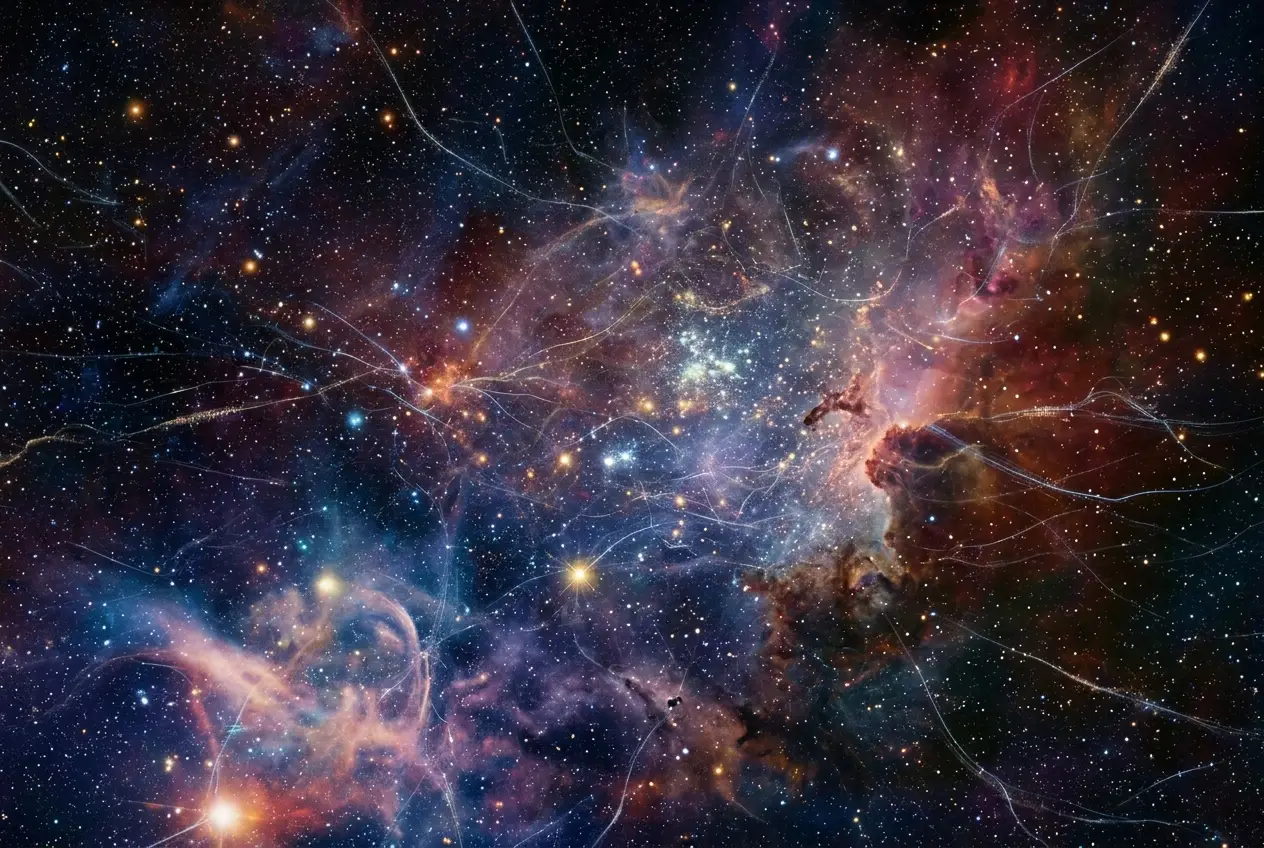
I’ve always been fascinated by the sheer vastness of space and the countless mysteries it holds. We spend so much energy looking for signals – radio waves, light pulses, anything that hints at intelligence beyond Earth. But what if the universe already has its own subtle, almost invisible postal service, carrying information right through us, unnoticed? I recently found myself pondering this exact question when thinking about one of the most enigmatic particles known to science: the neutrino.
Imagine a particle so tiny, so elusive, that billions of them pass through your body every second without a trace. They stream from the Sun, from exploding stars, and from the deep cosmos, traversing galaxies as if they weren’t there. These are neutrinos, often called "ghost particles," and I can't help but wonder if their unique properties could make them the ultimate cosmic messenger.
### **The Unseen River: What Exactly Are Neutrinos?**
Before we dive into their potential as cosmic communicators, let’s briefly introduce our protagonist. Neutrinos are fundamental subatomic particles, much like electrons, but with a few crucial differences. They have almost no mass (though we now know they have *some*, which was a major discovery!), no electric charge, and they interact with other matter only through the **weak interaction** and gravity – the weakest of the four fundamental forces. This means they rarely collide with anything. You could fill a light-year of lead with neutrinos, and most would still zip right through it.
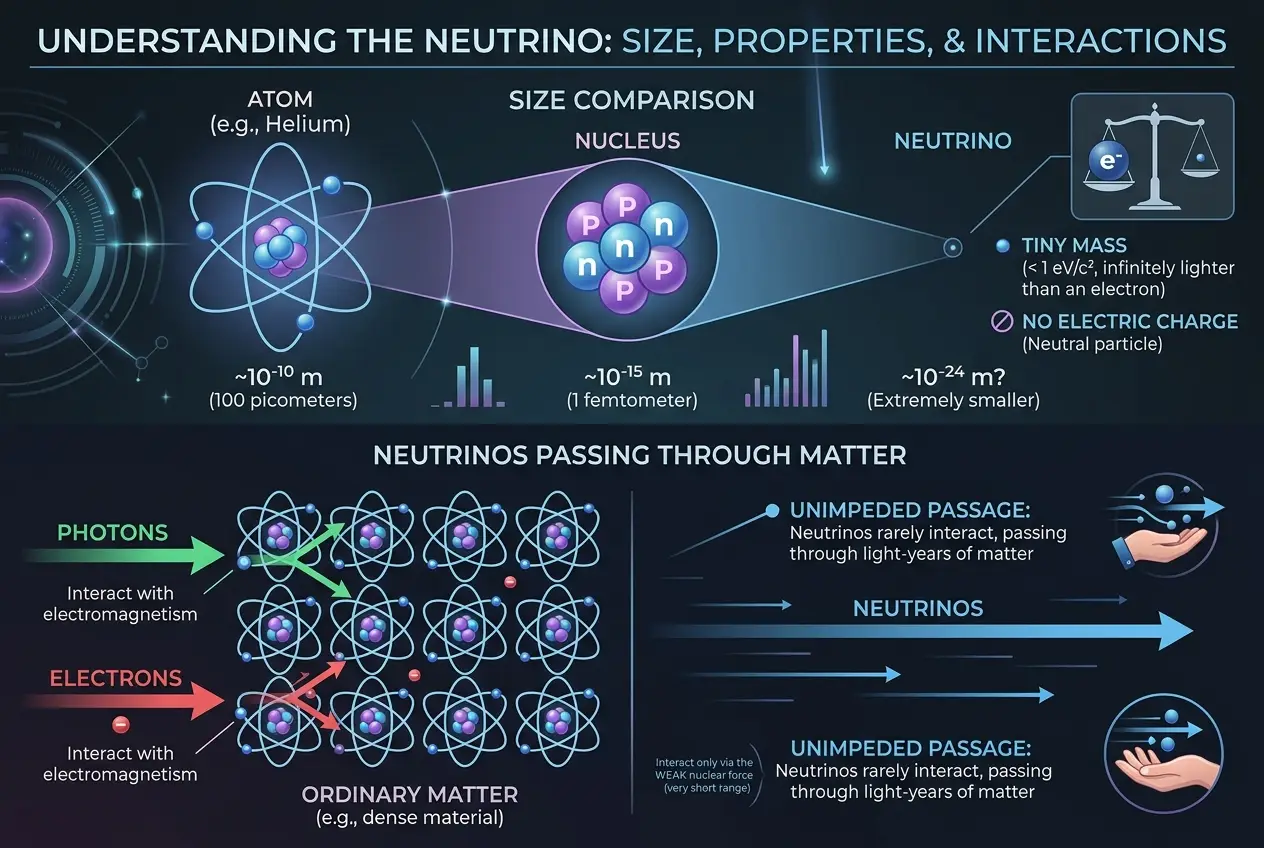
Think of it like this: if photons (light particles) are like express trains that get stopped by tunnels and mountains, neutrinos are like whispers carried on a supernatural breeze, passing through solid rock as if it were thin air. This ghost-like nature is what makes them so difficult to detect, but also so incredibly appealing for carrying information across vast cosmic distances without degradation or interference.
### **Cosmic Messengers: Why Neutrinos Stand Out**
When scientists talk about interstellar communication, they usually refer to electromagnetic waves – radio, visible light, or even X-rays. These are great for sending signals, but they have limitations:
* **Absorption and Scattering:** Dust, gas, and even planetary atmospheres can absorb or scatter electromagnetic signals, weakening them over long distances. Imagine trying to talk to someone across a crowded, foggy stadium.
* **Directionality:** Sending a focused beam across light-years requires immense power and precise aiming.
* **Background Noise:** The universe is full of natural radio noise, making it hard to pick out an artificial signal.
Neutrinos, however, laugh in the face of these challenges. Because they barely interact with matter, they would sail unimpeded through galaxies, nebulae, and even stellar cores. A neutrino signal sent from a distant civilization would arrive at Earth almost as pristine as it was sent, carrying very little information loss. This resilience to interference makes them uniquely suited for truly **interstellar communication**. I find this idea incredibly powerful – a message delivered flawlessly across unimaginable distances.
### **From the Sun to Supernovae: The Natural Neutrino Orchestra**
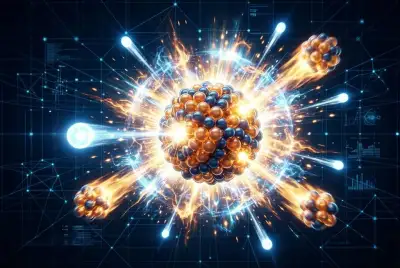
Our Sun is a prolific source of neutrinos, churning out trillions of them every second as a byproduct of nuclear fusion. Detecting these solar neutrinos was actually one of the first confirmations of the current model of solar fusion. But neutrinos don't just come from our star. They also originate from:
* **Supernovae:** When massive stars explode, they release an incredible burst of neutrinos even before the light reaches us. The detection of neutrinos from Supernova 1987A was a landmark event in astrophysics, providing a peek into the heart of a stellar collapse. You can read more about these cosmic events on [Wikipedia's Neutrino article](https://en.wikipedia.org/wiki/Neutrino).
* **Cosmic Ray Interactions:** High-energy cosmic rays crashing into Earth’s atmosphere produce a shower of particles, including neutrinos.
* **Earth's Interior:** Radioactive decays within our own planet generate a steady flux of geoneutrinos.
All these natural sources create a constant "neutrino hum" throughout the universe. The challenge, then, isn't just about detecting *a* neutrino, but detecting one that carries a deliberate message.
### **The Herculean Task of Detection: Listening to Ghosts**
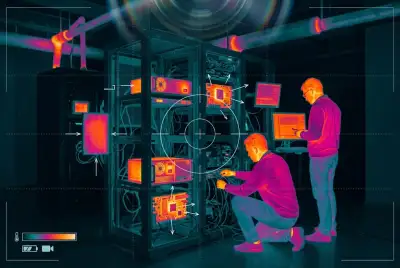
If neutrinos pass through almost everything, how do we detect them at all? This is where the ingenuity of modern physics comes in. Scientists build colossal detectors, often deep underground or under ice, to shield them from other cosmic rays and background noise.
One of the most famous is the **IceCube Neutrino Observatory** at the South Pole. It uses a cubic kilometer of clear Antarctic ice embedded with thousands of optical sensors. When a rare neutrino *does* interact with an atom in the ice, it produces a tiny flash of blue light (Cherenkov radiation). These sensors capture these flashes, allowing physicists to reconstruct the neutrino's energy and direction. More on this incredible facility can be found on [IceCube's Wikipedia page](https://en.wikipedia.org/wiki/IceCube_Neutrino_Observatory).
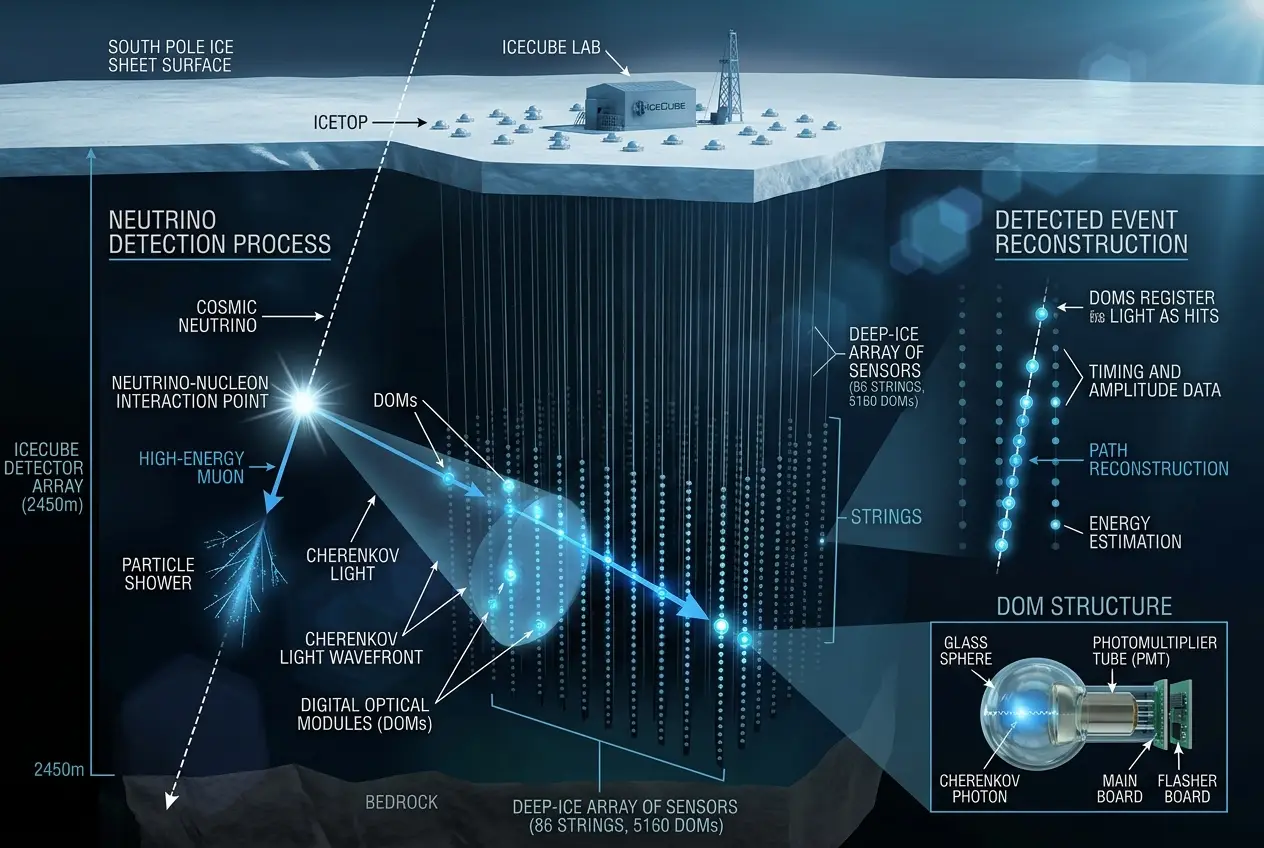
Other detectors, like Super-Kamiokande in Japan, use vast tanks of ultra-pure water. The principle is similar: a neutrino occasionally interacts with a water molecule, producing Cherenkov light that is detected by surrounding photomultiplier tubes.
The sheer scale of these detectors underscores the difficulty. We’re talking about instruments designed to catch the faintest whispers in a cosmic roar.
### **Could We Encode a Message in Neutrinos?**
Let’s step into the realm of theoretical physics and speculative engineering. If we wanted to send a message via neutrinos, how would we do it? I imagine the process would involve modulating neutrino properties.
1. **Flux Modulation:** The simplest idea is to vary the number of neutrinos emitted. A burst of neutrinos could represent a "1" and an absence a "0".
2. **Energy Modulation:** Encoding data by varying the energy of the emitted neutrinos. Different energy levels could correspond to different symbols or parts of a message.
3. **Flavor Modulation:** Neutrinos come in three "flavors" – electron, muon, and tau. They also undergo **neutrino oscillation**, changing between these flavors as they travel. Perhaps a message could be encoded in a specific sequence of flavors, or even manipulating the oscillation process itself. The weak interaction is responsible for these flavor changes, and you can learn more about it here: [Weak Interaction on Wikipedia](https://en.wikipedia.org/wiki/Weak_interaction).
The catch? Generating controlled, high-energy neutrino beams is incredibly difficult and energy-intensive. Particle accelerators can produce neutrinos, but the beams are spread out and weak over interstellar distances. A civilization capable of generating a coherent, powerful neutrino beam detectable across light-years would require technology far beyond anything we currently possess. They would need a power source equivalent to entire stars.
### **The Search for Silence: Neutrinos and the Fermi Paradox**
The idea of neutrinos as cosmic messengers takes on new meaning when we consider the **Fermi Paradox** – the glaring contradiction between the high probability of extraterrestrial life and the apparent lack of evidence for it. If advanced civilizations exist, where are they? You can delve deeper into this paradox here: [Fermi Paradox on Wikipedia](https://en.wikipedia.org/wiki/Fermi_paradox).
Could it be that we're simply looking for the wrong kind of signal? If a civilization decided to communicate via neutrinos, our current detection capabilities might not be sufficient to discern an artificial message from the natural cosmic background. They might be broadcasting a galactic encyclopedia, and we're just listening to static. Perhaps the silent universe isn't so silent after all, but rather communicating on a frequency we haven't quite tuned into yet. I'm reminded of earlier discussions about hidden cosmic data, like the idea of the universe itself being a giant computer, as explored in our blog on whether our universe is a hologram: [Is Our Universe a Hologram? Decoding Cosmic Data](https://curiositydiaries.com/blogs/is-our-universe-a-hologram-decoding-cosmic-data-8116).
This leads me to wonder about the implications. If a neutrino message arrived, what would it contain? Would it be a greeting, scientific data, or even a warning? Would we be able to decode it? The prospect is both thrilling and daunting.
### **The Future of Ghost Communication**
While neutrino communication remains firmly in the realm of science fiction for now, the continuous advancements in particle physics and astrophysics keep the possibility alive. New neutrino observatories, like those being planned or under construction, aim to detect ever fainter and higher-energy neutrinos. Researchers are also exploring novel detection methods.
Perhaps one day, we will be able to not only detect these cosmic ghosts but also understand their subtle whispers. For now, they continue their silent journey through the cosmos, a reminder of the universe’s endless wonders and the profound mysteries still waiting to be uncovered. They hint at a deeper, more resilient layer of reality, one that effortlessly transcends the barriers of matter and space. I believe that understanding these particles better might not just reveal new ways to communicate, but also shed light on the very fabric of the universe itself, perhaps even hinting at phenomena like dark matter, a topic we've touched upon in another post: [Does Dark Matter Hide a Universe We Can’t See?](https://curiositydiaries.com/blogs/does-dark-matter-hide-a-universe-we-cant-see-2793).
Frequently Asked Questions
Neutrinos travel at speeds extremely close to the speed of light, though slightly less due to their minuscule mass. They are among the fastest known particles in the universe.
The primary reasons are the incredible difficulty of detecting neutrinos at all, the immense energy required for a civilization to generate a detectable, encoded neutrino beam across interstellar distances, and our limited understanding of what a 'message' might look like within neutrino data.
It's a theoretical possibility. While neutrinos primarily interact via the weak force, some theories propose exotic interactions with dark matter particles. If such interactions exist, a highly advanced civilization might theoretically leverage them to encode information or use dark matter as a medium, but this is highly speculative.
Current neutrino observatories are primarily designed to detect natural astrophysical neutrinos (from the Sun, supernovae, cosmic rays, etc.) and study their fundamental properties. While they could theoretically detect an unexpectedly strong or patterned neutrino flux, there isn't a dedicated 'SETI for neutrinos' program currently in place due to the technological challenges involved.
While quantum entanglement offers instantaneous information transfer in theory, it's extremely fragile and currently impossible to sustain over macroscopic distances, let alone light-years. Neutrinos, though slower, offer robust, almost unimpeded travel through dense matter over vast cosmic distances, making them a more practical (albeit still futuristic) candidate for long-distance communication without signal degradation.
Verified Expert
Alex Rivers
A professional researcher since age twelve, I delve into mysteries and ignite curiosity by presenting an array of compelling possibilities. I will heighten your curiosity, but by the end, you will possess profound knowledge.
Leave a Reply
Comments (0)
No approved comments yet. Be the first to share your thoughts!
 Join Us

 Unknown Author
























Leave a Reply
Comments (0)