


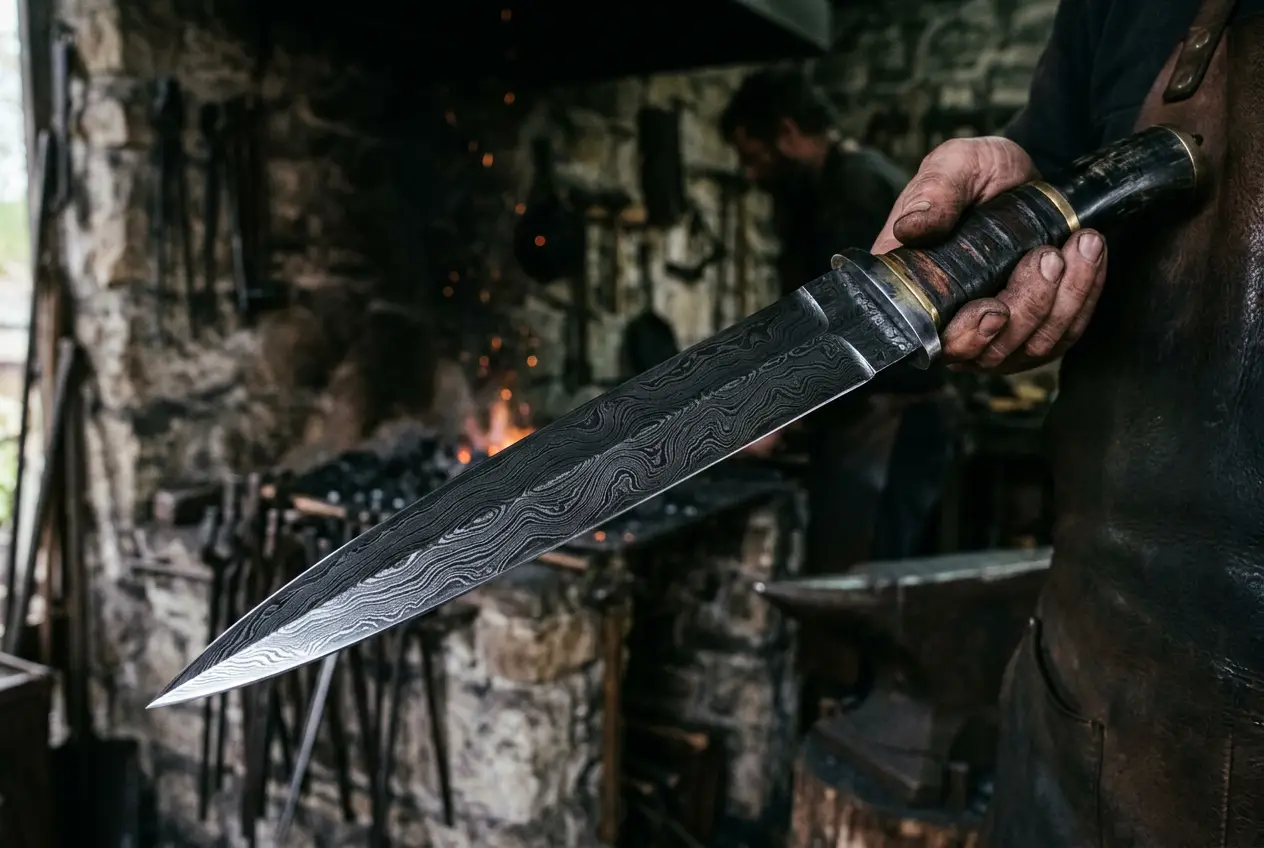
I remember the first time I saw a true Damascus steel blade. It wasn't just a knife; it was a swirling tapestry of dark and light, a liquid pattern frozen in metal. There was an undeniable aura about it, a sense of ancient power and mystery. For centuries, these blades, originating from the Near East and made with legendary Wootz steel from India, were renowned for their incredible sharpness, flexibility, and strength. Tales of them cutting through silk mid-air or slicing European armor like butter are the stuff of legends. But here's the kicker: the precise methods for creating this material were lost for centuries, defying attempts by the most skilled metallurgists. This raises a fascinating question for me: did ancient civilizations achieve a level of material science that, in some aspects, surpassed what we could replicate until very recently?
It's a bold claim, isn't it? To suggest that a technology from over a millennium ago could challenge modern material science. Yet, the story of Damascus steel, and its precursor Wootz steel, is a compelling dive into just such an anomaly. It forces us to reconsider the linearity of technological progress and question if some "lost arts" were, in fact, incredibly sophisticated scientific achievements.
The Legend of the Unbreakable Blade
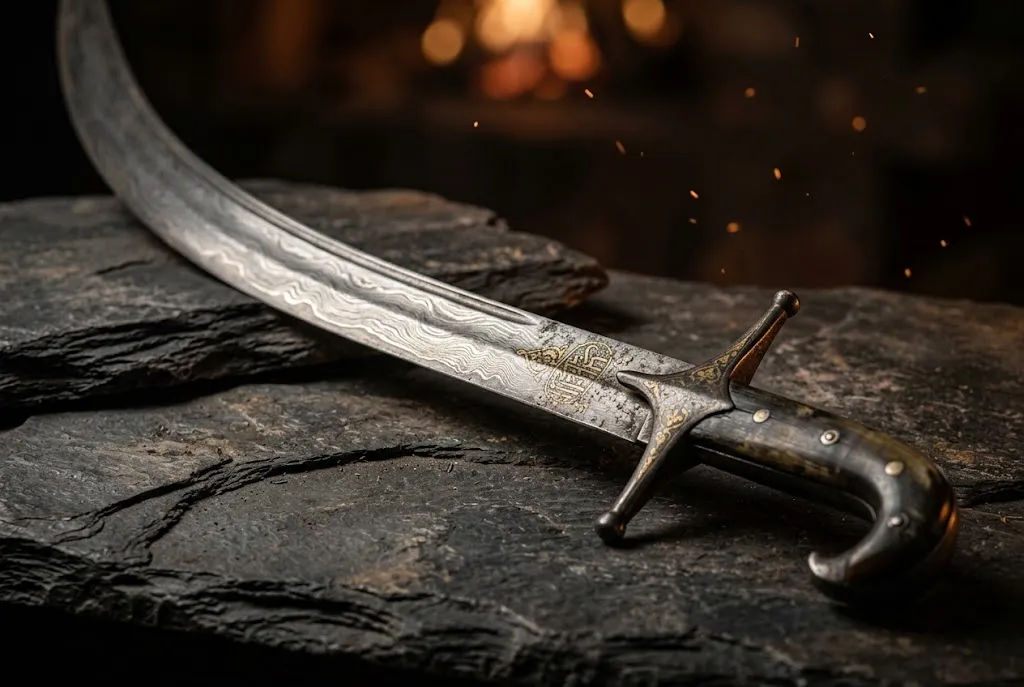
The legend of Damascus steel swords is steeped in history. Crusaders, returning from the Holy Land, brought back tales of Muslim warriors wielding blades that could bend almost ninety degrees without breaking, yet hold an edge sharp enough to cleave helmets and bodies with terrifying ease. These were not mere stories; historical accounts and archeological finds corroborate the exceptional quality of these weapons. The distinctive "watering" or "Damask" pattern on the surface wasn't just decorative; it was a visible manifestation of the internal microstructure that gave the steel its incredible properties.
This wasn't simply a case of good craftsmanship. The swords were made from ingots of Wootz steel, produced in India and Sri Lanka as early as the 3rd century BCE, and traded widely. Wootz steel was characterized by its extremely high carbon content – typically 1.5% to 2.0% – which is unusually high for steel that is both strong and flexible. Modern steel of such carbon content would typically be brittle. The secret wasn't just in the composition, but in the unique metallurgical processes involved in its creation and forging.
The Lost Art: A Scientific Enigma
For centuries, no one could replicate authentic Damascus steel once the original manufacturing techniques faded after the 18th century, largely due to trade route disruptions and the loss of specific ore sources. European metallurgists tried everything – different alloys, folding techniques, quenching methods – but could never achieve the full suite of properties: the combined hardness, flexibility, and distinctive pattern. It became one of the greatest historical tech mysteries.
It wasn't until the late 20th and early 21st centuries, with the advent of advanced electron microscopy and material science, that we began to unravel the true secrets. Researchers discovered that the unique patterns and superior properties of genuine Damascus steel were due to a hidden, nanoscale structure within the metal.
Dr. Peter Paufler and his colleagues at the University of Dresden, using high-resolution transmission electron microscopy, discovered cementite nanowires and carbon nanotubes embedded within the steel matrix. Yes, carbon nanotubes – structures that we consider a marvel of modern nanotechnology, developed only in the 1990s – were seemingly present in steel forged a thousand years ago. Imagine my surprise when I first learned this! It fundamentally changed how I viewed ancient metallurgy.
These nanotubes and nanowires are believed to have formed during the slow cooling process of the Wootz steel ingots and were then preserved and aligned through specific forging techniques. The layered structure, visible as the "Damask" pattern, would have provided pathways for these nanoscale structures, contributing to the steel's extraordinary resilience and edge retention.
Ancient Nanoscience?
The idea that ancient artisans, without microscopes or a theoretical understanding of carbon chemistry, were inadvertently (or perhaps even knowingly, through generations of empirical knowledge) manipulating materials at a nanoscale level is mind-boggling. They didn't have terms like "nanotubes" or "cementite," but their precise control over temperature, carbon content, impurities, and forging techniques produced a material that mimicked some of the most advanced concepts in modern material science.
It suggests a kind of "intuitive nanotechnology" that developed through meticulous observation and iterative refinement over centuries. The specific minerals used in the Wootz steel production, often containing trace amounts of vanadium or other elements, might have acted as catalysts for the formation of these nanoscale structures. You can learn more about the scientific breakthroughs in understanding Wootz steel on its Wikipedia page (opens in a new tab).
This isn't the only instance where ancient materials challenge our perceptions. I’ve read fascinating accounts of similar enigmas, like the incredible strength of Viking Ulfberht swords, which also hint at lost metallurgical prowess far ahead of their time. These blades, produced in a different region and era, share a common thread of unexplained metallurgical superiority, making me wonder just how much knowledge was truly lost to time. For another deep dive into lost ancient metal tech, check out our article on Ulfberht Swords: Did Vikings Forge Impossible Steel?.
Recreating the Impossible
Modern attempts to replicate Damascus steel have been successful, but only after understanding the underlying nanostructure. It requires precise control over carbon content, specific alloying elements, and thermal cycling processes that replicate the ancient methods. This means that while we can now produce steel with similar properties, it's often through sophisticated industrial processes informed by centuries of scientific discovery – not the intuition and empirical knowledge of a blacksmith from 1000 AD.
Consider the complexity:
- Controlling impurities: The original iron ores had specific trace elements that played a crucial role.
- Smelting temperature and time: Crucial for allowing carbon to diffuse and form the necessary microstructure.
- Cooling rates: The slow cooling of Wootz ingots was essential for cementite formation.
- Forging techniques: Specific heating and hammering cycles aligned the internal structures without breaking them.
This wasn't random trial and error; it was a highly refined, almost ritualistic process passed down through generations. It exemplifies how "art" and "craft" in ancient times often contained deep scientific principles. You can find more comprehensive details on the history and modern analysis of Damascus steel on its Wikipedia article (opens in a new tab).
Beyond the Blade: What This Means for Our Understanding of History
The story of Damascus steel isn't just about a powerful sword; it's a testament to the sophisticated understanding of materials that existed in various ancient cultures. It's a prime example of an out-of-place artifact not in its physical presence, but in its technological advancement relative to its historical context. While we might look back and assume ancient peoples were primitive, discoveries like this constantly force us to re-evaluate. It makes me reflect on other impossible artifacts: clues to lost ancient tech that we often dismiss as anomalies.
This material science achievement demonstrates that technological progress isn't always a linear climb. Sometimes, specific knowledge branches flourish, then wither, only to be rediscovered much later. The "lost art" of Damascus steel serves as a powerful reminder that our ancestors were ingenious problem-solvers, capable of astonishing feats of engineering and craftsmanship. And who knows, perhaps some of these ancient materials even exhibited properties we're only just beginning to explore, like the hypothetical self-healing powers some ancient metals are rumored to have possessed, a concept we discuss in another article. Take a look at Did Ancient Metals Have Self-Healing Powers?.
In conclusion, while "stronger than modern" might be an oversimplification, it's undeniable that ancient Damascus steel achieved a level of performance that was unparalleled for its time and challenged replication for centuries. The discovery of nanoscale structures within these blades bridges the gap between ancient craftsmanship and cutting-edge material science. It's a humbling thought, making me wonder what other scientific marvels from the past are still waiting to be truly understood. The past, it seems, still has plenty of surprises in store for our scientific curiosity.



Conversation0
No comments yet. Be the first to share a thought — the best questions often become new stories.