


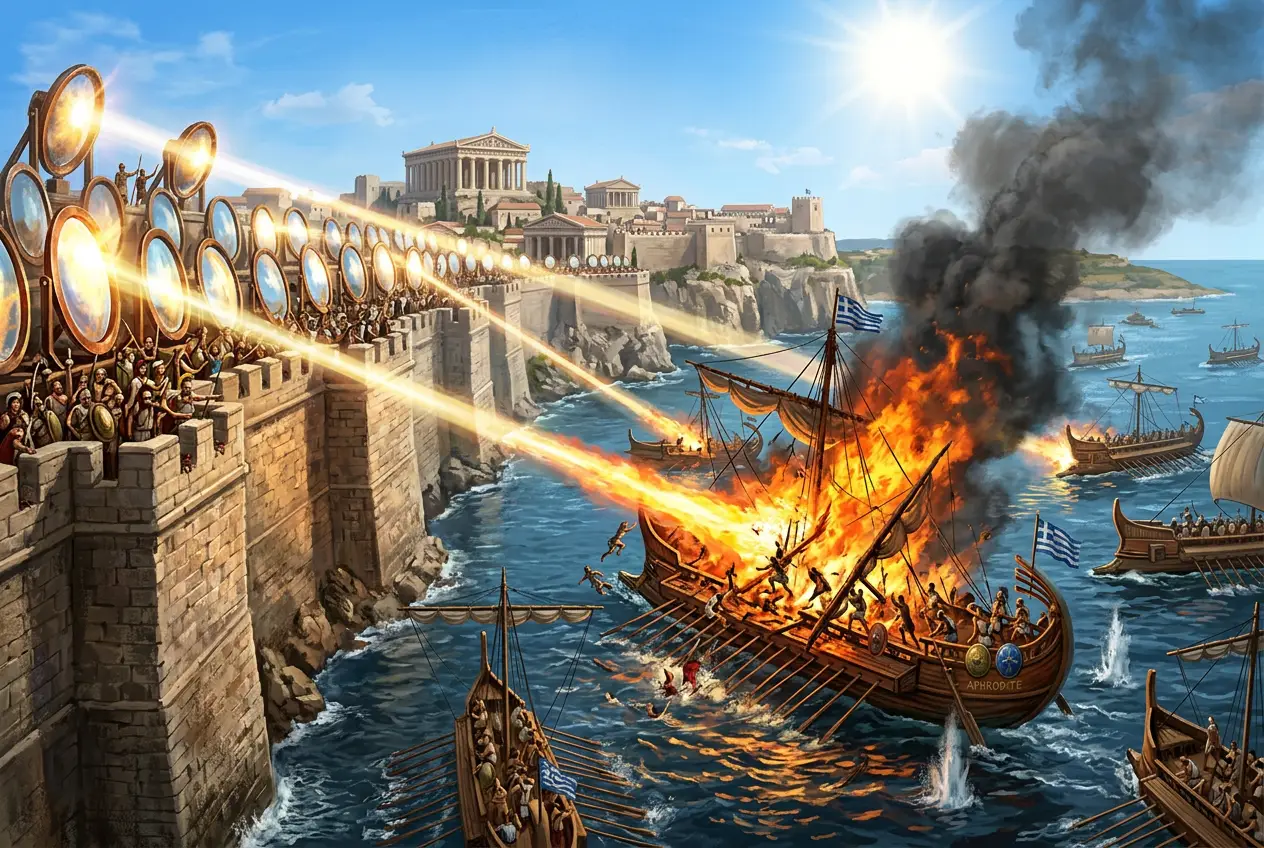
I remember sitting in a history class, utterly captivated by tales of ancient ingenuity. We talked about everything from the pyramids to the Library of Alexandria, but one particular story always stuck with me: the legend of Archimedes and his "death ray." The idea that a brilliant mind in ancient Greece could devise a weapon harnessing the sun’s raw power to incinerate enemy ships felt like something out of a science fiction novel, not a historical account. But could it be true? Did the legendary polymath really build a cosmic computer of light, a solar superweapon that turned sunlight into a burning inferno?
For centuries, this tale has sparked the imaginations of historians, scientists, and engineers alike. It's a classic "what if" scenario that perfectly blends historical mystery with cutting-edge science – even if that science is 2,000 years old. As someone fascinated by how past civilizations might have understood and manipulated the physical world, I find the Archimedes death ray one of the most compelling tech mysteries of all time.
The Siege of Syracuse and a Genius's Defense
Our story begins in 212 BC, during the Second Punic War. Rome, a burgeoning superpower, laid siege to Syracuse, a powerful Greek city-state on the island of Sicily. Syracuse was home to Archimedes, arguably one of the greatest scientific minds of antiquity. The Roman general Marcellus, facing the city’s formidable defenses, famously remarked, “We are fighting against a geometrician of battles.”
Ancient historians like Plutarch and Livy describe Archimedes deploying an array of ingenious war machines. These included massive cranes that could lift Roman ships out of the water and dash them against the rocks, and catapults that hurled huge stones with terrifying accuracy. But it’s the less conventional weapon—the supposed "burning mirrors"—that truly captures our imagination.
The accounts suggest that Archimedes arranged a multitude of polished bronze or copper shields to focus sunlight onto the sails and decks of the Roman fleet, setting them ablaze. Imagine the terror: Roman soldiers, confident in their siege engines, suddenly witnessing their ships spontaneously combusting under the intense glare of the sun. It's a dramatic image, to say the least, and it begs the question: was it real, or merely a heroic embellishment?
The Science Behind the Legend: Can Mirrors Burn?
At its core, the concept of the death ray relies on fundamental principles of optics and thermodynamics. Anyone who has used a magnifying glass to start a fire knows that focused sunlight can generate significant heat. The challenge, however, scales dramatically when you're trying to set fire to a wooden ship from a distance, with ancient technology.
To achieve combustion, you need to raise the target's temperature to its ignition point. For wood, this is typically between 250°C and 300°C (482°F to 572°F). The intensity of the sunlight, the efficiency of the mirrors, the distance to the target, and atmospheric conditions all play critical roles.
Archimedes was certainly familiar with optics. His work on reflection and refraction laid groundwork that wouldn't be fully explored for centuries. It's plausible he understood how to construct mirrors that could concentrate sunlight. The Greeks and Romans were masters of metalwork, capable of polishing bronze or copper to a high sheen. The real debate lies in the practicality of such a device on a grand scale.
Replicating the Ray: Modern Experiments
Over the centuries, many have attempted to recreate Archimedes’ feat. The results have been mixed, fueling the debate even further.
-
Buffon's Experiment (1747): The French scientist Georges-Louis Leclerc, Comte de Buffon, was one of the first to put the theory to the test. He used 168 small flat mirrors, each independently adjustable, to focus sunlight onto a wooden plank. He successfully ignited wood at a distance of 150 feet (about 45 meters), and even melted lead at 200 feet (about 60 meters). Buffon's experiment demonstrated the potential but involved a complex, modern setup that Archimedes likely didn't have.
-
MIT's MythBusters Episode (2004): Perhaps the most famous modern attempt was by a team of students from MIT for the TV show MythBusters. They used an array of 127 flat, square mirrors, each one foot by one foot, aimed at a wooden boat replica 120 feet away. While they achieved a significant temperature increase (over 200°C), they could only produce smoke and charring, not actual flames. The conditions needed to be perfect, with no clouds and a stationary target. The conclusion from this specific experiment was "busted."
-
The Greek Experiment (2005): A group of Greek scientists, determined to vindicate their ancient compatriot, conducted their own experiment. Using 70 concave, highly polished copper mirrors, they managed to set a wooden boat on fire in minutes at a distance of 50 meters (about 164 feet). Their key finding was the importance of concave mirrors, which are much more effective at focusing light than flat ones. This success reignited hope for the legend's authenticity, showing that with the right materials and design, it might indeed have been possible. For more on the specifics of this and other attempts, you might find this Wikipedia entry on the topic fascinating: Archimedes' death ray (opens in a new tab).
The Challenges and Skepticism
Despite the successes of some modern experiments, significant challenges remain in fully validating the death ray's historical reality:
- Logistics: Imagine managing hundreds of mirrors, each needing precise alignment, in the chaos of battle. Roman ships wouldn't have been stationary targets; they would have been moving, making precise focusing incredibly difficult.
- Weather: A cloudy day or even slight haze would render such a weapon useless. The sun's position also changes, requiring constant re-aiming.
- Material Limitations: While ancient Greeks were skilled metalworkers, producing perfectly concave, highly polished mirrors on a large scale would have been an immense undertaking. The efficiency of ancient materials might also have been lower than modern replicas.
- Historical Silence: The most significant piece of evidence against the death ray is the relative silence of some contemporary historians. Polybius, who was a more detailed historian of the period, mentions Archimedes' other war machines but not the burning mirrors. Plutarch, writing centuries later, provides the most vivid account, but his work often included dramatic flair.
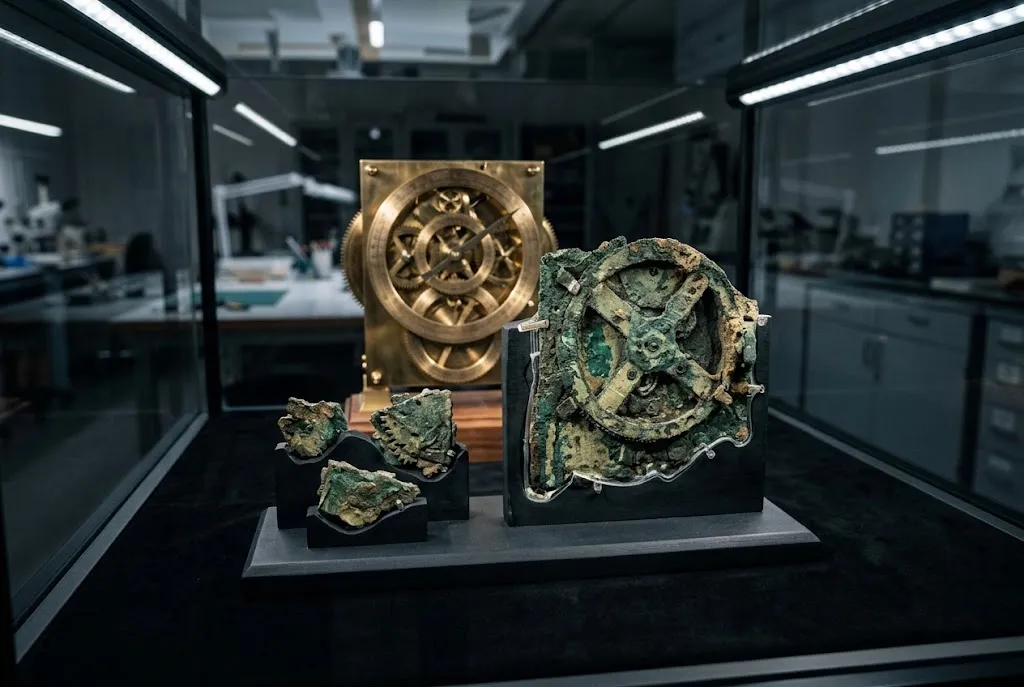
This doesn't mean it didn't happen, but it does mean we should approach the legend with a critical, scientifically informed eye. The absence of concrete archaeological evidence also leaves us guessing. We've explored other ancient engineering feats that pushed the boundaries of their time, like the precise constructions and potential celestial observations of the ancient alignments, but these typically leave more tangible traces.
Beyond the Ray: Archimedes' Enduring Legacy
Whether the death ray was a historical fact or a powerful myth, Archimedes' genius is beyond dispute. His contributions to mathematics, physics, and engineering were revolutionary. He discovered the principle of buoyancy (Archimedes' Principle), developed advanced levers and pulleys, and made significant strides in geometry. He even designed the Archimedes' screw, still used today for irrigation.
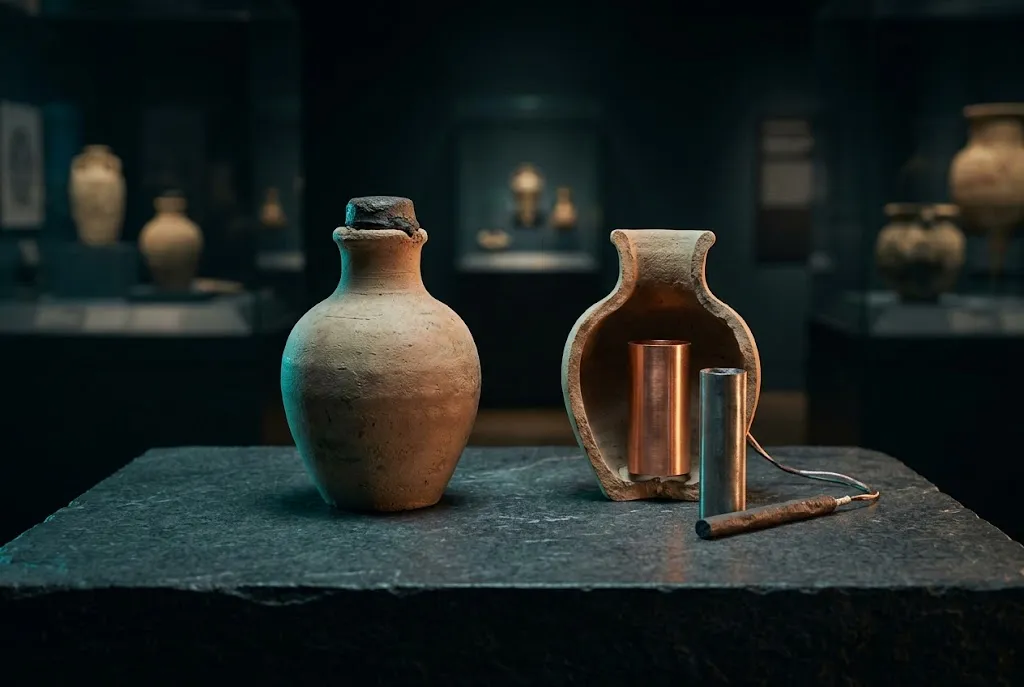
The legend of the death ray, in a way, embodies the boundless curiosity and innovative spirit of Archimedes himself. It pushes us to consider the limits of ancient technology and the sheer power of human intellect. Much like the debate around the Baghdad Battery and whether it was a voltaic pile, the "death ray" forces us to confront what ancient civilizations truly understood about the world around them.
The pursuit of understanding such historical anomalies helps us appreciate the cyclical nature of innovation. Modern solar power, for instance, operates on similar principles of harnessing sunlight, albeit with advanced photovoltaics and concentration methods for energy generation. Perhaps Archimedes was simply centuries ahead of his time, glimpsing a future where the sun could be a formidable source of power, both destructive and constructive. Even the Romans, known for their engineering prowess, perfected materials like immortal concrete that challenge our modern understanding.
Conclusion: A Blazing Myth or Hidden Truth?
So, did Ancient Greeks build a cosmic computer of light? The most probable answer is: they could have, under specific, ideal conditions, but it's unlikely to have been a consistently effective weapon in actual combat. The evidence from modern experiments suggests the physics is sound, but the practical application in ancient warfare remains highly questionable.
Regardless of its historical veracity, the legend of Archimedes' death ray continues to inspire. It serves as a potent reminder of humanity's enduring quest to understand and harness the forces of nature. It’s a powerful story that beautifully illustrates the intersection of science, history, and the boundless potential of human innovation. And for me, that's a story worth pondering, whether it ended in a blaze of glory or just a puff of smoke.
Conversation0
No comments yet. Be the first to share a thought — the best questions often become new stories.