



I remember staring at the intricate design of a rose window in a cathedral, completely mesmerized. The perfect symmetries, the repeating patterns, the sense of balance – it felt like more than just art. It felt like a hidden language, a universal truth etched into stone and glass. This fascination led me down a rabbit hole, exploring the concept of sacred geometry, and I couldn't help but wonder: could these ancient patterns, found in everything from megalithic structures to the smallest organisms, actually encode fundamental cosmic constants that govern our universe?
It’s a bold thought, isn't it? The idea that civilizations centuries, even millennia, ago might have embedded profound scientific knowledge within their art and architecture, disguised as spiritual symbols. We often think of scientific discovery as a linear progression, but what if some truths were understood, then lost, only to be "rediscovered" much later?
Unpacking Sacred Geometry: More Than Just Pretty Patterns
Sacred geometry is not just a New Age concept; it’s a field that studies the universal patterns, shapes, and ratios that are believed to be the fundamental building blocks of all life and the cosmos. From the spirals of a sunflower to the branching of a tree, from the proportions of the human body to the orbits of planets, these geometric principles seem to repeat across scales.
Ancient cultures across the globe incorporated sacred geometry into their spiritual beliefs, art, and architecture. You see it in the precise construction of the Pyramids of Giza, the intricate mandalas of Eastern traditions, the elaborate tile work of Islamic art, and the foundational layouts of Gothic cathedrals. It’s a language seemingly understood by all, a testament to shared human perception of order in the universe. But was it just aesthetic or something deeper?
Cosmic Constants: The Universe’s Blueprint Numbers
On the other side of this fascinating equation are cosmic constants. These are the fundamental physical quantities that describe the laws of the universe and remain constant throughout space and time. Think of them as the bedrock numbers upon which reality is built. Some of the most well-known include:
- Pi (π ≈ 3.14159): The ratio of a circle's circumference to its diameter, fundamental to circles, spheres, and waves.
- The Golden Ratio (Phi, φ ≈ 1.618): An irrational number found by dividing a line segment such that the ratio of the whole segment to the longer part is the same as the ratio of the longer part to the shorter part. It appears in nature, art, and even financial markets.
- The Speed of Light (c ≈ 299,792,458 m/s): The constant speed at which light and all electromagnetic radiation propagate in a vacuum.
- The Gravitational Constant (G ≈ 6.674 × 10⁻¹¹ N⋅m²/kg²): Determines the strength of the gravitational force between masses.
- The Fine-Structure Constant (α ≈ 1/137): A dimensionless physical constant that characterizes the strength of the electromagnetic interaction. Its precise value has long fascinated physicists.
These constants are not arbitrary; they define the very fabric of our reality. Alter them even slightly, and the universe as we know it would not exist, potentially preventing the formation of stars, galaxies, or even life itself. This delicate balance is often referred to as the "fine-tuning" of the universe, a concept that continues to perplex and inspire scientists and philosophers alike. You can read more about the fine-structure constant on its Wikipedia page (opens in a new tab).
Ancient Echoes: Where Geometry Meets the Cosmos
So, where do these two seemingly disparate fields intersect? The connection emerges when we examine ancient sites and texts with a curious eye.
1. The Great Pyramid of Giza: A Mathematical Marvel
The Great Pyramid stands as perhaps the most enduring symbol of ancient architectural precision. Its dimensions are not just impressive; they seem to encode mathematical constants with startling accuracy.
- Pi (π): The perimeter of the Great Pyramid divided by twice its height (a proxy for its radius) closely approximates Pi. This isn’t a coincidence; it reflects a deep understanding of circular geometry embedded in a four-sided structure.
- The Golden Ratio (Phi, φ): The ratio of the pyramid's slant height to half its base perimeter is very close to Phi. This isn't just an accident; it suggests deliberate design. For more on the mathematics of the pyramids, see this Wikipedia article on the Great Pyramid (opens in a new tab).
Could these precise ratios have been purely for structural stability, or were they meant to convey a deeper message about the universe's proportions? I believe it's difficult to dismiss such accuracy as mere chance.
2. The Parthenon and Classical Greek Architecture
The ancient Greeks were masters of aesthetics and mathematics. The Parthenon in Athens, a pinnacle of classical architecture, famously employs the Golden Ratio in many of its proportions, from its facade to the spacing of its columns. While some scholars debate the intentionality of Phi's application in every instance, its pervasive presence in structures considered epitomes of beauty suggests a conscious or intuitive understanding of its harmonious qualities. The use of optical illusions and precise measurements in these buildings shows a sophisticated grasp of spatial relationships.
3. Megalithic Structures and Astronomical Alignment
Sites like Stonehenge, Newgrange, and Gobekli Tepe (which we explored in a previous blog, "Gobekli Tepe: First Observatory or Cosmic Calculator?", a fascinating read if you haven't seen it: /blogs/gobekli-tepe-first-observatory-or-cosmic-calculator-6119) are aligned with celestial events. While this primarily points to astronomical observation, the underlying geometry of their construction, the precise placement of stones, and the angles involved could have been used to measure and represent fundamental cosmic cycles and ratios. For instance, if you're interested in how other ancient structures tracked the cosmos, check out our post on "Ancient Alignments: Did Structures Track the Cosmos?" at /blogs/ancient-alignments-did-structures-track-the-cosmos-1119.
4. Universal Patterns: Vesica Piscis and the Flower of Life
These patterns, found across continents and cultures, are not just decorative. The Vesica Piscis, formed by the intersection of two circles, is fundamental to creating the Flower of Life, a pattern composed of multiple overlapping circles. These geometric figures are often seen as blueprints for life itself, generating ratios that include Pi, Phi, and square root values that appear in fundamental physics. The mathematical precision required to generate these complex patterns perfectly suggests more than just artistic flair. It implies a deep contemplative understanding of geometry as a source of universal truth.
How Could They Have Known? The Enduring Mystery
This is where the true curiosity sparks. If ancient civilizations did indeed encode cosmic constants, how did they acquire such knowledge without modern instruments, advanced mathematics, or global communication?
- Direct Observation and Intuition: Perhaps through centuries of meticulous observation of nature and the cosmos, they intuitively grasped these underlying patterns. The spiral of a nautilus shell, the branching of trees, the proportions of the human body – all exhibit the Golden Ratio. By simply measuring and observing, they could have discerned these fundamental numbers.
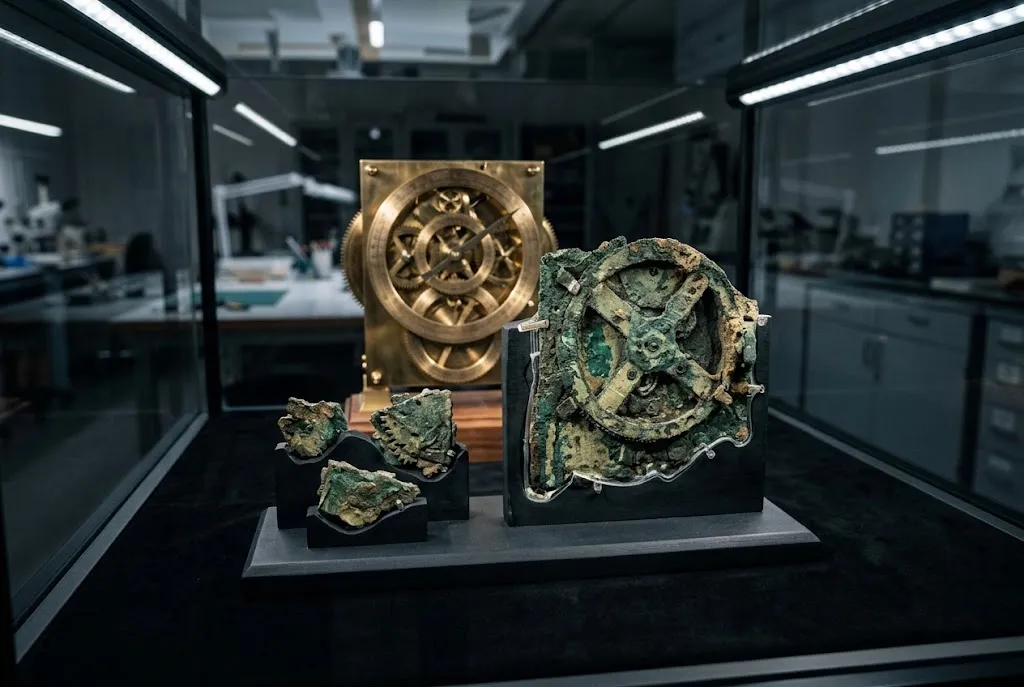
- Lost Advanced Knowledge: Another intriguing possibility is that a highly advanced civilization, perhaps now lost to history, passed down this knowledge. This taps into the idea of "impossible artifacts" or unexplained leaps in ancient technology, which we've discussed in blogs like "Impossible Artifacts: Clues to Lost Ancient Tech" at /blogs/impossible-artifacts-clues-to-lost-ancient-tech-2132.
- Spiritual Revelation: For many ancient cultures, geometry was sacred, a divine language. It's plausible they believed these patterns were revealed truths, a direct insight into the mind of the cosmos, rather than discovered through empirical science.
- A Universal Language: Perhaps these geometric and numerical truths are so fundamental that any sufficiently observant and intelligent culture, regardless of location, would eventually stumble upon them. Much like how ancient cultures might have coded planets into stone, as explored in /blogs/did-ancients-code-planets-into-stone-3992, these patterns could be a universal form of data storage.
Coincidence, Pareidolia, or Profound Wisdom?
It’s easy to dismiss these correlations as mere coincidence or an example of pareidolia—our mind’s tendency to see familiar patterns in random data. However, the sheer consistency and precision of these geometric and numerical relationships across diverse cultures and millennia make a strong case against pure randomness.
What if ancient builders weren't just building temples or tombs, but also crafting giant cosmic textbooks? Structures that, through their very dimensions and design, subtly whispered the secrets of the universe to those who knew how to listen. The integration of cosmic constants into sacred geometry could have been their way of anchoring profound scientific truths within a spiritual framework, ensuring their preservation and transmission through generations.
The Implications of Hidden Knowledge
If sacred geometry does indeed encode cosmic constants, it forces us to re-evaluate our understanding of ancient intelligence and the trajectory of human knowledge. It suggests that:
- Ancient civilizations possessed a more sophisticated understanding of mathematics and physics than we currently credit them with.
- Knowledge transmission might have occurred through non-obvious means, embedding information within cultural artifacts.
- There might be a unifying principle between scientific constants and aesthetic harmony, suggesting a deeper, interconnected reality.
The universe, in its elegant design, continually presents us with puzzles. The intricate dance between geometry, numbers, and the forces of creation is one of the grandest. Whether by empirical discovery, divine insight, or a blend of both, the possibility that ancient patterns hold the keys to cosmic constants is a profound thought that bridges the gap between science and spirituality, constantly reminding us of the endless mysteries that still await discovery.



Conversation0
No comments yet. Be the first to share a thought — the best questions often become new stories.