I found myself gazing at an image of Stonehenge the other day, those colossal stones standing silent sentinels against the sky, and a thought struck me. We often classify these ancient megalithic structures—from the famed circles of Britain to the unexplained alignments of Carnac—as astronomical observatories, ritual sites, or even territorial markers. But what if their purpose, or at least one of their functions, was far more sophisticated, hinting at an understanding of the cosmos we're only now beginning to grasp? What if these ancient architects were not just observing the stars but were subtly *sensing* invisible energies, like cosmic rays?
It sounds like something plucked from a science fiction novel, doesn't it? Yet, the idea that prehistoric cultures possessed a nuanced, empirical understanding of their environment, far beyond what we typically credit them with, is gaining traction among researchers. They might not have had particle accelerators, but their profound connection to the natural world and meticulous craftsmanship could have led them to discover and even utilize phenomena we consider purely modern science.
## The Invisible Rain: Understanding Cosmic Rays
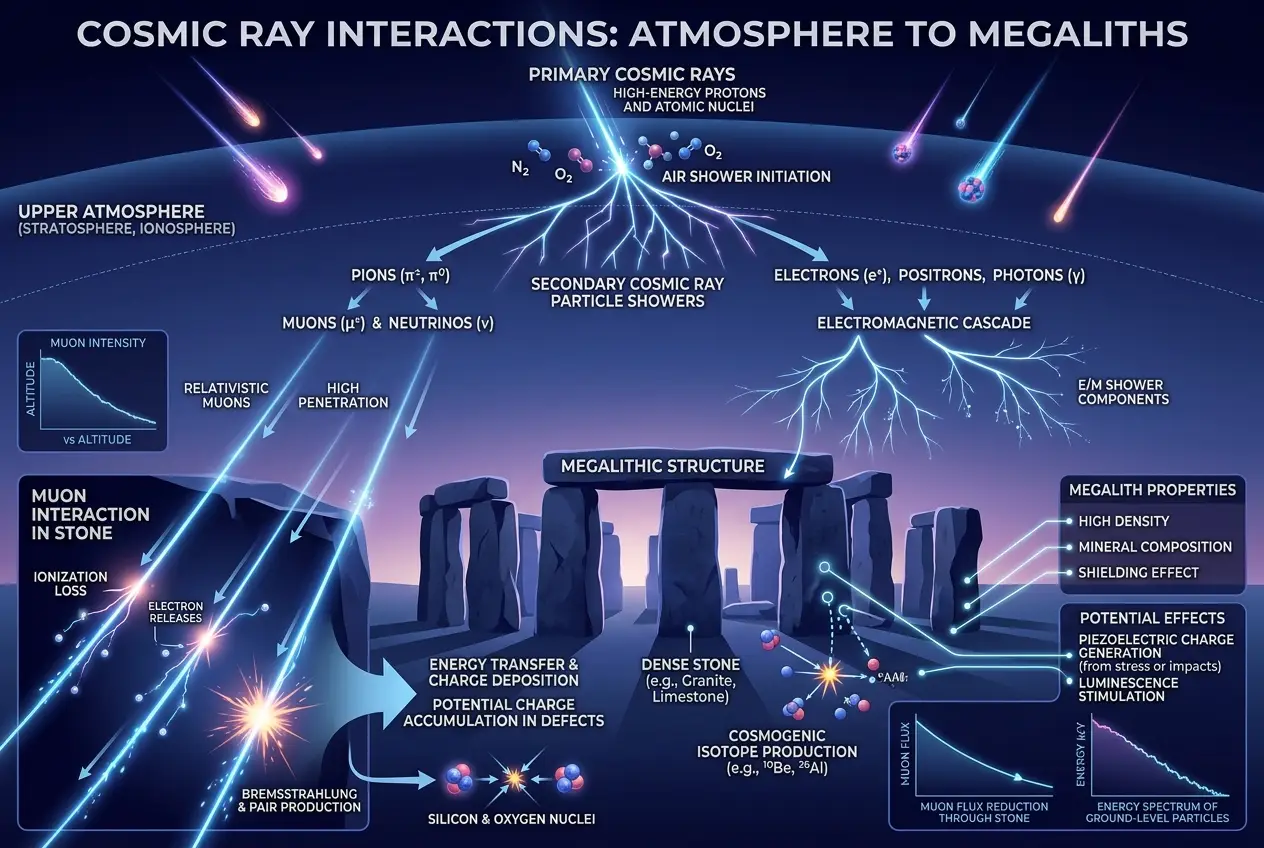
Before we delve into ancient possibilities, let's briefly touch upon what cosmic rays actually are. They are not "rays" in the traditional sense, but rather **high-energy particles** – mostly protons and atomic nuclei – that originate from outer space, traveling at nearly the speed of light. When these primary cosmic rays smash into Earth's atmosphere, they shatter into a cascade of secondary particles, including muons, electrons, and neutrinos. This invisible rain constantly bombards our planet, passing through us, our homes, and everything around us.
For modern science, cosmic rays are a treasure trove of information about distant supernovae, black holes, and other violent cosmic events. We detect them using sophisticated instruments like cloud chambers, scintillators, and vast detector arrays. But for ancient civilizations, without such tech, how could they possibly have been aware of these phenomena, let alone "sense" them?
## Megalithic Mysteries: More Than Just Big Stones
Megaliths are monumental structures built from large stones, often without mortar or sophisticated tools as we know them. They date back to the Neolithic period, appearing across continents from Europe to Asia, Africa, and the Americas. Sites like Stonehenge, Newgrange, Carnac, and Gobekli Tepe are prime examples. Their construction often involved immense effort and a deep understanding of geology, astronomy, and potentially, physics.
For centuries, archaeologists have debated their exact purpose. Are they burial sites? Calendars? Temples for forgotten gods? The answer is likely a combination of these, evolving over millennia. However, the sheer scale and precise alignment of many megalithic structures suggest a profound intentionality that goes beyond simple ritual or timekeeping. I've often wondered if their builders were attempting to harness or interact with natural forces in ways we've yet to comprehend. Indeed, some theories propose that ancient structures could resonate with Earth's frequencies, a concept explored in previous discussions like our article on ["Did Ancient Structures Resonate with Earth's Frequencies?"](/blogs/did-ancient-structures-resonate-with-earths-frequencies-1132).
## The Hypothesis: Megaliths as Particle Detectors?
The theory that megaliths might have functioned as rudimentary cosmic ray detectors is bold, but it's built on a few intriguing premises:
### 1. Density and Material Composition
Megalithic stones, often granite or sandstone, are incredibly dense. High-energy muons from cosmic ray showers can penetrate vast amounts of rock. When these muons pass through dense materials, they lose energy, and this energy loss can be influenced by the material's composition and structure. The sheer volume of stone in megalithic structures would have provided an ideal medium for cosmic ray interaction.
### 2. Piezoelectric and Triboelectric Effects
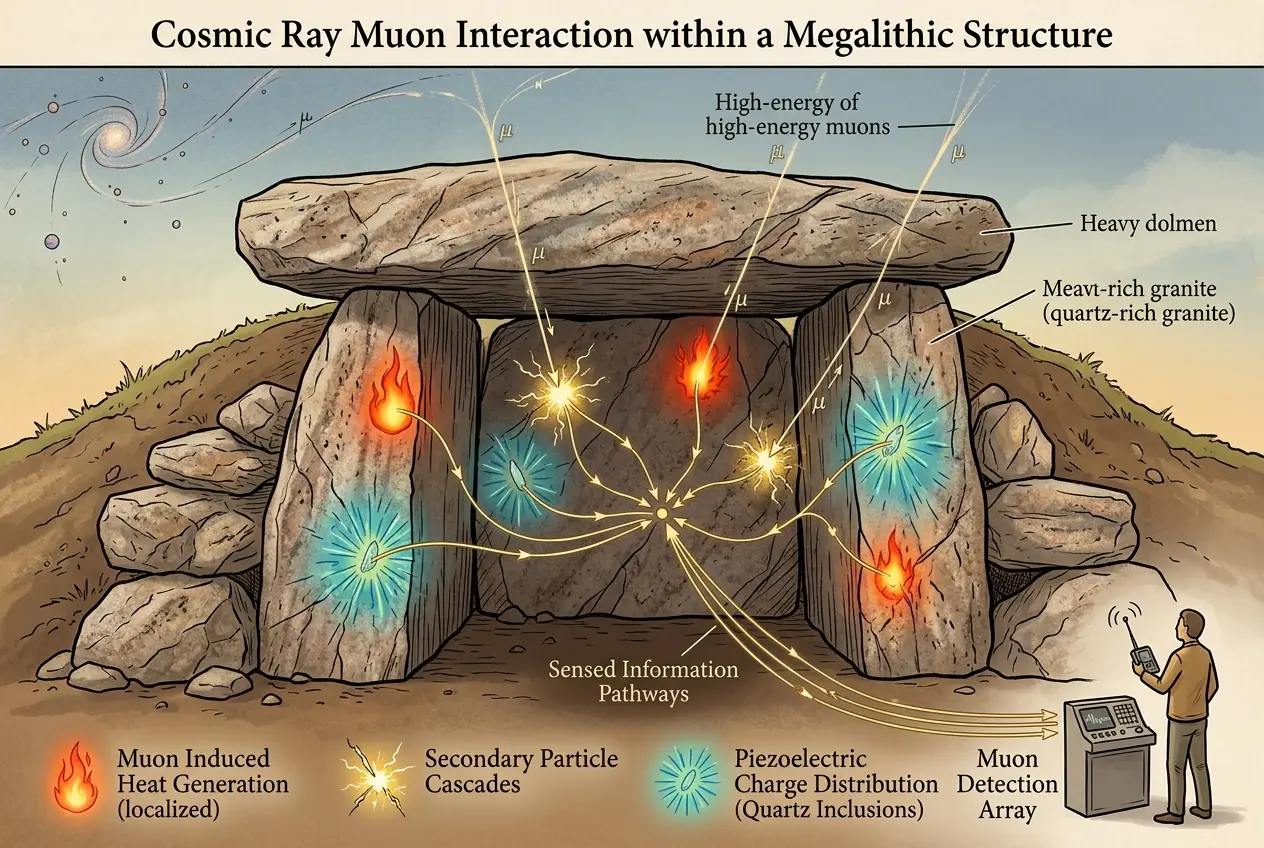
Many megalithic stones, especially granite, contain quartz crystals. Quartz exhibits **piezoelectric properties**, meaning it can generate an electric charge when subjected to mechanical stress, or conversely, vibrate when an electric field is applied. While direct interaction with a single cosmic ray wouldn't cause a noticeable stress, a sustained flux or localized energy deposition could theoretically induce minute vibrations or charge separations. Furthermore, **triboelectric effects** (charge generation through friction) could occur if stones experienced subtle shifts or internal stresses due to environmental factors, potentially amplified by cosmic ray interactions. For more on piezoelectricity, you can refer to its detailed explanation on [Wikipedia](https://en.wikipedia.org/wiki/Piezoelectricity).
### 3. Geometric Configurations and Alignments
The precise geometric arrangements of stones in sites like Stonehenge aren't random. They often align with solstices, equinoxes, and lunar cycles. Could these alignments also have played a role in focusing or channeling subtle energies? Some researchers suggest that the specific arrangements could create localized electromagnetic fields or act as passive resonators, subtly affected by the passage of energetic particles. This isn't far-fetched when considering discussions around whether ["Did Megaliths Tap Earth's Geomagnetic Grid?"](/blogs/did-megaliths-tap-earths-geomagnetic-grid-8273).
### 4. Detecting "Anomalies" Without Modern Instruments
How would ancient people have "detected" these subtle changes without Geiger counters? They wouldn't have. Instead, their observation might have been indirect, focusing on **anomalous effects** around these structures.
* **Localized Heat Differences:** Energy deposition from cosmic rays, while tiny, could contribute to minute, localized temperature fluctuations, especially if amplified by specific material properties or geometries.
* **Acoustic Signatures:** Small vibrations caused by particle interactions could, in specific resonant cavities or stone arrangements, produce very faint, low-frequency sounds or hums.
* **Biological Responses:** Plants, animals, or even humans spending extended periods within these structures might have experienced subtle, unexplained physiological or psychological changes, which ancient cultures, highly attuned to nature, could have interpreted as significant.
* **Water Conductivity:** The presence of water, either groundwater or rainfall, around the stones could have its conductivity subtly altered by ionization events caused by cosmic rays, leading to observable changes that were traditionally linked to celestial phenomena or "spirits."
## The Modern Parallel: Muon Tomography
Today, we use **muon tomography** (also known as muography) to non-invasively "see" inside large structures like pyramids, volcanoes, and even nuclear reactors. By detecting the absorption and scattering patterns of cosmic ray muons as they pass through these objects, scientists can create density maps. This technique was famously used to discover a hidden void within the Great Pyramid of Giza. If modern science can use cosmic ray muons to *image* hidden chambers, it begs the question: could ancient cultures, through careful observation and perhaps thousands of years of trial and error, have developed an intuitive, if not scientific, understanding of how these cosmic particles interacted with massive stone structures? Perhaps their "cosmic clocks" were not just observing visible phenomena, as detailed in ["Were Ancient Observatories Also Cosmic Clocks?"](/blogs/ancient-observatories-were-they-also-cosmic-clocks-8259), but also sensing invisible ones.
## The Lost Knowledge and Ancient Sensors
The key challenge to this theory is not the physics of cosmic ray interaction with stone, but how ancient peoples would have interpreted or utilized such subtle effects. It's plausible that they simply observed unusual phenomena around these sites – strange sounds, altered states of consciousness, or perceived "energies" – and attributed them to spiritual or mystical forces. Over generations, this observational data could have been codified into ritual practices or architectural principles, ensuring the continued construction of these powerful sites.
Consider this: if a particular stone arrangement consistently led to a higher incidence of certain biological or atmospheric anomalies, or if the passage of a comet or meteor shower (which can increase cosmic ray flux) correlated with specific measurable effects at a megalithic site, the ancients would have noticed. They might not have called them "cosmic rays," but they would have recognized a repeatable, albeit subtle, pattern of cause and effect.
As Professor Paul Devereux, a leading figure in archaeoacoustics and geomancy, eloquently stated, "Ancient peoples were often more attuned to the subtle energies of the Earth than we are. Their structures might have been designed to interact with these energies, rather than simply ignore them." This suggests a holistic approach to engineering, where physical structures were integrated with the natural environment and its unseen forces. You can find more of Devereux's work on archaeoacoustics and ancient sites on [Wikipedia](https://en.wikipedia.org/wiki/Paul_Devereux).
## The Silent Legacy
The notion of ancient megaliths as passive cosmic ray sensors fundamentally shifts our perspective on prehistoric capabilities. It doesn't imply advanced quantum computers hidden within stone circles, but rather a profound observational science rooted in experiential knowledge. They might not have known the physics, but they could have recognized the effects.
The archaeological record is replete with tantalizing hints of lost knowledge. From precision stonework that defies explanation to calendrical systems of astounding accuracy, our ancestors were anything but primitive. Perhaps their greatest technological achievement wasn't a complex machine, but an intuitive understanding of natural forces, culminating in structures that still stand today, silently receiving messages from the cosmos. The challenge for us is to learn to listen to what they might still be telling us.
**Conclusion:**
While direct proof remains elusive, the hypothesis that ancient megaliths could have served as rudimentary cosmic ray sensors adds another layer of intriguing possibility to the mysteries of our past. It encourages us to look beyond conventional explanations and consider how deeply our ancestors might have understood and interacted with the invisible forces shaping our world and the wider cosmos. As we continue to uncover the secrets of these monumental structures, perhaps one day we'll fully decipher the cosmic messages they were designed to detect.
Frequently Asked Questions
It's hypothesized that ancient cultures, deeply attuned to natural phenomena, could have observed subtle, repeatable anomalies around megalithic sites—such as localized temperature changes, faint acoustic hums, or even biological/psychological effects in living beings—which they then correlated with celestial events or other environmental cues, interpreting them through their spiritual or proto-scientific frameworks.
While the theory is broad, sites with dense stone compositions and complex geometric arrangements like Stonehenge, Newgrange, or the Carnac alignments are often cited as potential candidates. Researchers might look for specific mineral compositions, resonant properties, or unique structural features that could facilitate cosmic ray interaction and its observation.
No, it does not suggest they understood modern particle physics or the scientific definition of cosmic rays. Instead, it posits that through long-term observation and empirical understanding, they might have recognized repeatable effects caused by cosmic ray interactions, without necessarily understanding the underlying subatomic processes. Their 'science' would have been observational and experiential.
Potentially. If cosmic ray interactions led to observable or felt anomalies (e.g., unusual sounds, slight warmth, or altered states of consciousness), ancient cultures might have integrated these experiences into their rituals, attributing them to divine presence, spiritual energy, or communication from the cosmos. This could explain the sacredness of such sites.
Advanced geophysical surveys, detailed material analysis of megalithic stones (looking for specific crystal structures or trace elements), precise temperature monitoring over long periods, archaeoacoustic studies, and even attempts to simulate cosmic ray interactions with scaled models of megaliths could provide further insights. Muon tomography, while primarily imaging, indirectly supports the concept of cosmic ray interaction with these structures.
Verified Expert
Alex Rivers
A professional researcher since age twelve, I delve into mysteries and ignite curiosity by presenting an array of compelling possibilities. I will heighten your curiosity, but by the end, you will possess profound knowledge.
Leave a Reply
Comments (0)
No approved comments yet. Be the first to share your thoughts!
 Join Us




 Unknown Author





























Leave a Reply
Comments (0)