


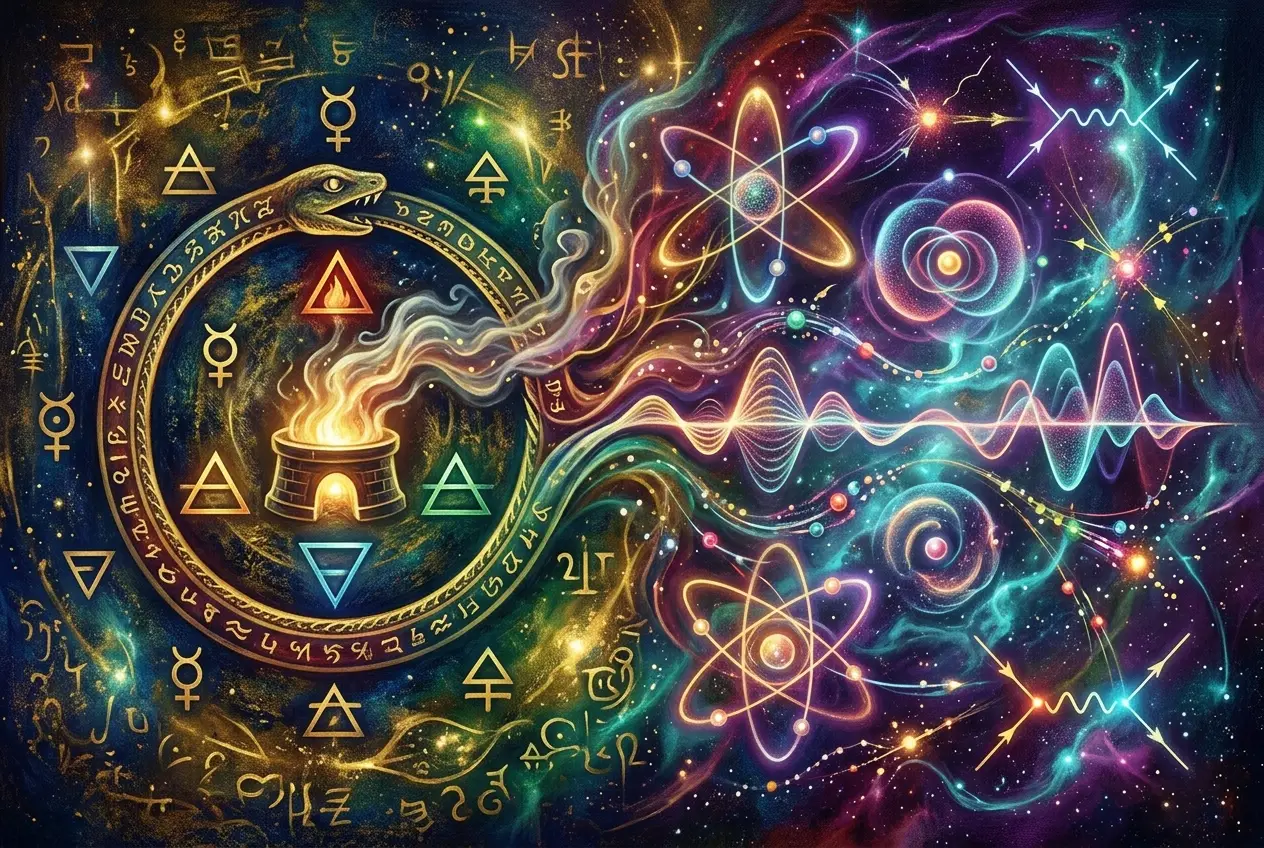
I’ve always been fascinated by the blurred lines between ancient knowledge and modern breakthroughs. There are moments in history that, when you look back with today’s understanding, make you wonder if our ancestors weren't just playing with crude tools, but perhaps intuitively grasping concepts far ahead of their time. Recently, I found myself diving deep into the enigmatic world of medieval alchemy, and a thought struck me: could these ancient practitioners, obsessed with transmuting base metals into gold, have stumbled upon something akin to quantum mechanics?
It sounds audacious, I know. Quantum mechanics is the bedrock of modern physics, describing the bizarre and counter-intuitive behavior of matter and energy at the atomic and subatomic levels. Alchemy, on the other hand, is often dismissed as a pseudoscience, a quaint historical precursor to chemistry, riddled with mysticism and impossible goals. But what if we're missing a crucial piece of the puzzle? What if, within their cryptic texts and relentless experiments, alchemists were unknowingly grappling with concepts that echo the very heart of quantum reality?
The Alchemist's World: More Than Just Gold
When we think of alchemy, we typically envision cloaked figures hunched over bubbling retorts, dreaming of turning lead into gold or discovering the elixir of life. And while these were certainly primary goals, alchemy was far more profound and complex. It was a philosophy, a spiritual quest, and a practical science all rolled into one. Alchemists were the proto-chemists, meticulously documenting experiments, developing laboratory equipment, and classifying substances. They sought to understand the fundamental nature of matter, its transformations, and the hidden forces that governed the universe.
Their worldview was holistic, believing that everything was interconnected and that the spiritual and material realms were intertwined. They talked about prima materia (the undifferentiated first matter), the four elements (earth, air, fire, water), and the three philosophical principles (salt, sulfur, mercury) as the building blocks of existence. These weren't just abstract ideas; they were the lenses through which they observed and manipulated the world around them.
One of alchemy's central tenets was transmutation – the idea that one substance could be transformed into another. They weren't just thinking of physical changes, like melting ice, but fundamental changes in identity. This pursuit led them down countless experimental paths, often involving long processes of dissolution, purification, and recombination, referred to as the "Great Work." The ultimate prize, the Philosopher's Stone, was believed to be the agent of this perfect transformation. You can read more about its historical pursuit on Wikipedia's entry for Alchemy (opens in a new tab).
Quantum Parallels: A Leap of Faith?
Now, let's fast-forward to the 20th century and the birth of quantum mechanics. At its core, quantum mechanics tells us that at the smallest scales, particles don't behave like solid, predictable billiard balls. Instead, they exist in superpositions (existing in multiple states simultaneously) and exhibit wave-particle duality. Observing them can fundamentally change their state, a concept beautifully illustrated by Schrödinger's Cat. Furthermore, the identity of an atom is defined by its number of protons – change that, and you change the element. This is nuclear transmutation, a process now understood and achieved in particle accelerators.
So, where do the parallels lie?
- The Quest for Fundamental Transformation: Alchemists believed in changing the very essence of matter. They tried to "perfect" metals, bringing them closer to gold. While they didn't have a concept of protons or neutrons, their drive to fundamentally alter matter resonates with the quantum understanding of nuclear transmutation. They might not have known how or why, but they instinctively pursued what modern physics has achieved.
- Hidden Properties and Unseen Forces: Alchemists constantly spoke of "hidden virtues," "occult properties," and "sympathies" between substances. These intangible qualities determined how substances reacted and transformed. In the quantum realm, particles possess intrinsic properties like spin, charge, and quantum numbers that dictate their interactions, often in ways that defy classical intuition. These are "hidden" from our macroscopic view, but fundamentally govern everything.
- The Observer Effect: While not a direct parallel, the alchemical emphasis on the practitioner's inner state and spiritual purity impacting the success of the Great Work hints at a subjective element in observation. In quantum mechanics, the act of observation fundamentally affects the state of a quantum system. This isn't mysticism, but a core scientific principle. Could the alchemists, in their own crude way, have recognized that the "experimenter" was an integral part of the "experiment"?
- The Prima Materia and Subatomic Particles: Alchemists believed in a universal, undifferentiated primordial matter from which all other substances arose. This concept, the prima materia, can be seen as a philosophical precursor to our understanding of elementary particles like quarks and leptons, which combine in various ways to form all known matter. While the alchemists envisioned a single base substance, modern physics offers a set of fundamental building blocks. To delve deeper into the historical perspective of atomic theory, you might find this Wikipedia article on Atomic Theory (opens in a new tab) insightful.
From Intuition to Explanation
It's crucial to state that medieval alchemists did not have a quantum theory in any scientific sense. They lacked the mathematical framework, the experimental precision, and the conceptual vocabulary to articulate what we now call quantum mechanics. However, their persistent efforts to categorize, purify, and transmute substances laid important groundwork for modern chemistry. Many alchemists, such as Robert Boyle, transitioned from alchemical pursuits to become foundational figures in modern chemistry, questioning the traditional elemental theories and emphasizing empirical evidence. His work marked a significant shift, as detailed on his Wikipedia page (opens in a new tab).
Their inquiries into the fundamental nature of matter, their attempts to quantify and qualify transformations, and their belief in a deeper, underlying order to the universe are echoes of scientific inquiry that eventually led to quantum physics. Perhaps their "Philosopher's Stone" was less about a physical object and more about unlocking the hidden "quantum secrets" of matter itself. The idea of unlocking universal secrets with specific tools is a recurring theme, much like the debate on whether ancient Greek thinkers foresaw quantum concepts.
As I explored this fascinating intersection, I kept thinking about how often humanity stumbles close to profound truths long before it has the tools to fully articulate them. The alchemists were, in their own way, seeking a unified theory of everything, a grand explanation for how the universe worked, both physically and spiritually. They grappled with concepts of change, identity, and underlying essence – all themes that resonate deeply within quantum mechanics. Could their intuitive understanding have skirted the edges of quantum reality, long before anyone dreamt of wave functions or subatomic particles? This notion reminds me of contemporary questions, like whether empty space itself acts as a quantum computer.
The Lingering Mystery
The notion that alchemists, through their mystical and empirical pursuits, might have grazed the edges of quantum understanding is a powerful thought experiment. It challenges our linear view of scientific progress, suggesting that profound insights can emerge through various avenues, even those steeped in pre-scientific thought. They may not have built "cosmic computers" or harnessed electricity, but their relentless exploration of matter's core identity, its potential for transformation, and the hidden forces governing it, provides an intriguing historical echo to the quantum revolution.
Today, we're still uncovering how quantum principles influence life itself, exploring ideas like quantum biology unlocking life's deepest secrets. Perhaps the alchemists, in their own arcane language, were describing a similar, profound interconnectedness. While they never created gold from lead, their unwavering belief in transformation might have been an ancient whisper of the universe's most fundamental secret: that at the smallest scale, reality is far stranger, more fluid, and more interconnected than our macroscopic senses can comprehend.




Conversation0
No comments yet. Be the first to share a thought — the best questions often become new stories.