I often find myself lost in the stories of ancient civilizations, not just for their myths and legends, but for the astonishing ingenuity they displayed with the limited tools at their disposal. We tend to think of advanced technology as a modern phenomenon, born from silicon valleys and quantum labs. But what if I told you that some of the most fearsome warriors of antiquity wielded blades imbued with properties that baffled scientists for centuries, properties that hint at a profound, almost accidental, understanding of materials science akin to **nanotechnology**?
I'm talking about **Damascus steel**.
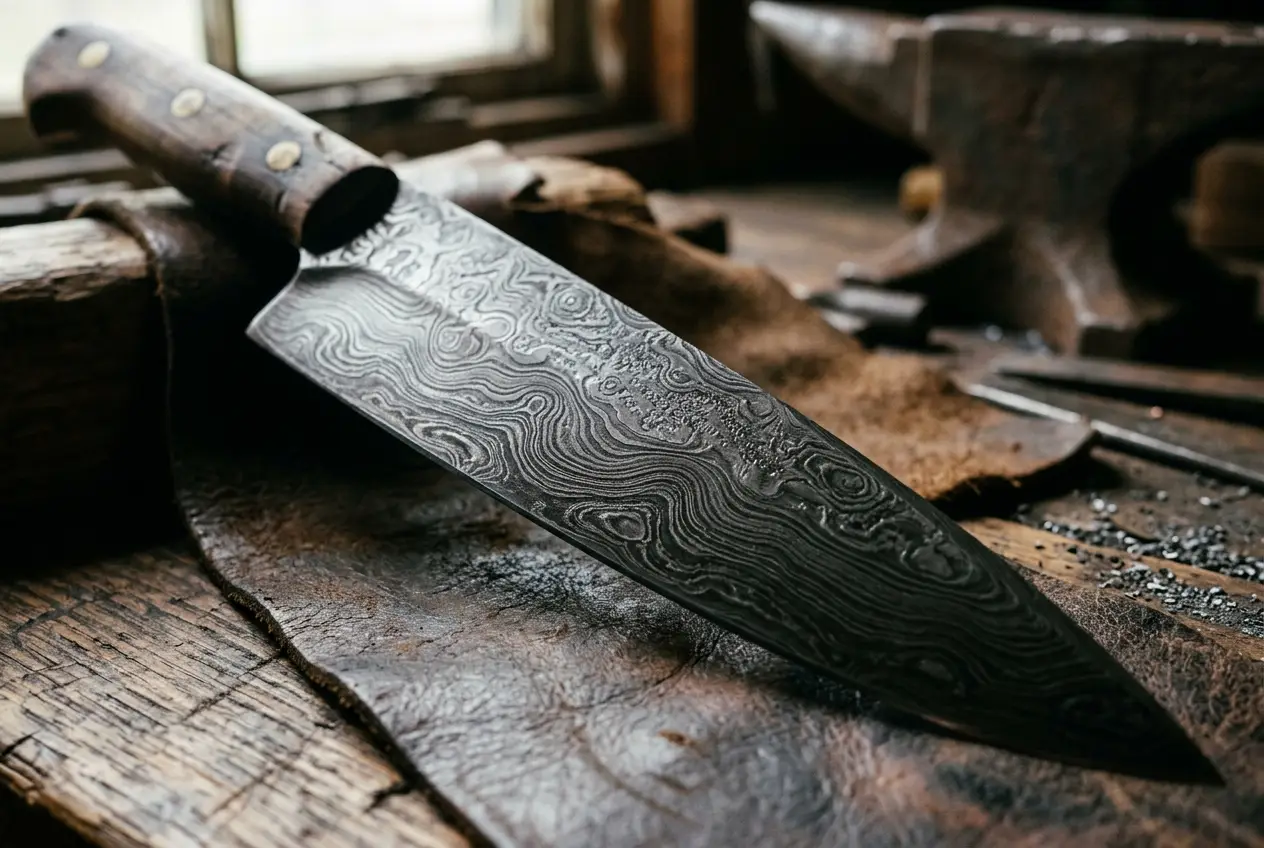
Imagine standing on a battlefield in the medieval Middle East, facing an opponent whose sword gleams with an almost mystical, swirling pattern. This isn't just aesthetic; this blade is renowned for its incredible sharpness, flexibility, and edge retention, far superior to anything else known at the time. Tales describe these swords as being able to cut through silk mid-air, or even cleave through lesser steel blades without dulling. For generations, the secret of Damascus steel was lost, making it one of history's most compelling technological mysteries.
## The Legend of the "Watered Steel"
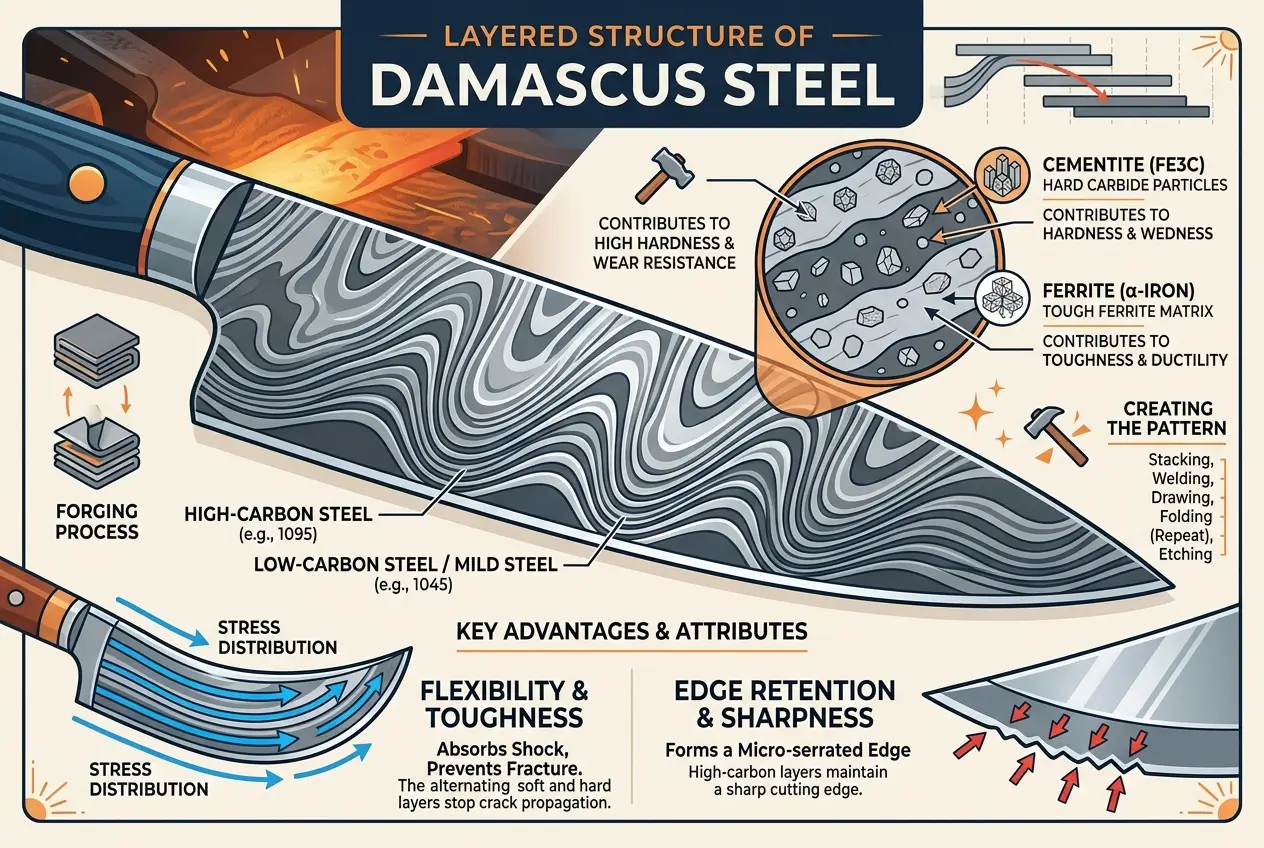
The name "Damascus steel" primarily refers to the blades produced in the Near East, particularly in the city of Damascus, from roughly 900 AD to 1750 AD. The signature feature was its unique, wavy, ladder-like, or rose-patterned surface, which gave it the moniker "watered steel." This wasn't merely decorative; it was a visible manifestation of the internal structure that gave the steel its legendary properties.
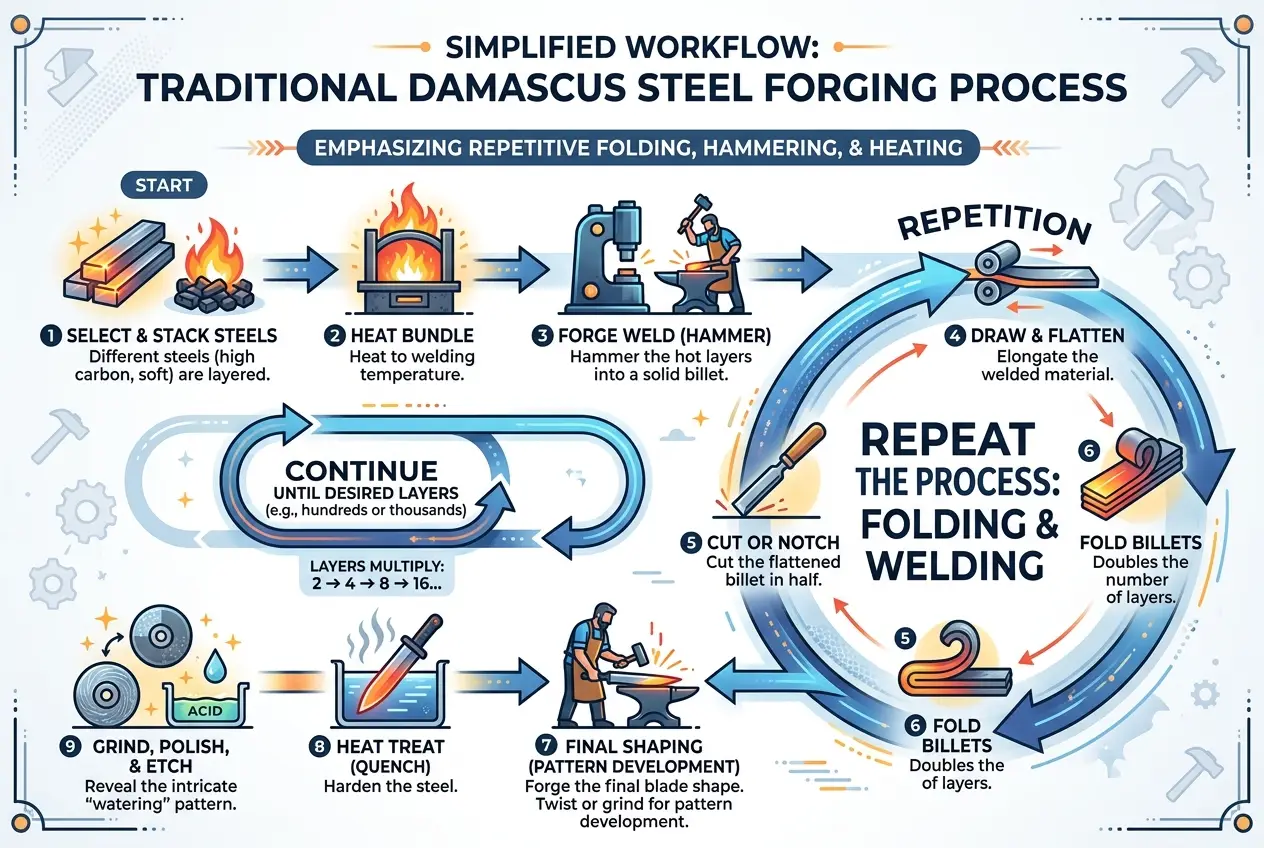
The true source material for Damascus steel was a type of steel ingot imported from India and Sri Lanka known as **Wootz steel**. This crucible steel, made by melting iron and carbon in a sealed crucible, was celebrated for its high carbon content and remarkable purity. The process of forging these Wootz ingots into the fabled Damascus blades involved a series of precise heating, hammering, and cooling steps, often performed by skilled smiths who guarded their methods fiercely.
## The Lost Secret and Modern Rediscovery
For reasons still debated—perhaps a shift in trade routes, the loss of skilled smiths, or the depletion of specific ore sources for Wootz steel—the ability to produce true Damascus steel vanished by the mid-18th century. Modern metallurgists spent decades trying to replicate its properties, often without success. Many early attempts focused on pattern welding, which creates a layered aesthetic but doesn't fully capture the microstructural advantages of true Damascus steel.
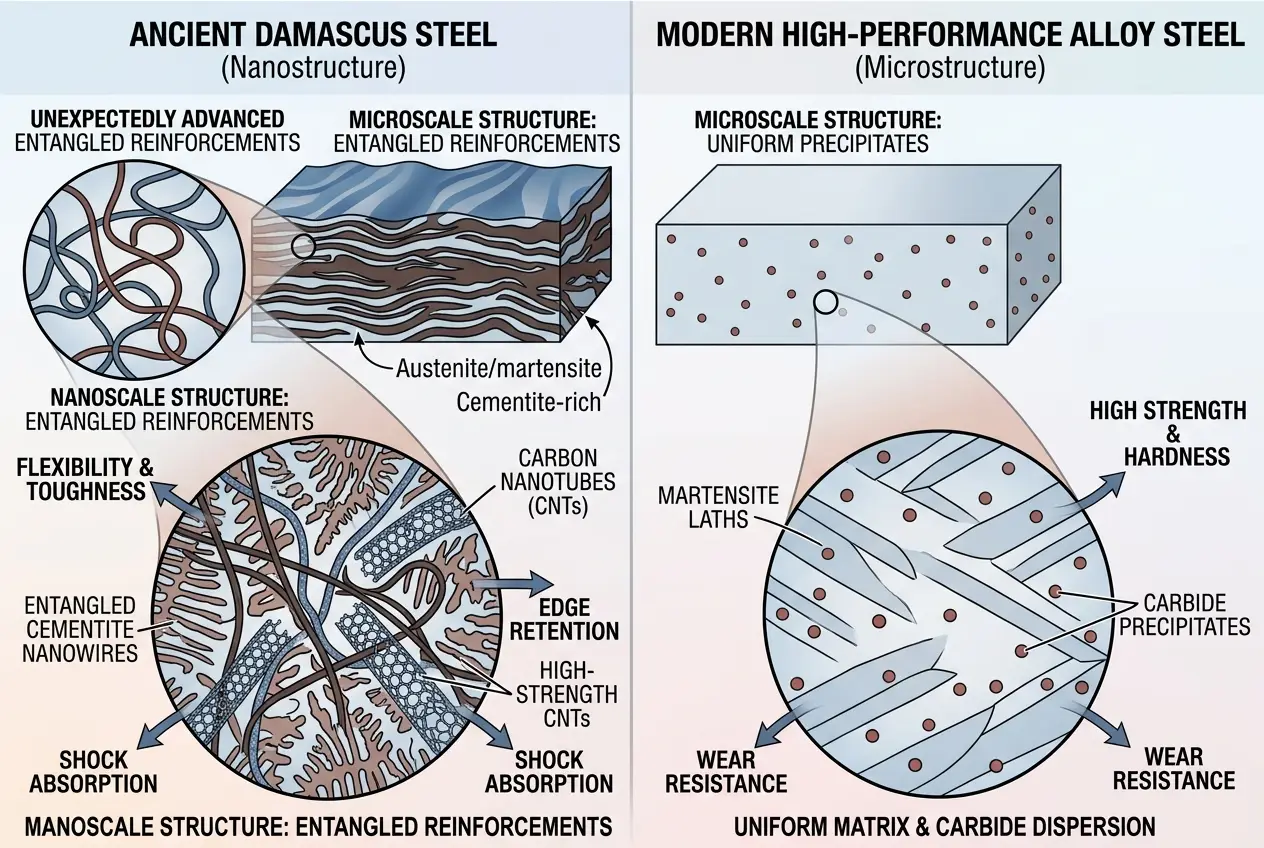
It wasn't until the late 20th and early 21st centuries, with advancements in microscopy and materials science, that the veil over Damascus steel began to lift. Researchers started examining original artifacts using powerful electron microscopes and sophisticated analytical techniques. What they found was astonishing: a complex internal microstructure containing **carbon nanotubes** and **cementite nanowires**.
"The discovery of carbon nanotubes and cementite nanowires in ancient Damascus steel is absolutely mind-boggling," noted Peter Paufler from the Technical University of Dresden in an interview, whose team published groundbreaking research in 2006. "It indicates a level of material control that was truly beyond their conscious grasp, yet achieved through empirical wisdom."
These **nanostructures**, invisible to the naked eye, are critical to the steel's exceptional performance. Carbon nanotubes are incredibly strong and light, known for their tensile strength and flexibility. Cementite (iron carbide) is a very hard and brittle compound, but when organized into **nanowires** within a softer iron matrix, it provides immense hardness without making the entire blade fragile. This combination allowed the blades to be both incredibly sharp and resilient, resisting fracture even under extreme stress. For more details on this fascinating discovery, you can read about it on [Wikipedia's Damascus Steel article](https://en.wikipedia.org/wiki/Damascus_steel).
## Accidental Nanotechnology or Empirical Mastery?
The big question, then, is: did ancient smiths *know* they were creating nanostructures? The answer, unequivocally, is no. They didn't have the scientific understanding of carbon atoms arranging into tubes or the concept of materials at the nanoscale. However, they possessed something equally valuable: **empirical mastery**.
Through generations of trial and error, observation, and refinement, they developed specific forging, heating, and quenching techniques that, by sheer happenstance, created the perfect conditions for these nanostructures to form. Factors like the specific trace elements in the Wootz steel (such as vanadium, chromium, or manganese, which could have acted as catalysts), the precise temperatures used during forging, and the repeated slow cooling cycles, likely contributed to the growth and arrangement of these carbides and nanotubes.
I often wonder about the intuitive genius of these artisans. They might have observed that a certain type of Wootz ingot, when processed in a particular way and cooled slowly, yielded a blade with superior performance and the desirable "watered" pattern. They passed this knowledge down, not as scientific principles, but as an intricate ritual of craftsmanship. This highlights how practical knowledge can often precede theoretical understanding, much like how ancient healers used herbal remedies long before modern medicine understood their biochemical mechanisms.
## The Role of Microstructures
Let's break down the significance of these microstructures. In materials science, the properties of a material are heavily influenced by its internal structure at the microscopic and even nanoscopic level.
* **Carbon Nanotubes:** These cylindrical nanostructures of carbon atoms possess extraordinary strength and thermal conductivity. Their presence would have significantly enhanced the blade's resistance to fracture and its ability to maintain a sharp edge.
* **Cementite Nanowires:** Cementite is hard but brittle. However, when it forms as fine nanowires embedded within a softer, more ductile iron matrix, it creates a composite material. This allows the blade to have both incredible hardness (for sharpness) and flexibility (to prevent catastrophic breakage), a combination often difficult to achieve in steel.
This intricate dance between hard and soft components, facilitated by nanostructures, made Damascus steel exceptional. It's a testament to the power of structured materials, a concept we actively pursue in modern metallurgy and materials engineering today. The precise arrangement of these elements meant the blades could bend without breaking, yet hold an edge that could slice through formidable targets.
## Legacy and Modern Implications
The study of Damascus steel continues to be a vibrant field of research. Modern metallurgists aren't just trying to recreate it; they're learning from it. Understanding how ancient smiths, through empirical methods, achieved such sophisticated material properties informs our own quest for advanced materials. It prompts us to consider the subtle roles of trace elements and processing techniques that we might sometimes overlook in our highly controlled, yet sometimes less intuitive, modern approaches.
The insights gained from analyzing Damascus steel are relevant to fields like **composite materials**, **nanomaterials engineering**, and even the development of **new alloys** for everything from aerospace to medical implants. It also serves as a powerful reminder that "primitive" doesn't mean "unsophisticated." Sometimes, a deep, practical understanding of nature's laws can lead to innovations that rival, and even precede, our most advanced scientific discoveries.
This historical tech anomaly, the mystery of Damascus steel, shows us that the boundaries between ancient craftsmanship and modern science are often blurred. The idea that ancient smiths, through generations of dedicated practice, unknowingly stumbled upon a form of nanotechnology is truly fascinating. It encourages me to look at other ancient artifacts, not just as relics of the past, but as potential blueprints for technologies we might still be struggling to perfect.
If you’re intrigued by how ancient cultures achieved seemingly impossible feats with their materials, you might also be interested in exploring how the Romans mastered [self-healing materials with their concrete](/blogs/roman-concrete-did-ancients-master-self-healing-materials-6161), or ponder whether [ancient dyes held quantum secrets](/blogs/did-ancient-dyes-hold-quantum-secrets-8243). The past, it seems, has many more technological surprises in store for us than we often assume, challenging our perceptions of advancement. For a deeper dive into materials science, consider the [Wikipedia article on Materials Science](https://en.wikipedia.org/wiki/Materials_science).
Could other lost technologies of antiquity also hide similar nanoscale secrets, waiting for our modern scientific instruments to unveil them? The thought sends a shiver of curiosity down my spine.
## Conclusion
The story of Damascus steel isn't just about a legendary weapon; it's a testament to human ingenuity across millennia. It challenges our modern perception of "advanced" technology, showing us that remarkable discoveries can emerge from meticulous empirical practice, even without the theoretical framework we possess today. As we continue to unravel the secrets of materials at the nanoscale, perhaps the wisdom of ancient smiths will offer unexpected guidance for our future innovations.
Frequently Asked Questions
Carbon nanotubes are microscopic, cylindrical structures made of carbon atoms, known for their exceptional strength and unique electrical properties. Cementite (iron carbide) nanowires are extremely fine, rod-like structures of iron and carbon that provide hardness to the steel, but when arranged as nanowires, they contribute to flexibility rather than brittleness.
Ancient smiths didn't have conscious knowledge of nanotechnology. Instead, through centuries of empirical trial-and-error, they developed specific heating, hammering, and cooling techniques, combined with unique Wootz steel ingots, that inadvertently created the ideal conditions for these nanostructures to form and arrange themselves optimally.
While modern metallurgists have made significant progress in understanding and replicating the properties of Damascus steel, exact replication is challenging. We can create pattern-welded steel that looks similar, but achieving the precise internal nanostructure of ancient Damascus steel requires specific conditions, including the exact composition of Wootz steel and the precise, lost forging methods.
Its superiority came from a unique combination of extreme sharpness, remarkable flexibility, and excellent edge retention. This was due to its complex internal microstructure, particularly the presence of carbon nanotubes and cementite nanowires, which allowed the blade to be both incredibly hard for cutting and resilient against breaking.
While not directly 'nanotechnology' in the modern sense, other ancient artifacts display properties that hint at advanced material manipulation at a micro/nano scale. Examples include the Lycurgus Cup, a Roman chalice made of dichroic glass which changes color based on light, due to embedded gold and silver nanoparticles, or certain ancient pigments with surprisingly stable and vibrant colors.
Verified Expert
Alex Rivers
A professional researcher since age twelve, I delve into mysteries and ignite curiosity by presenting an array of compelling possibilities. I will heighten your curiosity, but by the end, you will possess profound knowledge.
Leave a Reply
Comments (0)
No approved comments yet. Be the first to share your thoughts!
 Join Us



 Unknown Author



































Leave a Reply
Comments (0)