


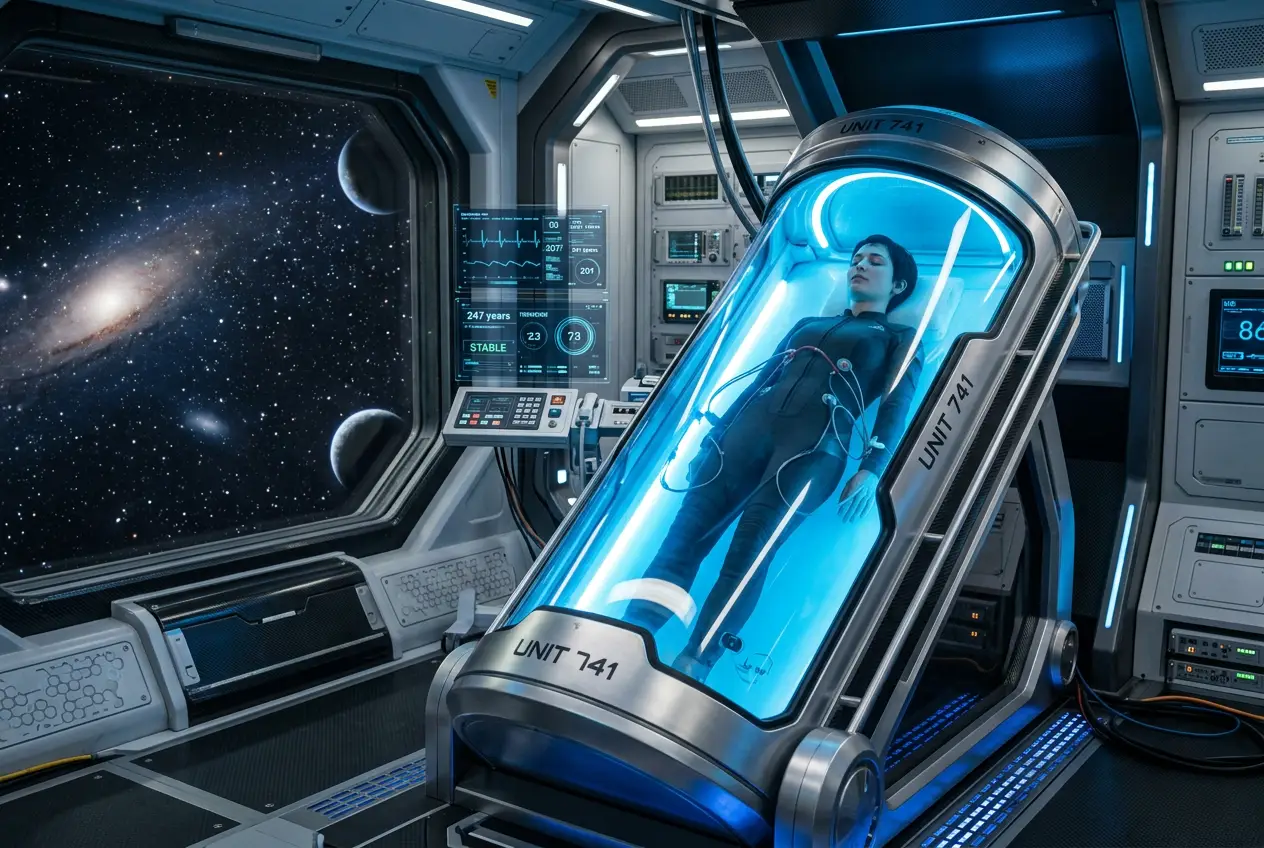
I stood there, gazing at the star-studded ceiling projection, lost in thought about humanity's cosmic ambitions. For centuries, we've dreamed of journeying to distant stars, to exoplanets that orbit alien suns. But the sheer, unforgiving vastness of space has always been our greatest adversary. The distances are so immense, the journey so prolonged, that the human lifespan becomes a cruel limitation. This is where the fantastical notion of cryosleep steps in – a concept once confined to science fiction, now increasingly a subject of serious scientific inquiry. Could the ability to put humans into a deep, sustained hibernation truly be the key to unlocking interstellar travel, allowing us to traverse light-years while decades melt away?
The challenges of interstellar travel are daunting, to say the least. Even the fastest spacecraft we've ever conceived would take tens of thousands of years to reach our nearest stellar neighbor, Alpha Centauri. Beyond the propulsion challenges, which are immense (perhaps one day exotic matter could help, as discussed in Could Exotic Matter Unlock Faster-Than-Light Travel?), consider the human element. How do you provision a crew for generations? How do you maintain their sanity and health in isolation? How do you protect them from the relentless barrage of cosmic radiation? Cryosleep, or medically induced suspended animation, offers a tantalizing solution to many of these seemingly insurmountable problems.
What Exactly is Cryosleep? (And What It Isn't)
Before we dive deep, let's clarify what we mean by cryosleep. It's crucial to distinguish it from cryopreservation, which is the practice of freezing biological material, often whole bodies, after death with the hope of future revival. Cryopreservation involves temperatures low enough to cause cellular damage through ice crystal formation and is generally viewed as a highly speculative, long-shot endeavor for whole-body revival.
Cryosleep, on the other hand, is closer to therapeutic hypothermia or induced torpor. It involves significantly lowering a living organism's core body temperature and metabolic rate, often to near-freezing or even slightly below, but without causing cell-damaging ice crystals. The goal is a reversible state of suspended animation, where life processes slow down dramatically, but don't stop. Imagine pressing the "pause" button on human biology.
The Science of Suspended Animation
Nature provides us with incredible examples of suspended animation. Bears, ground squirrels, and even some primates enter states of hibernation or torpor to survive harsh winters or periods of food scarcity. During these periods, their body temperature drops significantly, their heart rate slows to a few beats per minute, and their metabolism plummets by 90-95%. They effectively "sleep" through months, emerging largely unscathed.
Scientists have been studying these natural hibernators for decades, trying to understand the molecular mechanisms that protect their bodies from the damage typically associated with such extreme physiological states. Key areas of research involve:
- Metabolic Suppression: Identifying the biochemical pathways that allow cells to function with minimal oxygen and nutrient supply.
- Cryoprotectants: Natural compounds or synthetic agents that protect cells from damage during cooling and rewarming.
- Neuroprotection: Understanding how hibernating animals' brains avoid injury despite drastically reduced blood flow.
One of the leading techniques being explored for humans is therapeutic hypothermia, which is already used in medicine to protect patients from tissue damage after cardiac arrest or traumatic brain injury. While typically only involving a few degrees Celsius drop and lasting for days, it demonstrates the principle of metabolic suppression for medical benefit. The challenge for interstellar travel is to extend this state for months, years, or even decades, with much more profound temperature drops. You can learn more about the biological process on Wikipedia's page for Hibernation (opens in a new tab).
Cryosleep for Space Travel: The Cosmic Dream
Why is this seemingly radical idea so appealing for journeys to the stars? The benefits are multifaceted:
1. Resource Conservation
A traditional space mission requires enormous amounts of food, water, and oxygen to sustain a crew for years. Reducing a crew's metabolic rate by 90% or more would slash these requirements proportionally. This means smaller, lighter spacecraft, significantly lower launch costs, and longer mission durations. Think of it: a small crew in cryosleep could travel for a century on the resources that would barely sustain an awake crew for a few years.
2. Psychological and Physiological Well-being
The psychological toll of long-duration space travel is immense. Confinement, isolation, boredom, and the immense distance from Earth can lead to severe mental health challenges. Cryosleep bypasses these issues entirely. Crew members would simply sleep through the journey, arriving fresh and ready for their mission. Furthermore, the physical degradation experienced in microgravity – muscle atrophy, bone density loss – could potentially be mitigated if the body's processes are slowed down sufficiently, and perhaps combined with specialized protocols.
3. Radiation Shielding
Deep space is a hostile environment, constantly bombarded by solar flares and galactic cosmic rays. These high-energy particles can cause DNA damage, cancer, and acute radiation sickness. A hibernating body, with its slowed cellular division and repair mechanisms, might be less susceptible to radiation damage. Additionally, a smaller, cryo-chamber-equipped vessel would require less mass for shielding compared to one built for an active, multi-generational crew.
4. Reduced Ship Size and Cost
Combining all these factors, a spacecraft designed for cryosleep could be significantly smaller and less complex than a traditional crewed vessel. This translates directly into lower development, manufacturing, and launch costs, making ambitious interstellar missions more economically feasible.
Current Research & Hurdles
While the dream is compelling, the scientific and engineering hurdles are substantial. Here’s what researchers are tackling:
The "Sweet Spot" for Human Torpor
We can induce therapeutic hypothermia in humans for a few days, but achieving a safe, long-term, deep torpor state is a different beast. Scientists are looking for a "sweet spot" where metabolism is significantly reduced, but without irreversible damage. This might involve cycles of torpor and brief awakening, similar to how bears periodically rouse themselves during hibernation.
Preventing Cellular Damage
The human body is not naturally equipped for long-term extreme cold. Preventing cellular damage from insufficient oxygen, nutrient deprivation, and the rewarming process is critical. Researchers are exploring novel cryoprotective agents and precise temperature control mechanisms.
Maintaining Muscle and Bone Density
Even in natural hibernators, some muscle and bone loss occurs. For humans in cryosleep for years, this could be debilitating. Solutions might involve periodic electrical muscle stimulation, growth hormones, or even specialized anti-atrophy drugs administered automatically during the dormant state. The human body is a complex biological system, and keeping it stable for extended periods is a monumental task.
"The greatest challenge is not cooling, but waking up without damage," notes Dr. Mark Roth, a pioneering scientist in suspended animation research, quoted in a recent Nature article on the topic. "We need to understand how to preserve all the body's functions perfectly throughout that entire process." You can read more about Dr. Roth's work and the broader field of suspended animation on Wikipedia's Suspended Animation page (opens in a new tab).
Ethical Considerations
Beyond the technical challenges, there are profound ethical questions. What are the long-term psychological effects of waking up decades or centuries in the future? Who decides who gets to go? What are the implications for society and the individuals involved? These aren't just scientific questions; they are deeply philosophical, touching on themes of identity, sacrifice, and the very nature of human existence.
Engineering the Cryochamber: A Futuristic Nursery
If the biological challenges are overcome, the engineering of the cryochamber itself becomes the next frontier. Imagine a module on a starship that functions as a highly sophisticated, automated nursery.
Each individual pod would need:
- Precise Temperature Control: To maintain optimal, stable body temperature without fluctuations.
- Automated Nutrient Delivery: Intravenous feeding or specialized nutritional solutions to sustain minimal bodily functions.
- Waste Management: Efficient systems for biological waste removal.
- Medical Monitoring: Constant, sophisticated biometric monitoring to detect any adverse reactions and initiate emergency protocols.
- Radiation Protection: Enhanced local shielding around the individual pods.
- Automated Rewarming and Awakening: A carefully calibrated system to bring the crew members out of torpor safely, reversing the process without harm.
The ship itself would need to be an incredibly robust, self-sustaining system, capable of operating autonomously for decades. This includes advanced AI for navigation, maintenance, and emergency response – capabilities that echo discussions in blogs like Can AI Build Itself? The Dawn of Self-Replicating Tech and Can AI Truly Learn From Human Intuition?.
The Journey Ahead
The path to cryosleep-enabled interstellar travel is long, but humanity has a remarkable track record of turning impossible dreams into reality. I believe the first steps will be relatively modest: extending therapeutic hypothermia for longer durations in critical medical scenarios, followed by short-term induced torpor for human astronauts on missions within our solar system. Think of it: a mission to Mars or the outer planets could be made safer, cheaper, and faster if astronauts could sleep for months during the "cruise phase" of the journey. For an overview of how we get our spacecraft into orbit, see From Earth to Orbit: How Satellites Reach Space.
The ultimate prize is a future where humanity is not confined to one planet or even one star system. Cryosleep, if mastered, would represent a profound leap in our capabilities, allowing us to send exploratory missions to exoplanets with the hope of returning or establishing new outposts for humanity. This quest to expand beyond our home system is tied to fundamental questions about our survival and evolution as a species, touching upon ideas like "The Great Filter" as explored in Is The Great Filter Real? Tech’s Biggest Cosmic Test. The mysteries of the universe, and perhaps even what lies Beyond Our Universe: What Types of Multiverses Exist?, might one day be within our reach, thanks to this ambitious technology.
The concept of cryosleep forces us to confront not only the limits of our biology but also the boundless nature of our aspirations. While the engineering and biological challenges remain immense, the tantalizing possibility of pressing pause on life to traverse the cosmic ocean is a powerful motivator. As research progresses, what was once pure fantasy may one day become the default mode of travel for humanity's intrepid interstellar explorers. The journey to the stars might just begin with a long, profound sleep.
Conversation0
No comments yet. Be the first to share a thought — the best questions often become new stories.