


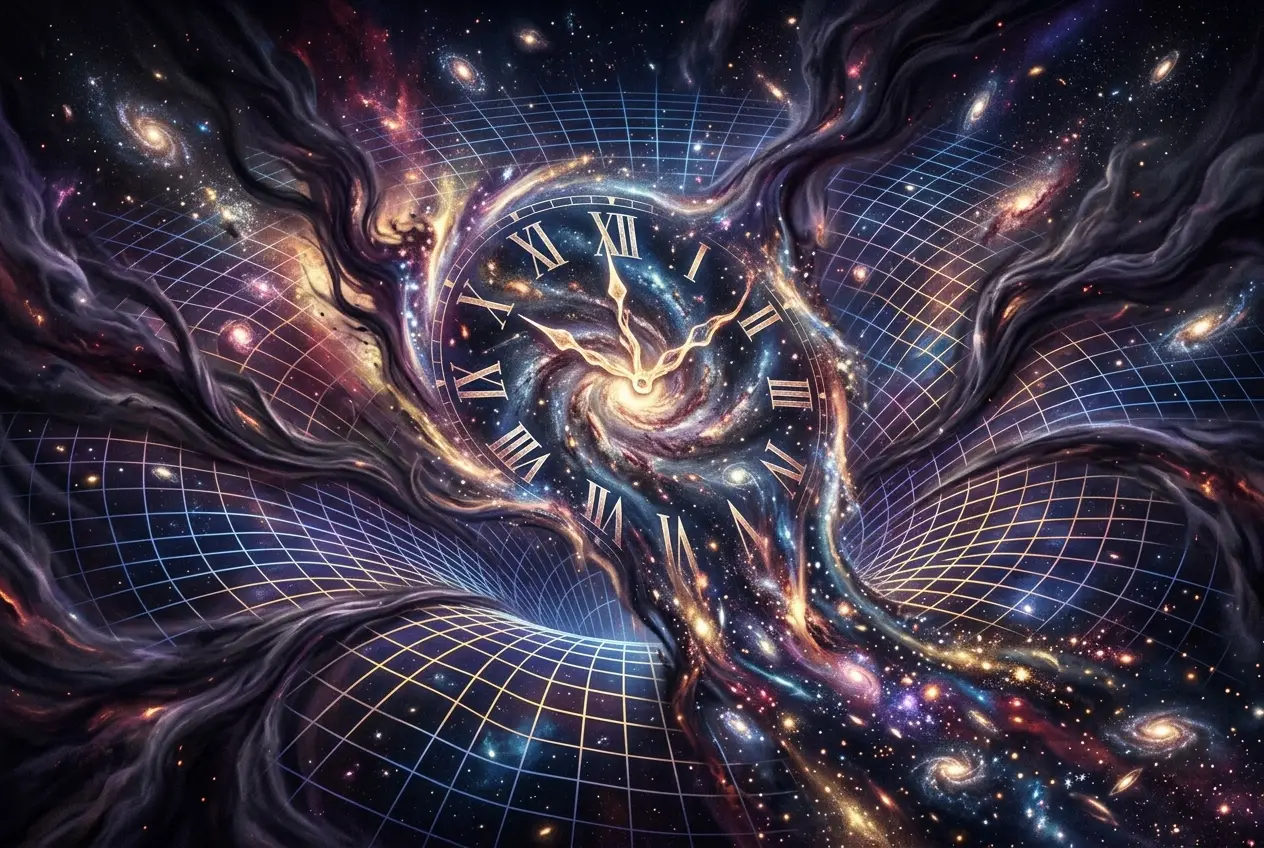
The universe, in its vast and silent grandeur, holds mysteries that humble even the most brilliant minds. I often find myself pondering the fundamental forces that sculpt our reality, and none loom larger, or more enigmatically, than dark energy. It's the unseen architect of cosmic acceleration, pushing galaxies apart at an ever-increasing rate. But what if its influence isn't just on space, but also on something as intimately personal and universally fundamental as time itself? Could this elusive force, responsible for the universe’s expanding destiny, be subtly warping our very perception or the physical flow of time?
Recently, I was engrossed in a documentary discussing the latest theories on cosmic expansion, and the narrator posited a question that sent my thoughts racing: if dark energy is constantly stretching space, does it also stretch time, or at least our experience of it? It’s a thought-provoking angle that dives deep into the intricate relationship between spacetime, quantum mechanics, and our conscious awareness. This isn't about time travel in a sci-fi sense, but a profound inquiry into how the universe's dominant, yet invisible, force might be playing tricks on the cosmic clock.
Unveiling the Universe’s Hidden Driver: Dark Energy
To understand how dark energy might influence time, we first need to grasp what it is – or rather, what we think it is. Cosmologists tell us that roughly 68% of the universe is composed of dark energy, a mysterious form of energy that permeates all of space and is responsible for the observed acceleration of the universe's expansion. Unlike gravity, which pulls things together, dark energy acts as a repulsive force, pushing everything apart. Imagine throwing a ball into the air; gravity pulls it back down. Now imagine an invisible force not only fighting gravity but actively making the ball accelerate upwards faster and faster. That's dark energy at work on a cosmic scale.
Its existence was first inferred in the late 1990s from observations of distant supernovae, which showed that the universe's expansion isn't slowing down due to gravity, as previously thought, but speeding up. For a more detailed dive into its discovery, you can explore the Nobel Prize-winning work on cosmic acceleration on Wikipedia (opens in a new tab).
The leading candidate for dark energy is the cosmological constant, an idea originally introduced by Albert Einstein (and later retracted) to make his equations of general relativity describe a static universe. Reintroduced in light of the accelerating expansion, it represents the energy density of empty space itself. This means that as space expands, more "empty space" is created, and with it, more dark energy, leading to even faster expansion – a truly mind-bending feedback loop.
Time: A Cosmic River or a Local Stream?
Our everyday understanding of time is linear: past, present, future. But in physics, especially post-Einstein, time is not a separate entity but interwoven with space into a single fabric called spacetime. General relativity teaches us that massive objects warp spacetime, and this warping is what we experience as gravity. It also means that time can flow differently for different observers, a phenomenon known as time dilation. For instance, time runs slightly slower for objects moving at high speeds or in strong gravitational fields. We touched on how gravity waves might ripple through this fabric in our blog, Do Gravity Waves Warp Time? Unpacking Cosmic Ripples.
But how does dark energy, which doesn't seem to be associated with mass in the traditional sense, fit into this picture? If gravity warps spacetime, and dark energy is a cosmic anti-gravity, could it also, in its own way, warp time?
Dark Energy’s Subtle Hand on the Cosmic Clock
The influence of dark energy on time is a subject of intense theoretical debate and goes beyond simple time dilation from gravity or velocity. Here are a few ways scientists ponder this connection:
1. The Stretching of Spacetime
Dark energy's primary action is to stretch spacetime. If space itself is expanding and being stretched, does this fundamental stretching affect the dimension of time embedded within it? The accelerated expansion driven by dark energy implies that the scale factor of the universe (which describes the expansion) is growing at an increasing rate. In some theoretical models, this could influence how local clocks keep time, though the effects would likely be imperceptibly small on a human scale. However, over cosmic timescales, these tiny effects could accumulate.
2. The Arrow of Time
The arrow of time refers to the asymmetry of time, the fact that time seems to move in only one direction – from past to future. This is generally attributed to the second law of thermodynamics, which states that entropy (disorder) in a closed system tends to increase over time. A universe that is continuously expanding and cooling due to dark energy might influence the conditions under which entropy increases, potentially impacting the cosmic arrow of time. Some physicists speculate whether the ultimate "heat death" of the universe, largely influenced by dark energy, could lead to a scenario where time effectively ceases to have meaning in the way we understand it, as all processes halt.
3. Observer-Dependent Time in an Expanding Universe
Consider how different observers across the vast, accelerating universe would perceive time. Because dark energy causes space to expand faster between distant galaxies, light from very distant objects is red-shifted and experiences cosmic time dilation – their events unfold more slowly from our perspective. While this is a known effect of expansion, the acceleration of this expansion due to dark energy magnifies these differences. As the expansion continues, regions of the universe will eventually accelerate away from each other so fast that they will lose causal contact. This means that events in those distant regions would effectively cease to exist in our observable future, creating a kind of "cosmic horizon" that is influenced by dark energy. The very definition of simultaneous events becomes increasingly complex across vast, accelerating distances.
4. The Fabric of Reality and Fundamental Constants
Some highly speculative theories suggest that dark energy isn't just a force, but a property woven into the very fabric of reality, possibly linked to quantum vacuum energy. If dark energy is tied to the fundamental properties of the vacuum, then changes or fluctuations in dark energy could, in extreme theoretical scenarios, influence fundamental constants of physics over cosmic timescales. If, for example, the strength of fundamental forces or the mass of elementary particles were subtly affected, then the rate of chemical and nuclear processes, which underpin our biological clocks and even the decay of atoms, could be influenced. This would mean that dark energy could potentially, at a very deep level, alter the actual rate at which physical processes unfold, rather than just our perception of them.
This idea echoes some of the profound questions we ask about the nature of our universe, like "Is Our Universe a Hologram?" as explored in decoding-cosmic-data-8116.
The Human Element: Our Perception of Time
It's crucial to distinguish between physical time (the objective, measurable flow of time governed by physics) and perceived time (our subjective experience of time). While dark energy's effects on physical time are theoretical and likely microscopic on local scales, its impact on the universe’s overall evolution could indirectly influence our perceived time.
As the universe ages and expands faster, the cosmic background changes. Could living in a universe dominated by accelerated expansion, with fewer nearby galaxies visible over billions of years, subtly alter the biological and psychological mechanisms that govern our internal clocks? This is a much softer, more philosophical question, but one that highlights the deep interplay between cosmic phenomena and sentient experience.
"The distinction between past, present, and future is only a stubbornly persistent illusion," famously said Albert Einstein. If even a master of spacetime like Einstein viewed our temporal divisions as an illusion, how much more illusory might our perception be under the immense influence of dark energy? This quote, though not directly about dark energy, perfectly frames the profound questions it raises about time.
Research and Future Implications
Currently, the direct observational evidence for dark energy warping our sense of time is non-existent, and the theoretical links are highly complex and speculative. However, the pursuit of these questions drives new research in cosmology, quantum gravity, and fundamental physics. Scientists continue to refine measurements of the universe's expansion rate, probe the nature of dark energy with experiments like the Dark Energy Survey, and develop new theoretical frameworks to unify gravity with quantum mechanics.
Perhaps one day, technological advancements will allow us to detect the most subtle cosmic influences on time. Until then, dark energy remains one of the universe's greatest riddles, a cosmic conductor silently orchestrating the grand symphony of expansion, potentially even tweaking the tempo of time itself. It’s a compelling thought that reminds me how much more there is to discover about the fundamental workings of our reality, much like the enigmatic signals explored in What are Fast Radio Bursts? Decoding Cosmic Enigmas.
Conclusion: A Universe Still Unfolding
The idea that dark energy might warp our sense of time is a profound and captivating concept. While still largely in the realm of theoretical physics, it highlights the deeply interconnected nature of our universe. Dark energy is not just a force pushing galaxies apart; it is a fundamental component of the cosmos that shapes its destiny, and in doing so, potentially affects the very dimension through which that destiny unfolds. As we continue to unravel the universe's secrets, one thing remains clear: our understanding of time, space, and the forces that govern them is continuously evolving, promising even more astounding revelations in the future.
Conversation0
No comments yet. Be the first to share a thought — the best questions often become new stories.