I remember staring at the intricate gears of a grandfather clock during my childhood, fascinated by how such precise mechanics could track something as abstract as time. Now, as an adult immersed in the world of technology, I find myself equally captivated by something far more subtle, yet infinitely more profound: **quantum sensors**. These aren't just advanced gadgets; they're instruments pushing the very boundaries of our perception, enabling us to “see” reality with a clarity and depth previously confined to science fiction.
For centuries, our understanding of the universe has been shaped by the tools we’ve used to observe it. From Galileo’s telescope to the electron microscope, each innovation has peeled back another layer of the cosmic onion. But what if the next layer isn't about looking further out or deeper in, but about feeling the subtle whispers of reality itself? That's precisely what quantum sensors promise. They leverage the bizarre rules of quantum mechanics – the science of the impossibly small – to detect phenomena with unprecedented sensitivity. It’s like upgrading from a blunt instrument to a surgeon's scalpel, capable of discerning the faintest tremors in the fabric of existence.
### What Makes a Quantum Sensor So Revolutionary?
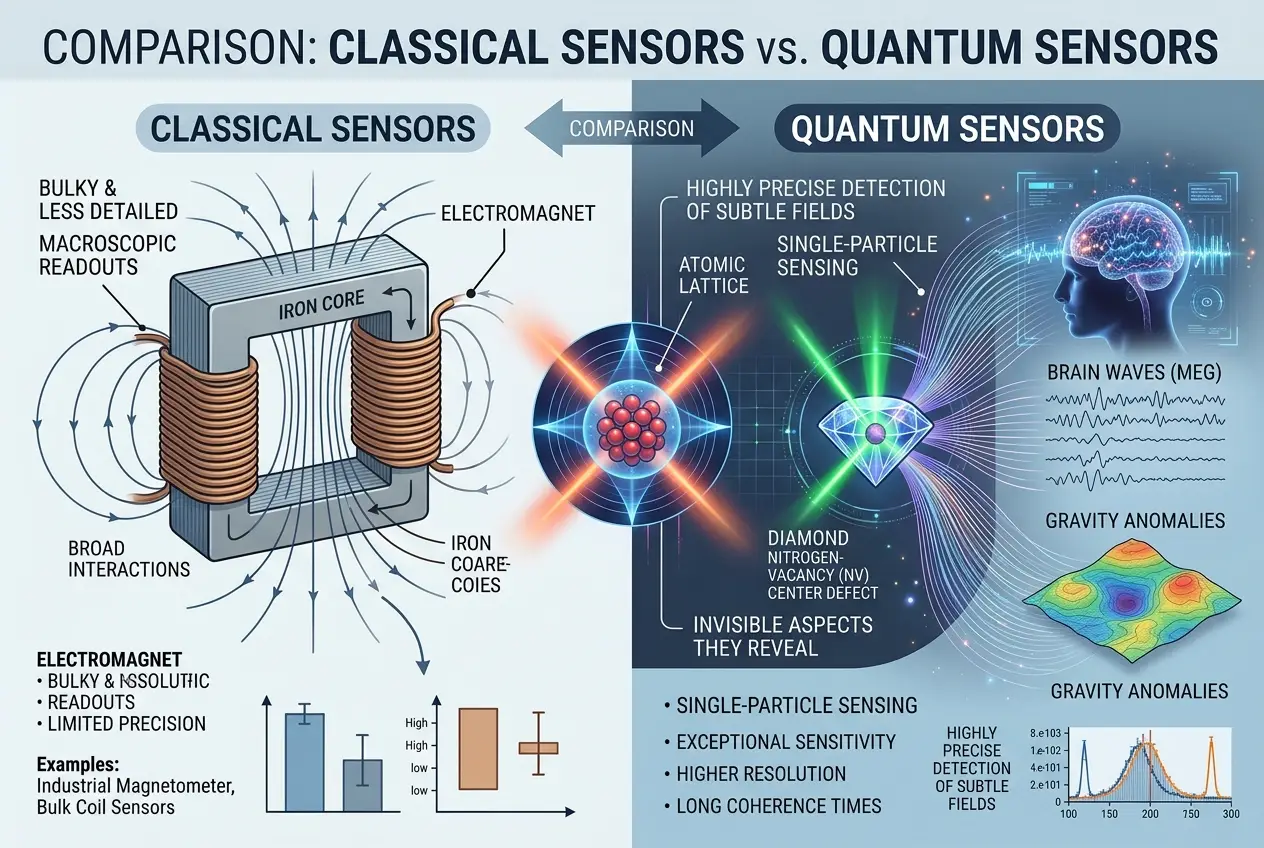
At its core, a quantum sensor exploits quantum phenomena like **superposition** and **entanglement**. Unlike classical sensors that rely on bulk material properties and average measurements, quantum sensors use individual quantum states (like an electron's spin or an atom's energy level) as their "sensing element." These quantum states are incredibly sensitive to external disturbances – be it a minuscule change in a magnetic field, a tiny gravitational shift, or a faint electrical signal.
Imagine you have a single atom that can be in two places at once (superposition). If a tiny force nudges it, that delicate balance is immediately disturbed, giving us a precise measurement of that force. This is a vastly simplified explanation, but it highlights the core principle: using the inherent fragility and quantum weirdness of matter at its smallest scale to achieve unparalleled precision.
This sensitivity allows them to detect things that are utterly invisible to traditional technology. We're talking about measuring gravitational fields with such accuracy that we could potentially map underground structures in unprecedented detail, or detecting magnetic fields so weak they’re generated by individual neurons firing in the human brain. The implications are staggering, from medical diagnostics to fundamental physics research.
### Peering into the Invisible: Applications Redefining Perception
The promise of quantum sensors isn’t just theoretical; they are already beginning to revolutionize various fields, offering a new lens through which we perceive the world.
#### **Unveiling Hidden Worlds: Precision Navigation & Earth Sciences**
Think about how GPS works today. It relies on satellite signals. But what if you’re underwater, underground, or in an urban canyon where GPS signals are blocked? **Quantum gravimeters** and **quantum accelerometers** offer a potential solution. By detecting minute variations in Earth's gravity or tracking extremely subtle changes in motion, these sensors could enable navigation without reliance on external signals. I recently read about experiments demonstrating such inertial navigation systems, which could be transformative for submarines, autonomous vehicles, and even space exploration.
For earth scientists, these sensors are like a new pair of eyes. They can detect changes in groundwater levels, monitor volcanic activity, and even help predict earthquakes by observing subtle shifts in the Earth's crust. Imagine being able to create incredibly detailed maps of subterranean geology, distinguishing between rock, water, and even different mineral deposits based on their gravitational signatures. This capability would be invaluable for resource exploration and hazard prediction. You can learn more about how advanced measurements impact our understanding of Earth’s processes on [Wikipedia's page on gravimeters](https://en.wikipedia.org/wiki/Gravimeter).
#### **Revolutionizing Healthcare: From Brain Scans to Early Disease Detection**
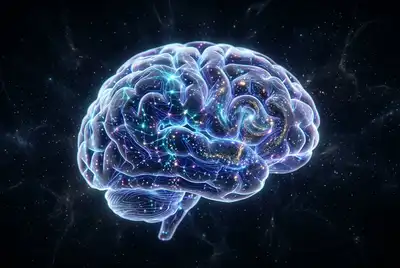
The human body is a symphony of subtle electrical and magnetic signals. Our brains, for example, generate incredibly weak magnetic fields when neurons communicate. Traditional MRI machines are powerful but often require bulky, supercooled magnets. Quantum sensors, specifically **magnetoencephalography (MEG) sensors** built on quantum principles, are being developed that can measure these faint brain signals with unprecedented accuracy, potentially without the need for cryogenic cooling.
This could lead to breakthroughs in understanding neurological disorders like epilepsy, Alzheimer's, and Parkinson's. Imagine a helmet-like device that can map brain activity in real-time, allowing doctors to precisely locate the source of seizures or identify the earliest markers of neurodegenerative diseases. This shift from large, complex machinery to compact, highly sensitive devices represents a profound change in how we diagnose and monitor human health.
Beyond the brain, quantum sensors could detect minute quantities of specific molecules, paving the way for ultra-early disease detection. Think about breathalyzers that can detect cancer biomarkers or blood tests that catch infections at their nascent stages. This ability to perceive molecular-level changes could truly redefine preventive medicine.
#### **Beyond Encryption: Quantum Computing & Security**
While not strictly sensors, the underlying principles of quantum mechanics that enable quantum sensors also power the burgeoning field of quantum computing. The unique quantum states used in sensors are analogous to the qubits used in quantum computers. These interconnected quantum systems are incredibly powerful, capable of performing calculations that are currently impossible for even the most powerful supercomputers. The sensitivity that makes a quantum sensor excellent at detection also means that quantum computers are very susceptible to noise and interference.
This connection is important because quantum sensors are also being developed to test and validate components for quantum computers, helping to build more stable and reliable systems. Furthermore, the advent of quantum computing will necessitate new forms of encryption, leading to the development of quantum-safe cryptography. To learn more about the challenges and potential of this field, I recommend checking out our blog post, "Can Quantum Computers Break Every Encryption?" [/blogs/can-quantum-computers-break-every-encryption-1438]. This is a fascinating area where the lines between sensing, computing, and security begin to blur.
### The Future is Quantum: A Paradigm Shift in Observation
The journey into quantum sensing is still in its early stages, but the trajectory is clear: we are moving towards a world where our ability to perceive is no longer limited by classical physics. Consider the implications for fundamental science. Quantum sensors are already being used in the search for dark matter, hunting for the elusive particles that make up a significant portion of our universe but remain invisible to us. They could also help us probe the very nature of spacetime itself. The concept of how quantum entanglement defies the laws of space and time is mind-boggling, and these sensors give us a way to potentially observe such phenomena. For more on this, you might enjoy reading our article, "How Does Quantum Entanglement Defy Space-Time?" [/blogs/how-does-quantum-entanglement-defy-space-time-5424].
In quantum gravity research, ultra-sensitive atomic clocks (a form of quantum sensor) are being developed to measure tiny shifts in time caused by gravitational fields, potentially offering new insights into Einstein's theory of relativity and its unification with quantum mechanics. Just as we explored in our previous post, "Can Quantum Computers Break Gravity's Rules?" [/blogs/can-quantum-computers-break-gravitys-rules-9323], these technologies are all intertwined, each pushing the boundaries of the other.
As Professor John K. Thompson from the National Institute of Standards and Technology (NIST) once noted regarding atomic clocks, **"We're seeing a renaissance in metrology driven by quantum mechanics. These new clocks aren't just telling time; they're sensing the universe."** This sentiment perfectly encapsulates the broader impact of quantum sensors: they are not merely instruments of measurement but probes that extend our senses into realms previously unimaginable.
#### **Challenges and the Road Ahead**
Despite their immense promise, quantum sensors face significant challenges. They often require highly controlled environments—ultra-low temperatures, vacuum chambers, or precisely tuned lasers—to maintain the delicate quantum states. Miniaturization, robust engineering, and overcoming environmental noise are crucial hurdles that researchers are actively addressing.
However, rapid advancements in fields like quantum optics, nanotechnology, and materials science are bringing us closer to practical, deployable quantum sensors. We are seeing the development of chip-scale quantum sensors that could operate at room temperature, making them viable for everyday applications.
The impact of quantum sensors on our perception of reality cannot be overstated. They are not just enhancing existing capabilities; they are creating entirely new ones. They allow us to sense the infinitesimal, revealing the subtle interconnectedness of the physical world. From mapping the invisible geology beneath our feet to decoding the faint whispers of our own brains, these devices are fundamentally reshaping what we can observe and, by extension, what we understand about the universe and ourselves.
As I reflect on these incredible advancements, I realize that these aren't just about building faster computers or more accurate navigation systems. They're about expanding the very notion of what it means to perceive. We are on the cusp of a revolution in observation, one that will unveil realities we never knew existed. And that, to me, is the true magic of quantum sensors.
Frequently Asked Questions
Quantum sensors utilize the unique properties of quantum mechanics, such as superposition and entanglement, at the atomic or subatomic level to achieve unparalleled sensitivity. Traditional sensors, conversely, rely on classical physics and bulk material properties, offering less precision when detecting subtle phenomena.
Quantum sensors are being developed for applications in highly precise navigation (like GPS-independent systems), advanced medical imaging (such as ultra-sensitive brain scans), early disease detection, geological surveying, and even fundamental physics research, including the search for dark matter.
Currently, many high-precision quantum sensors require specialized environments like ultra-low temperatures or vacuum conditions to maintain their delicate quantum states. However, ongoing research is focused on miniaturizing these sensors and developing room-temperature operating versions to make them more practical and widely deployable for everyday use.
Yes, quantum sensors and quantum computing share common underlying principles of quantum mechanics. The quantum states exploited by sensors are analogous to the qubits used in quantum computers. Advancements in one field often benefit the other, particularly in areas like component development and understanding quantum coherence.
Quantum sensors can detect extremely subtle changes in magnetic fields (e.g., from individual neurons), minute gravitational shifts, ultra-small electrical signals, and even the faint presence of specific molecules. This allows them to reveal phenomena that are simply too weak or too fine-grained for classical sensors to perceive.
Verified Expert
Alex Rivers
A professional researcher since age twelve, I delve into mysteries and ignite curiosity by presenting an array of compelling possibilities. I will heighten your curiosity, but by the end, you will possess profound knowledge.
Leave a Reply
Comments (0)
No approved comments yet. Be the first to share your thoughts!
 Join Us



 Unknown Author





























Leave a Reply
Comments (0)