


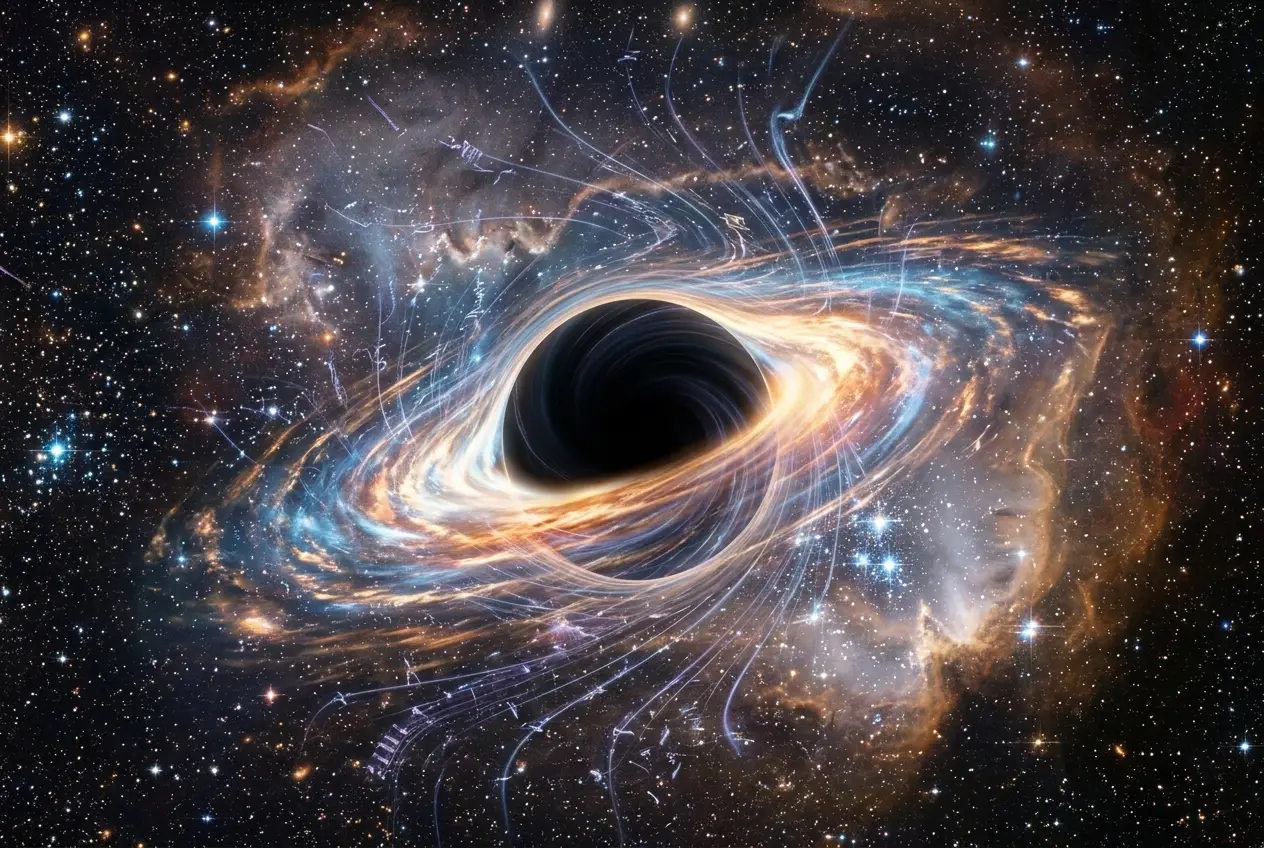
Have you ever stared at a corrupted hard drive, perhaps a cherished old one filled with digital photos and documents, and felt a pang of despair? The data, once meticulously organized and seemingly permanent, is now gone – or is it? The digital world grapples with data loss, but what if the universe itself has a similar, far grander problem? I'm talking about the ultimate cosmic data shredder: black holes.
For decades, these enigmatic behemoths of the cosmos have fascinated scientists and science fiction enthusiasts alike. Their immense gravity warps spacetime, creating a boundary known as the event horizon, beyond which nothing, not even light, can escape. But beyond their awe-inspiring power, black holes present one of the most profound paradoxes in modern physics: the black hole information paradox. This isn't just a theoretical quandary; it challenges our fundamental understanding of how the universe works, suggesting that perhaps, information — the very essence of existence — might be irreversibly lost.
The Unthinkable Loss: Why Information Matters
In physics, "information" isn't just what’s on your computer; it refers to the complete description of a system. If you know all the particles, their positions, and velocities, you have all the information about that system. A fundamental principle of quantum mechanics, known as unitarity, dictates that information cannot be truly destroyed. It can be scrambled, transformed, or hidden, but it must always, in principle, be recoverable. This conservation of information is a cornerstone of our physical laws.
When something falls into a black hole, it crosses the event horizon. From an outside observer's perspective, the object appears to slow down and red-shift, eventually fading from view, never truly crossing. But for the object itself, it plunges into the singularity. The problem arises when we consider the fate of this information. If the black hole eventually evaporates, as Stephen Hawking theorized, what happens to the information of everything it consumed?
Hawking's Revelation: A Cosmic Incinerator?
The story of the information paradox truly ignited in the 1970s with Stephen Hawking’s groundbreaking work. Initially, black holes were thought to be entirely black, absorbing everything. But Hawking, applying quantum mechanics to the extreme gravitational fields near an event horizon, predicted that black holes actually radiate energy, a phenomenon now known as Hawking radiation.
This radiation arises from quantum fluctuations near the event horizon, where particle-antiparticle pairs spontaneously appear. One particle might fall into the black hole, while its partner escapes as Hawking radiation. Crucially, Hawking initially calculated that this radiation is purely thermal – meaning it carries no information about what fell into the black hole. It’s like burning a book: you get ashes and heat, but you can’t reconstruct the book's contents from them. If black holes eventually evaporate completely through this process, and the radiation carries no information, then the information of everything that ever entered the black hole would be irrevocably lost. This directly contradicts the principle of unitarity.
For a deeper dive into Hawking's contributions, you might be interested in a blog like this: Stephen Hawking: A Mind Beyond Gravity's Reach.
The Clash of Titans: Quantum vs. Gravity
The information paradox represents a fundamental conflict between two pillars of modern physics: General Relativity (Einstein's theory of gravity) and Quantum Mechanics. General Relativity describes black holes as smooth, simple objects defined by only a few properties (mass, charge, angular momentum), losing all other "information" about what formed them—the famous "no-hair theorem" (Wikipedia: No-hair theorem (opens in a new tab)). Quantum mechanics, on the other hand, insists on information conservation. This is the crux of the paradox.
Imagine throwing a meticulously crafted, unique snowflake into a black hole. According to general relativity, all its intricate details are erased upon crossing the event horizon, leaving only a tiny increment in the black hole's mass. If that black hole then evaporates via non-informational Hawking radiation, the snowflake's unique quantum state is gone forever from the universe. This is a scientific nightmare.
Table: General Relativity vs. Quantum Mechanics on Information
| Feature | General Relativity Perspective | Quantum Mechanics Perspective |
|---|---|---|
| Black Hole State | Described by simple macroscopic properties (mass, charge, spin). | Must retain full quantum information of infalling matter. |
| Information | Lost beyond event horizon; "no-hair" theorem. | Absolutely conserved; cannot be destroyed. |
| Hawking Radiation | Purely thermal, carries no information. | Must encode information to maintain unitarity. |
Potential Solutions: Where Could the Information Be?
The scientific community has explored numerous theoretical solutions to the information paradox, each with profound implications for our understanding of reality.
1. Information is Not Lost (Hawking's Later Shift)
Initially, Hawking himself argued that information was lost. However, he later reversed his stance, proposing that information might escape, though in a highly scrambled form. One idea is that the event horizon isn't as clean a boundary as once thought. Quantum gravity effects, still largely unknown, might allow information to "leak" out or be stored in subtle ways at or near the event horizon.
2. The Holographic Principle
Perhaps one of the most radical and intriguing solutions comes from the holographic principle (Wikipedia: Holographic principle (opens in a new tab)). This principle suggests that all the information contained within a volume of space can be encoded on its boundary. Applied to black holes, this would mean that the information about everything that falls in isn't lost but is instead "painted" onto the two-dimensional surface of the event horizon, like a cosmic hologram. When the black hole evaporates, this information could then be radiated away, albeit in a highly entangled and complex form that would be incredibly difficult to decode.
This concept implies that our three-dimensional universe might itself be a hologram, with all its information encoded on a distant two-dimensional surface. It's mind-bending to consider, suggesting a different texture to reality than we perceive. This ties into broader questions about the universe as a computational system, which you can explore further in concepts like Is Empty Space a Quantum Computer?.
3. Baby Universes
Another speculative idea, once championed by Hawking, suggests that information isn't destroyed but instead escapes into "baby universes" that branch off from our own. This would save unitarity within our universe, but the information would effectively be lost to us forever. It's a tantalizing thought, opening doors to a multiverse scenario, but currently lacks empirical evidence.
4. Firewalls
A more recent and controversial proposal involves "firewalls." The firewall paradox suggests that if information is indeed preserved and emitted with Hawking radiation, then something incredibly energetic must be present at the event horizon to "process" this information. This would create a "firewall" of high-energy particles that would instantly incinerate anything attempting to cross the event horizon, directly contradicting Einstein's equivalence principle (which states that a free-falling observer shouldn't notice anything special when crossing the event horizon). This idea has sparked considerable debate, as it pits the principle of information conservation against another fundamental tenet of general relativity.
The Search for Answers: The Future of Physics
Resolving the black hole information paradox is not merely an academic exercise; it's a critical step toward a unified theory of quantum gravity. It pushes the boundaries of our understanding, demanding that we reconcile the seemingly incompatible laws governing the very large (general relativity) and the very small (quantum mechanics).
The implications of its resolution are immense:
- A Unified Theory: A definitive answer could pave the way for a complete theory of everything, bringing together all fundamental forces of nature.
- The Nature of Reality: It could redefine our understanding of spacetime, causality, and the very fabric of reality, perhaps even affirming the holographic principle.
- Information Technology: Understanding how information is processed and potentially recovered in such extreme environments could inspire entirely new paradigms in computing and data storage, far beyond anything we can imagine today. While not directly about cosmic data, the idea of how the universe might store or process information touches upon themes like Do Gravitational Waves Hold Universe's Hidden Data?.
Researchers continue to explore various avenues, including string theory, loop quantum gravity, and quantum entanglement. Experiments, though indirect, such as observing gravitational waves from black hole mergers, provide crucial data points that constrain theoretical models. The debate remains fierce, with leading physicists holding diverse views.
The black hole information paradox is a stark reminder that even with our incredible scientific progress, the universe still holds profound secrets. The question of whether black holes erase cosmic memory touches the deepest layers of physics, forcing us to confront the limits of our knowledge and inspiring us to push further into the unknown. What we ultimately discover about these cosmic enigmas could reshape our understanding of existence itself.
Conclusion:
The black hole information paradox isn't just a riddle for physicists; it's a cosmic mystery that challenges the very foundation of how we believe the universe operates. Whether information is preserved, encoded on a holographic boundary, or truly lost, the answer will undoubtedly be revolutionary. As we continue to probe the secrets of these gravitational titans, we're not just trying to understand black holes; we're trying to decode the universe's ultimate instruction manual, hoping to prevent the ultimate cosmic data loss.

Conversation0
No comments yet. Be the first to share a thought — the best questions often become new stories.