


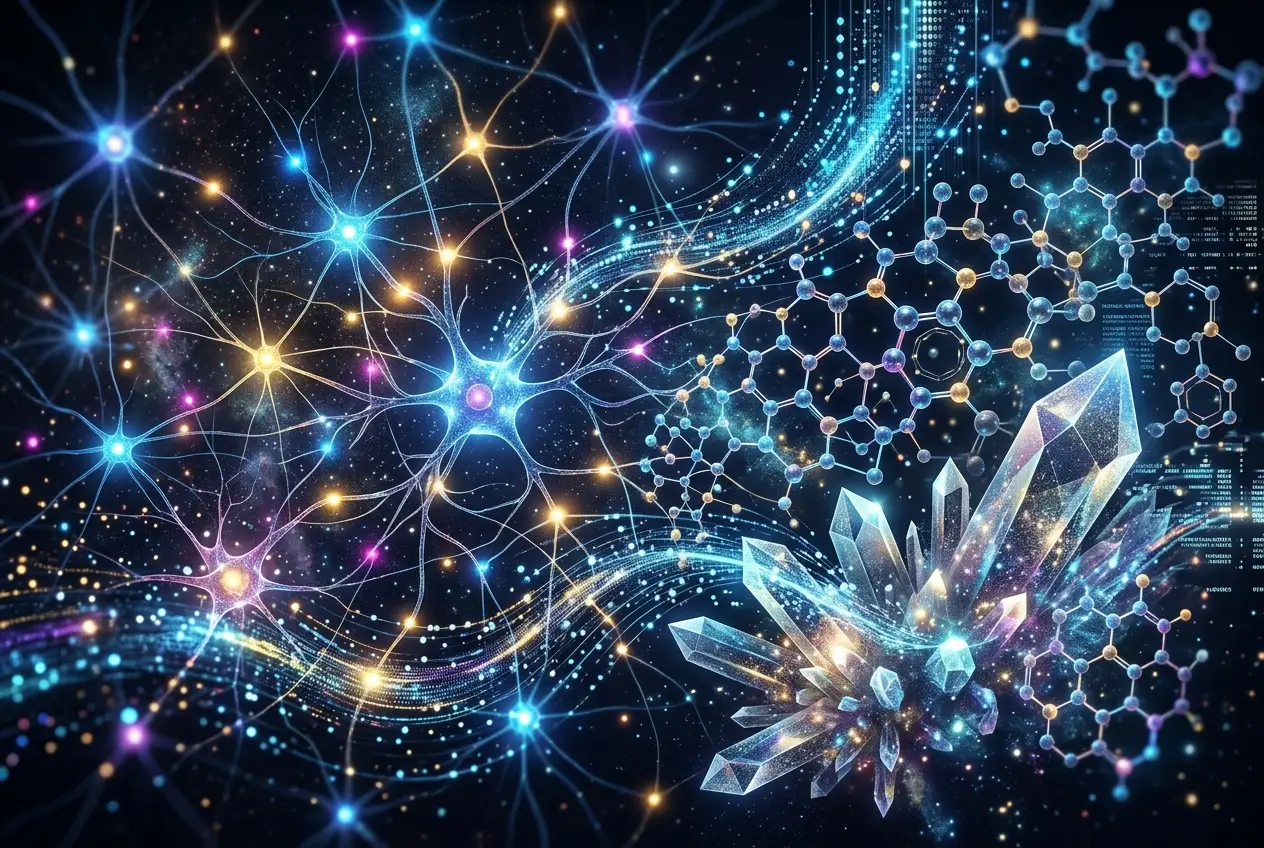
I was recently captivated by a thought: what if the ancient dream of alchemy wasn’t about turning lead into gold, but about something far more profound, something that modern technology is only just beginning to grasp? I’m talking about the fundamental creation and transformation of matter itself. For centuries, the idea of creating new elements or materials was confined to the realm of fiction or arcane mysticism. Yet, in our increasingly digital age, I’ve started to see tantalizing hints that this age-old ambition might be finding its true inheritor: Artificial Intelligence.
Forget the bubbling cauldrons and cryptic symbols; the new alchemists are crunching data, running simulations, and learning at scales no human mind ever could. Can AI truly forge new forms of matter? The answer is not a simple yes or no, but a fascinating exploration into the cutting edge of materials science, AI, and even quantum mechanics.
The Dawn of Digital Discovery in Materials Science
For a long time, the discovery of new materials was a slow, painstaking process. Scientists would synthesize compounds in the lab, test their properties, tweak their compositions, and then repeat. It was largely empirical, driven by intuition, trial-and-error, and sometimes, sheer luck. Think about the discovery of penicillin or Teflon – often serendipitous observations that took years to understand and optimize.
But what if we could predict a material's properties before it even exists? What if we could design new materials with specific functionalities from the ground up, atom by atom? This is where AI, particularly machine learning and deep learning, enters the scene, transforming the landscape of materials science. I believe this isn't just an improvement; it's a paradigm shift.
Traditional methods can explore only a minuscule fraction of the vast "materials space" – the almost infinite combinations of elements and structures possible. The sheer combinatorial explosion makes comprehensive experimental exploration impossible. A famous estimation suggests that there are 10^100 possible stable inorganic compounds, a number far exceeding the atoms in the observable universe. How could humans ever hope to sift through such a colossal haystack?
AI as the Ultimate Material Scientist's Assistant
AI excels at pattern recognition, optimization, and prediction – precisely the skills needed to navigate this immense materials space. Here’s how AI is becoming indispensable:
- Predicting Properties: Given a chemical composition and crystal structure, AI models can predict properties like strength, conductivity, melting point, or even catalytic activity with remarkable accuracy. This saves countless hours of lab work. Researchers can input hypothetical structures and compositions, and the AI can tell them if it's worth pursuing.
- Accelerating Simulations: Materials discovery often relies on computationally intensive simulations, like Density Functional Theory (DFT), to understand material behavior at the atomic level. AI can learn the underlying physics from these simulations and then perform predictions much faster, acting as a "surrogate model" that maintains high accuracy at a fraction of the computational cost. This speeds up the design cycle dramatically.
- Generating Novel Structures: This is where the "forging new matter" truly begins. AI isn't just predicting properties for existing structures; it's generating entirely new molecular and crystalline arrangements. Generative AI models, akin to those creating images or text, can propose novel compounds that have never been synthesized but are predicted to have desired characteristics.
One particularly exciting area is the use of reinforcement learning. Imagine an AI agent learning to play a game where the "score" is how close a generated material's properties are to a target. The AI iteratively designs and refines materials, learning from its "failures" and "successes" to converge on optimal, and often entirely novel, structures.
Case Studies: From Superconductors to Catalysts
The impact of AI in materials science is already evident.
1. Discovering Superconductors: Finding materials that conduct electricity with zero resistance at higher temperatures is a holy grail for energy and electronics. AI is being used to screen vast databases of potential compounds and even suggest new ones that might exhibit superconductivity under specific conditions. Imagine a world powered by lossless electricity! You can read more about the hunt for advanced materials in blogs like Is Room-Temp Superconductivity Real? Tech's Holy Grail on our site.
2. Designing Better Catalysts: Catalysts are crucial for countless industrial processes, from producing fuels to manufacturing plastics. AI can analyze molecular structures and predict their catalytic activity, leading to the design of more efficient and sustainable catalysts. For instance, AI has been used to identify new metal alloys for converting carbon dioxide into useful chemicals.
3. Developing Advanced Batteries: The quest for longer-lasting, faster-charging, and safer batteries for electric vehicles and renewable energy storage is relentless. AI helps explore new electrode materials and electrolytes, predicting their stability and performance, drastically cutting down the R&D cycle. The potential of Diamond Batteries to power our future is another fascinating area where material innovation is key.
As researchers from the National Institute of Standards and Technology (NIST) note, "AI provides a powerful new lens through which to view and accelerate materials discovery, but it requires careful integration with domain expertise and experimental validation." (Source: NIST, The Materials Genome Initiative program, https://www.nist.gov/programs-projects/materials-genome-initiative (opens in a new tab)). This underscores that AI is a tool, albeit a revolutionary one, that still needs human guidance and experimental verification.
Beyond Prediction: The Realm of "True" Creation
When I talk about "forging new matter," I'm not just referring to predicting known compounds or optimizing existing ones. The exciting frontier is the AI's ability to propose entirely unforeseen combinations of atoms or novel crystal structures that violate our current intuition but are theoretically stable and possess extraordinary properties.
Imagine a hypothetical scenario: An AI, fed with quantum mechanics principles and desired properties (e.g., "transparent, conducts electricity like a metal, but is as light as air"), begins to generate molecular structures. It might propose a lattice arrangement of carbon and nitrogen atoms unlike anything found in nature or previously imagined by human chemists. This would be a truly new form of matter, synthesized by human hands but conceived by an artificial intelligence. This takes us closer to the idea of a "digital alchemist."
One fascinating aspect of this involves quantum materials. These are materials whose properties are dominated by quantum mechanical effects, leading to bizarre and useful phenomena like high-temperature superconductivity or topological insulation. Designing such materials is incredibly complex for humans due to the non-intuitive nature of quantum interactions. AI, however, can learn these complex quantum rules from massive datasets and potentially design materials with tailored quantum properties. The discussion around quantum dots seeing other dimensions gives a glimpse into the strange world of quantum possibilities.
Challenges and Ethical Considerations
While the promise is immense, there are significant challenges.
- Synthesizability: An AI can propose a theoretically stable and desirable material, but can it actually be synthesized in a lab? Some proposed structures might be too complex or require extreme conditions that are currently unachievable. The bridge between theoretical AI design and practical lab synthesis is a critical one.
- Data Scarcity: AI models need vast amounts of high-quality data to learn effectively. For truly novel materials, such data simply doesn't exist. Researchers are working on techniques like active learning (where AI guides experiments to generate its own training data) and transfer learning to overcome this.
- Validation: Every AI-predicted material still requires rigorous experimental validation. AI is a powerful hypothesis generator, not a definitive truth-teller.
- Ethical Implications: As AI gains more autonomy in discovery, ethical questions arise. What if an AI designs a material with unforeseen toxic properties? Or a material that could be weaponized? The responsibility for such creations ultimately rests with the human developers and users.
The Future: A Collaborative Human-AI Frontier
I don't envision a future where AI replaces human material scientists. Instead, I see a powerful collaboration. AI will be the indefatigable explorer, sifting through possibilities, predicting, and generating novel ideas at speeds we can barely comprehend. Human scientists will provide the intuition, define the problems, perform the crucial experimental validation, and guide the AI's learning process.
This partnership could unlock a new era of material discovery, leading to innovations we can only dream of today: super-efficient solar cells, self-healing coatings, biological implants that seamlessly integrate with our bodies, materials for sustainable space exploration, and perhaps even entirely new states of matter with properties we can't yet imagine.
The ancient alchemists sought to master the elements through mystic wisdom. Modern AI, with its vast computational power and learning algorithms, offers a new form of alchemy – a digital alchemy capable of unlocking the secrets of matter and, perhaps, creating entirely new ones. The future of material science isn't just about discovery; it's about intelligent, targeted creation.





Conversation0
No comments yet. Be the first to share a thought — the best questions often become new stories.