


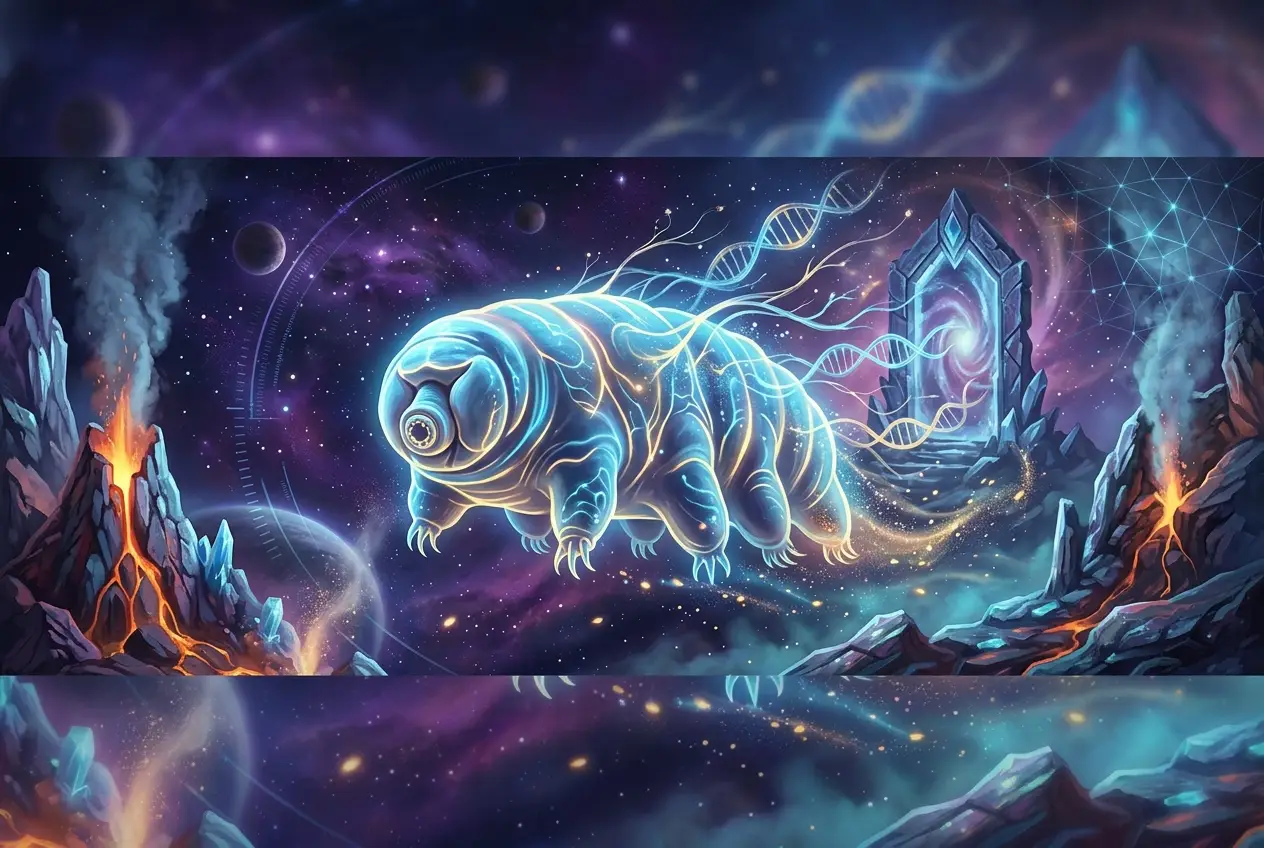
I remember the first time I truly wrapped my head around the concept of "immortality." Not the mythical kind, but the biological one. It was during a deep dive into the most bizarre corners of the animal kingdom, searching for creatures that defy conventional understanding of life and death. And that's when I stumbled upon the tardigrade, often affectionately known as the "water bear" or "moss piglet." These microscopic invertebrates, barely half a millimeter long, possess an almost supernatural ability to survive conditions that would instantly annihilate nearly every other living thing on Earth. This isn't just a quirky evolutionary trait; it’s a living blueprint for resilience, hinting at secrets that could revolutionize our understanding of longevity, human survival, and perhaps, even true immortality.
The Unkillable Micro-Beast: What Makes Tardigrades So Special?
Imagine an animal that can be boiled, frozen, blasted with radiation, starved for decades, or even exposed to the vacuum of space, only to reanimate and carry on as if nothing happened. That’s a Tuesday for a tardigrade. These eight-legged micro-animals are extremophiles par excellence, thriving—or at least surviving—in environments ranging from the highest mountains to the deepest oceans, and even in the harsh radiation of outer space. Their astounding capabilities have fascinated scientists for decades, prompting intense research into their unique biology.
What extremes can they withstand?
- Temperature: From a scorching 150°C (302°F) down to an astonishing -272°C (-458°F), just above absolute zero.
- Pressure: They can survive pressures six times greater than those found at the deepest ocean trenches.
- Radiation: Tardigrades can endure radiation doses hundreds of times higher than what would be lethal to humans. They’ve even survived direct solar radiation and cosmic rays in low Earth orbit.
- Dehydration: They can enter a state called cryptobiosis, shedding almost all their body water and shriveling into a "tun" state, surviving for decades without water.
- Vacuum: Famously, they are the only animal known to survive direct exposure to the vacuum of space, including its intense radiation.
This unparalleled resilience isn't mere luck; it's engineered at a molecular level. Researchers are just beginning to unravel the genetic and biochemical mechanisms behind these incredible feats.
The Secret of Cryptobiosis: A Pause Button for Life
The key to the tardigrade's astonishing survival lies in its ability to enter a dormant state known as cryptobiosis. When faced with life-threatening conditions—most commonly extreme dehydration, but also freezing, oxygen deprivation, or even high salinity—a tardigrade can retract its legs, expel most of the water from its body, and curl into a barrel-shaped "tun." In this state, its metabolism can drop to less than 0.01% of its normal rate.
During cryptobiosis, the tardigrade essentially puts life on hold. Scientists believe that specific molecules play crucial roles in protecting its cellular machinery. One of the most significant discoveries is the role of Tardigrade-specific intrinsically disordered proteins (TDPs). These proteins are thought to form a glass-like matrix inside the cells, preventing damage to sensitive biomolecules like DNA and proteins when water is absent. Think of it like a natural cryopreservation process, but without the need for sophisticated lab equipment. You can learn more about this fascinating state on Wikipedia's Cryptobiosis page (opens in a new tab).
Beyond TDPs, tardigrades also produce trehalose, a sugar that acts as a powerful protectant against desiccation, and unique DNA-repair mechanisms. When conditions improve, the tardigrade can rehydrate, shake off its tun state, and resume its normal life, sometimes even after decades of dormancy. This remarkable ability begs the question: could we harness these biological blueprints to extend human longevity or even achieve a form of biostasis for interstellar travel, similar to what we discussed in our article on Did Ancients Master Biostasis for Eternal Life? (opens in a new tab)?
Unlocking Human Longevity: Lessons from the Water Bear
The scientific community is buzzing with the potential applications of tardigrade biology. If we could understand and replicate the mechanisms that allow tardigrade cells to survive extreme stress and desiccation, the implications for human health and space exploration would be profound.
1. Revolutionizing Medicine: Imagine organs that could be preserved for extended periods without refrigeration, vastly improving organ donation and transplantation. Or vaccines that don't require cold chains, making them accessible to remote areas. The ability to "pause" biological activity could lead to novel therapies for conditions like stroke or heart attack, where preserving tissue during oxygen deprivation is critical. Research into tardigrade proteins is already showing promising results in protecting human cells from desiccation and radiation.
2. Enhancing Space Exploration: One of the biggest hurdles for long-duration space missions, especially to distant planets like Mars or beyond, is the immense biological toll on astronauts. Cosmic radiation, microgravity, and isolation all degrade human health. If we could induce a controlled, reversible state of cryptobiosis in humans or even just protect astronauts' cells with tardigrade-inspired therapies, it would be a game-changer. It might even open doors to faster-than-light travel concepts or advanced forms of human stasis. Our previous blog, Could Cosmic Rays Alter Our DNA? Unpacking Space Radiation (opens in a new tab), delves into the very challenges tardigrades effortlessly overcome.
3. The Quest for Immortality (or Radical Life Extension): While true biological immortality for humans remains firmly in the realm of science fiction, tardigrade research provides a fascinating pathway for radical life extension. By understanding how they protect and repair their DNA, stabilize proteins, and minimize metabolic activity, we might find ways to slow down or even reverse the aging process in human cells. The goal wouldn't be to turn us into dried-up tuns, but to incorporate these protective mechanisms into our own biology, making us more resilient to cellular damage and the ravages of time. The broader quest for extended lifespans is a recurring theme, as explored in Can We Halt Aging? The Quest for Immortality (opens in a new tab).
Genetic Engineering and Synthetic Biology: A Tardigrade Toolkit
Scientists are actively exploring the genetic code of tardigrades to identify the specific genes responsible for their extraordinary traits. By inserting tardigrade genes into other organisms, researchers have already observed increased resilience. For instance, expressing a tardigrade protein in human cells has shown to reduce DNA damage from X-rays.
This work is foundational for synthetic biology, where we could engineer organisms (or even human cells) with enhanced survival capabilities. Imagine synthetic organisms designed for harsh environments, or human therapies that make us less susceptible to disease and decay. The possibilities extend even to novel forms of biocomputing, where living cells are leveraged for computational power, a concept touched upon in Can Living Organisms Compute? The Rise of Biocomputing (opens in a new tab).
However, ethical considerations are paramount. Modifying human biology with traits from an extremophile raises complex questions about what it means to be human, the potential for unintended consequences, and equitable access to such transformative technologies. The journey from understanding tardigrade biology to applying it in humans is long and fraught with both immense promise and significant challenges.
The Road Ahead: Challenges and Ethical Questions
While the prospect of harnessing tardigrade secrets for human benefit is exciting, it's essential to temper enthusiasm with scientific realism. Humans are vastly more complex organisms than tardigrades. Our metabolic rates are higher, our brains require constant oxygen and glucose, and our intricate biological systems are finely tuned to a stable, temperate environment. Inducing a full cryptobiotic state in a human without causing irreversible damage is a monumental task, currently beyond our scientific grasp.
Moreover, the ethical implications of tampering with human longevity and resilience are immense. Who would have access to such technologies? What would be the societal impact of significantly extended lifespans or even a limited form of human biostasis? These are questions that will require careful consideration as our understanding of tardigrade biology deepens.
Nonetheless, the water bear continues to serve as an inspiring biological anomaly, a testament to life's incredible adaptability. Its mere existence challenges our preconceived notions of what is possible, pushing the boundaries of scientific inquiry and whispering promises of a future where true immortality, in some form, might just be within our reach. The journey to unlock the tardigrade’s ultimate secrets is still ongoing, and I, for one, can’t wait to see what else these tiny titans teach us. For a deeper dive into their genetic makeup, you can visit the Wikipedia page on Tardigrade (opens in a new tab).



Conversation0
No comments yet. Be the first to share a thought — the best questions often become new stories.