


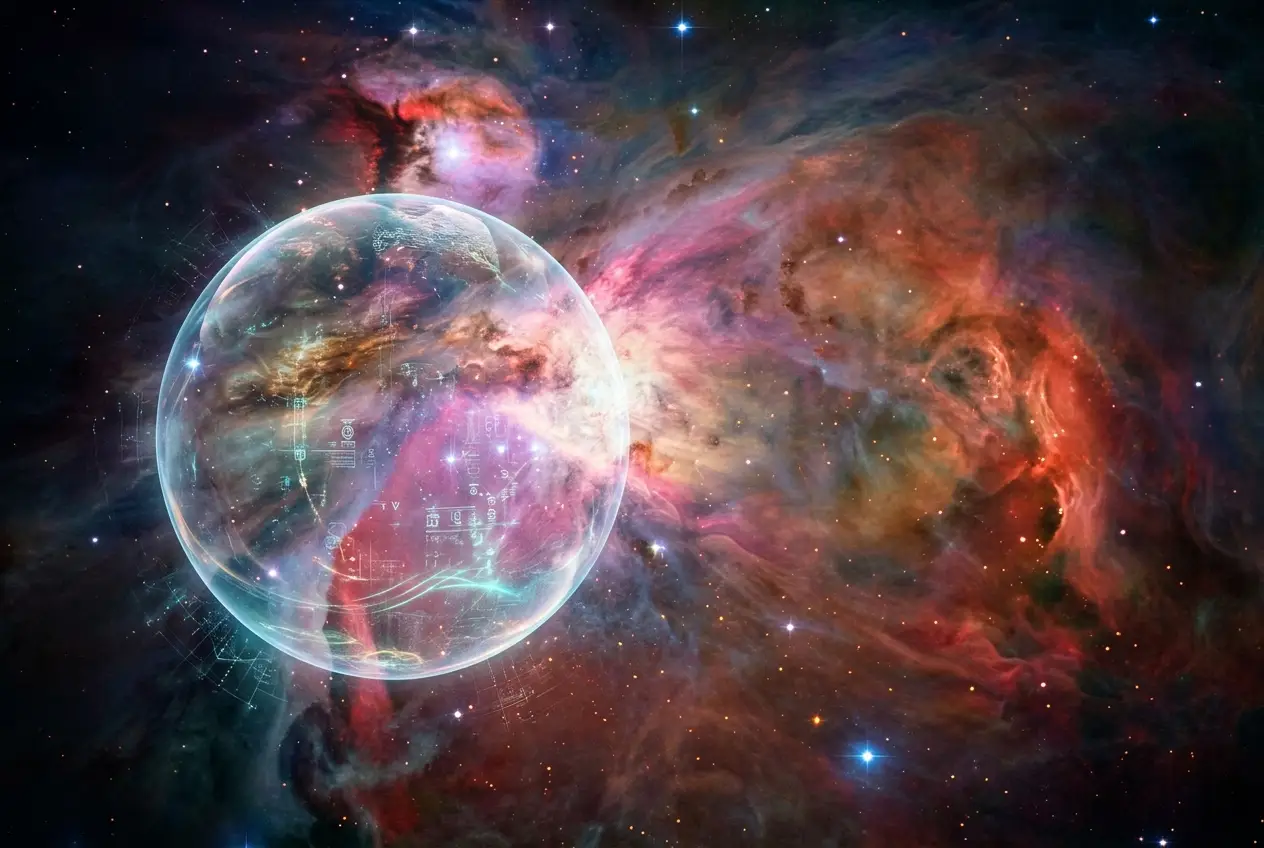
Have you ever paused to consider the sheer immensity of our universe? Billions of galaxies, each containing billions of stars, and orbiting those stars, countless exoplanets. It’s a mind-boggling scale that inevitably leads to profound questions. Beyond the hunt for alien life, I've often wondered if these distant worlds could be more than just potential habitats or barren rocks. What if, rather than just hosting life, they were also acting as cosmic hard drives, silently archiving the universe's most profound secrets, perhaps even the encoded histories of long-lost civilizations?
The concept might sound like science fiction, pulled straight from a grand space opera, but the underlying scientific principles that make it plausible are surprisingly grounded. We're talking about the potential for natural or even engineered mechanisms on or within exoplanets to store vast amounts of information – from the evolutionary paths of their biospheres to the fundamental laws governing their existence, or even messages deliberately left behind by advanced extraterrestrial intelligence.
The Universe as an Information System
At its core, physics tells us that information is fundamental. From the quantum foam of spacetime to the black holes that theoretically swallow and scramble it, the universe is constantly processing and storing data. Think about it: every atom carries information about its type, its energy state, and its interactions. Black holes, for instance, are theorized to be the ultimate information processors, potentially encoding all the data of what falls into them on their event horizons, a concept known as the holographic principle. If information is so intrinsic to the cosmos, why couldn't larger, more complex structures like planets participate in this grand cosmic library?
One of the most intriguing aspects I consider is how such information might be stored. It wouldn't be in a USB drive, of course, but perhaps through incredibly stable, long-lasting natural processes. On Earth, we have geological records, ice cores, and even the very DNA of living organisms that act as biological archives of our planet's past. Extending this idea to exoplanets, the possibilities multiply.
Natural Archives: Planets as Geologic Scrolls
Imagine a planet with a stable, slow-changing crust, perhaps one that experiences infrequent but powerful geological events that leave distinct, layered records. Each layer could contain traces of its atmospheric composition, volcanic activity, or even fossilized microbial mats from eons past. These aren't just 'fossils' in the traditional sense; they are a sequential record of environmental conditions and biological activity.
Consider exoplanets with extreme conditions. A diamond planet, for instance, might crystallize under immense pressure, forming vast crystalline structures. Could these perfect lattices, formed over billions of years, encode information at an atomic level? Certain crystals are known to store information in their defects or impurities. On a planetary scale, this could lead to natural archives of unprecedented density and longevity. Such a planetary body could be a "geologic scroll," its very structure a testament to its long journey through the cosmos. For more on how such extreme conditions might lead to unusual planetary formations, you might find this Wikipedia article on exotic matter (opens in a new tab) insightful.
Biosignatures and Technosignatures: Beyond Life
The search for extraterrestrial life often focuses on biosignatures – chemical evidence of biological processes in an exoplanet's atmosphere or on its surface. But what if we broaden our scope to technosignatures? These are observable signs of technology, whether active (like radio signals) or passive (like Dyson spheres). What if some technosignatures aren't active transmissions but rather planetary-scale data storage systems?
Imagine an advanced civilization that, facing its own demise or simply wanting to leave a permanent legacy, engineered its home planet to be a data repository. They could embed information into the planet's core, manipulate its geological processes to create intricate patterns, or even seed its oceans with specially designed, self-replicating information carriers. This isn't just about finding alien structures, as discussed in /blogs/alien-megastructures-are-we-missing-cosmic-architects-6667, but about recognizing deliberate data encoding.
Quantum-Level Storage: The Universe's Ultimate Memory?
Moving beyond geological or biological mechanisms, the most speculative, yet perhaps the most robust, form of cosmic data storage involves quantum mechanics. We know that quantum entanglement allows particles to be linked across vast distances, with the state of one instantly affecting the state of another. Could an advanced civilization leverage this to create a galactic quantum internet or, more fundamentally, a quantum memory system embedded within the fabric of space-time around or even within their planet?
Quantum dots, for example, are tiny semiconductor nanocrystals that exhibit quantum mechanical properties and can be used to store information. If these could naturally form or be engineered on a planetary scale, perhaps deep within a planet's mantle where conditions are stable, they could act as immensely dense and long-lasting storage units. The concept that information might be stored at a quantum level isn't new; even the idea that the universe itself might be a giant neural network has been explored in /blogs/is-the-universe-a-giant-neural-network-2907.
Table: Potential Exoplanetary Data Storage Mechanisms
| Storage Type | Mechanism | Plausibility | Longevity | Potential Data Volume |
|---|---|---|---|---|
| Geological | Layered rock formations, mineral composition changes | Medium | Billions of years | Low to Medium (environmental) |
| Crystalline | Atomic arrangements in planetary-scale crystals | Low to Medium (natural) | Billions of years | Medium to High (fundamental data) |
| Biological | Engineered extremophiles, DNA-like structures | Medium (engineered) | Millions to Billions of years | High (complex narratives) |
| Atmospheric | Stable, complex chemical patterns in gas giants | Low (natural stability) | Thousands to Millions of years | Low to Medium (environmental cycles) |
| Technological | Engineered mega-structures, embedded devices | Medium (detection) | Millions to Billions of years | Very High (explicit messages) |
| Quantum | Entangled particles, quantum-stable states | Very Low (speculative) | Potentially infinite | Extremely High (universal laws) |
Decoding the Cosmic Code: The Ultimate SETI Challenge
If exoplanets are indeed cosmic data archives, how would we ever decode them? This is where the challenge truly lies. It would require a leap in our understanding of exotic materials, quantum communication, and perhaps even entirely new physics. Our current SETI efforts primarily listen for radio signals, but what if the most important messages are not broadcast, but etched into the planets themselves?
This would be a far more complex task than merely translating an alien language. It would involve identifying patterns that are clearly artificial amidst natural noise, distinguishing purposeful encoding from random cosmic processes. It's a bit like searching for a message in a bottle, but the bottle is an entire planet, and the message is written in a language we don't even know exists yet. Discovering unusual cosmic signals, such as those discussed in /blogs/what-are-fast-radio-bursts-decoding-cosmic-enigmas-3192, is just the first step. The next is understanding if they contain intelligence, or even, information.
As astronomer Carl Sagan famously said, "Extraordinary claims require extraordinary evidence." The idea of exoplanets as cosmic data centers is undoubtedly extraordinary. Yet, the continuous discovery of exoplanets with increasingly bizarre and unexpected properties pushes the boundaries of our imagination and scientific inquiry. Each new world we find teaches us more about the incredible diversity and potential of the cosmos. For a comprehensive overview of exoplanet research, the NASA Exoplanet Archive (opens in a new tab) is an invaluable resource.
One of the most exciting implications of this idea is the potential for discovering not just alien life, but alien wisdom. What if an exoplanet held the sum total of an advanced civilization's scientific knowledge, their philosophical insights, or even their artistic expressions? Such a discovery would fundamentally alter humanity’s place in the universe, providing an unparalleled window into an extraterrestrial mind. It would be a universal "Rosetta Stone" on a planetary scale. For more on the challenges of decoding alien communication, you might enjoy /blogs/can-ai-decode-animal-language-new-rosetta-stone-5105.
The challenge of differentiating between a naturally occurring, highly complex pattern and a deliberately encoded message is immense. Consider the intricate patterns found in fractals, or the self-organizing principles seen in complex systems here on Earth. How would we tell if a planetary characteristic was a product of blind physical laws or intelligent design? It would likely involve statistical analysis, searches for non-random compression, redundancy, and patterns that conform to mathematical or logical structures known to be universal.
As our technological capabilities expand, particularly in fields like artificial intelligence and quantum computing, our capacity to analyze vast amounts of data will grow exponentially. Perhaps future AI systems, far more advanced than anything we have today, could be the key to sifting through the noise of the cosmos and identifying these subtle, profound whispers from other worlds. The journey to understand the cosmos is far from over, and the possibility that entire planets serve as silent libraries adds another layer of profound wonder to that ongoing quest. It's a reminder that the universe, in its boundless creativity, might just be storing its own story for us to one day read. Another fascinating thought is whether cosmic rays could influence these potential data structures, a concept explored in /blogs/do-cosmic-rays-secretly-glitch-our-tech-3330.
In the grand scheme of things, whether exoplanets literally store "data" in a human-comprehensible way remains to be seen. But the contemplation of such possibilities pushes the boundaries of our scientific imagination, encourages us to look for the unexpected, and reinforces the idea that the universe is far stranger, and perhaps far more intricate, than we can currently conceive.


Conversation0
No comments yet. Be the first to share a thought — the best questions often become new stories.