


I remember staring at an old pendulum clock in my grandmother's house, mesmerized by its steady, rhythmic swing. Tick-tock, tick-tock. It was an embodiment of time, a constant motion that seemed to defy the slow creep of entropy, at least for a while. For physicists, the concept of symmetry is deeply ingrained in how we understand the universe, from the fundamental laws that govern particles to the grand dance of galaxies. One of these symmetries is time-translation symmetry – the idea that the laws of physics remain the same whether you perform an experiment today or tomorrow, or even a billion years from now. It’s a bedrock principle, and it dictates that a system in its lowest energy state, or ground state, should be perfectly still, unchanging over time.
So, imagine my fascination, and frankly, my initial disbelief, when I first encountered the concept of time crystals. These aren't just theoretical constructs; they are a real, observable phase of matter that seems to defy this fundamental understanding. They possess a persistent, periodic motion even in their lowest energy state, like a quantum pendulum that never runs out of swing, without any external energy input. Does this mean they break the rules of physics? Not quite, but they certainly bend our traditional interpretations in mind-bending ways.
The Unchanging World of Regular Crystals
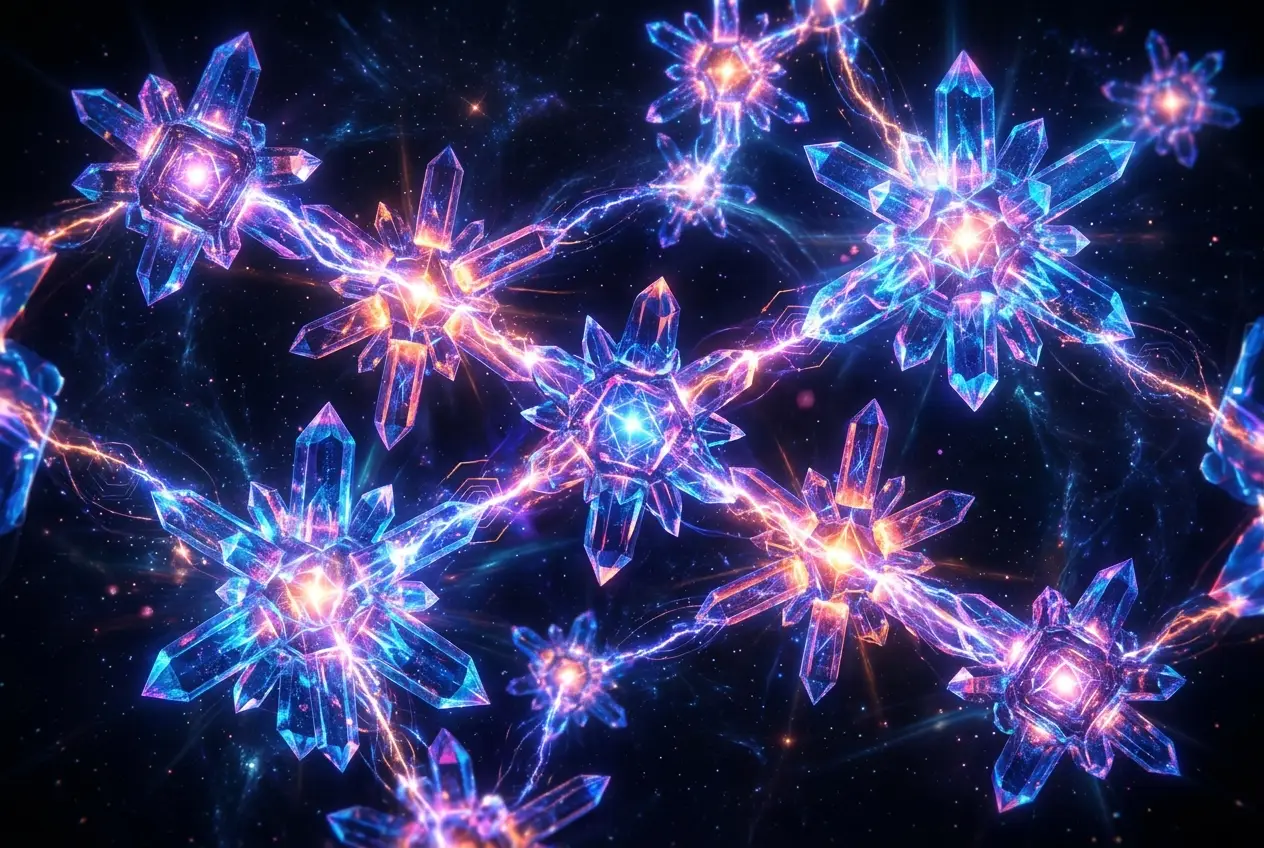
Before diving into the temporal, let's briefly revisit spatial crystals. Think of a diamond or a snowflake. These are everyday examples of crystals, where atoms arrange themselves in a perfectly repeating pattern in space. This spatial periodicity is stable and requires energy to break. Once formed, they maintain this ordered structure indefinitely, given stable conditions. Their stability comes from reaching a minimal energy state, where the atoms are locked into positions that minimize their collective energy. This is a crucial concept to grasp when we consider their temporal cousins.
In a normal crystal, the system settles into a state where its energy is as low as possible. In this state, atoms vibrate a little but don't spontaneously move or reconfigure themselves. This is their ground state, where any further decrease in energy is impossible. This state is static, unchanging over time, perfectly obeying time-translation symmetry.
What Exactly is a Time Crystal?
A time crystal, however, is something fundamentally different. Imagine a system where its constituent particles spontaneously enter a repeating, oscillating pattern in time—not just once, but perpetually—even in its ground state. This is the hallmark of a time crystal: it breaks time-translation symmetry. Instead of repeating in space, its fundamental pattern repeats in time. It behaves like a tiny, self-sustaining clock that ticks forever without needing a battery or external push.
This isn't about perpetual motion in the classical sense, which violates the laws of thermodynamics. Time crystals don't produce usable work from nothing. Instead, they represent a fascinating loophole in how we define equilibrium and ground states in quantum mechanics. They don't heat up or transfer energy out; they simply exist in a state of continuous, coherent oscillation.
The concept was first proposed by Nobel laureate Frank Wilczek in 2012, who theorized about a new phase of matter that could exhibit a periodic motion in its lowest energy state. Initially, many physicists were skeptical, believing such a state would violate the laws of thermodynamics. How could something be in constant motion without continuously expending energy? The answer lies in the subtle world of quantum mechanics and non-equilibrium systems.
“The most beautiful thing we can experience is the mysterious. It is the source of all true art and science.” – Albert Einstein (Attributed)
How Do They Work? The Quantum Twist
The key to understanding time crystals lies in a phenomenon called many-body localization (MBL). In most quantum systems, if you add energy, it quickly spreads throughout the system, leading to thermalization – the system reaches a state of uniform temperature and disorder. MBL is a quantum phenomenon where particles in a disordered system fail to thermalize, even when you pump energy into them. Instead, they become localized and "remember" their initial quantum state for an extraordinarily long time.
This resistance to thermalization is crucial for time crystals. Without it, any periodic motion would quickly dissipate into heat, and the system would settle into a static ground state. MBL allows a system to maintain quantum coherence and order, even when driven out of equilibrium, providing the stability for time crystals to exist.
The first experimental realization of time crystals occurred in 2017, almost simultaneously, by two independent research teams at the University of Maryland and Harvard University. They didn't find "continuous" time crystals, which were initially thought to be impossible, but rather discrete time crystals (DTCs).
Discrete Time Crystals: The Experimental Breakthrough
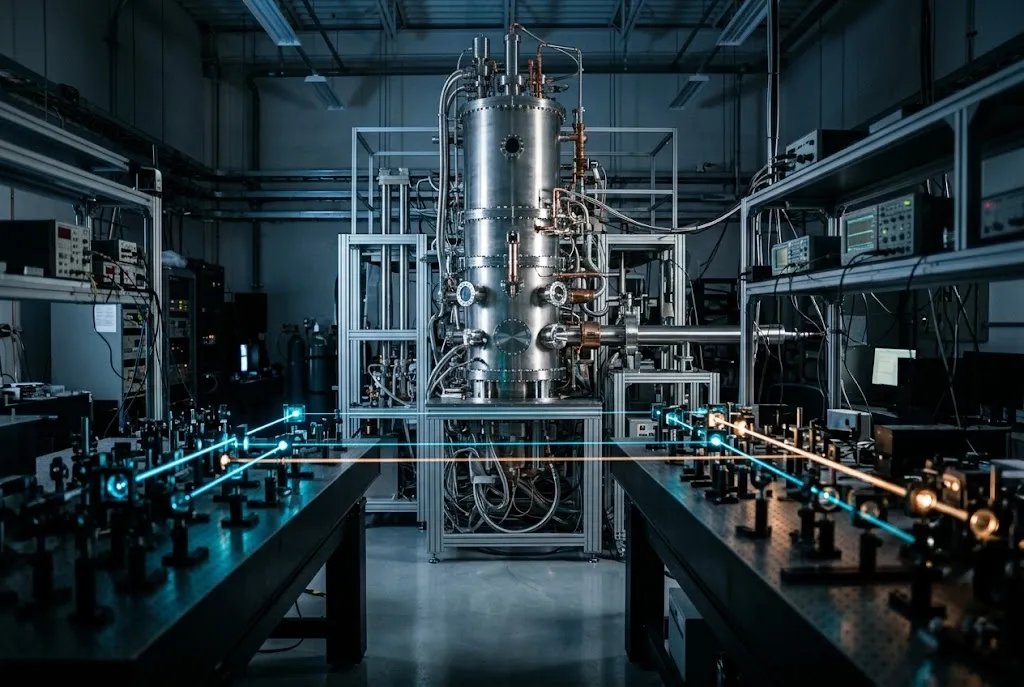
Discrete time crystals are created by periodically "driving" a system with a laser or microwave pulse. Think of it like pushing a swing at regular intervals. What makes DTCs so special is that they respond by oscillating at a different frequency than the driving force, typically at half the frequency (a subharmonic oscillation). And they maintain this oscillation even when the external drive is turned off, or in this case, even as they remain in their lowest energy state with respect to the drive.
In the Harvard experiment, scientists used a chain of 10 entangled ytterbium ions. They hit the ions with two lasers, causing the ions' spins to flip. Instead of flipping with every laser pulse, the spins flipped only every other pulse, exhibiting a subharmonic rhythm. This persistent, spontaneous, synchronized flipping at half the driving frequency, without losing energy to its surroundings, was the signature of a discrete time crystal. You can read more about how scientists achieve this delicate balance of quantum states on Wikipedia's Time Crystal page (opens in a new tab).
This breakthrough was a monumental step, confirming that matter can indeed possess intrinsic temporal order, a concept previously thought impossible for systems in thermal equilibrium. It's a testament to the strange and wonderful rules of quantum mechanics that continue to challenge our classical intuitions.
Breaking Symmetry, Not Laws
So, do time crystals break the laws of physics? No, they don't violate the fundamental laws of thermodynamics. They don't offer a pathway to free energy or perpetual motion machines in the classical sense. Instead, they demonstrate a spontaneous breaking of time-translation symmetry. This is analogous to how a spatial crystal spontaneously breaks translational symmetry; while the laws of physics are the same everywhere, a crystal chooses a specific repeating pattern, breaking the continuous symmetry of space. You can learn more about spontaneous symmetry breaking in physics on Wikipedia (opens in a new tab).
Time crystals exist in a non-equilibrium phase of matter. This distinction is critical. Most of our understanding of matter phases (solids, liquids, gases) applies to systems in thermal equilibrium. Time crystals thrive when they are perpetually out of equilibrium, being constantly driven by an external force (like the laser pulses), yet managing to maintain their coherent, periodic motion without absorbing energy and heating up. This is where many-body localization plays its crucial role, preventing the energy from dissipating. For systems not subject to MBL, the concept of a ground state is typically one of thermal equilibrium where all motion ceases. More on this crucial concept can be found on Wikipedia's Ground State article (opens in a new tab).
Implications and Future Frontiers
The discovery and realization of time crystals open up fascinating avenues for research and potential applications.
1. Fundamental Physics: Time crystals push the boundaries of condensed matter physics and our understanding of what constitutes a "phase of matter." They offer a new lens through which to explore non-equilibrium dynamics and the interplay between quantum mechanics and statistical mechanics. They deepen our understanding of concepts like many-body localization, a state where quantum systems resist thermalization, further explored on Wikipedia's Many-body localization page (opens in a new tab).
2. Quantum Computing: One of the biggest challenges in quantum computing is decoherence, where quantum states lose their coherence due to interaction with their environment. Time crystals, with their inherent stability and ability to maintain coherent oscillation even under external driving, could potentially offer new ways to store and process quantum information, leading to more robust quantum computers. This idea aligns with some of the mind-bending possibilities we discussed in our blog about how can quantum computers break time's rules.
3. Ultra-Precise Clocks and Sensors: The stable, inherent periodicity of time crystals makes them potential candidates for incredibly precise timekeeping devices or highly sensitive sensors. Their ability to maintain a consistent rhythm could lead to advancements far beyond current atomic clocks.
4. New Materials: The principles governing time crystals might inspire the design of novel materials with exotic temporal properties, leading to unforeseen technological applications. Just as we're constantly decoding reality for extra dimensions, uncovering new states of matter continues to expand our understanding of the cosmos and its potential.
The Mystery Unfolds
The journey into time crystals is still in its early stages. While discrete time crystals are a reality, the search for "continuous" time crystals – those that spontaneously exhibit temporal order without any external driving – remains an open question, and current theories suggest they might be impossible in an isolated system.
The universe continues to unveil its secrets, often in ways that challenge our most cherished assumptions. Time crystals serve as a powerful reminder that our understanding of reality, while extensive, is far from complete. They are a profound example of how strange and beautiful the quantum world truly is, inviting us to keep exploring the enigmatic phenomena, much like we delve into whether dark matter hides an invisible universe. What other surprises lie hidden in the fabric of space and time, waiting for us to discover? Only curiosity and rigorous scientific inquiry will tell.



Conversation0
No comments yet. Be the first to share a thought — the best questions often become new stories.