


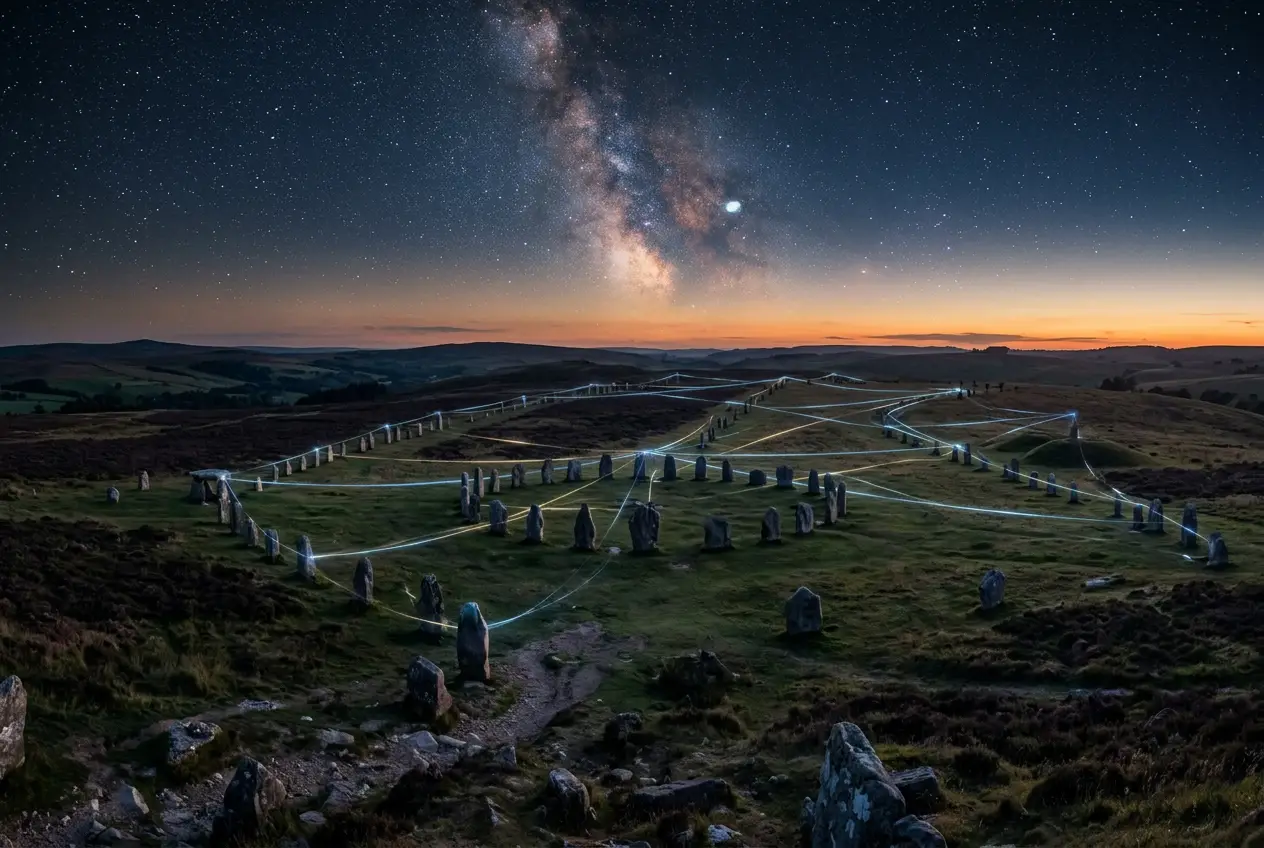
I remember standing before the towering stones of Carnac in Brittany, France, a labyrinth of over 3,000 megaliths stretching across fields, perfectly aligned in rows. The sheer scale and precision of these ancient monuments, erected thousands of years ago by cultures we often dismiss as primitive, absolutely captivated me. It wasn't just the physical effort that struck me, but the profound sense of intention behind their placement. These aren't random rocks; they are carefully positioned, geometrically precise, and often astronomically aligned. It made me wonder: what if these incredible structures weren't just solitary temples or burial sites, but components of something far grander – an ancient, Earth-spanning network, a precursor to our modern internet, built from stone and cosmic insight?
This idea, that ancient megalithic sites across the globe might be interconnected, forming a kind of planetary grid or even a "cosmic computer," has fascinated researchers and theorists for decades. It challenges our conventional understanding of prehistoric capabilities and hints at a lost science, a sophisticated knowledge of Earth's energies and celestial mechanics that predates written history. Could our ancestors have harnessed invisible forces to create a global system of communication, navigation, or even energy generation?
Decoding the Enigma of Megalithic Structures
When we talk about megaliths, we're referring to massive stones used to construct monuments, often without mortar. They span diverse cultures and geographies, from the iconic Stonehenge in England to the dolmens of Korea, the ancient temples of Malta, and the enigmatic Nazca Lines in Peru (though the lines are geoglyphs, they often fall into discussions of ancient large-scale design). What unites them, beyond their monumental scale, is an often baffling level of precision and alignment.
What is a Megalith? Megaliths are typically found in the Neolithic and Bronze Age periods. The word itself comes from Greek: megas (great) and lithos (stone). These structures include standing stones (menhirs), stone circles (cromlechs), and chamber tombs (dolmens or passage graves). The engineering feats involved in quarrying, transporting, and erecting these colossal stones are impressive even by modern standards. For a deeper dive into these ancient marvels, you can explore the topic of Megalith on Wikipedia.
The Precision Paradox: How Did They Do It?
One of the most compelling arguments for an advanced understanding lies in the remarkable precision of these sites. Many megaliths are meticulously aligned with celestial events: solstices, equinoxes, and specific lunar and stellar positions. For example, the famous heel stone at Stonehenge aligns perfectly with the sunrise on the summer solstice. Newgrange in Ireland, an ancient passage tomb, is illuminated by the rising sun only once a year, on the winter solstice, reaching its innermost chamber.
This wasn't just rudimentary sky-watching. It required centuries of systematic observation, sophisticated mathematical understanding, and highly accurate surveying techniques. How did these ancient builders, without compasses or advanced optics, manage to achieve such exact orientations over vast landscapes? The fact that many different cultures, separated by oceans and millennia, exhibited similar astronomical knowledge is a profound mystery. I often find myself wondering if they possessed an intuitive grasp of the cosmos that we, with all our technology, have perhaps lost.
Furthermore, there’s evidence of intricate geometrical relationships between distant sites. Researchers like Alfred Watkins, who coined the term "ley lines" in the early 20th century, proposed that many ancient sites were deliberately placed along straight lines across the landscape. While initially dismissed as pseudoscience, the concept of ley lines suggests a purposeful arrangement, perhaps for navigation, territorial marking, or even energetic purposes. You can read more about this fascinating concept on the Ley Line Wikipedia page.
Earth's Hidden Energies: The Global Network Hypothesis
The idea that megalithic sites form a "global network" goes beyond simple geographical alignments. It often posits that these structures were strategically placed to interact with Earth's natural energy fields. Our planet is crisscrossed by various energetic phenomena: geomagnetic fields, telluric currents (electrical currents flowing underground), and subtle geological stresses.
Some theories suggest that ancient cultures were acutely aware of these energies and designed megaliths to either tap into, amplify, or transmit them. Imagine these structures acting like acupressure points on a planetary body, or resonant circuits tuning into Earth's natural frequencies. This is not purely speculative; there’s some intriguing evidence:
- Magnetic Anomalies: Studies at certain megalithic sites have detected subtle magnetic anomalies, suggesting that the stones themselves might have been chosen for their specific magnetic properties or that their placement influences the local geomagnetic field.
- Acoustic Resonance: Many ancient chambers and structures exhibit remarkable acoustic properties, amplifying sounds or creating specific resonant frequencies. Could these have been used for communication, healing, or even altering states of consciousness? This ties into theories explored in blogs like "Did Ancient Structures Resonate With Earth's Frequencies?"
The theory suggests these sites weren't just aligned with the stars, but also with each other, forming a planetary "grid." This grid, some propose, could have served multiple purposes:
- Communication: A network for transmitting information, perhaps through resonant frequencies or subtle energy pulses.
- Navigation: Guiding travelers across vast distances, using the energy points as markers or beacons. This could be an evolved form of celestial navigation, as discussed in "Did Ancient Mariners Sense Unseen Cosmic Cues?".
- Energy Harvesting: Tapping into telluric currents or other Earth energies for purposes we don't yet understand, possibly for localized power or to sustain the network itself.
- Data Storage/Prediction: Functioning as a massive, distributed "computer" to track cosmic cycles, predict astronomical events, or even record geological phenomena. This resonates with the idea explored in "Did Ancients Code Planets Into Stone?" and "Did Ancient Structures Track Cosmic Particles?".
The Cosmic Computer: More Than Just Stones
The leap from aligned stones to a "cosmic computer" requires a shift in perspective. A computer isn't just silicon and wires; it's any system capable of processing, storing, and transmitting information. If these megaliths were intentionally placed nodes within a planetary energy grid, they could collectively function as a complex system for understanding and interacting with the cosmos.
Imagine a network of sites that, through their precise alignments and material properties, could:
- Track Celestial Mechanics: Predict eclipses, planetary movements, and stellar cycles with remarkable accuracy. This goes beyond simple observation to active modeling.
- Monitor Geophysical Changes: Detect changes in Earth's magnetic field, seismic activity, or even weather patterns, potentially sharing this "data" across the network.
- Encode Knowledge: Act as a giant mnemonic device or a distributed archive, encoding vast amounts of astronomical, geological, and spiritual knowledge into their very construction and placement. This echoes some theories about "Quipu: Did Inca Knots Encode Cosmic Data?", but on a grander scale.
"The greatest mystery is not that we don't know what these structures were, but that we don't know what they did together," a colleague once remarked, highlighting the systemic nature of this hypothesis. This concept forces us to reconsider the sophistication of ancient minds, suggesting they might have had an empirical, if not theoretical, understanding of principles we now associate with physics and engineering.
Skepticism and the Path Forward
It's important to approach these theories with a healthy dose of scientific skepticism. Many of the "lines" and "alignments" can be attributed to coincidence or pareidolia – our brain's tendency to find patterns where none exist. Proving a deliberate, interconnected global network with concrete evidence of energy transfer or data exchange is incredibly challenging, if not impossible, given the millennia that have passed.
However, the consistent patterns, the sheer scale of effort, and the shared knowledge across disparate cultures suggest that something more than random chance was at play. Modern archaeoastronomy and geophysics continue to uncover new details about the precision and unique properties of these sites. While we may never find a stone "motherboard" or a "power cord," ongoing research into the magnetic properties of stones, the acoustic resonance of chambers, and the subtle telluric currents flowing beneath our feet continues to shed light on the extraordinary ingenuity of our ancestors. For those interested in the scientific study of ancient astronomy, the Wikipedia page on Archaeoastronomy is an excellent resource.
Conclusion: A Legacy Etched in Stone
The idea that ancient megaliths formed Earth's first global network is a powerful narrative that challenges our preconceptions about prehistoric civilizations. It paints a picture of highly intelligent people who possessed a deep connection to their planet and the cosmos, using monumental architecture not just for ritual or burial, but perhaps as a sophisticated system for knowledge, communication, or even energy manipulation.
While definitive proof remains elusive, the curiosity these massive stones inspire is undeniable. They stand as silent testament to an incredible human capacity for innovation, observation, and grand vision. As I reflect on these wonders, I can't help but feel a profound sense of awe. They beckon us to look beyond the obvious, to question what we think we know, and to imagine a lost chapter of human history where the Earth itself was part of a cosmic computer, waiting for us to rediscover its operating system. Perhaps the answers aren't hidden in dusty scrolls, but etched into the very landscape of our planet.





Conversation0
No comments yet. Be the first to share a thought — the best questions often become new stories.