I often find myself gazing at the night sky, marveling at the vastness and the myriad of stars visible to the naked eye. It’s a profound experience, and it's easy to assume that our understanding of the cosmos, especially its hidden elements, is a purely modern achievement, driven by powerful telescopes and intricate computations. Yet, a fascinating question lingers: **could ancient cultures, without any modern instruments, have charted stars we couldn't even see?** This isn't about mere myth or legend; it's about compelling evidence and enduring mysteries that challenge our very perception of historical scientific advancement.
Recently, I was researching the origins of astronomy and stumbled upon an anomaly that truly captivated me. It wasn't about ancient civilizations tracking familiar constellations or predicting eclipses – impressive feats in themselves, but widely acknowledged. Instead, it concerned knowledge of celestial bodies so faint, so obscure, that they should have been utterly invisible to pre-telescopic observers. The most striking example comes from a remote corner of Africa, involving a people whose astronomical wisdom seems to defy the very limits of human vision.
## The Dogon's Cosmic Secret: Sirius B
The most famous and perplexing case involves the **Dogon people** of Mali, West Africa. For centuries, perhaps millennia, their oral traditions have spoken of a companion star to Sirius, the brightest star in our night sky. They call it *Po Tolo*, which they describe as incredibly small, immensely heavy, and invisible to the human eye. What makes this extraordinary is that *Po Tolo* perfectly matches the description of **Sirius B**, a white dwarf star that orbits Sirius A.
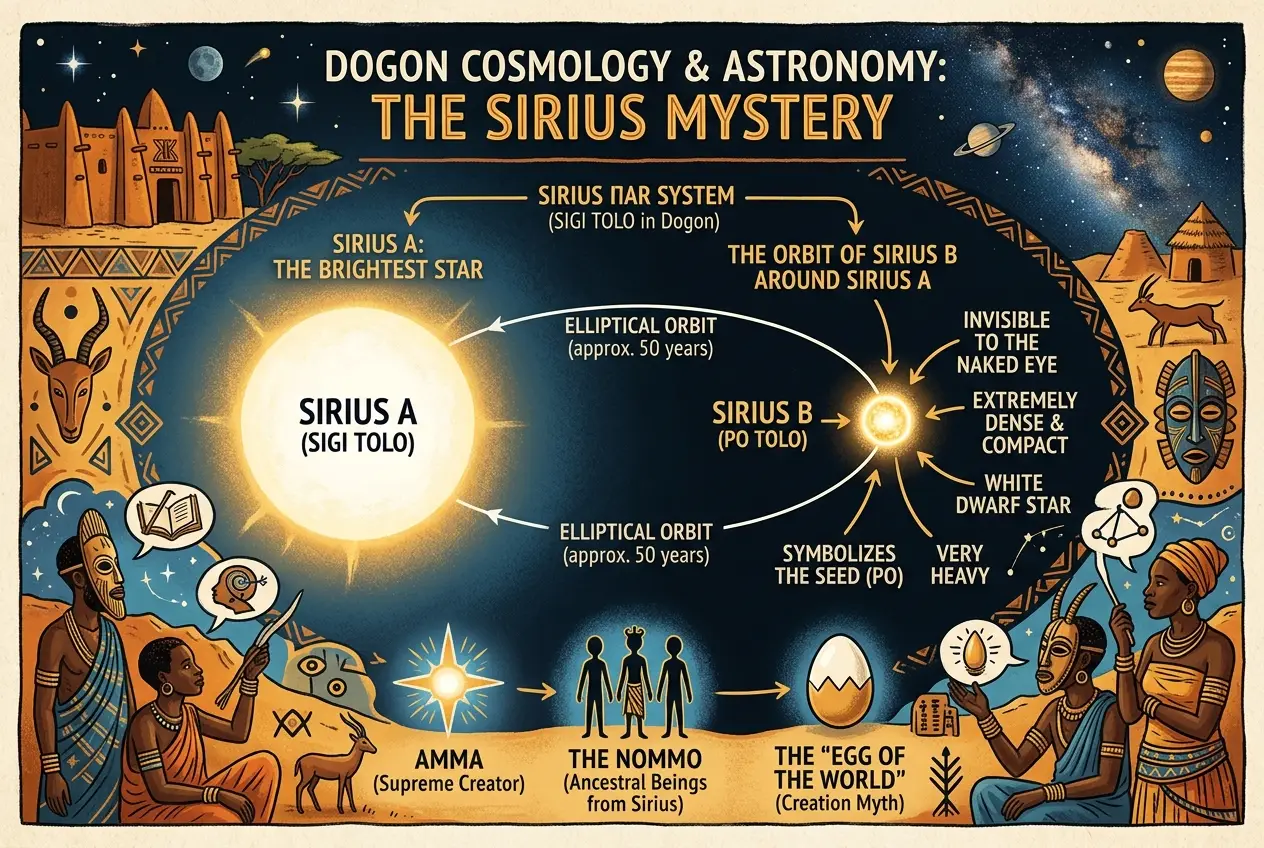
Sirius B is a staggering scientific marvel. It's a stellar remnant, a tiny, super-dense star that packs roughly the mass of our Sun into a sphere not much larger than Earth. Its light is so faint, overwhelmed by the brilliance of Sirius A, that it wasn't even *photographically confirmed* by Western astronomers until 1862 and wasn't visually observed through a powerful telescope until 1970. So, **how could the Dogon people know about it?**
Their knowledge goes beyond mere existence. Dogon traditions speak of Sirius B's 50-year orbital period around Sirius A, its invisible nature, and its incredible density. They also mention a third star in the system, *Emme Ya*, which remains unconfirmed by modern astronomy but fuels further curiosity. This isn't just a vague prophecy; it's a detailed astronomical description that seems impossibly precise for a culture without telescopes. As Walter van Beek, an anthropologist who studied the Dogon, remarked: "Although the Dogon have an elaborate system of astronomical lore, it is hard to ascertain what is ancient and what is new, without a long term study." This highlights the challenge of disentangling genuine ancient knowledge from later influences.
The mystery deepened when French anthropologists Marcel Griaule and Germaine Dieterlen published their findings in the 1930s and 40s, asserting the Dogon's detailed knowledge of Sirius B. Their work sparked immense debate, and I can see why. It presents a profound challenge to conventional historical narratives.
### Theories Behind the "Impossible" Knowledge
The question of the Dogon’s knowledge has spawned various theories, each with its own set of proponents and detractors:
1. **Pre-telescopic Observation:** Some suggest the Dogon might have developed incredibly sophisticated, perhaps unique, methods of naked-eye observation. While Sirius B is too faint to see directly, perhaps they observed subtle wobbles in Sirius A's motion, indicating an unseen gravitational pull. However, this level of precision would require observations over many human lifetimes, meticulous record-keeping, and an understanding of gravitational physics that feels anachronistic.
2. **Cultural Diffusion:** This theory proposes that the knowledge wasn't indigenous but transmitted from another culture that *did* have access to advanced astronomical information. Perhaps from ancient Egypt, which had deep astronomical roots, or even a lost civilization. But even then, the question shifts: where did *that* source get its information? The precise knowledge of Sirius B is absent in other ancient astronomical texts. You can read more about the Dogon people's cultural aspects on [Wikipedia](https://en.wikipedia.org/wiki/Dogon_people).
3. **Modern Contamination/Misinterpretation:** Skeptics argue that the anthropologists Griaule and Dieterlen might have either misinterpreted Dogon myths, unknowingly introduced modern astronomical concepts to the Dogon during their interviews, or that the Dogon, in turn, integrated modern knowledge acquired from missionaries or other travelers into their existing traditions to please the researchers. This is a crucial point, as the exact timing of when the Dogon acquired this knowledge is difficult to pinpoint.
4. **"Extra-terrestrial" Influence:** This is perhaps the most dramatic, yet least scientifically accepted, theory. It posits that the Dogon's knowledge came from visitors from outer space, an idea popularized by Robert Temple in his book *The Sirius Mystery*. While fascinating, it lacks any empirical evidence and falls into the realm of pure speculation rather than scientific inquiry.
## Beyond Sirius B: Other Whispers of Hidden Celestial Knowledge
While the Dogon-Sirius B connection remains the most prominent example, it isn't the only instance where ancient astronomical understanding seems to stretch the boundaries of what was possible.
* **Uranus in Ancient China:** Some historical records suggest Chinese astronomers might have documented Uranus as early as 2,000 years before its official "discovery" by William Herschel in 1781. Uranus is technically visible to the naked eye under ideal conditions, but its slow movement and dimness make it incredibly difficult to distinguish from an ordinary star without optical aid or long-term, precise positional tracking. Could ancient observations of **stellar parallax** have provided clues, or perhaps their dedicated celestial mapping allowed for subtle distinctions? Such detailed mapping efforts are explored in our post, [Did Ancient Star Maps Predict Cosmic Events?](/blogs/did-ancient-star-maps-predict-cosmic-events-9973).
* **Ancient Supernovae Observations:** Many cultures, including the Chinese and indigenous North Americans, recorded supernovae – the violent explosions of dying stars. While bright supernovae are naked-eye visible, accurately charting their appearance and fading, sometimes hundreds or thousands of years before corresponding Western records, speaks to incredibly diligent and systematic sky-watching.
* **Naked-Eye Observatories:** Many ancient civilizations built elaborate observatories, like those described in [Were Ancient Observatories Also Cosmic Clocks?](/blogs/were-ancient-observatories-also-cosmic-clocks-8259), to meticulously track celestial movements. While primarily for calendars and ritual, the precision required for these could, theoretically, lead to incidental discoveries of faint objects or anomalous motions.
These examples, while not as stark as Sirius B, collectively suggest a level of astronomical dedication and potentially a different paradigm of observation that we might not fully appreciate today.
## The Science of Seeing the "Invisible"
To truly grasp the Dogon mystery, it helps to understand why Sirius B is so challenging to observe.
| Feature | Sirius A (Visible Star) | Sirius B (White Dwarf) |
| :------------ | :---------------------------------------------- | :----------------------------------------------------- |
| **Size** | ~2 times the radius of the Sun | ~0.0084 times the radius of the Sun (~Earth's size) |
| **Mass** | ~2.02 times the mass of the Sun | ~1.02 times the mass of the Sun |
| **Luminosity**| ~25 times the luminosity of the Sun (very bright)| ~0.0025 times the luminosity of the Sun (very dim) |
| **Density** | ~1.4 g/cm³ (similar to water) | ~2.37 x 10⁶ g/cm³ (extremely dense, "heavy" star) |
| **Visibility**| Naked-eye visible, brightest star in night sky | Invisible without powerful telescopes, masked by Sirius A|
This table clearly illustrates the immense difference in properties. Sirius B is not just "dim," it's incredibly faint relative to its brilliant companion, making it almost impossible to resolve without significant magnification and specific filters to block out Sirius A's glare. The concept of a **white dwarf** itself – a star that has exhausted its nuclear fuel and collapsed into a super-dense state – is a relatively modern scientific understanding, based on principles of quantum mechanics. Learn more about white dwarfs on [Wikipedia](https://en.wikipedia.org/wiki/White_dwarf).
For ancient cultures to describe its characteristics so accurately without any known technology capable of observing it suggests either a profound, intuitive grasp of stellar evolution, an unparalleled observational method, or perhaps knowledge passed down from a source we don't yet understand. It echoes the historical thought experiments of ancient Greek thinkers like Democritus, who conceptualized the "atom" millennia before it could be observed, as discussed in [Ancient Atoms: Did Greek Thinkers Foresee Quantum?](/blogs/ancient-atoms-did-greek-thinkers-foresee-quantum-4841).
## An Enduring Challenge to History
The Dogon mystery and similar astronomical anomalies present a fascinating challenge to our understanding of human intellectual history. They force us to consider that perhaps our timeline of scientific discovery isn't as linear or as complete as we often assume. Could there be lost forms of observation, or perhaps ancient knowledge systems that allowed for insights into the natural world we're only just beginning to rediscover?
The skepticism surrounding the Dogon narrative is healthy and necessary for scientific rigor. Yet, the enduring enigma compels us to keep asking questions, to look beyond the obvious, and to acknowledge that the universe, and humanity's ancient interactions with it, still hold countless secrets waiting to be unveiled. It is a potent reminder that curiosity is a timeless human trait, driving us to chart the seen and the unseen, across millennia.
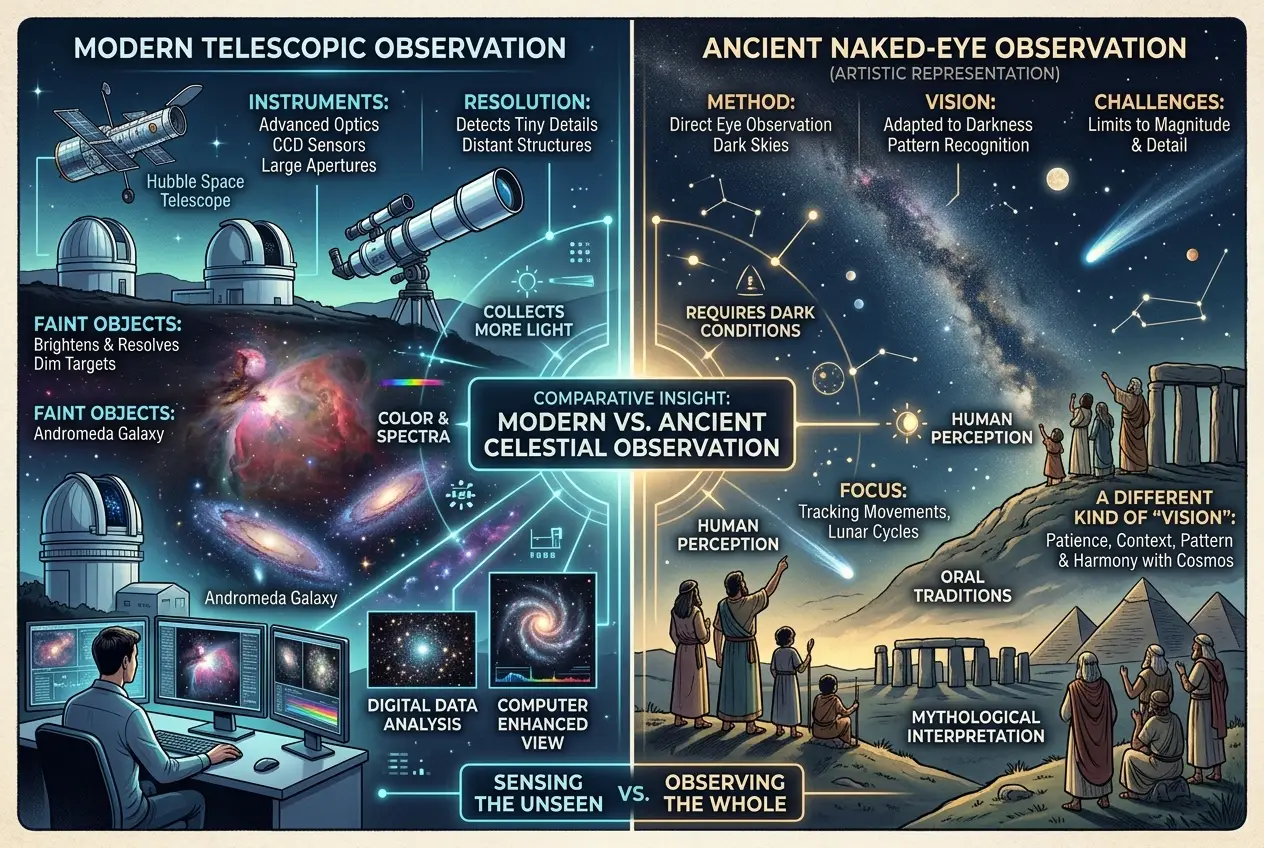
Ultimately, whether the Dogon's knowledge came from incredibly acute observation, undocumented historical contact, or a unique form of cultural insight, the fact remains that their traditions speak of a star that should have been utterly beyond their reach. It's a cosmic riddle whispered across centuries, inviting us to rethink the boundaries of ancient wisdom.
Frequently Asked Questions
Sirius B is a white dwarf star, incredibly dense and faint, making it invisible to the naked eye. Its significance lies in the Dogon people's detailed ancient knowledge of its existence, orbital period, and physical properties, long before modern astronomy confirmed them with powerful telescopes.
The main theories include pre-telescopic observation (highly unlikely), cultural diffusion from another advanced civilization, modern contamination or misinterpretation by anthropologists, and fringe theories like extraterrestrial contact. Each theory has its own set of arguments and criticisms.
While not as extensively debated as Sirius B, some ancient Chinese astronomical records might suggest observations of Uranus much earlier than its Western discovery. Additionally, various cultures accurately charted supernovae, which are visible but require meticulous, long-term observation to fully understand.
It's difficult because the evidence relies heavily on oral tradition, which can evolve over time, and ethnographic interpretations from decades ago. Disentangling genuine ancient knowledge from later influences or potential miscommunications between researchers and the Dogon people is a complex anthropological challenge.
It challenges our understanding by suggesting that ancient civilizations might have possessed observational techniques, conceptual frameworks, or even inherited knowledge that allowed them to grasp aspects of the cosmos beyond what we typically attribute to their technological capabilities. It encourages a reevaluation of the history of science and human ingenuity.
Verified Expert
Alex Rivers
A professional researcher since age twelve, I delve into mysteries and ignite curiosity by presenting an array of compelling possibilities. I will heighten your curiosity, but by the end, you will possess profound knowledge.
Leave a Reply
Comments (0)
No approved comments yet. Be the first to share your thoughts!
 Join Us

 Unknown Author


















Leave a Reply
Comments (0)