



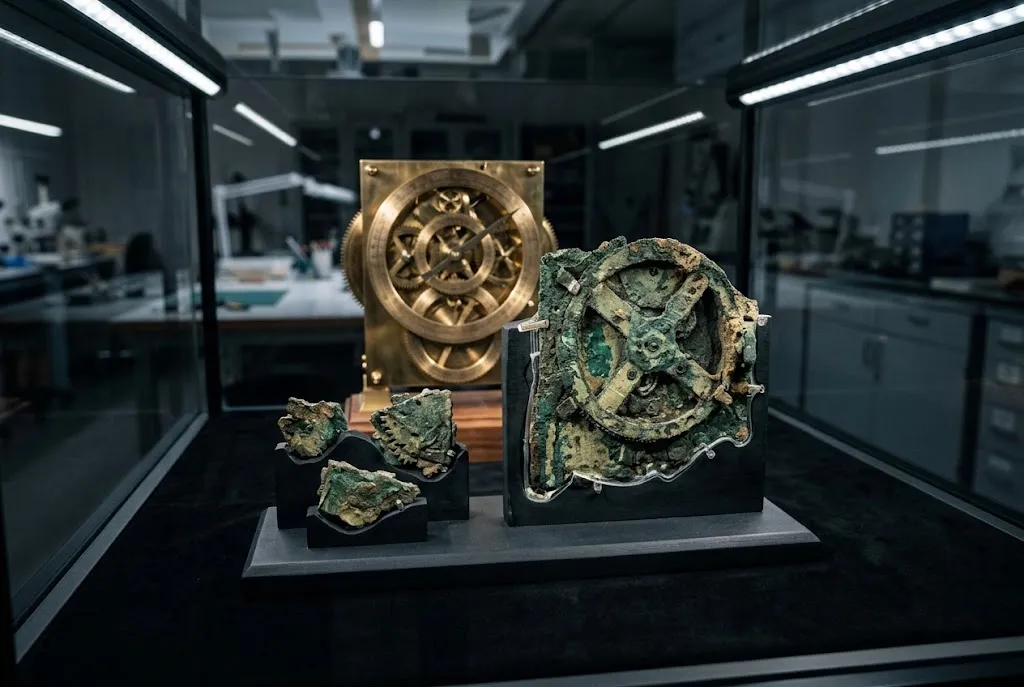
I remember a moment in a dusty museum, staring at an artifact that seemed so simple yet held such profound mystery. It was a collection of knotted cords, seemingly innocuous, yet its presence evoked an almost reverent silence. This wasn't just a rope; it was a quipu, one of the most enigmatic "technologies" to emerge from the ancient Inca Empire. We often marvel at the Antikythera mechanism as an ancient cosmic computer, but what if another civilization, without gears or bronze, encoded similar cosmic secrets using nothing but textile and knots?
The Inca Empire, sprawling across the Andes, was an administrative marvel. Yet, unlike virtually every other complex civilization, they left no written language as we understand it. No hieroglyphs, no cuneiform, no alphabets. Instead, they had the quipu. For centuries, these intricate arrangements of cotton or camelid fiber cords have puzzled archaeologists and linguists alike. We know they were used for keeping meticulous records—census data, tax records, even historical accounts. But the lingering question, one that continues to fuel intense research, is: Did Inca knots encode cosmic data? Were these tactile "computers" capable of charting the heavens, predicting celestial events, and storing a universe of knowledge in their silent loops?
What Exactly is a Quipu? The Incas' Unique Information System
Imagine a central cord, from which numerous pendant cords hang. From these pendant cords, even more subsidiary cords might dangle, creating a complex, hierarchical structure. Each cord is adorned with knots of various types, positions, and combinations. This, in essence, is a quipu. The materials themselves were significant – cotton for coastal regions, alpaca or llama wool for the highlands. The color of the cords, the direction of the ply (S-twist or Z-twist), and the way the knots were tied all held meaning.
"The quipu," notes Dr. Gary Urton, a leading expert on Inca knots from Harvard University, "is not a simple abacus. It is a highly sophisticated system of information storage and retrieval, fundamentally different from any other known writing system." Indeed, it challenges our very definition of what constitutes writing or data storage.
Key Components of a Quipu:
- Main Cord: The horizontal cord from which other cords are suspended.
- Pendant Cords: Vertical cords attached to the main cord.
- Subsidiary Cords: Cords attached to pendant cords, forming sub-levels.
- Knots: The primary means of encoding information, typically grouped in clusters.
Beyond Numbers: The Enigma of Narrative Quipu
For a long time, scholars believed quipus were primarily mnemonic devices for numerical data, essentially sophisticated abacuses. And for numerical records, they were incredibly effective. A decimal system was evident: knot clusters closer to the main cord often represented higher values (hundreds, thousands), while those further down denoted units and tens. This system allowed the Inca Empire to manage its vast resources, administer taxes, and track populations with impressive precision. The quipucamayocs, the official quipu keepers, were highly trained individuals entrusted with interpreting and creating these records.
However, the mystery deepens when we consider the possibility of narrative quipu. Some researchers hypothesize that certain quipu were designed to store non-numerical information—stories, laws, genealogies, or even historical narratives. If true, this would mean the Inca developed a unique form of three-dimensional writing, a physical "text" woven from fibers. The challenge lies in deciphering the code. How would a concept like "the valiant warrior fought bravely" be represented in knots?
This is where the idea of the quipu as an ancient "information system" truly comes alive. It's not just about counting llamas; it's about encoding complex ideas without relying on phonetic symbols. Imagine a world where every twist, every color, every knot type is a potential key to an unfolding narrative. It suggests a level of abstract thinking and systematic encoding that rivals, in its own way, the intricate logic gates of modern computers.
Cosmic Connections: Charting the Andean Sky
The Inca, like many ancient civilizations, were astute observers of the cosmos. Their cosmology was deeply intertwined with their daily lives, agriculture, and spiritual beliefs. They tracked the movements of the sun, moon, and stars, understanding solstices and equinoxes crucial for their farming cycles. Sacred sites like Machu Picchu and Pisac feature astronomical alignments, demonstrating their advanced knowledge of celestial mechanics. You can read more about how other cultures may have done this in our blog post, "Did Ancient Cultures Map Invisible Skies?".
Given this sophisticated astronomical understanding, the question naturally arises: could quipu have encoded cosmic data? Perhaps specific patterns of knots or cords represented constellations, planetary orbits, or cycles of lunar eclipses. The lengths of cords might correspond to astronomical periods, and the types of knots could denote different celestial bodies or phenomena. For instance, a specific color might represent the Milky Way (which the Inca called Mayu, the Celestial River), while a unique knot combination could signify a meteor shower or a significant conjunction.
Consider the complexity of predicting astronomical events. A "cosmic computer," whether mechanical like the Antikythera or conceptual like the quipu, needs to process various inputs (observations) and generate outputs (predictions or records). If quipu could record census data across vast territories, it's not a leap to imagine them recording astronomical observations across vast spans of time. They could be chronological records of celestial movements, serving as a dynamic calendar or even a predictive model for future events.
Deciphering the Lost Language: Modern Quest for Understanding
The quest to fully decipher the quipu is one of archaeology's greatest challenges. Sadly, many quipu, and the quipucamayocs who understood them, were destroyed during the Spanish conquest. The systematic suppression of Inca culture meant that the keys to this unique "language" were largely lost.
Modern research, however, is making slow but steady progress. Scholars like Gary Urton have been meticulously cataloging and analyzing the surviving quipu, searching for statistical patterns and recurring motifs that might hint at their deeper meaning. They employ computational methods, comparing knot densities, cord lengths, and color variations, hoping to find a "Rosetta Stone" that could unlock their secrets. This mirrors attempts to decipher other ancient data systems, as explored in "Phaistos Disc: Ancient Data or Lost Code?".
Urton's work suggests that a binary-like system might be embedded within the quipu structure, where the twist direction of a cord (S-twist or Z-twist) could represent a fundamental unit of information, similar to a "bit" in modern computing. If true, this implies an incredibly advanced understanding of data encoding for its time. You can learn more about Gary Urton's significant contributions to quipu research on Wikipedia (opens in a new tab).
The Quipu as a Precursor to Information Technology
Thinking about the quipu as a precursor to information technology offers a fascinating perspective. It was a portable, scalable, and robust system for storing and transmitting complex data across a vast empire. In an age before paper or widespread literacy, the quipu provided a tangible, tactile medium for knowledge. It required specialized "processors" (the quipucamayocs) to operate, much like early computers required human operators and programmers.
Could this unique system be considered an ancient form of distributed computing, where information was recorded, compiled, and interpreted across different regions by skilled individuals? The parallel with modern data centers, albeit highly analog, is intriguing. It reminds us that "technology" isn't solely defined by circuits and silicon, but by any ingenious method humans devise to solve problems and manage information. Sometimes, the most impossible artifacts hint at lost ancient tech, a concept explored in "Impossible Artifacts: Clues to Lost Ancient Tech".
Why Unlocking Quipu Secrets Matters
If quipu did indeed encode cosmic data, historical accounts, or complex narratives, its full decipherment would revolutionize our understanding of the Inca Empire. It would reveal a civilization far more sophisticated in its intellectual and scientific pursuits than previously imagined. It would be a testament to the diverse ways human intelligence has developed methods for understanding and interacting with the world.
Moreover, it broadens our perspective on the evolution of information technology itself. The quipu reminds us that the fundamental challenge of storing, processing, and retrieving data is universal, and ancient cultures often found remarkably inventive, non-obvious solutions. The Inca Empire, a civilization that managed to sustain millions across a challenging terrain without a conventional written language, offers a profound lesson in the power of innovation. You can delve deeper into the history and achievements of the Inca Empire on Wikipedia (opens in a new tab).
Conclusion: A Universe of Knots Awaiting Discovery
The quipu remains one of history's most compelling mysteries. Was it merely a bureaucratic tool, or did it hold the keys to Inca cosmology, their understanding of the stars, their histories, and perhaps even their prophecies? As researchers continue their painstaking work, one can only imagine the revelations that might emerge from these silent, knotted cords. Each knot might be a whispered word, each cord a celestial path, waiting for us to finally learn its language and unlock the cosmic data of the ancient Andes. The universe of knowledge encoded within these fibers still beckons, promising to reshape our understanding of ancient ingenuity and the very nature of information itself.



Conversation0
No comments yet. Be the first to share a thought — the best questions often become new stories.