


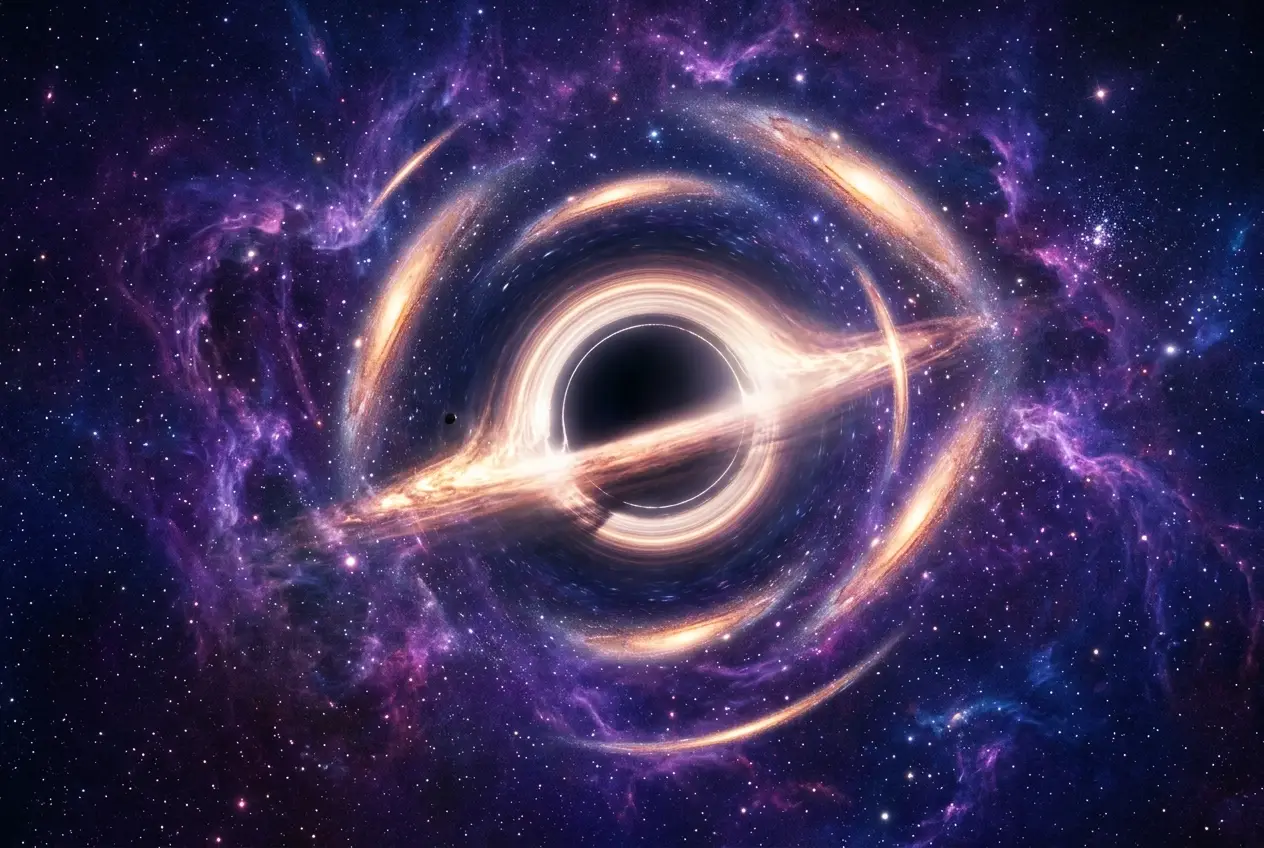
I remember the first time I truly grasped the concept of gravitational lensing. It wasn't in a textbook, but watching a documentary, seeing those incredible, distorted arcs of light from faraway galaxies. It felt like a cosmic magic trick, a celestial magnifying glass wielded by the universe itself. But then a thought struck me: if the universe can bend light in such extraordinary ways, could this phenomenon be more than just a scientific spectacle? Could it be a hidden highway, a cosmic amplifier for messages from advanced extraterrestrial civilizations?
The question gnaws at my curiosity. We spend billions searching for intelligent life, scanning the skies with radio telescopes, hoping to pick up a whisper in the cosmic static. What if the messages aren't whispers, but rather carefully aimed signals, magnified and directed by the very fabric of spacetime? What if we've been looking for a direct line when the universe itself offers a relay station? This isn't just science fiction; it’s a fascinating corner where physics meets the profound possibilities of alien intelligence.
The Universe's Natural Magnifying Glass: Gravitational Lensing Explained
Gravitational lensing is one of the most compelling predictions of Albert Einstein's theory of general relativity. Imagine a massive object – a galaxy, a cluster of galaxies, or even a black hole – positioned between a distant light source (like another galaxy or quasar) and an observer (us). This massive object, known as the "lens," warps the fabric of spacetime around it. As light from the distant source travels through this warped space, its path is bent, much like light passing through a glass lens.
The result is truly spectacular: the distant light source can appear distorted, magnified, or even multiplied into several images. Sometimes, the alignment is so perfect that the light forms a complete or partial ring around the lensing object, a phenomenon beautifully named an Einstein Ring. This isn't just a theoretical construct; we've observed countless examples of gravitational lensing across the cosmos, providing crucial evidence for general relativity and offering astronomers unique insights into distant galaxies and the elusive dark matter that makes up much of the universe's mass. You can dive deeper into the science of gravitational lensing on its Wikipedia page (opens in a new tab).
Types of Lensing: From Strong to Microlensing
Gravitational lensing manifests in various forms, each offering different opportunities:
- Strong Lensing: This occurs when the lens is extremely massive (like a galaxy cluster) and produces dramatic distortions, multiple images, or Einstein Rings. It allows us to see objects that would otherwise be too faint or too far away.
- Weak Lensing: Here, the lens is less massive, causing subtle, statistical distortions in the shapes of many background galaxies. While not as visually dramatic, weak lensing is invaluable for mapping the distribution of dark matter.
- Microlensing: This involves a much smaller, compact lens (like a star, brown dwarf, or even a planet) passing in front of a distant star. It doesn't produce multiple images but causes a temporary brightening of the background star as its light is magnified. Microlensing has become a powerful tool for discovering exoplanets, even those too distant for other methods.
The incredible precision and predictability of these gravitational lenses raise an intriguing question: could an advanced civilization harness this cosmic phenomenon for their own purposes, perhaps to transmit signals across vast interstellar distances?
The SETI Connection: Could Lenses Be Alien Beacons?
For decades, the Search for Extraterrestrial Intelligence (SETI) has primarily focused on detecting radio signals, assuming alien civilizations would broadcast like we do. But what if they're more sophisticated, leveraging natural cosmic phenomena? Imagine a civilization intentionally aligning a powerful signal with a massive cosmic lens – a galaxy, a black hole, or even a carefully chosen star system. The lens would then amplify and focus this signal, directing it towards specific points in the galaxy, including potentially Earth.
This isn't about simply building a bigger antenna; it's about using the universe's own architecture. A signal that might otherwise be undetectable could become a beacon, visible across light-years. The challenge, of course, is that these "natural antennas" are constantly in motion, and their alignments are transient. An alien civilization aiming such a signal would need a deep understanding of celestial mechanics and predictive astrophysics, far beyond our current capabilities.
"The cosmos is a vast ocean, and we are but a small boat on its surface. Gravitational lensing provides a unique opportunity to peer into its depths, not just for cosmic wonders, but potentially for signs of life." — Attributed to an astronomer, concept based on SETI discussions.
The idea of alien signals is not new to Curiosity Diaries. We've explored the enigmatic nature of potential alien tech in discussions like Is Oumuamua Alien Tech? and the subtle hints in Do Exoplanet Transits Hide Alien Tech?. Gravitational lensing adds another fascinating layer to this cosmic puzzle.
Challenges and Opportunities for Detection
Detecting such a lensed signal presents unique challenges. First, we wouldn't be looking for a continuously broadcast signal. Instead, we'd be searching for transient events, bursts of highly focused energy that appear when the alignment between the source, lens, and receiver (Earth) is just right. This would require sophisticated, rapid-response observational techniques.
Second, the signal itself might be unlike anything we currently search for. It might be compressed, highly directional, or encoded in a way we haven't anticipated. It could even be a "time-stamped" message, designed to be received when a specific lensing event occurs.
However, the opportunities are equally compelling. Gravitational lenses offer unprecedented magnification. A signal originating from a distant exoplanet that would normally be too weak to detect might be amplified by orders of magnitude. This could open up detection avenues for civilizations that are not necessarily "loud" broadcasters but rather efficient communicators using cosmic phenomena. The Square Kilometre Array (SKA), currently under construction, with its unparalleled sensitivity, might be the perfect instrument to search for these elusive, lensed signals.
The Role of Dark Matter and Cosmic Webs
Gravitational lensing isn't just about visible matter; it's profoundly influenced by the invisible dark matter that constitutes about 27% of the universe's mass. Dark matter doesn't emit or reflect light, but its gravitational pull warps spacetime, making it a powerful lense. This means that the cosmic lenses we observe are often dominated by dark matter halos.
The universe itself is structured like a vast, intricate web, with galaxies and galaxy clusters forming dense knots connected by filaments of dark matter. This "cosmic web" creates vast gravitational landscapes. Could an advanced civilization not only predict individual lensing events but potentially leverage the large-scale structure of the cosmic web as a gigantic, interconnected communication network? Imagine signals bouncing and amplifying along these cosmic filaments, a galaxy-spanning internet woven by gravity itself. We've previously touched on the mysteries of invisible cosmic components in Do Gravitational Waves Hold Universe's Hidden Data?, and gravitational lensing offers another perspective on these hidden cosmic influences.
From Passive Observation to Active Search
While current gravitational lensing studies primarily focus on using lenses for astrophysical observations (e.g., studying distant galaxies or measuring dark matter), the SETI community is slowly starting to consider active searches for lensed signals. This shift involves looking for specific signatures that distinguish a natural astrophysical phenomenon from a deliberately crafted message.
For instance, a lensed signal from an intelligent source might exhibit:
- Non-natural bandwidth or modulation: A highly organized, non-random signal pattern.
- Repetitive or patterned structure: Unlike the chaotic noise from natural cosmic events.
- Specific timing: Coordinated with precise lensing events, potentially even using multiple lenses in series for extremely powerful amplification.
These are incredibly difficult searches, requiring new algorithms and observational strategies. However, the potential payoff — making contact with an alien civilization — makes the effort worthwhile. It moves beyond the simple "Are you there?" question to "Are you using the universe's physics to tell us something?"
Future Prospects and the Call to Look Deeper
The next generation of telescopes, both ground-based and space-based, will dramatically improve our ability to detect and analyze gravitational lensing events. Projects like the Nancy Grace Roman Space Telescope, with its wide field of view and high resolution, will map even more lensing phenomena. This increased data will not only enhance our understanding of cosmology and dark matter but also provide a richer dataset for SETI researchers to scrutinize.
If advanced civilizations do exist and are using gravitational lensing for communication, then the signals are out there, waiting to be deciphered. It's a testament to the elegance of physics that the very forces shaping the universe could also be the medium for interstellar dialogue. As I consider the sheer scale and complexity of such an endeavor, I feel a renewed sense of wonder about what else the cosmos might be hiding, and what ancient, profound messages might be traveling along these invisible cosmic pathways. We must continue to push the boundaries of our understanding, not just of technology, but of the universe itself, for the answers might be woven into its very fabric.
The quest to find alien signals is a marathon, not a sprint. It demands patience, innovation, and an open mind to possibilities that defy our current technological limitations. Gravitational lensing represents one of the most intriguing, yet challenging, frontiers in this search. It beckons us to look beyond the obvious, to understand the universe not just as a backdrop, but as an active participant in the story of cosmic communication.


Conversation0
No comments yet. Be the first to share a thought — the best questions often become new stories.