


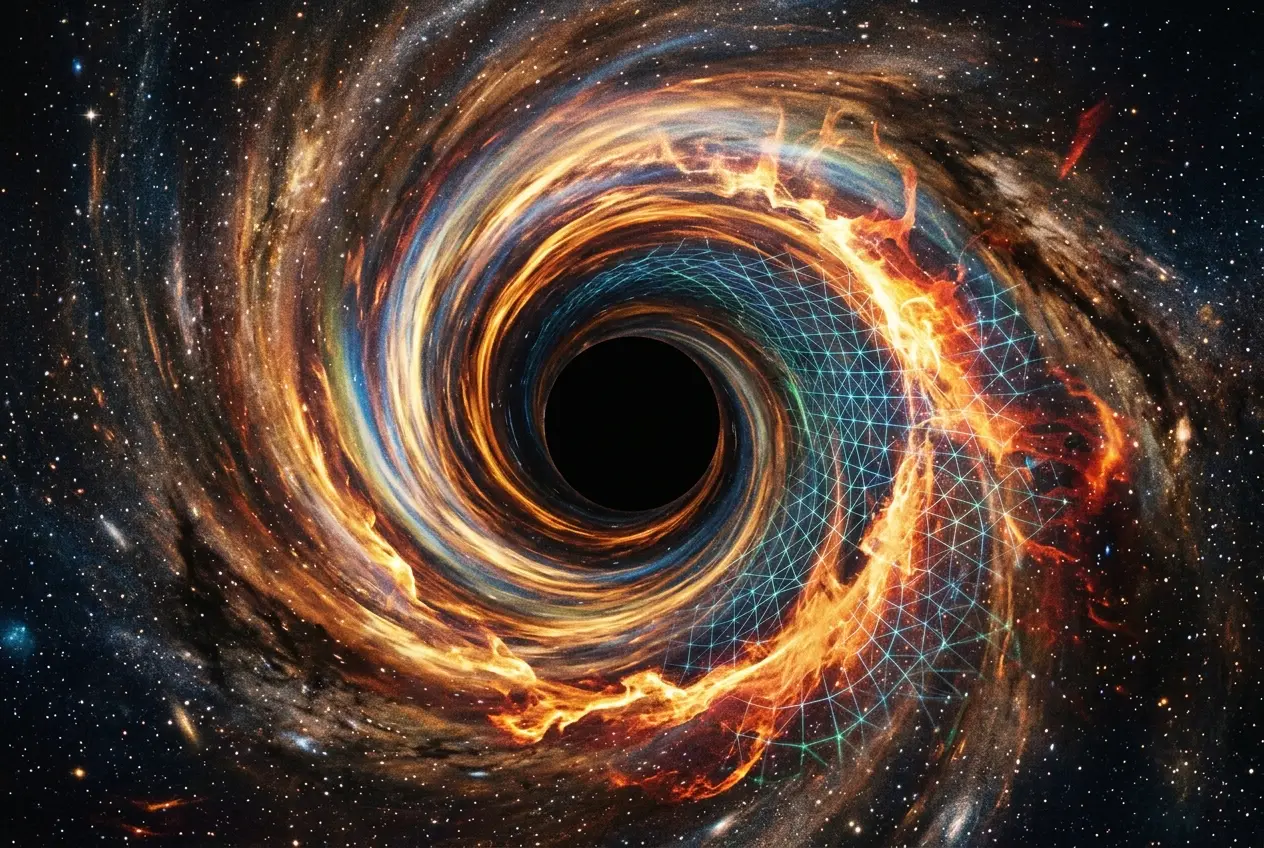
I often find myself lost in thought, pondering the universe's most extreme phenomena. Black holes, in particular, hold an almost mythical grip on my imagination. They are the ultimate cosmic devourers, bending space and time to their will, yet they also pose some of the most profound puzzles in modern physics. What happens when matter, or even information, crosses their event horizon? For decades, our understanding painted a picture of a smooth, uneventful plunge into oblivion. But what if that picture is wrong? What if the edge of a black hole isn't a serene one-way door, but a blazing inferno that incinerates everything, including quantum data?
This dramatic concept is at the heart of the "firewall paradox," a theoretical bombshell dropped into the lap of theoretical physics that challenges our very understanding of spacetime, gravity, and quantum mechanics. It’s a paradox that makes even seasoned cosmologists scratch their heads, suggesting that black holes might be far stranger—and more violent—than we ever imagined.
The Smooth Journey: Hawking's Original Vision
For a long time, physicists largely agreed on how objects interact with a black hole's event horizon – the point of no return. According to Albert Einstein's general theory of relativity, crossing the event horizon should be perfectly unremarkable from the perspective of an infalling observer. They wouldn't feel anything unusual; the fabric of spacetime would simply stretch and distort around them, pulling them inevitably towards the singularity at the center. This is known as the Equivalence Principle, a cornerstone of general relativity.
However, the plot thickened dramatically with Stephen Hawking's groundbreaking work on black hole radiation in the 1970s. Hawking theorized that black holes aren't entirely black. Instead, due to quantum effects near the event horizon, they emit a faint glow of particles, now known as Hawking radiation. This radiation slowly causes black holes to lose mass and eventually evaporate. Crucially, Hawking argued that this radiation is thermal, meaning it carries no information about what fell into the black hole. This led to the black hole information paradox: if a black hole evaporates and its radiation carries no information, then what happens to all the unique quantum information of the matter it consumed? Does it simply vanish from the universe, violating a fundamental principle of quantum mechanics that states information can never be truly destroyed?
The Firewall Paradox: A Fiery Resolution?
The information paradox ignited fierce debate for decades. Many physicists believed there must be a way for information to escape, perhaps subtly encoded in the Hawking radiation, preserving quantum mechanics. Then, in 2012, a group of physicists (Joseph Polchinski, Ahmed Almheiri, Donald Marolf, and James Sully, collectively known as AMPS) proposed a radical idea: the "firewall paradox."
Their argument was rooted in a concept called quantum entanglement. Entanglement is a bizarre quantum phenomenon where two particles become linked, sharing the same fate no matter how far apart they are. If you measure one, you instantly know the state of the other. In a black hole scenario, Hawking radiation is created when a pair of entangled particles forms just outside the event horizon. One particle falls into the black hole, and its entangled partner escapes as Hawking radiation.
The AMPS paradox arises when you try to reconcile three fundamental principles:
- The Equivalence Principle: Infalling observers cross the event horizon smoothly, feeling nothing unusual.
- Unitarity (Information Preservation): Quantum mechanics dictates that information is never truly lost. What goes into the black hole must, in some form, come out.
- Local Quantum Field Theory: Physics works "locally" – entanglement exists only between nearby particles or particles that have interacted.
Here’s where the paradox bites: If information is preserved (unitarity), then the Hawking radiation emitted today must be entangled with the particles that fell into the black hole long ago. But for an infalling observer to experience a smooth crossing (equivalence principle), the particle they are carrying must also be entangled with its partner that just fell in, maintaining entanglement across the event horizon.
The problem? A single particle cannot be maximally entangled with two independent systems simultaneously. This is a quantum mechanics no-go theorem known as the "monogamy of entanglement." To maintain both unitarity and local quantum field theory, the AMPS paper suggested that the entanglement across the event horizon must be broken. And what breaks entanglement? A massive amount of energy – a "firewall" – right at the event horizon.
"The firewall hypothesis posits that an observer falling into an old black hole would encounter a 'firewall' of high-energy quanta at the event horizon," explains physicist and author, Leonard Susskind in his book Black Holes: The Reith Lectures. "This would incinerate them instantly, violating the equivalence principle."
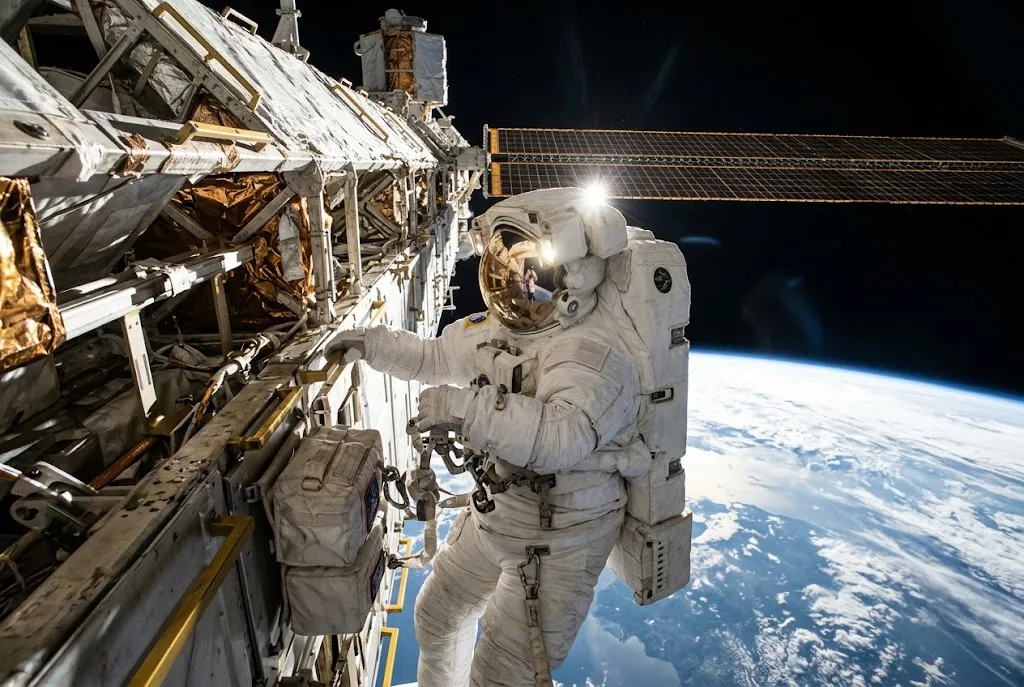
The implication is profound: if a firewall exists, then the fundamental principle of general relativity – that spacetime is smooth at the event horizon – is broken. Instead of a gentle passage, an infalling astronaut would be instantly vaporized, their quantum data burned away by a searing curtain of energy. This would be catastrophic for the "smooth journey" promised by Einstein.
The Quantum Data Dilemma
If a firewall exists, it implies a violent end to any infalling matter. But more importantly, it offers a radical (if destructive) solution to the black hole information paradox. Instead of information being encoded and escaping subtly, it's effectively "reprocessed" or "destroyed" by the firewall at the event horizon. This is where the term "burning quantum data" comes into play – the firewall acts like a cosmic shredder, eradicating the delicate entanglement that preserves quantum information.
The challenge, of course, is that neither a firewall nor a complete loss of quantum information is easily accommodated by our current understanding of physics. Physicists are desperately trying to find a way to reconcile these conflicting ideas. Some theories propose that information might escape in a highly scrambled form, making it appear lost, or that perhaps our understanding of spacetime at these extreme scales needs a radical overhaul. You can learn more about the complexities of quantum information in this Wikipedia article on the Black Hole Information Paradox (opens in a new tab).
Beyond the Horizon: Seeking Solutions
The firewall paradox has spurred intense research and fascinating theoretical developments. Several proposed solutions aim to save either the equivalence principle or the unitarity of quantum mechanics, often by introducing exotic new physics:
- Fuzzballs: Proposed by Samir Mathur, this theory suggests that black holes aren't singularities surrounded by empty space but rather dense, "fuzzy" objects made of strings, where information is stored on the surface rather than lost inside.
- Wormholes and ER=EPR: Leonard Susskind and Juan Maldacena suggested a deep connection between quantum entanglement (EPR) and wormholes (ER), proposing that the interior of a black hole might be connected to the emitted Hawking radiation through tiny wormholes, allowing information to escape. This intriguing idea suggests a bridge between two seemingly disparate areas of physics. For a deeper dive into how wormholes might theoretically connect parts of the cosmos, check out our blog on /blogs/can-wormholes-really-connect-two-universes-science-vs-theory.
- Non-local theories: Some theories propose that at extreme scales, physics might become non-local, meaning that interactions can happen without immediate spatial contact, potentially circumventing the monogamy of entanglement issue.
- New interpretations of spacetime: Perhaps the very fabric of spacetime at the event horizon is far more complex than we currently grasp, allowing for a resolution without a firewall. The idea that space itself might be capable of storing quantum information is explored in our article /blogs/is-empty-space-a-quantum-computer-9021.
The debate remains incredibly active. While the firewall hypothesis offers a stark answer to the information paradox, it creates new problems by violating the equivalence principle. The scientific community is still divided, with many physicists working on various models to solve this fundamental puzzle without resorting to such extreme measures. It’s a testament to the fact that even our most robust theories, like general relativity and quantum mechanics, still have unresolved tensions when pushed to their limits. The question of whether black holes truly burn quantum data or merely encode it in an unfathomable way continues to drive cutting-edge research.
Understanding these cosmic behemoths and their fundamental properties is not just an academic exercise. It pushes the boundaries of our knowledge, forcing us to rethink the very nature of reality, information, and the universe's ultimate laws. The black hole firewall paradox is a stark reminder that even the most well-established theories can hold surprises, urging us to continue our quest to uncover the cosmos's deepest secrets. It's a mystery that makes me wonder, if black holes truly do incinerate quantum information, what other cosmic shredders might be out there, redefining the limits of what we thought possible? For further reading on the challenges black holes pose to information theory, you might find this Wikipedia article on Black Hole Thermodynamics (opens in a new tab) insightful. And to consider how black holes generally interact with information, our previous post on /blogs/do-black-holes-store-universes-lost-data-5797 offers a good foundation.
Conversation0
No comments yet. Be the first to share a thought — the best questions often become new stories.