


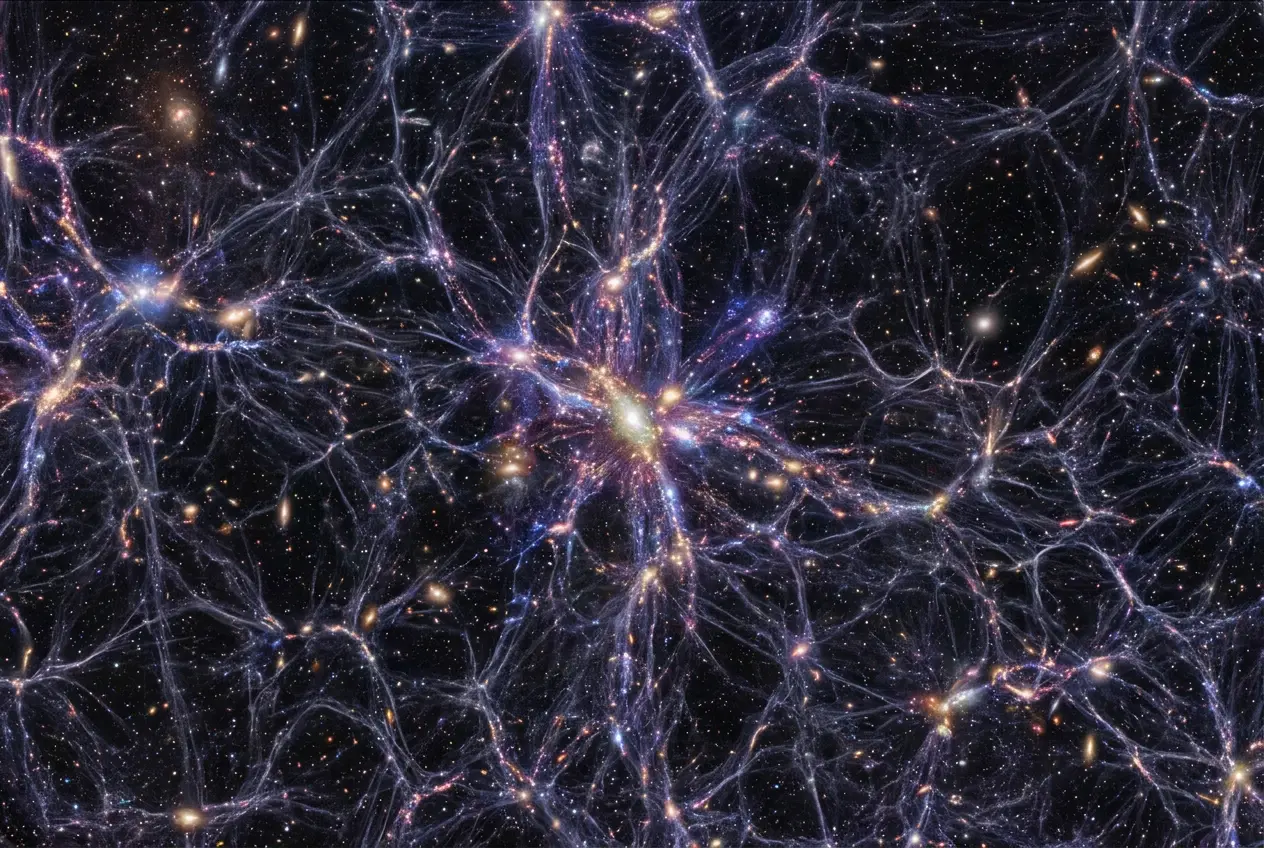
I remember staring up at the night sky as a child, utterly captivated by the countless pinpricks of light. Each star, a distant sun, represented a known, visible universe, vast and magnificent. Yet, as I grew older and delved into the mysteries of cosmology, I learned a startling truth: all the stars, galaxies, and cosmic dust we can see—everything that emits, reflects, or absorbs light—makes up less than 5% of the universe's total mass-energy. A staggering 95% remains an enigma, primarily comprised of dark matter and dark energy.
For decades, dark matter has been the universe’s most perplexing ghost. We know it’s there because of its gravitational pull on galaxies and galaxy clusters, but it doesn't interact with light or other electromagnetic forces, making it utterly invisible to our telescopes. Imagine an entire cosmic web, a scaffolding holding galaxies together, yet utterly silent and unseen. This invisible scaffold isn't empty; it's teeming with something. And that 'something' might not be alone. What if the darkness isn't just a void, but a mirror reflecting another, equally complex universe of its own? This is where the intriguing, speculative, yet scientifically grounded concept of dark photons comes into play.
Unmasking the Invisible: Beyond Standard Matter
The universe, as we perceive it, is governed by four fundamental forces: gravity, electromagnetism, the strong nuclear force, and the weak nuclear force. Our understanding of particles—from quarks to electrons—is beautifully encapsulated in the Standard Model of Particle Physics. This model describes how these particles interact via messenger particles: gluons for the strong force, W and Z bosons for the weak force, and crucially, photons for the electromagnetic force. Photons are the quantum packets of light, responsible for everything from radio waves to X-rays, allowing us to see and interact with our world.
But dark matter, by definition, doesn't interact with any of these known forces in the same way. It's largely immune to light. This led physicists to hypothesize that if dark matter has its own unique interactions, it might also have its own set of messenger particles. Enter the dark photon—a hypothetical elementary particle that could be the "light" of a hidden, or "dark," sector of the universe.
The Concept of a "Hidden Sector"
The idea of a dark photon isn't just about dark matter having its own light; it opens up the possibility of an entire "hidden sector" of particles and forces, running parallel to our observable universe. Think of it like this: if our universe is a brightly lit room, the dark sector is an equally furnished room next door, illuminated by its own kind of light—dark photons. These two rooms might only have a tiny, almost imperceptible crack between them, allowing for a whisper of interaction.
This "whisper" is what physicists call kinetic mixing. It's the most widely discussed mechanism by which dark photons might interact with our world. In essence, kinetic mixing suggests that dark photons could occasionally "mimic" the electromagnetic properties of regular photons, allowing for a very weak interaction with charged particles in our universe. It’s not a direct interaction, but more like a slight, almost imperceptible jiggle. This subtle influence is what makes detecting them so incredibly challenging, yet also so fascinating. For more on how dark matter interacts (or doesn't), you might find our blog on whether dark matter hides a universe we can't see insightful.
Why Do We Need Dark Photons?
The primary motivation for dark photons stems from the long-standing puzzle of dark matter. While the gravitational evidence for dark matter is overwhelming, its precise nature remains elusive. Many proposed dark matter candidates, such as Weakly Interacting Massive Particles (WIMPs), have yet to be definitively detected. Dark photons offer an alternative or complementary path.
Furthermore, dark photons could resolve other cosmological anomalies. Some models suggest they could explain the "muon g-2 anomaly," a discrepancy between theoretical predictions and experimental measurements of the muon's magnetic moment, hinting at the existence of unknown particles or forces. They could also contribute to the mysterious composition of dark energy, the force driving the accelerated expansion of the universe.
The Search for the Unseen Light
If dark photons exist, they would be incredibly light and interact very feebly with ordinary matter. This makes them incredibly difficult to detect, requiring highly sensitive experiments. Researchers around the globe are employing a variety of ingenious methods to try and catch a glimpse of this invisible light:
- Light-Shining-Through-Walls (LSW) Experiments: These experiments attempt to observe dark photons transforming into regular photons after passing through an opaque barrier. A strong laser beam is directed at a wall; if dark photons exist and interact via kinetic mixing, some of the photons might transform into dark photons, pass through the wall, and then transform back into regular photons on the other side, creating a faint signal. Experiments like ALPS II at DESY in Germany are at the forefront of this approach.
- Astrophysical Signatures: Dark photons could leave subtle imprints in astronomical observations. For instance, the decay of dark matter into dark photons, or vice-versa, might produce unusual radiation signatures in regions dense with dark matter, such as galaxy clusters or the galactic center.
- Direct Detection Experiments: While typically designed for WIMPs, some experiments are being re-purposed or specifically designed to look for very light dark matter candidates, which could interact via dark photons. These often involve ultra-sensitive detectors shielded from all known background radiation.
The hunt for dark photons is a monumental task, pushing the boundaries of experimental physics. It reminds me of the early days of hunting for the Higgs boson or gravitational waves—once theoretical concepts, now confirmed realities through painstaking scientific effort. The ingenuity involved in trying to observe these elusive particles is truly inspiring.
What if They Exist? The Mind-Bending Implications
If dark photons are confirmed, the implications for our understanding of the universe would be profound.
A New Force of Nature?
The existence of dark photons would imply the existence of a fifth fundamental force, albeit a very weak one, specific to the dark sector. This would fundamentally alter our understanding of the universe's basic laws, expanding the Standard Model in an unprecedented way. This isn't just a new particle; it's a new interaction, a new way things can fundamentally connect. Wikipedia has an excellent overview of hypothetical particles and forces that you can explore further here (opens in a new tab).
Revealing an Entire Dark Universe
Dark photons wouldn't just be messenger particles; they would be the medium through which dark matter particles interact with each other. Just as our photons allow electrons to orbit nuclei and create atoms, dark photons could enable dark matter particles to form "dark atoms" or even "dark molecules." Imagine: entire dark stars, dark planets, or even dark galaxies, all interacting through their own unique forces, largely decoupled from our visible cosmos. This concept truly stretches the imagination, suggesting a cosmic landscape far richer and stranger than we can currently fathom. For more on the fundamental building blocks of the universe, consider reading about tiny strings as the universe's secret code.
The Door to Inter-Universal Communication (Theoretical!)
While highly speculative, if kinetic mixing exists, it provides a faint, shimmering bridge between our universe and a potential dark sector. Could future, far more advanced technologies someday manipulate this subtle interaction? Could it ever lead to a form of communication or energy transfer between these otherwise separate realms? These are questions firmly in the realm of science fiction for now, but the fundamental discovery of dark photons would lay the groundwork for such possibilities.
The Challenges and the Journey Ahead
The scientific community remains cautiously optimistic. The concept of dark photons is elegant and could solve several persistent cosmological puzzles. However, the lack of definitive detection means it remains a hypothesis. The sensitivity required to find these particles is immense, often pushing experimental technology to its absolute limits.
The journey to understand the 95% of our universe that remains unseen is one of the most exciting frontiers in modern physics. The existence of dark photons would not only shed light on the nature of dark matter but would also open up an entirely new chapter in cosmology and particle physics, revealing a hidden, parallel universe that has been alongside us all along. It's a testament to human curiosity that we continue to peer into the darkness, not fearing the unknown, but seeking to illuminate it. The universe, I believe, still holds countless secrets, waiting for our ingenuity and perseverance to uncover them. If you're fascinated by the hidden layers of reality, our discussion on whether our universe is a hologram might also pique your interest.


Conversation0
No comments yet. Be the first to share a thought — the best questions often become new stories.