I was recently captivated by a thought, a whisper from history that often gets lost in the thunderous advancements of modern science. We tend to think of quantum mechanics, string theory, and the intricate dance of subatomic particles as the pinnacle of 20th and 21st-century genius. And largely, they are. But what if the seeds of these profoundly complex ideas were sown much, much earlier? What if, in the bustling agora and quiet academies of ancient Greece, brilliant minds stumbled upon concepts that, while lacking the empirical proof and mathematical rigor of today, remarkably echoed our understanding of the fundamental nature of reality?
The notion of the "cosmic computer" we often associate with ancient civilizations, exemplified by the Antikythera Mechanism (though we've covered that gem already in our post on [Greece's Ancient Cosmic Computer](/blogs/the-antikythera-greeces-ancient-cosmic-computer-6564)), points to a surprising aptitude for complex engineering. But my curiosity stretches beyond physical devices. I'm talking about conceptual frameworks, abstract ideas that attempted to explain the very fabric of existence. Did ancient Greek thinkers, known for their philosophical prowess, inadvertently grasp the outlines of a quantum reality, a world where discrete, indivisible units governed the universe?
### The Dawn of Atomism: A Bold New Idea
Imagine a world where everything, from the mightiest mountain to the smallest grain of sand, was thought to be made of four fundamental elements: earth, air, fire, and water. This was the dominant view for centuries. Then, around the 5th century BCE, a radical idea emerged from the Greek city of Abdera, championed by Leucippus and his more famous student, **Democritus**. They proposed something truly revolutionary: that matter was not infinitely divisible. Instead, it was composed of tiny, indivisible, eternal particles they called *atomos*, meaning "uncuttable" or "indivisible."
These *atomos*, they argued, were imperceptible to the senses, numerous beyond comprehension, and varied in shape, size, and arrangement. They moved in an infinite void, colliding, hooking together, and separating to form all the observable phenomena of the world. Different combinations and arrangements of these atoms gave rise to different substances. For instance, according to Democritus, the atoms of water were smooth and round, allowing it to flow, while the atoms of fire were sharp and prickly, explaining its stinging sensation.
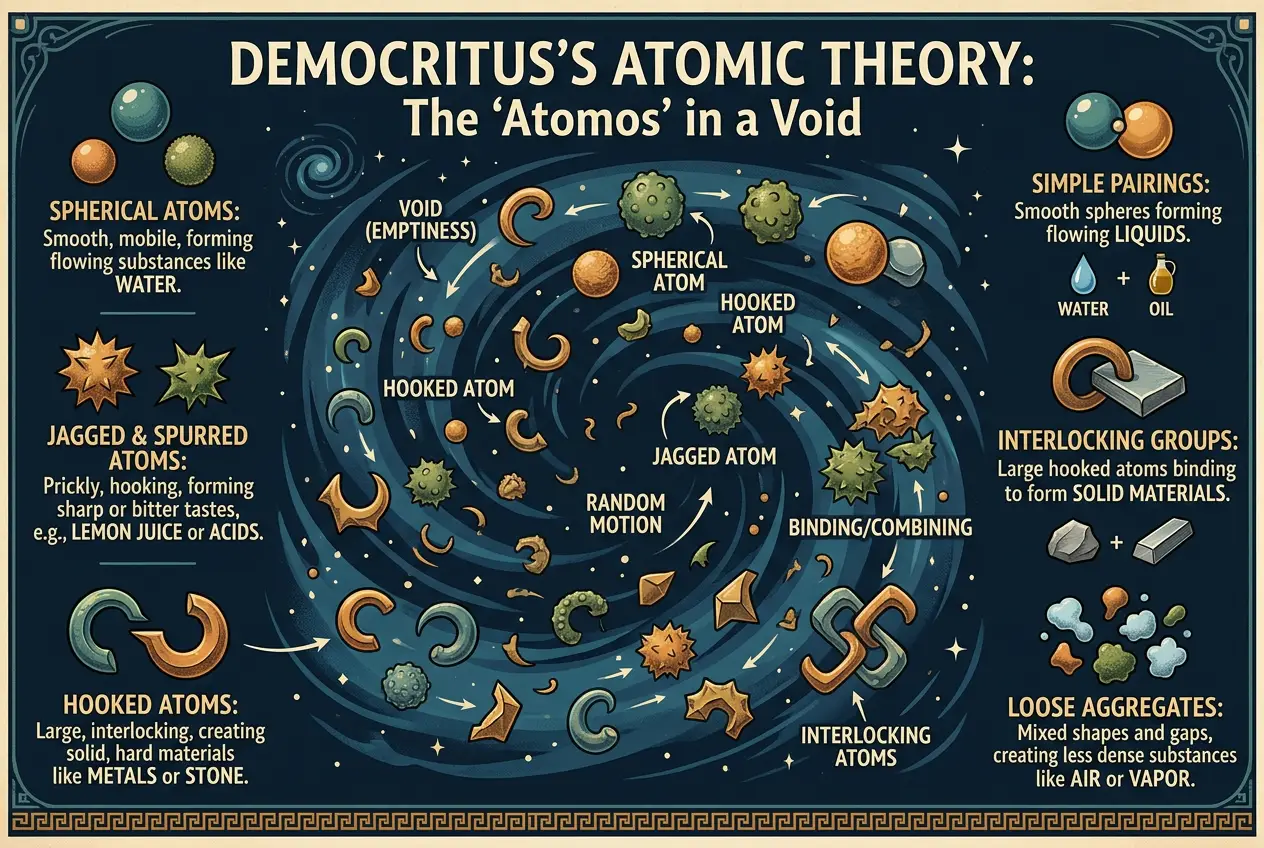
This was a colossal leap from the prevailing belief systems. It moved away from mystical explanations and divine interventions towards a mechanistic view of the universe, driven by the inherent properties and interactions of these fundamental particles. It was, in essence, the first major attempt at a unified theory of everything, positing a basic building block for all existence. You can read more about Democritus and his groundbreaking ideas on [Wikipedia](https://en.wikipedia.org/wiki/Democritus).
### Plato, Aristotle, and the Challenge to Atomism
Despite its logical elegance, Democritus’s atomism didn't become the mainstream scientific consensus of the ancient world. Powerful voices like **Plato** and **Aristotle** vehemently opposed it. Plato, while acknowledging the existence of indivisible units, sought to imbue them with geometric perfection, linking them to regular polyhedra. He wasn't interested in the random, mechanistic collisions of Democritean atoms.
Aristotle, arguably the most influential philosopher of the Western world for nearly two millennia, rejected atomism outright. He believed in the continuous nature of matter and the four elements, adding a fifth, *aether*, to explain celestial bodies. His rejection was largely based on the idea of a void – for Aristotle, nature abhorred a vacuum. Without a void, atoms couldn't move, and thus, atomism collapsed in his view. Aristotle’s enormous authority ensured that his continuous model of matter dominated Western thought, effectively sidelining Democritus’s atomic theory for nearly 2,000 years.
I often wonder how different the trajectory of scientific discovery might have been if Democritus’s ideas had gained wider acceptance. Would the scientific revolution have happened centuries earlier? It’s a fascinating thought experiment, particularly when we consider how crucial the concept of indivisible particles became in modern physics.
### Echoes of Quantum: Uncanny Parallels?
Now, let's fast forward to the 20th century. Enter quantum mechanics. Suddenly, the universe isn't continuous and predictable at its smallest scales. It's granular, probabilistic, and behaves in ways that defy classical intuition. Could there be uncanny parallels between ancient atomism and quantum reality?
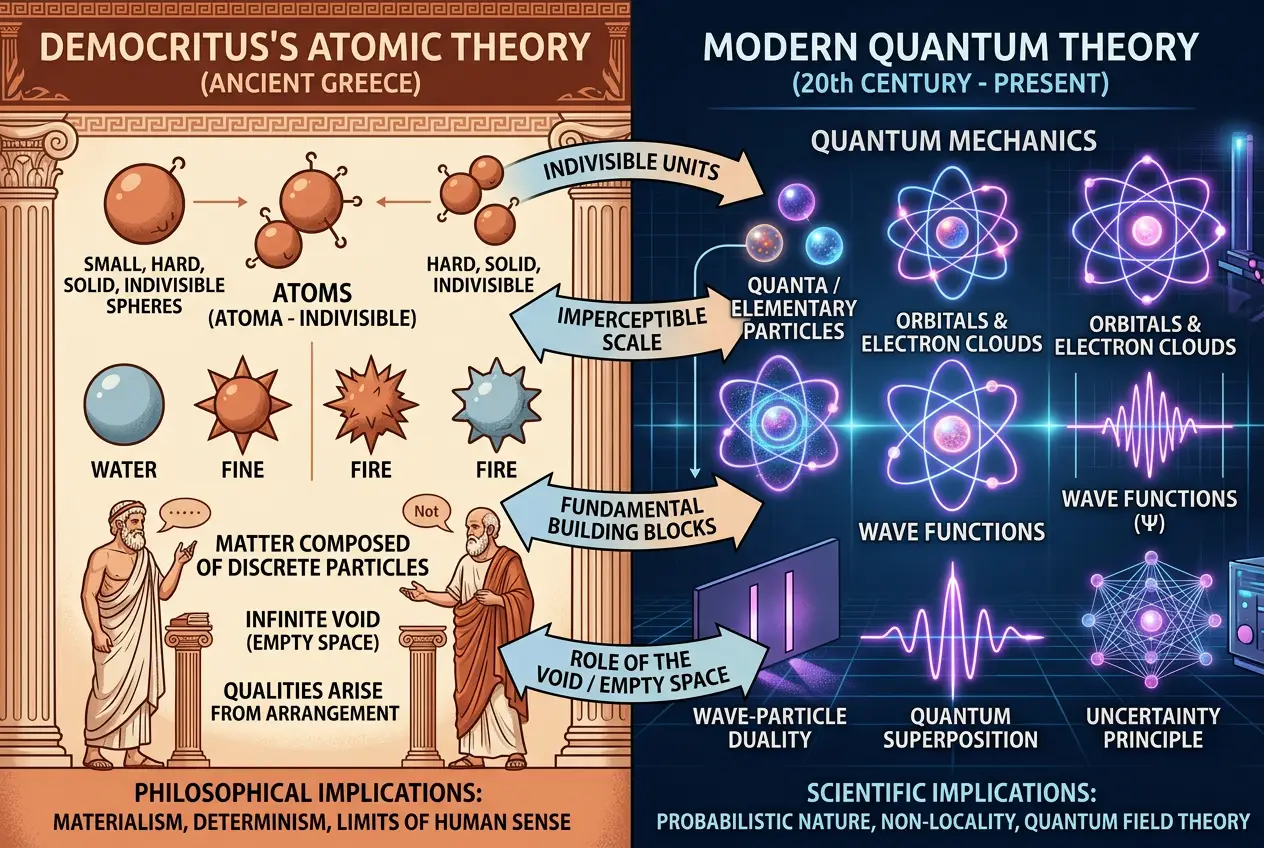
1. **Indivisible Units (Quanta):** The most striking similarity is the concept of indivisible units. Democritus's *atomos* are, by definition, the smallest units of matter. In quantum mechanics, energy, light, and even matter itself are often described as existing in discrete packets called **quanta**. Photons are quanta of light, electrons exist in quantized energy levels around an atom, and even the fundamental particles of the Standard Model are, in a sense, indivisible (at least with our current understanding). The idea that there's a fundamental 'floor' to divisibility, a smallest unit that cannot be broken down further, rings true for both ancient atomism and quantum theory. While we now know atoms *are* divisible into protons, neutrons, and electrons, and those into quarks, the underlying concept of fundamental, elementary particles persists.
2. **Void and Motion:** Democritus proposed *atomos* moving in a void. While modern physics doesn't exactly describe a literal "void" (quantum fields permeate everything), the idea of particles interacting and moving within a defined space, influencing each other through forces, resonates. The vacuum of quantum mechanics is far from empty; it's a bustling sea of virtual particles popping in and out of existence, a dynamic backdrop for fundamental particle interactions.
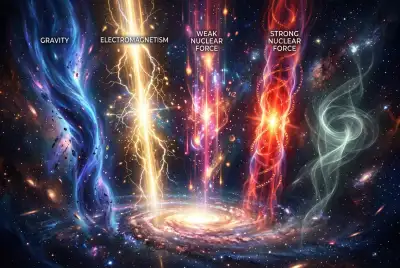
3. **Fundamental Properties and Interactions:** For Democritus, the different shapes and arrangements of atoms determined the properties of macroscopic objects. In quantum mechanics, the properties of elementary particles (mass, charge, spin) and how they interact via fundamental forces (strong, weak, electromagnetic, gravitational) dictate the behavior of everything in the universe. While the ancient "hooked" or "smooth" atoms are a poetic oversimplification, they represent an attempt to attribute fundamental properties to elementary units that explain macroscopic observations.
4. **Limits of Perception:** Democritus explicitly stated that *atomos* were imperceptible to human senses. Quantum particles, too, exist far beyond our direct sensory experience. We infer their existence and properties through complex experiments and mathematical models, much as Democritus arrived at his conclusions through pure reason. My own understanding of quantum phenomena, even with all our advanced tools, still feels like I'm trying to grasp smoke. It’s a testament to the human mind's capacity to conceive of the unseeable.
Of course, the differences are profound. Democritus’s theory was philosophical and speculative, lacking any experimental basis or predictive mathematical framework. Quantum mechanics, conversely, is one of the most rigorously tested and empirically successful theories in the history of science, leading to technologies like lasers, transistors, and nuclear power. You can delve deeper into the mysteries of quantum entanglement, a phenomenon that truly defies classical intuition, in our blog post on [How Does Quantum Entanglement Defy Space-Time?](/blogs/how-does-quantum-entanglement-defy-space-time-5424).
### The Enduring Legacy of Ancient Thought
While Democritus did not have a "cosmic computer" to crunch numbers or predict quantum states, his mind was, in a sense, a conceptual computer, running simulations based on pure logic and observation. His atomism, resurrected during the Renaissance and refined by scientists like John Dalton in the 19th century, laid the groundwork for modern atomic theory. It took millennia, but the core idea of fundamental, indivisible particles persisted and eventually became a cornerstone of scientific understanding.
It’s a powerful reminder that even the most abstract philosophical musings can contain kernels of truth that resonate across civilizations and millennia. The ancient Greeks might not have had our particle accelerators or quantum computers (a topic we explored in [Why is Quantum Computer 1 Million Times Faster Than SuperComputers?](/blogs/why-is-quantum-computer-1-million-times-faster-than-supercomputers?)), but their intellectual daring to question the obvious and imagine the unseen was a profound act of scientific foresight.
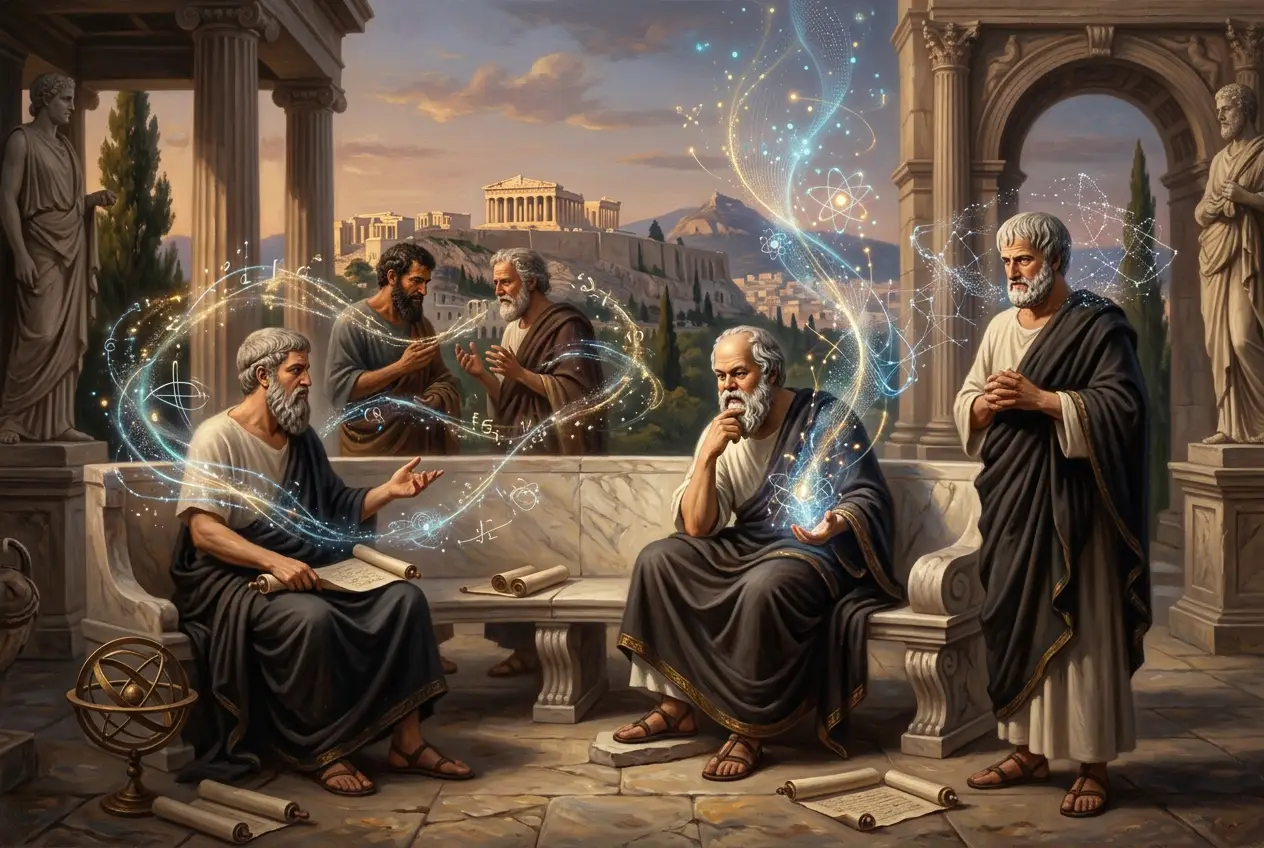
Their theories, like ancient maps, might have been inaccurate in their details but pointed in the correct general direction. And in that sense, perhaps Democritus and his fellow atomists did, indeed, "foresee" a glimpse of the quantum reality we continue to unravel today.
The human mind, whether in an ancient agora or a modern laboratory, remains the ultimate engine of curiosity, ever striving to understand the fundamental code of our universe. What other ancient insights might still await rediscovery, hidden in plain sight or obscured by historical biases?
Frequently Asked Questions
Democritus developed his atomic theory primarily through philosophical reasoning, logical deduction, and observation of the natural world. He considered thought experiments about dividing matter until it could be divided no further, leading him to the concept of an indivisible particle.
Aristotle primarily rejected atomism due to his belief that a void (empty space) could not exist. Since Democritus's atoms needed a void to move within, Aristotle’s rejection of the void led him to dismiss atomism in favor of a continuous model of matter composed of four elements.
No, while the concept of fundamental, indivisible particles is similar, Democritus’s 'atomos' were philosophical constructs. Modern atoms are complex structures composed of protons, neutrons, and electrons, and these subatomic particles can be further divided into quarks and leptons. The historical impact of Democritus, however, lies in introducing the core idea of discrete fundamental units of matter.
Yes, atomistic ideas also appeared in ancient Indian philosophy. The Vaisheshika school, founded by Kanada around the 6th-2nd century BCE, developed a theory involving indivisible, eternal particles called 'anu,' which combined to form more complex substances. This developed independently of Greek atomism and shows a convergent intellectual path.
Verified Expert
Alex Rivers
A professional researcher since age twelve, I delve into mysteries and ignite curiosity by presenting an array of compelling possibilities. I will heighten your curiosity, but by the end, you will possess profound knowledge.
Leave a Reply
Comments (0)
No approved comments yet. Be the first to share your thoughts!
 Join Us


 Alex Rivers

































Leave a Reply
Comments (0)