


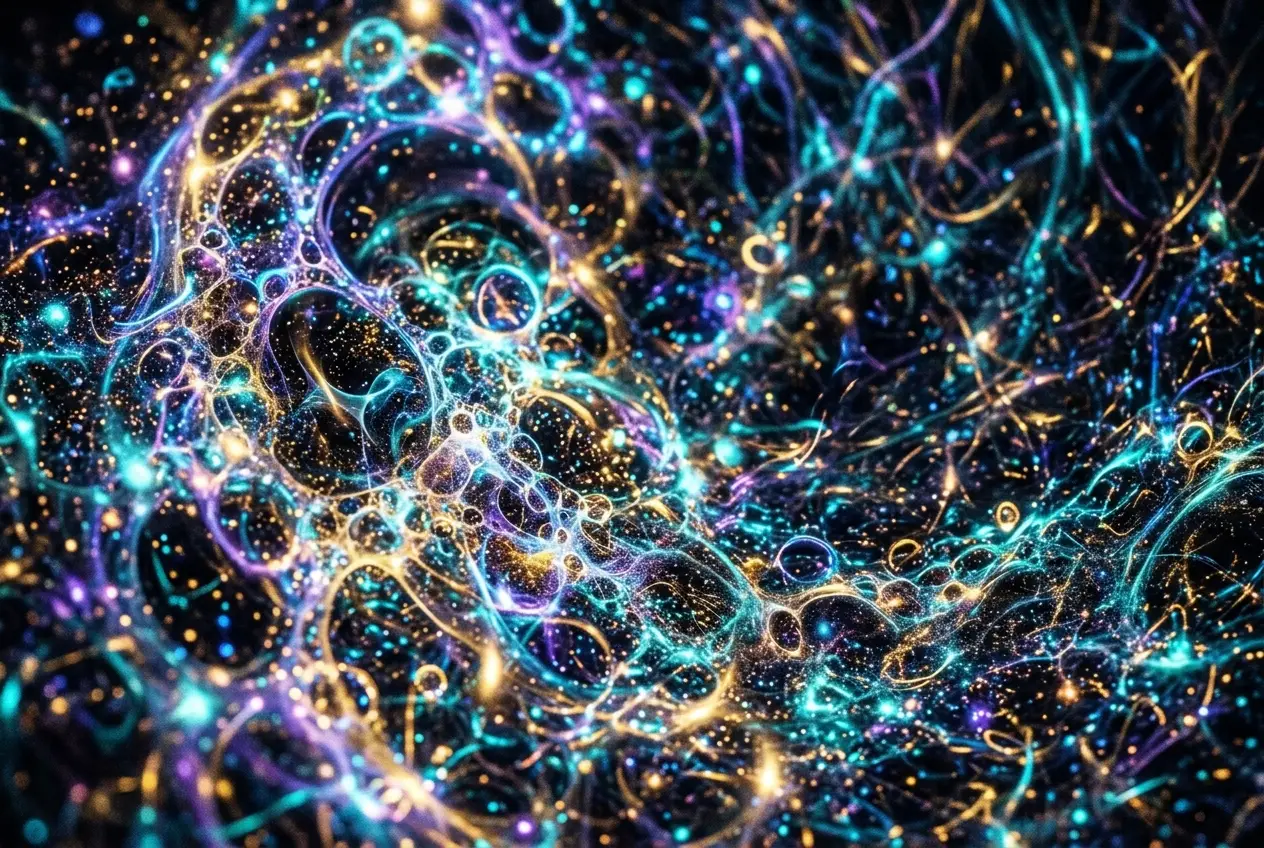
I remember staring at an old television screen, getting close enough to see the individual red, green, and blue dots that made up the picture. Each dot, a tiny pixel, was a fundamental unit of light, and zooming out, they blended seamlessly into the images we perceived as continuous. This experience often makes me wonder: what if our entire reality, the universe itself, functions in a similar way? What if, at its most fundamental level, spacetime isn't smooth and continuous, but rather a shimmering, bubbling "quantum foam," a cosmic tapestry woven from discrete, infinitesimal units?
This isn't just a philosophical musing. It's a profound question at the heart of modern physics, a fascinating intersection where the macrocosm of general relativity meets the microcosm of quantum mechanics. For decades, scientists have grappled with the apparent incompatibility between these two pillars of modern physics. General relativity describes gravity as the curvature of smooth spacetime, while quantum mechanics dictates that energy and matter exist in discrete, quantifiable packets. How do you reconcile a smooth, continuous fabric with a world built on tiny, indivisible quanta?
The Cosmic Conundrum: Merging Gravity with Quanta
The problem arises when physicists attempt to describe gravity at extremely small scales, such as those found within a black hole or at the very beginning of the universe. In these extreme environments, both general relativity and quantum mechanics should apply, but their mathematical frameworks clash. This incompatibility suggests that our understanding of spacetime itself might be incomplete. The concept of quantum foam emerges as a theoretical solution, proposing that at the smallest possible scales, spacetime is not smooth but highly turbulent and unpredictable, like the frothing surface of a boiling pot.
Imagine zooming into spacetime, past atoms, past quarks, past everything we conventionally understand as matter. What would you see? According to quantum foam theory, proposed by physicist John Archibald Wheeler in the 1950s, you wouldn't find an empty void. Instead, you'd encounter a chaotic, fluctuating realm where virtual particles constantly pop in and out of existence, and spacetime itself warps and buckles in unpredictable ways. This isn't just quantum jitters; it's the very structure of reality becoming frothy and ill-defined.
This "foamy" behavior is thought to occur at the Planck length, an unimaginably tiny scale of approximately 10⁻³⁵ meters. To give you a perspective, if an atom were expanded to the size of the observable universe, a Planck length would still be smaller than a single atom within that universe. At this minuscule dimension, the principles of quantum mechanics become dominant, and the smooth, predictable geometry of spacetime described by general relativity breaks down entirely. It's here that the idea of reality having a "pixel limit" truly takes hold. If spacetime itself is granular, then there's a fundamental minimum size beyond which nothing smaller can exist or be measured. This threshold is often referred to in quantum gravity theories as the point where our conventional understanding of space and time ceases to be valid. You can read more about the Planck length and its implications on Wikipedia (opens in a new tab).
What Does a "Pixel Limit" Mean for Reality?
If reality indeed has a pixel limit, it implies several profound consequences:
-
Discreteness of Spacetime: Just as digital images are made of pixels, and energy is made of quanta, spacetime might be composed of fundamental, indivisible units. This challenges our intuitive perception of space and time as continuous and infinitely divisible. Instead, space might be "quantized" – existing in tiny, discrete packets, and time might flow in infinitesimal "ticks."
-
Uncertainty at the Extreme Edge: At the Planck scale, the very notions of "where" and "when" become fuzzy. The Heisenberg Uncertainty Principle, which famously states that you cannot simultaneously know both the precise position and momentum of a particle, would extend to spacetime itself. The foam implies inherent uncertainty in the very fabric of existence, making it impossible to pinpoint exact locations or moments.
-
A New Fundamental Theory: The existence of quantum foam necessitates a new theory of physics – a theory of quantum gravity – that can successfully merge general relativity and quantum mechanics. Prominent candidates include String Theory and Loop Quantum Gravity, both of which attempt to describe spacetime as fundamentally discrete. Loop Quantum Gravity, for instance, posits that spacetime is made of tiny loops of gravitational fields, forming a network of "spacetime atoms." You can explore Loop Quantum Gravity further on Wikipedia (opens in a new tab).
The Search for Experimental Evidence
Verifying the existence of quantum foam is one of the greatest challenges in experimental physics. The scales involved are so incredibly small that direct observation is currently beyond our technological capabilities. However, physicists are devising ingenious indirect methods to search for subtle clues:
- Gamma-Ray Bursts (GRBs): These incredibly powerful cosmic explosions produce photons across a wide range of energies. If spacetime is foamy, higher-energy photons (which have shorter wavelengths) might experience slightly different travel times through the "pixelated" cosmos compared to lower-energy photons. Imagine trying to run through a dense, uneven forest versus a clear field – the foamy spacetime could cause slight delays for particles interacting with its granular structure. This effect, though tiny, could accumulate over vast cosmic distances.
- Gravitational Waves: Recent detections of gravitational waves by observatories like LIGO have opened a new window to the universe. These ripples in spacetime could potentially carry signatures of quantum foam, especially if they interact with the granular structure as they propagate. As explained in our previous post, understanding the universe's hidden data in gravitational waves could reveal profound insights: Do Gravitational Waves Hold Universe's Hidden Data?.
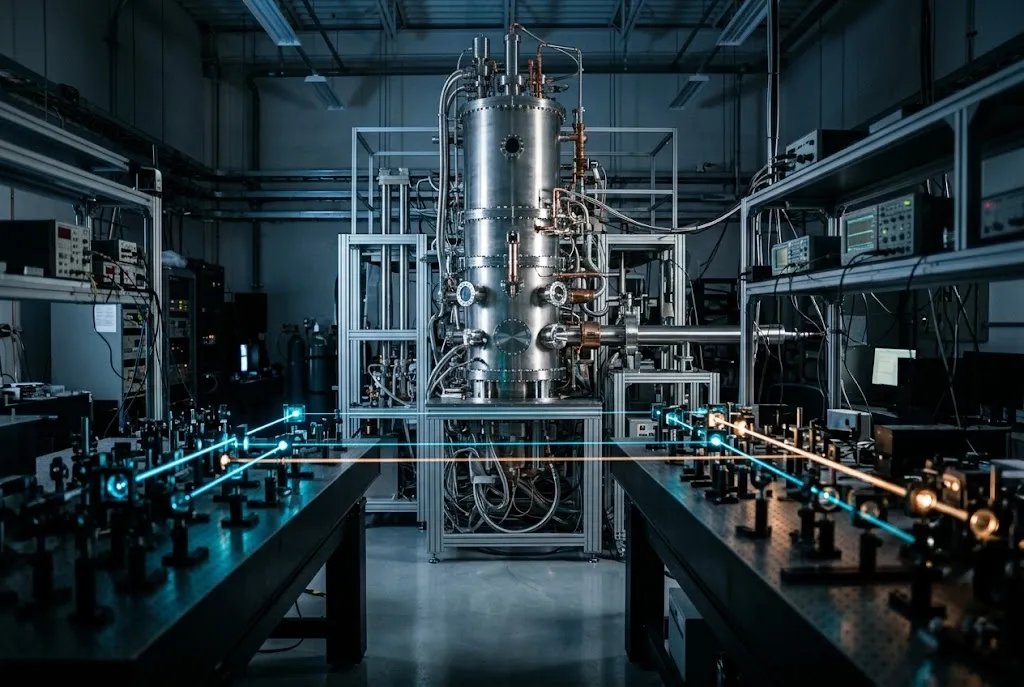
- Laboratory Experiments (Indirect): While creating Planck-scale conditions in a lab is impossible, some theories predict that quantum foam might have observable effects on light propagation or other quantum phenomena at more accessible scales. For instance, extremely precise measurements of the speed of light or the behavior of entangled particles might reveal subtle deviations if spacetime isn't perfectly smooth. The idea of quantum fluctuations coding our reality is intricately linked to these concepts: Do Quantum Fluctuations Code Our Reality?.
The implications of a pixelated reality extend beyond fundamental physics. If space and time are indeed discrete, it raises questions about the nature of information itself. Could the universe be a giant, natural computer, processing information at the Planck scale? Our previous discussion about whether empty space could be a quantum computer touches on similar themes: Is Empty Space a Quantum Computer?. The very notion of causality and how events unfold might need re-evaluation.
The Beauty of the Unknown
The hunt for quantum foam is a testament to humanity's insatiable curiosity and our drive to understand the deepest truths of existence. It pushes the boundaries of imagination and experimental ingenuity, forcing us to confront a universe far stranger and more beautiful than we might have ever conceived. Whether spacetime is ultimately smooth or pixelated, the journey to find the answer promises to revolutionize our understanding of reality, paving the way for a unified theory that could finally merge the grandeur of cosmic scales with the enigmatic dance of the quantum realm. The ultimate pixel limit, if it exists, is not an end but a new beginning for discovery.



Conversation0
No comments yet. Be the first to share a thought — the best questions often become new stories.