I once found myself lost in thought, pondering the ultimate cosmic paradox: what if the most destructive forces in the universe also held the key to humanity's greatest advancements? It's a question that sounds like science fiction, a plot device from a blockbuster film where heroes traverse galaxies. Yet, at the heart of this fantastical notion lies one of the most profound predictions of Albert Einstein's general theory of relativity: **gravitational time dilation**. This isn't just theoretical musing; it's a verifiable phenomenon, and its most extreme manifestations occur around black holes. I've often wondered if we, as a species, are missing an incredible opportunity by viewing black holes solely as cosmic destroyers, rather than potential laboratories or time-bending engines for unlocking technologies we can only dream of today.
## The Cosmic Clockwork: How Gravity Bends Time
To understand how black holes could be integral to future technology, we first need to grasp the concept of gravitational time dilation. Imagine two identical clocks. Place one far away from any massive object, perhaps floating freely in interstellar space. Place the other near a massive object, like a neutron star, or even better, a black hole. According to Einstein's theory, the clock closer to the massive object will tick slower than the one far away. This isn't a malfunction; it's how spacetime itself behaves.
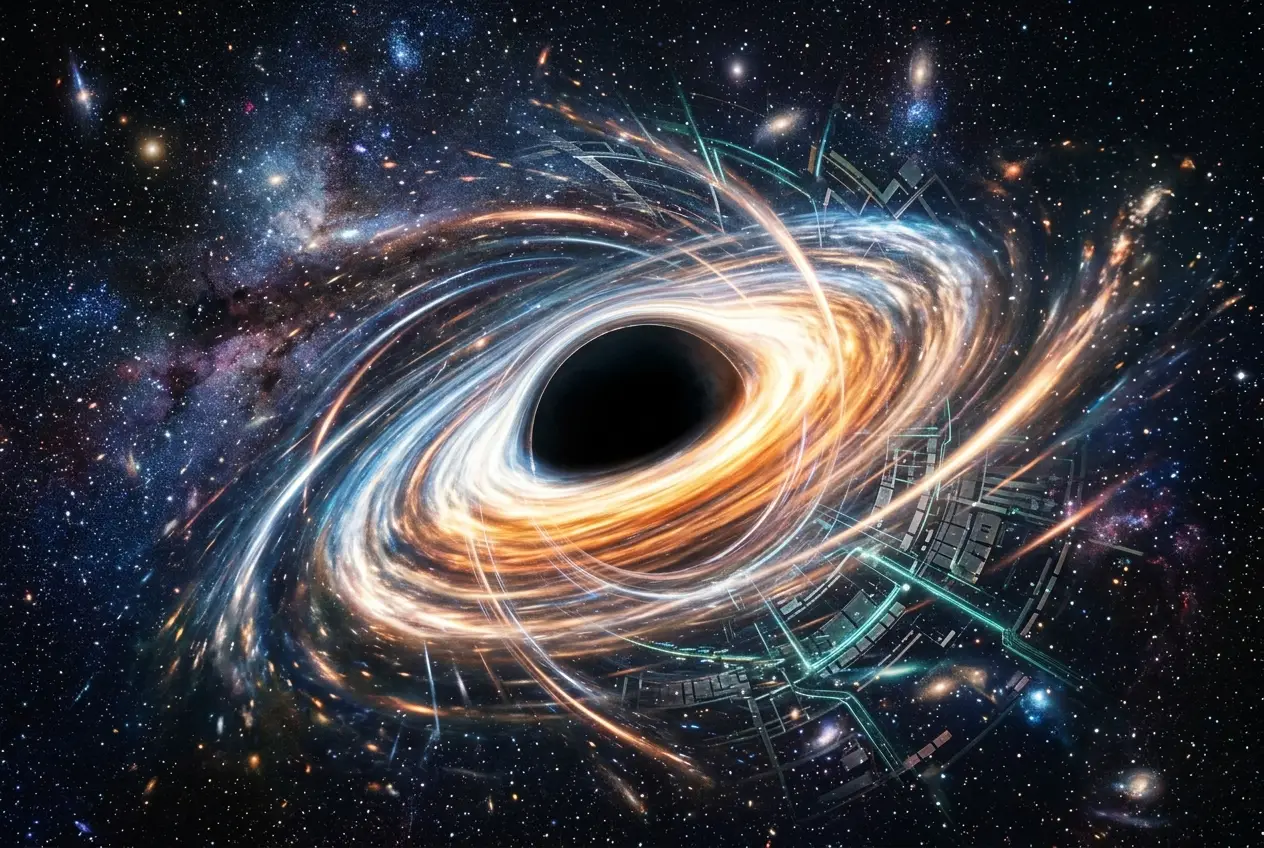
**Spacetime isn't a static backdrop; it's a dynamic fabric.** Massive objects, like planets and stars, warp this fabric, much like a bowling ball placed on a stretched rubber sheet. The deeper the "well" in spacetime, the slower time progresses for anything within that well. Black holes, being regions where gravity is so intense that nothing, not even light, can escape their pull once past the event horizon, represent the ultimate spacetime distortion. The time dilation near a black hole is not just measurable; it's astronomical, presenting mind-boggling implications for potential technological exploitation.
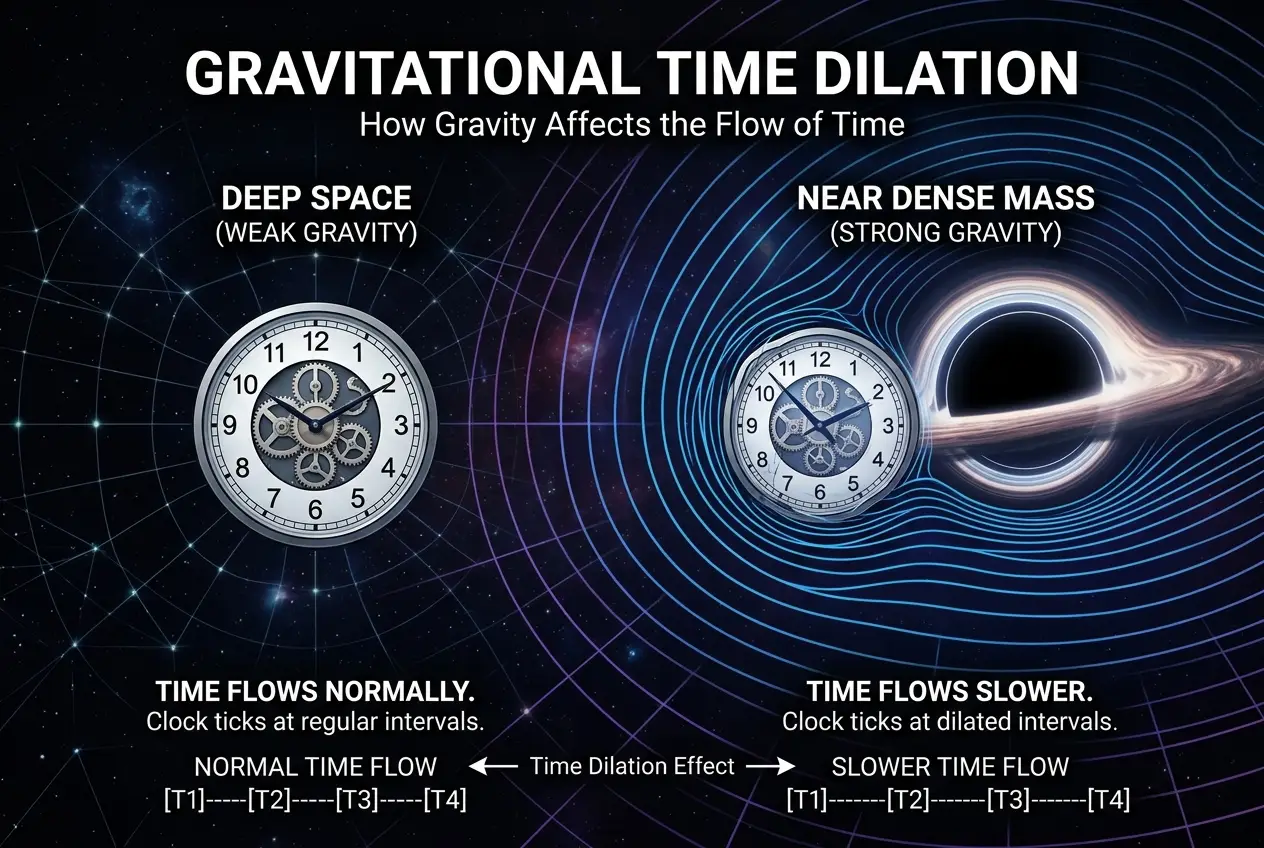
In his seminal work, *Relativity: The Special and the General Theory*, Einstein articulated the principles that govern this cosmic slowdown. As we delve deeper into regions of extreme gravity, time effectively stretches. For an observer safely far away, a minute spent near the event horizon of a black hole could translate to days, months, or even years passing in the distant universe. This dramatic difference in the passage of time is what sparks the imagination of physicists and futurists alike.
## Harnessing the Time Anomaly: Theoretical Tech Frontiers
So, how exactly could this incredible phenomenon of time dilation around black holes be leveraged for future technology? The ideas are largely speculative, certainly, but they are firmly rooted in the known laws of physics.
### Accelerated Research and Development
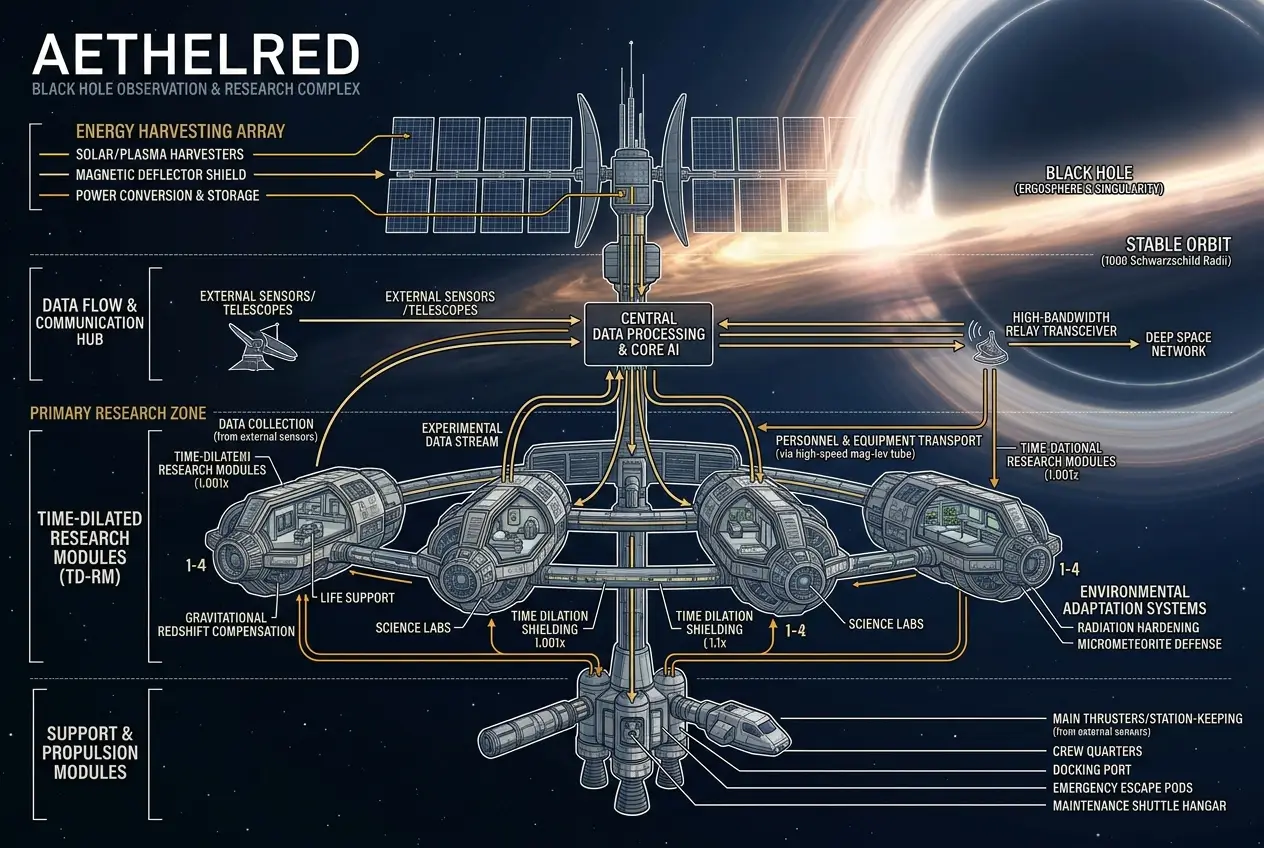
Imagine a research facility, not on Earth, but orbiting a carefully chosen black hole. Within this facility, experiments could be conducted at an accelerated rate *relative to the outside universe*. A complex material science experiment that might take centuries to yield results on Earth could, in theory, be completed in a human lifetime near a black hole.
"The possibility of time travel to the future is a direct consequence of Einstein's general theory of relativity," notes physicist Kip Thorne, a leading authority on general relativity and black holes. This isn't about going back in time, but experiencing time differently. A team of scientists could develop groundbreaking technologies, solve intractable problems, or conduct long-term evolutionary studies of artificial intelligence or biological systems within a compressed timeframe, only to return to a future where their discoveries are millennia ahead of their contemporaries. This concept isn't far from what was explored in films like *Interstellar*, which famously consulted Thorne on its scientific accuracy.
### The Ultimate Interstellar Bypass
Long-duration interstellar travel poses immense challenges, primarily the sheer amount of time it takes to reach distant stars. Even at relativistic speeds, journeys can span generations. Gravitational time dilation offers a tantalizing "solution." If a spacecraft could accelerate to very high speeds and then perform close passes around supermassive black holes, its crew would experience significantly less time than those on Earth. A journey that might take thousands of years for observers on Earth could feel like decades for the travelers.
This isn't just a trick of perception; the biological clocks of the astronauts would indeed slow down. They would arrive at their destination relatively "younger," having experienced a much shorter duration of the journey. This principle could make truly galactic exploration feasible, turning what seems like an impossible voyage into a plausible one. For more on the challenges of deep space travel, check out our insights on whether
AI bots could colonize distant worlds alone.
### Extreme Data Processing and Storage
The unique conditions around black holes could also present opportunities for novel forms of computation or data storage. While highly theoretical, some physicists have mused about black holes as natural quantum computers, capable of processing information in ways we can barely comprehend. The extreme gravitational fields might allow for manipulation of quantum states that are otherwise unstable, or provide environments for entirely new computing paradigms. We've previously discussed how
black holes might be nature's ultimate quantum computers, and time dilation could add another layer to this complexity.
The event horizon itself could be viewed as a boundary where information is "encoded," though the exact mechanism remains a subject of intense debate, especially concerning the black hole information paradox. Harnessing such a phenomenon for data storage would be a monumental feat, potentially allowing us to preserve vast amounts of information for billions of years, effectively archiving humanity's entire knowledge base for future eras.
## The Daunting Reality: Challenges and Limitations
While the prospects are exciting, the practicalities are, to put it mildly, terrifying. The environment around a black hole is anything but hospitable.
### Tidal Forces and Spaghettification
The gravitational pull near a black hole is not uniform. The side of an object closer to the black hole experiences a stronger pull than the side further away. This differential force is known as **tidal force**. If an object, or even a spacecraft, gets too close, these forces would stretch it out like spaghetti, a phenomenon vividly named "spaghettification." Any technological venture would need to operate at a safe, yet still time-dilated, distance. This delicate balance is crucial, as too far negates the time dilation benefits, and too close means instant destruction.
### Radiation and Energy
Black holes are often surrounded by accretion disks—swirling superheated plasma that emits intense X-rays and gamma rays. This radiation would be lethal to any biological organism and highly damaging to electronics. Shielding would need to be incredibly advanced, capable of withstanding extreme energetic bombardment for extended periods. Furthermore, the energy required to even *reach* a black hole and then maneuver within its gravitational influence would be colossal, far beyond our current capabilities. Launching such missions would require breakthroughs in propulsion and energy generation. You can learn more about how
gravitational waves carry cosmic data, which are also products of these extreme environments.
### The General Relativity Barrier
Navigating and precisely controlling a spacecraft in such an extreme relativistic environment would require a mastery of general relativity that goes beyond our current understanding. Precise orbital mechanics, gravitational lensing effects, and the very nature of spacetime would need to be understood with unparalleled accuracy to avoid catastrophic errors.
## The Promise of the Distorted Future
Despite these immense challenges, the theoretical potential of utilizing black holes to warp time remains a compelling frontier for future technology. It pushes the boundaries of our understanding of physics and engineering, forcing us to consider truly radical solutions. Research into black holes continues to advance, from observing their mergers to probing the mysterious nature of their event horizons. Every new discovery, such as those made possible by the Event Horizon Telescope, brings us closer to understanding these enigmatic cosmic giants, and perhaps, one day, to harnessing their power.
The idea that we might one day leverage gravitational time dilation isn't just about faster research or interstellar travel; it's about fundamentally reshaping our relationship with time itself. It’s a vision where humanity could become an inter-era species, capable of experiencing time on multiple scales. While the practical realization of such concepts remains firmly in the realm of future dreams, the science that underpins them is very real, challenging us to think beyond conventional boundaries and embrace the astonishing possibilities of the cosmos.
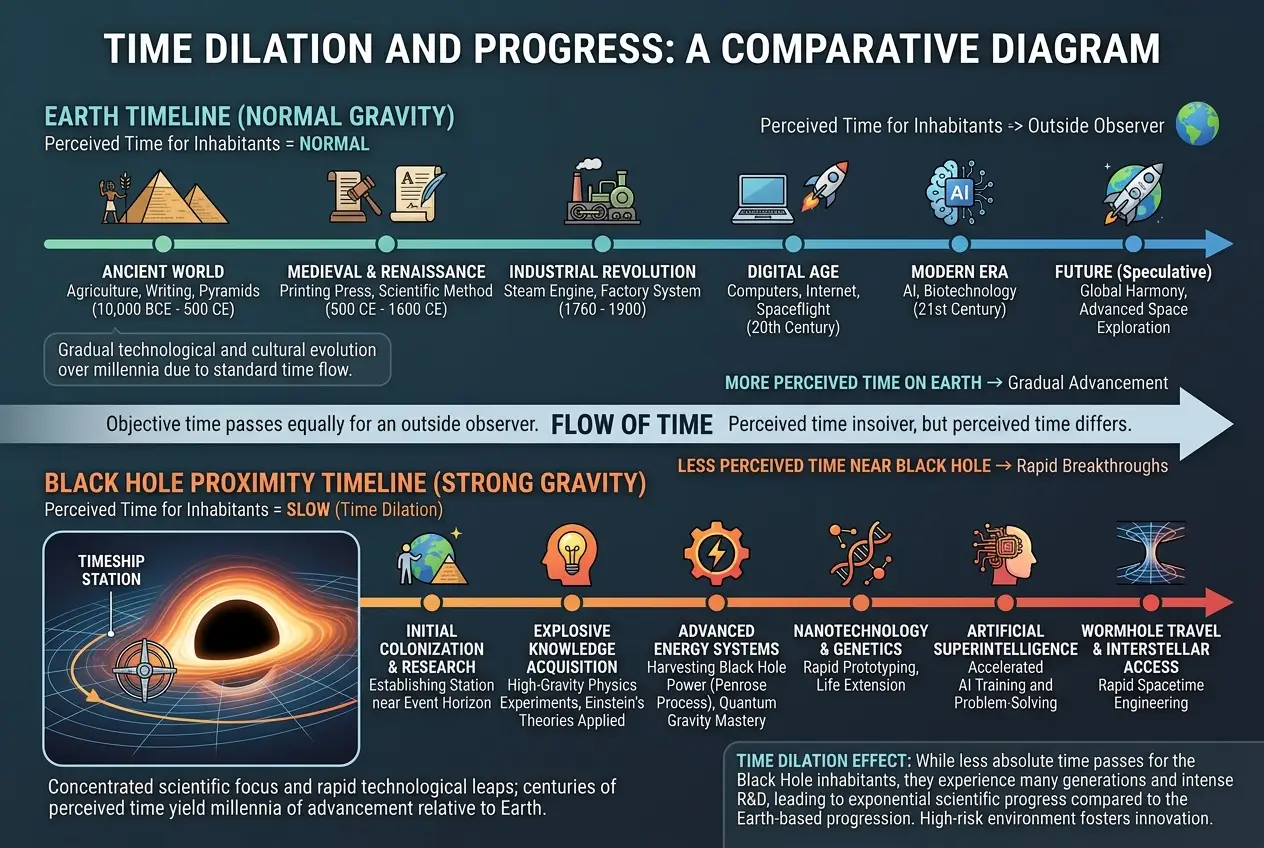
The universe is full of wonders, and black holes, far from being just cosmic vacuum cleaners, might hold secrets to temporal manipulation and technological leaps that could define the next chapter of human civilization. It's a journey into the unknown, but one that promises rewards as vast as space and as profound as time itself.
 Join Us


 Unknown Author
























Leave a Reply
Comments (0)